

We research everything we recommend. When you buy through our links, we may earn a commission. Learn more

Buying guide · 11 min read · Updated October 2, 2026

5 Best Budget 48V RV Air Conditioners in 2026: A Practical RV Guide

Five genuine 48V DC RV air conditioners for battery-bank rigs, from rooftop heat pumps to hidden split systems, sorted by draw, cable and install.

Bowen HigginsBy Bowen HigginsRV Editor at RV Gear Lab5 products comparedSpec-sheet researched

At a glance

Our top picks

A 48 volt air conditioner makes sense for one kind of buyer: someone whose rig already has a 48 volt battery bank, usually lithium, feeding a large inverter or a DC bus. The attraction is arithmetic. A load of 1,000 watts pulls about 83 amps at 12 volts but only about 21 amps at 48 volts, so cables run cooler, wires can be thinner and voltage drop shrinks. Everything on this page is a native 48 volt unit, with no inverter between the bank and the compressor, which removes a conversion step and the heat and losses that come with it.

That native requirement trimmed the field. Plenty of 115 volt rooftop units show up for this search term and quietly ignore the voltage in the keyword, so we left those out, including a well-known 115 volt rooftop model that turned up in the results, because a misleading listing is worse than a short one. Five units genuinely accept 48 volt DC input. Three are rooftop or low-profile units with heat pumps, and two are hidden split systems built for trucks, campers and trailers. That split between bolt-on and build-it-yourself is the first choice to make.

Budget is relative here, since a 48 volt unit costs more than a 12 volt split. The entry picks are the two hidden NEKPOKKA splits, the middle is the Gidrox heat pump, and the top is the TURBRO and the RecPro. The sections below tie each step up to a mechanism, such as inverter control, a supplied cable or a heat pump, so you can judge whether it is worth it for the rig you actually own, not the one in the brochure, and whether a hands-on install fits your skills.

RV Gear Lab field notes

The Rig Fit Check

Start with the job
Gidrox 12000 BTU 48V DC RV Air Conditioner with Heat Pump, Battery Powered leads this shortlist for 48V battery rigs that want a quiet heat pump and an easy install.. Use that fit as a reference point, then compare the alternatives against your own space and workload.
Specs that separate the picks
The first details to compare are 12,000 BTU cooling, 11,000 BTU heat, 15,000 BTU with heat pump, 13,500 BTU with heat pump. Confirm the exact model and included components before ordering.
Trade-off to plan for
Capacity suits mid-size rigs

Before you buy

What Matters Before You Choose a Budget 48V RV Air Conditioner

Key buying criteria so you get the right fit the first time.

  1. 01

    Why 48 volt changes the wiring math

    Power equals volts times amps, so a given load draws a quarter of the current at 48 volts that it draws at 12 volts. A 35 amp requirement at 48 volts is about 1,700 watts, which would be roughly 140 amps at 12 volts. Lower current means thinner cable, cooler connections and less voltage drop over a long run. Size your breaker and wire to the listed amp figure and add a safety margin.

  2. 02

    Matching the unit to your battery bank

    A native 48 volt unit has to match the nominal voltage of your bank, and many 48 volt lithium banks run slightly above the number, around 51 volts when full. Confirm the unit's accepted input range against your bank's charged and discharged voltages. Check that the bank and its battery management system can deliver the startup current as well as the running load. A mismatch trips low-voltage protection or damages the unit.

  3. 03

    Reading watts versus BTU claims

    One watt of cooling is about 3.412 BTU per hour, so 2,200 to 2,800 watts is roughly 7,500 to 9,500 BTU per hour. A listing that quotes a larger BTU number than the watt rating supports is using a different basis or an optimistic claim. Prefer the number backed by electrical specifications. This conversion takes ten seconds and exposes the most common overstatement in the category.

  4. 04

    Heat pump versus cooling only

    A heat pump adds a reversing valve and a defrost cycle, which is why the Gidrox, TURBRO and RecPro cost more than the cooling-only splits. It lets a 48 volt bank warm the cabin on mild mornings at a fraction of the draw of a resistance heater. Outputs fall as outdoor temperatures drop, so a furnace still has a role in deep cold. Pay for it only if your trips include cool nights.

  5. 05

    Rooftop versus split architecture

    A rooftop unit is one box that bolts through a roof opening and needs no refrigerant work from you. A split has separate indoor and outdoor parts joined by refrigerant lines and often arrives uncharged. Splits keep the roof clear and cost less, while rooftops install faster. Honestly assess your tools and skills before choosing the cheaper path.

  6. 06

    Supplied cable, hardware and controls

    A heavy-gauge cable, mounting hardware and a thermostat are not trivial at 48 volts, because the right wire and fusing are part of safety. The TURBRO includes an 8 AWG cable and the Gidrox includes a 19.7 foot cable. For the splits, plan to buy wire, a fuse or breaker and refrigerant. Add those costs to the sticker before comparing totals.

Our standards

Why You Can Trust RV Gear Lab

At RV Gear Lab, we compare products based on rig fit and power or hookup compatibility, verified specifications, usability, setup requirements, weight, durability, and real-world trade-offs. We do not rank products purely on marketing claims or commission rates.

We have not personally tested every product listed. Where hands-on testing is not available, recommendations are based on verified manufacturer specifications, product documentation, use-case fit, and comparative research.

How we review RV gear →

Detailed reviews

The 5 best budget 48v rv air conditioners, explained

01
Gidrox 12000 BTU 48V DC RV Air Conditioner with Heat Pump, Battery Powered
  • 12,000 BTU cooling, 11,000 BTU heat
  • 48V DC, 300W sleep-mode draw
  • 54 lb, 19.7 ft power cable
Check price on Amazon for Gidrox 12000 BTU 48V DC RV Air Conditioner with Heat Pump, Battery Powered (opens in a new tab)
Best for: 48V battery rigs that want a quiet heat pump and an easy install.

Our take

At 54 pounds it is light for a rooftop heat pump, and the package includes mounting hardware and a 19.7 foot power cable.

Why it made the shortlist

The Gidrox 48V is the mid-band pick of this shortlist, and it earns first place because its listing gives real numbers for a battery-powered buyer. It cools at 12,000 BTU with an EER of up to 13, heats at 11,000 BTU, and runs on 48 volt DC directly from the bank with no inverter, which makes the whole setup simpler to wire.

Its sleep mode is rated at 300 watts of consumption at 30 degrees Celsius ambient, a figure that makes overnight battery planning straightforward. The brushless fan and sound insulation bring operation down to 40 dB in sleep mode, and control comes by Bluetooth app, infrared remote or buttons on the unit, so the unit can be adjusted from bed or from the driveway.

Compared with the TURBRO, it gives up some capacity and gains a lower price and a stated sleep-mode draw. Best for a rig with a 48 volt bank, solar input and a priority on quiet overnight running.

What works

  • Stated 300W sleep-mode draw
  • Heat pump with 11,000 BTU heating
  • 40 dB sleep mode
  • Power cable and hardware included

Watch out for

  • Capacity suits mid-size rigs
  • Bluetooth app range is limited
02
TURBRO 15,000 BTU 48V DC RV Air Conditioner with Heat Pump, Non-Ducted
  • 15,000 BTU with heat pump
  • Native 48V DC, 8 AWG cable included
  • Twin-rotary inverter compressor
Check price on Amazon for TURBRO 15,000 BTU 48V DC RV Air Conditioner with Heat Pump, Non-Ducted (opens in a new tab)
Best for: Big trailers and motorhomes on a high-capacity 48V bank.

Our take

Wi-Fi and remote control let you adjust temperature and fan speed from your phone, and the non-ducted design drops into a standard ceiling arrangement.

Why it made the shortlist

The TURBRO 48V is one of the two most expensive picks here, and the step up buys 15,000 BTU of cooling with heat pump heating, which is the highest capacity of the five. It connects directly to a compatible 48 volt battery using the included 8 AWG UL-certified cable, so there is no AC inverter in the chain.

A twin-rotary inverter compressor adjusts its speed to the cooling demand, which the listing says improves efficiency, saves battery power and holds a steady temperature. The lower current demand of a 48 volt supply is built into the product concept, and the listing pairs it with a high-capacity bank or a solar-charged system for boondocking.

Compared with the Gidrox, it adds capacity and a bundled heavy-gauge cable. Best for a 30 to 40 foot rig with a serious lithium bank, where one capable rooftop unit has to carry the whole cabin through a hot afternoon.

What works

  • Highest capacity of the five
  • Inverter compressor saves battery power
  • Heavy-gauge 48V cable included
  • App and remote control

Watch out for

  • Needs a high-capacity battery bank
03
RecPro 48V Low Profile RV AC with Heat Pump, White, 13.5K BTU
  • 13,500 BTU with heat pump
  • 48V low-profile rooftop unit
  • Touch-screen plenum, four outlets
Check price on Amazon for RecPro 48V Low Profile RV AC with Heat Pump, White, 13.5K BTU (opens in a new tab)
Best for: RV owners who want a low-profile 48V unit with a touch-screen thermostat.

Our take

The listing stresses minimal amp draw to cut load while traveling and describes the unit as designed for low drag.

Why it made the shortlist

The RecPro 48V is the most expensive pick on this page, and the step up buys a 13,500 BTU low-profile rooftop unit with a heat pump from an established RV brand. A touch-screen plenum display lets you adjust the temperature to the degree, which is a more refined interface than the app-and-remote setups of its rivals.

Four adjustable air outlets move air quickly and evenly across the living space, and a washable return air filter keeps maintenance simple and cheap through the season. Automatic coil defrosting in heat mode protects the compressor and coils when the weather turns cold, so the heat pump is usable well into the shoulder season and gives the unit a long, useful working year.

Step up from the Gidrox and you gain capacity and a wall-style display, at a higher cost. Owners replacing an older rooftop unit who want a polished control panel will like the heat pump and low-profile shape of this modern design.

What works

  • Touch-screen plenum display
  • Automatic coil defrost in heat mode
  • Four adjustable air outlets
  • Washable return air filter

Watch out for

  • Most expensive pick in this guide
  • No published amp draw, so size wiring generously
04
NEKPOKKA 48V DC Air Conditioner, Concealed RV AC Unit
  • 48V DC, 2,200 to 2,800W cooling
  • 35A current requirement
  • 760 m3/h evaporator airflow
Check price on Amazon for NEKPOKKA 48V DC Air Conditioner, Concealed RV AC Unit (opens in a new tab)
Best for: DIY builders who need to place the compressor wherever there is space.

Our take

It is aimed at trucks, campers, trailers, vans and RVs, which covers most small builds.

Why it made the shortlist

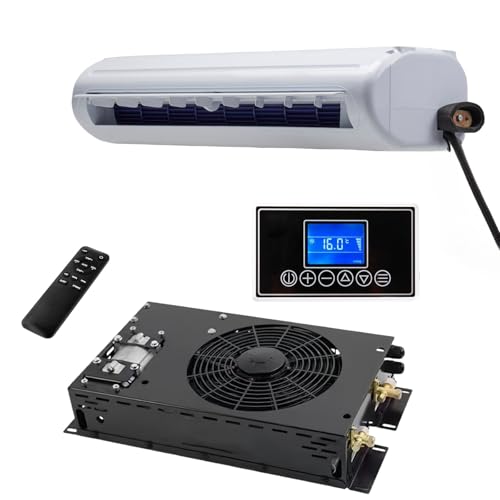
The NEKPOKKA Concealed is an entry pick of this shortlist and a split system that gives builders room to improvise. The compressor and fan assembly support multiple installation methods and can be mounted in any position, which helps in a trailer or camper where free space is scarce and oddly shaped, and it lets the builder decide where the noise and weight end up.

The listing gives clear electrical figures: 48 volt operation, 2,200 to 2,800 watts of cooling capacity, a 35 amp current requirement and an evaporator airflow of 760 cubic meters per hour. A settable range of 16 to 32 degrees Celsius and a 100 watt evaporator keep the interior side simple, and the cabin-side load stays small next to the compressor.

Priced noticeably below the three heat pump units, it sheds the roof opening and the rooftop weight in exchange for a hands-on installation. Best for an experienced DIY owner who wants to run a native 48 volt split without paying for a rooftop unit.

What works

  • Compressor mounts in any position
  • Clear published amps and watts
  • No roof opening needed
  • Lower cost than heat pump units

Watch out for

  • Refrigerant is not included
  • Cooling only, no heat pump
05
Universal 48V Air Conditioner Hidden Underbody RV Air Conditioner, DC Silent
  • 48V DC, 2,200 to 2,800W cooling
  • Hidden underbody outdoor unit
  • 15 cm ceiling-mount evaporator
Check price on Amazon for Universal 48V Air Conditioner Hidden Underbody RV Air Conditioner, DC Silent (opens in a new tab)
Best for: Trailer and camper builders who want the hardware hidden underneath.

Our take

The listing advises using a multimeter to test whether the battery can supply the starting current, which is sound practice for any DC compressor.

Why it made the shortlist

The NEKPOKKA Underbody is the lowest priced pick here, which makes it the cheapest way into a native 48 volt air conditioner. The outdoor unit has a sturdy metal shell and a personalized design with multiple installation options, and it is intended to be hidden under the floor of a trailer, camper or van, out of sight and out of the wind.

Its evaporator is 15 centimeters thick and can be mounted on the ceiling, with a separate control panel that adjusts air volume and temperature and monitors low pressure for protection. Rated electrical figures include 48 volts, 2,200 to 2,800 watts of cooling, a 35 amp current requirement and 760 cubic meters per hour of airflow.

Against the NEKPOKKA Concealed it adds the metal-shelled underbody concept and the separate panel. Builders who want a hidden, low-cost 48 volt system and will handle the refrigerant charge are the natural audience.

What works

  • Hidden underbody outdoor unit
  • Separate control panel with pressure protection
  • Metal shell is rugged

Watch out for

  • Refrigerant must be added separately

Methodology

How We Built This Shortlist

Each pick was assessed across 5 criteria weighted for real-world use.

01

Native 48 volt input only

Every pick had to accept 48 volt DC directly. A unit that merely mentions batteries, or a 115 volt rooftop sold under a 48 volt keyword, was excluded. That cut the field to five units that genuinely fit the title.

02

Stated electrical figures

We compared wattage, amperage, sleep-mode draw and cable gauge where a listing provides them, such as the 35 amp requirement on the NEKPOKKA units and the 300 watt sleep draw on the Gidrox. A unit that publishes its load is easier to size a bank and breaker around. Based on product specs, the heat pumps publish less than the splits.

03

Capacity and efficiency

BTU ratings, watt ratings, EER and the compressor type were reviewed. We converted watts to BTU per hour with the standard factor of about 3.412 so a mismatch between a headline number and a rated number stood out. Inverter compressors scored above fixed ones.

04

Installation and what is supplied

Cable, mounting hardware, control panel and refrigerant all affect the real cost of a 48 volt install. The TURBRO and Gidrox include cables, and the NEKPOKKA splits need the refrigerant added. We weighed that against the skill an install demands.

05

Budget position

Each pick was placed in the entry, mid or top band of this shortlist and the step between bands was tied to a mechanism. The split units sit at the entry, the Gidrox in the middle, and the TURBRO and RecPro at the top. Our analysis keeps the money tied to features you can name.

Decision guide

Match a Budget 48V RV Air Conditioner to Your RV

By Rig Length

Capacity should follow the space you are cooling.

RigBest pick
30 to 40 foot trailer or motorhomeTURBRO 48V
Mid-size travel trailerRecPro 48V
Van, camper or short trailerGidrox 48V
Custom build with scattered free spaceNEKPOKKA Concealed
Floor-mounted outdoor unit preferredNEKPOKKA Underbody

By Budget

Bands show position inside this shortlist and what each step buys.

BandPick and what it buys
Entry of this shortlistNEKPOKKA Underbody buys a hidden split with a separate control panel
Entry of this shortlistNEKPOKKA Concealed adds a compressor that mounts in any position
Mid of this shortlistGidrox 48V adds a heat pump and a stated sleep-mode draw
Top of this shortlistTURBRO 48V adds 15,000 BTU and a heavy-gauge cable
Top of this shortlistRecPro 48V adds a touch-screen display, roughly double the entry pick

Rooftop Heat Pump vs Hidden Split

This is the central design choice among the five.

Rooftop heat pump

One bolt-on box with cooling and heating, no refrigerant work, and a higher cost. Gidrox 48V, TURBRO 48V and RecPro 48V belong here.

Hidden split

Lower cost and a clear roof, at the price of a hands-on install and a refrigerant charge. NEKPOKKA Concealed and NEKPOKKA Underbody belong here.

Choose Gidrox 48V for an easy install and a NEKPOKKA split if you will do the build yourself.

By Installation Skill

The second axis is how much work you want to take on.

Skill and goalBest pick
Bolt-on with cable and hardware in the boxGidrox 48V
Replacing an existing rooftop unitRecPro 48V
Comfortable charging refrigerant, wants flexibilityNEKPOKKA Concealed
Comfortable charging refrigerant, wants it hiddenNEKPOKKA Underbody

For Boondocking Specifically

Off-grid use makes draw and efficiency the main criteria.

Look for

A stated low-power mode, an inverter compressor and a published amp figure. Gidrox 48V and TURBRO 48V meet that description.

In this comparison

Gidrox 48V states a 300 watt sleep draw, and TURBRO 48V pairs a twin-rotary inverter with the largest capacity.

When to Spend More

The upper band buys capacity, features and finish.

Spend more if

You have a large rig and want the biggest capacity and an included cable, which points to TURBRO 48V.

Save if

Your build is small and you can charge refrigerant, where NEKPOKKA Underbody or NEKPOKKA Concealed deliver native 48V cooling at the lower end.

FAQ

Before You Bring One Home

Why choose a 48 volt air conditioner over a 12 volt one?

The current is a quarter as large for the same power, so cable runs, fuses and connections are easier to manage. A 1,000 watt load is about 83 amps at 12 volts and about 21 amps at 48 volts. It only makes sense if you already have, or are building, a 48 volt bank. Otherwise a 12 volt unit avoids the need for a converter.

Do I need an inverter with these units?

No. The listings describe direct 48 volt DC operation, and the Gidrox and TURBRO say no inverter is required. That removes the conversion loss that comes with running a 115 volt unit from batteries. You still need the right cable, a fuse or breaker and a bank that can handle the startup current.

Are the NEKPOKKA BTU numbers reliable?

Use the watt rating, which is 2,200 to 2,800 watts of cooling, and convert at about 3.412 BTU per hour per watt. That puts the capacity near 7,500 to 9,500 BTU per hour. A larger BTU figure in a listing does not match its own watt rating. Size the unit from the watts.

Is a 115 volt rooftop unit a substitute?

It is a different product that needs an inverter, and its efficiency and wiring math are different. We left 115 volt units out of this guide on purpose, including a well-known rooftop model that appears in search results. If your bank is 12 volt or 24 volt, look at the 12 volt and inverter guides instead.

What size battery bank do I need?

Divide the usable watt-hours by the unit's running watts to estimate run time. The Gidrox sleep mode is listed at 300 watts, so a 5 kilowatt-hour bank gives well over ten hours at that setting in theory. Real use varies with heat and sun. Size generously and add solar to offset the draw.

Do the NEKPOKKA splits come ready to run?

They need refrigerant added, and the listings state about 500 to 600 grams of R134a, which is not included. You also need wire, a breaker and a vacuum pump or a shop to charge the system. The Gidrox and TURBRO are rooftop units that avoid that step. Budget for the extra work.

Bottom line

The short version

Browse more budget 48v rv air conditioners on Amazon →
Bowen Higgins, RV Editor at RV Gear Lab

About the author

Bowen Higgins

RV Editor at RV Gear Lab

Bowen covers RV power, water systems, towing and leveling, upkeep and interior comfort, with a focus on matching gear to the rig, the hookups and the way you actually travel.

More from Bowen →Editorial standards

Keep reading

Related guides