

We research everything we recommend. When you buy through our links, we may earn a commission. Learn more

Buying guide · 11 min read · Updated October 2, 2026

5 Best Budget Energy Efficient RV Air Conditioners in 2026: A Practical RV Guide

Five budget RV and camper air conditioners ranked by how little power they pull, from inverter rooftop units to a SEER2 mini split, with buying advice.

Bowen HigginsBy Bowen HigginsRV Editor at RV Gear Lab5 products comparedSpec-sheet researched

At a glance

Our top picks

Efficiency in an RV air conditioner comes down to how many amps the unit pulls once the compressor is running, because that number decides whether a 30 amp pedestal, a small generator or a lithium bank can keep up. Standard rooftop units start and stop at full draw. Inverter units ramp the compressor up and down instead, which trims the startup surge and the average load across a long, hot afternoon in a campground with no shade. This guide ranks five budget picks by the mechanism each uses to save power rather than by the slogans on the box.

Not every efficient unit here is a conventional rooftop. Two picks run on 12 volt DC straight from a battery bank, one is a wall-mounted mini split with a published SEER2 figure, and two are 18,000 BTU rooftop units that still need 115 volt shore or generator power plus a 12 volt feed for the controls. Which design fits depends on whether your electricity comes from a campground pedestal or from batteries and solar, so that sorting happens before any ranking does, and a buyer with a pedestal can skip the battery-only picks.

Budget changes the question, because efficiency features normally arrive with a price jump. The least expensive efficient options in this list get their savings from modest capacity or DC-only operation, while the large rooftop units spend more to deliver inverter control or a heat pump. When a listing quotes a saving, such as a percentage cut in consumption, read it as the seller's own figure and compare units on specs you can see yourself: BTU rating, airflow, noise level and supply voltage. Those are the numbers that stay true after the product page changes.

RV Gear Lab field notes

The Rig Fit Check

Start with the job
Treeligo 12V RV Air Conditioner, 12000 BTU Fast Cooling RV Rooftop A/C Unit leads this shortlist for Van, truck camper and small trailer owners running on batteries and solar.. Use that fit as a reference point, then compare the alternatives against your own space and workload.
Specs that separate the picks
The first details to compare are 12,000 BTU, 500 CFM airflow, 12,000 BTU, SEER2 18 rating, 18,000 BTU with heat pump. Confirm the exact model and included components before ordering.
Trade-off to plan for
Saving figure is the seller's own

Before you buy

What Matters Before You Choose a Budget Energy Efficient RV Air Conditioner

Key buying criteria so you get the right fit the first time.

  1. 01

    Compressor type: inverter versus fixed speed

    A fixed-speed compressor runs at full output until the thermostat is satisfied and then shuts off, so each restart pulls a surge. An inverter compressor changes speed continuously and holds the cabin near the setpoint at a lower average load. That behavior is why inverter units can run from a smaller generator or inverter, and it often means a quieter night. Look for the words inverter, twin rotary or variable speed in the listing body, not only in the title.

  2. 02

    Supply voltage and conversion losses

    A 12 volt DC unit connects straight to a battery bank, while a 115 volt unit on batteries needs an inverter that wastes some energy as heat. At low voltage the current is large, so cable gauge matters, and listings that name the included cable are easier to plan around. The 18,000 BTU units here also need a 12 volt feed for control electronics. Write down the exact supply before choosing, and size your wire and breaker to the larger current.

  3. 03

    Efficiency ratings: EER, SEER2 and the seller's percentages

    EER and SEER2 are efficiency ratios, where a higher number means more cooling per watt consumed. Only one pick in this guide publishes a SEER2 figure, so most comparisons rely on BTU and wattage. Percent savings such as up to 30 percent compare the unit to an unspecified baseline, which makes them hard to use. Prefer a stated rating or a stated wattage you can compare unit to unit.

  4. 04

    Capacity and space: sizing without waste

    More BTU is not better when it makes the unit cycle on and off. A 12,000 BTU unit with a 470 square foot rating suits a van or short trailer, while the 18,000 BTU units are aimed at 28 to 36 foot rigs. Oversizing wastes energy through short cycling, and undersizing makes the compressor run flat out. Match capacity to your rig length and sun exposure, and give insulation and window area weight too.

  5. 05

    Roof opening and ducting compatibility

    Most rooftop installs rely on a 14.25 inch square roof opening, and the existing ceiling assembly decides whether the unit is ducted or non-ducted. A ducted ceiling sends air through channels to several vents, and a non-ducted one uses a single distribution box. Units that handle both give flexibility. Measure your opening and look at the ceiling before ordering, because a mismatch adds modification time.

  6. 06

    Heat pump versus cooling only

    A heat pump moves heat indoors using the same refrigerant circuit, so a unit with that feature can warm the cabin on mild mornings for a fraction of an electric heater's draw. It adds cost and is rated for a limited outdoor temperature range, so it does not replace a furnace in freezing weather. Cooling-only units save money and are right for warm-climate travel. Decide based on how many cool nights you actually camp through.

Our standards

Why You Can Trust RV Gear Lab

At RV Gear Lab, we compare products based on rig fit and power or hookup compatibility, verified specifications, usability, setup requirements, weight, durability, and real-world trade-offs. We do not rank products purely on marketing claims or commission rates.

We have not personally tested every product listed. Where hands-on testing is not available, recommendations are based on verified manufacturer specifications, product documentation, use-case fit, and comparative research.

How we review RV gear →

Detailed reviews

The 5 best budget energy efficient rv air conditioners, explained

01
Treeligo 12V RV Air Conditioner, 12000 BTU Fast Cooling RV Rooftop A/C Unit
  • 12,000 BTU, 500 CFM airflow
  • 12V DC inverter compressor
  • Over-discharge voltage protection
Check price on Amazon for Treeligo 12V RV Air Conditioner, 12000 BTU Fast Cooling RV Rooftop A/C Unit (opens in a new tab)
Best for: Van, truck camper and small trailer owners running on batteries and solar.

Our take

Rigs where the air conditioner should behave like one more DC load, instead of a reason to buy a large inverter and battery upgrade, are the target.

Why it made the shortlist

The Treeligo Inverter is the entry pick among the rooftop-style units, and it earns the top slot by bundling the efficiency features that matter into a 12 volt package. Its inverter compressor adjusts output to the room temperature instead of cycling at full load, and the listing credits that with up to 30 percent lower consumption. Cooling is rated at 12,000 BTU with 500 CFM of airflow.

Because it runs from the vehicle battery or an external supply, no 115 volt inverter sits between your bank and the compressor, so none of the conversion loss that comes with powering an AC unit from batteries. Four operating modes, including sleep and air supply, let you drop the load overnight, and over-discharge protection shuts the unit down when voltage sags so the bank is protected while you boondock, which is useful at 2 a.m. in a remote lot.

The ABS housing resists weather and road deformation, and the pre-charged design keeps installation realistic for a weekend DIY job. Buyers who want one efficiency feature at the low end of this list should start here.

What works

  • Inverter compressor trims power use
  • Runs on 12V without a separate inverter
  • Low-voltage cutoff protects your battery bank
  • Four modes including sleep

Watch out for

  • Saving figure is the seller's own
  • Cooling suits small to mid-size rigs
02
Albott 12,000 BTU Mini Split Air Conditioner and Heater SEER2 18, 115V
  • 12,000 BTU, SEER2 18 rating
  • 115V inverter heat pump
  • 5 to 122 degree operating range
Check price on Amazon for Albott 12,000 BTU Mini Split Air Conditioner and Heater SEER2 18, 115V (opens in a new tab)
Best for: Skoolies, tiny homes and stationary rigs that want a published SEER2 number.

Our take

Converted buses, tiny homes on a foundation and long-term park models, where wall space is easier to find than a roof opening, are the natural fit.

Why it made the shortlist

The Albott is the one pick in this guide that publishes a SEER2 rating, and 18 is a strong figure for a 12,000 BTU inverter heat pump. A ductless split puts the compressor outside and a slim head inside, so cooling, heating, dehumidifying and fan modes all come from one 115 volt system with a 61 to 90 degree setting range.

Where the rooftop picks above and below it compete on airflow and roof fit, this one competes on efficiency per watt. The listing quotes operation from 5 to 122 degrees Fahrenheit, a 24 hour timer, a sleep mode, and a self-cleaning function with removable filters, which keeps winter heating and summer cooling on the same inexpensive hardware and gives you one set of filters to maintain through the year.

The 5 year compressor and 7 year parts warranty give a budget buyer a longer safety net than most rooftop listings offer, and the indoor head runs below 29 dB.

What works

  • Heats as well as cools
  • 5 year compressor warranty
  • Very quiet indoor head

Watch out for

  • Built for homes, not road vibration
  • Needs a wall mount and line set
03
Best for: 28 to 36 foot trailers and fifth wheels that need heat and serious cooling.

Our take

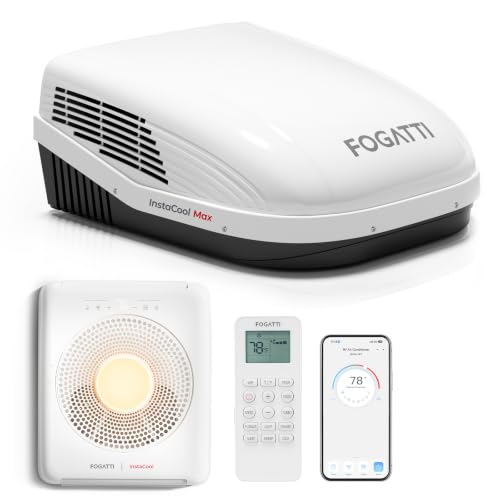
Control comes four ways: remote, mobile app, a wall ADB panel or Alexa voice commands.

Why it made the shortlist

The Fogatti 18K is the most expensive pick in this guide, and the step up buys a dual inverter system, a built-in heat pump and 18,000 BTU of cooling sized for rigs in the 28 to 36 foot range. The listing rates it for extreme heat up to 114 degrees Fahrenheit, which is the situation where a compact unit runs flat out all day without catching up.

Dual inverter control keeps airflow steady and quiet at 52 dB while holding the compressor at whatever speed the cabin needs. Just below on price sits the Kingrver 18K, and the Fogatti adds heat pump heating, so a single rooftop unit covers shoulder-season mornings without firing the furnace, and the compressor stays in a gentle range during the afternoon.

It fits a ducted or non-ducted ceiling, which means it can replace an existing rooftop unit in most rigs without reworking the interior. Best for full-time travelers who want one capable unit and will run it from shore or generator power.

What works

  • Dual inverter keeps cooling steady and quiet
  • Heat pump adds winter heating
  • Works with ducted or non-ducted ceilings
  • App, remote and Alexa control

Watch out for

  • Most expensive pick in this guide
  • Needs both 115V and 12V connections
04
KINGRVER 18,000 BTU RV Air Conditioner, Cooling Only, Non-ducted, White
  • 18,000 BTU, cooling only
  • Non-ducted, R32 refrigerant
  • 52 dB, app and Alexa control
Check price on Amazon for KINGRVER 18,000 BTU RV Air Conditioner, Cooling Only, Non-ducted, White (opens in a new tab)
Best for: Big rigs on shore power that want WiFi control without paying for a heat pump.

Our take

Medium to large RVs that spend most of their time on pedestal power in warm regions, and do not need winter heat from the roof, suit it well.

Why it made the shortlist

The Kingrver 18K takes the same 18,000 BTU rooftop footprint as the Fogatti and drops the heat pump, which is why it sits noticeably lower on price. Cooling is its sole job, and it still carries R32 refrigerant, a 52 dB sound rating and three ways to control it: remote, app and Alexa. For a motorhome or large trailer that has a separate furnace, cooling alone is a sensible way to keep the cost down.

Multiple fan speeds let you tune airflow for a long, narrow floor plan, and the non-ducted design fits the common roof opening without needing duct work in the ceiling. R32 is a lower-impact refrigerant than the older R410A found on many legacy units, which suits a buyer who wants a current design instead of a clearance model.

It is the practical middle step between the DC picks and the full heat pump unit, and the app means you can pre-cool the cabin on the walk back from the trailhead.

What works

  • Lower cost than the heat pump 18K
  • Modern R32 refrigerant
  • App, remote and Alexa control

Watch out for

  • Cooling only, no heat pump
  • Needs 115V and 12V connections
05
12V RV Rooftop Air Conditioner 12,000 BTU DC Motorhome AC Unit, Ultra Quiet
  • 12,000 BTU, 20A peak draw quoted
  • IP65 housing, LCD and remote
  • 18 x 13 inch roof opening
Check price on Amazon for 12V RV Rooftop Air Conditioner 12,000 BTU DC Motorhome AC Unit, Ultra Quiet (opens in a new tab)
Best for: Off-grid campers who want the lowest quoted amp draw and a roof light.

Our take

The 18 by 13 inch roof opening and pre-drilled holes make it a straightforward swap for small vent openings.

Why it made the shortlist

The Treeligo Rooftop quotes a 20 amp peak draw on 12 volt DC, the lowest current figure in this guide, with 12,000 BTU of cooling for spaces up to 470 square feet. It runs directly from the battery system with no inverter, and an adjustable thermostat and fan speed let you hold the cabin at a steady level without constant manual changes.

This model adds an LCD display, remote control, a built-in cabin light and low-voltage protection over the Treeligo Inverter, and its IP65-rated housing is built for dusty or wet off-road use. The dual fan layout and oversized condenser are aimed at keeping the cabin cool when the sun is on the roof all day, even on gravel roads where dust gets everywhere.

Best for solar-and-lithium setups where every amp counts and the buyer wants a self-contained DC unit in the middle price band of this shortlist, with enough extras that nothing else needs to be bought separately for day-to-day operation.

What works

  • Lowest quoted amp draw in this guide
  • IP65 housing for dusty roads
  • LCD display and remote included
  • Built-in cabin light

Watch out for

  • Non-standard roof opening size
  • Draw figure is the listing's own

Methodology

How We Built This Shortlist

Each pick was assessed across 5 criteria weighted for real-world use.

01

Power mechanism first

We sorted each unit by how it saves energy: an inverter compressor, a native DC supply, a published seasonal rating or a heat pump. A unit that only says efficient in its title without a mechanism was kept out. That focus keeps the ranking tied to features a buyer can read on the listing.

02

Supply voltage and what it implies

A 12 volt unit, a 115 volt unit and a 115 volt unit that also needs a 12 volt control feed each stress an RV electrical system differently. We recorded the supply requirement for every pick and weighed it against typical pedestal, generator and battery setups. A confusing voltage description counted against a pick.

03

Capacity matched to realistic spaces

BTU rating, airflow and the sizing language in each listing were compared to the rig lengths and square footage the sellers cite. Over-sized units that short-cycle waste energy, so we favored capacity that suits the stated space. Based on product specs, the picks span compact vans to 36 foot trailers.

04

Installation fit

Roof opening size, ducted versus non-ducted ceiling support and the included hardware were reviewed for each unit. A pick that fits the common 14.25 inch opening or ships with mounting hardware scored higher than one needing custom work. Wall-mounted designs were judged on how much install effort they imply.

05

Budget position and value

Every pick was placed in the entry, mid or top band of this shortlist, and the step between bands was tied to the feature it buys. We read verified buyer feedback themes and listing specs to judge whether the extra spend delivers a real efficiency gain. Our analysis favors mechanisms over marketing.

Decision guide

Match a Budget Energy Efficient RV Air Conditioner to Your RV

By Power Source

Where your electricity comes from decides the right design before anything else does.

Your power setupBest pick
Lithium bank with solar, no big inverterTreeligo Inverter
Off-grid with the tightest amp budgetTreeligo Rooftop
Campground pedestal or generator, large rigFogatti 18K
Pedestal power, cooling only is enoughKingrver 18K
Stationary or converted vehicle with wall spaceAlbott Mini Split

By Budget

Price bands here describe position within this shortlist, not a fixed figure.

BandPick and what it buys
Entry of this shortlistAlbott Mini Split buys the strongest published rating but no roof mounting
Entry of this shortlistTreeligo Inverter gets an inverter compressor on 12V DC
Mid of this shortlistTreeligo Rooftop adds an LCD, remote and IP65 housing
Mid of this shortlistKingrver 18K steps up to 18,000 BTU on 115V
Top of this shortlistFogatti 18K adds dual inverter and a heat pump, roughly double the entry pick

DC Direct vs Shore Power Unit

The biggest efficiency decision is whether to run straight from batteries or from a 115 volt source.

12V DC direct

No inverter losses and a low peak draw, but capacity tops out around 12,000 BTU. Treeligo Inverter and Treeligo Rooftop fall in this group.

115V rooftop or split

More cooling and a heat pump option, but it needs pedestal, generator or a large inverter. Fogatti 18K, Kingrver 18K and Albott Mini Split fall in this group.

Pick Treeligo Inverter if batteries do the work and Fogatti 18K if shore power does.

By Climate and Season

A second decision axis is whether you need heat as well as cooling.

ClimateBest pick
Hot summers only, warm nightsKingrver 18K
Four-season use, mild wintersFogatti 18K
Cold nights in a stationary buildAlbott Mini Split
Hot and dusty off-road tripsTreeligo Rooftop

For Boondocking Specifically

Boondocking turns every watt into a daily battery cost.

Look for

A native 12V design, low-voltage cutoff, a sleep mode and a quoted peak amp figure. Treeligo Inverter and Treeligo Rooftop both satisfy this.

In this comparison

Treeligo Rooftop quotes the lowest peak draw, and Treeligo Inverter adds inverter control and cutoff protection for the bank.

When to Spend More

The top of this shortlist buys capacity and features, not just a longer name.

Spend more if

You tow a 28 to 36 foot rig and want heat pump heating and dual inverter control, which points to Fogatti 18K.

Save if

Your rig is a van or short trailer on batteries, where Treeligo Inverter delivers the key efficiency feature at the low end.

FAQ

Before You Bring One Home

Does an inverter RV air conditioner really use less power?

An inverter compressor varies its speed instead of switching fully on and off, so it avoids repeated startup surges and holds a steady lower load. Sellers quote savings of 20 to 30 percent, but those figures come from their own comparisons. Treat them as direction rather than a guarantee. The quieter running and softer start are the benefits you will notice first.

Can I run a 115V rooftop unit from batteries?

It is possible with a large inverter and a big battery bank, but conversion losses and the startup surge make it demanding. The 18,000 BTU units here also need a 12 volt supply for controls in addition to 115 volt power. If batteries are your main source, a native 12 volt unit such as the Treeligo Inverter is the simpler path. Check the surge rating of any inverter you pair with it.

What is SEER2 and why does it matter?

SEER2 is a seasonal efficiency rating where higher means more cooling per unit of electricity. The Albott lists SEER2 18, which gives it a measurable rating most RV rooftop listings do not publish. That makes it easy to compare against a home system, though it was designed for buildings. Rooftop RV units usually quote BTU and wattage instead.

Is an 18,000 BTU unit overkill for my RV?

It depends on rig length, insulation and sun exposure. The listings for the Fogatti and Kingrver cite 28 to 36 foot rigs, while the 12,000 BTU Treeligo units cite spaces up to 470 square feet. An oversized unit cools quickly but cycles often, which wastes energy. Pick the capacity that matches your floor plan rather than the biggest number.

Do I need to modify my roof for these units?

Most RV rooftop units fit the common 14.25 inch square opening, and the Fogatti works with either a ducted or non-ducted ceiling. The Treeligo Rooftop lists an 18 by 13 inch opening, so measure first. A wall-mounted unit like the Albott needs an exterior mounting location instead. Always confirm your existing ceiling assembly before purchase.

How do I keep an air conditioner efficient year after year?

Clean or wash the filter regularly, keep the condenser fins clear of debris and make sure the roof gasket stays sealed. A dirty coil forces the compressor to work harder for the same cooling. The Albott includes a self-cleaning function and removable filters, and most rooftop units have washable filters. Parking in shade also lowers the load.

Bottom line

The short version

Browse more budget energy efficient rv air conditioners on Amazon →
Bowen Higgins, RV Editor at RV Gear Lab

About the author

Bowen Higgins

RV Editor at RV Gear Lab

Bowen covers RV power, water systems, towing and leveling, upkeep and interior comfort, with a focus on matching gear to the rig, the hookups and the way you actually travel.

More from Bowen →Editorial standards

Keep reading

Related guides