

We research everything we recommend. When you buy through our links, we may earn a commission. Learn more

Buying guide · 11 min read · Updated October 2, 2026

5 Best Budget RV Air Conditioners for a Pop-Up Camper in 2026: A Practical RV Guide

Five budget RV air conditioners for pop-up campers ranked by weight, power source, mounting flexibility and capacity, so a light roof is not overloaded.

Bowen HigginsBy Bowen HigginsRV Editor at RV Gear Lab5 products comparedSpec-sheet researched

At a glance

Our top picks

A pop-up camper is the hardest rig to cool on a budget, because the things that make it light and cheap also work against an air conditioner. The roof lifts and folds, the bunk ends are soft-sided, and the whole body is built to a weight target that a heavy rooftop unit can blow straight through. A smart purchase here starts with weight and mounting, not with the biggest BTU number on the shelf. Skipping that step is how a cheap air conditioner turns into an expensive roof repair, so we weight stated weight and mounting flexibility above raw cooling power throughout.

Because pop-up roofs vary so much, treat every unit below as a candidate to confirm with the camper maker. The questions are how much weight the roof or wall can carry, where a unit can physically sit without fouling the lift mechanism, and what power the campsite or the battery can supply. This guide ranks five units by the specs that answer those questions, from a featherweight 12V unit to larger shore-power models for big hybrids. A few of the larger units are included deliberately, because expandable and hybrid pop-ups with rigid roofs do exist, and those owners shop in the same budget range.

We evaluated the five units from the entry of this budget range to a name-brand pick, reading each listing for stated weight, mounting method, noise and power source. The ranking uses product specs and mechanisms rather than popularity. Each pick is placed against its neighbors so you can see what a step up buys, and which pop-up owner should stop before the heavy end of the list. Where a listing leaves out a weight or a mounting detail, we flag it as a buyer tip to settle before ordering, not something to guess.

RV Gear Lab field notes

The Rig Fit Check

Start with the job
Xenjum 12V RV Air Conditioner with Heater, 11000BTU ONLY-43LBS Camper AC Unit, 12 Volt DC leads this shortlist for Light pop-ups wanting a 43 pound 12V unit for no-hookup camping.. Use that fit as a reference point, then compare the alternatives against your own space and workload.
Specs that separate the picks
The first details to compare are 11,000 BTU cool, 4,500 BTU heat, 18,000 BTU cool, 10,236 BTU heat, 10,000 BTU, PTC heater. Confirm the exact model and included components before ordering.
Trade-off to plan for
Needs a large battery bank for long runs

Before you buy

What Matters Before You Choose a Budget RV Air Conditioner for a Pop-Up Camper

Key buying criteria so you get the right fit the first time.

  1. 01

    Roof load and where the unit sits

    A pop-up roof is a lightweight panel that lifts and folds, and a rooftop air conditioner is one of the heaviest things you can add to it. Compare the stated weight, such as the 43 pounds on the Xenjum 12V, against what the camper maker says the roof can carry. A wall mount or a fixed hard roof section can be safer than the lift-up lid. Ask the manufacturer before cutting anything.

  2. 02

    How much cooling a soft-sided camper holds

    Canvas or vinyl bunk ends leak cold air and soak up sun, so a pop-up needs enough capacity to overcome that loss without becoming so large it adds heavy hardware. A unit in the 10,000 to 11,000 BTU range is a common fit, while 15,000 BTU and above is aimed at bigger rigs. Shade the camper, close the vents and use the Eco mode to hold the temperature. Oversizing adds weight without adding comfort.

  3. 03

    Running on a modest battery

    Many pop-ups carry a single battery, not a large bank, so a 12V air conditioner can drain it fast. Watts divided by 12 gives amps, and the OutEquip 10000 quotes eight hours on a 480Ah bank, while the Xenjum 12V quotes ten on 600Ah. Size the bank before the unit, or plan to camp with hookups. A small bank will not carry a compressor overnight.

  4. 04

    Shore power and small generators

    The Arsenda 18000, TOSOT 16000 and Brisk II need 115V, and the Arsenda also needs a 12V feed. A compressor surges when it starts, so a small inverter generator may struggle with a large unit. Match the unit to your pedestal rating, typically 30 amps in many campgrounds. A soft-start device can help.

  5. 05

    Heat for cold nights

    Pop-ups lose heat as quickly as they lose cold, so a unit that also warms is useful. The Arsenda and TOSOT use heat pumps that work in milder weather, while the 12V units add a PTC heater with supplementary output. The listings call that heat a supplement, not a furnace replacement. Pick based on your camping season.

  6. 06

    Installation effort and support

    A heavy unit on a light roof is a two-person job, and sealing the roof opening is critical. A foam housing, such as on the Brisk II, eases lifting, and a brand with dealers makes troubleshooting simpler. Several listings advertise DIY installation. Plan the seal and support before the roof cut.

Our standards

Why You Can Trust RV Gear Lab

At RV Gear Lab, we compare products based on rig fit and power or hookup compatibility, verified specifications, usability, setup requirements, weight, durability, and real-world trade-offs. We do not rank products purely on marketing claims or commission rates.

We have not personally tested every product listed. Where hands-on testing is not available, recommendations are based on verified manufacturer specifications, product documentation, use-case fit, and comparative research.

How we review RV gear →

Detailed reviews

The 5 best budget rv air conditioners for a pop-up camper, explained

01
Best for: Light pop-ups wanting a 43 pound 12V unit for no-hookup camping.

Our take

Price places it at the entry of this shortlist, and its stated 43 pound weight is the saving that matters most on a light lift-up roof, where every pound of rooftop hardware counts.

Why it made the shortlist

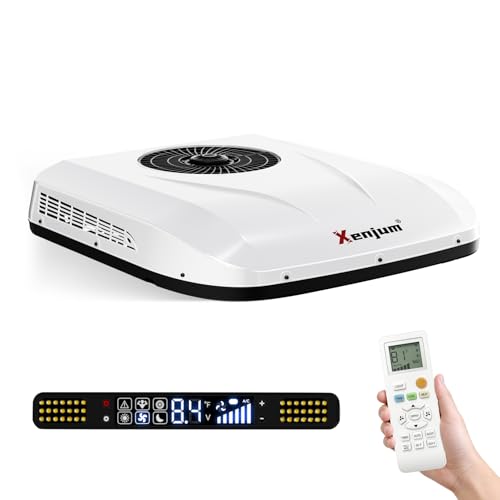
The Xenjum 12V is the lightest unit on this list at 43 pounds, with a slim 6.1 inch profile and an aerodynamic shroud that cuts drag. It delivers 11,000 BTU of cooling and 4,500 BTU of heating from a 12V system, so a pop-up owner without a generator can run it straight from the battery bank.

An inverter scroll compressor and aerodynamic fan blades hold the sound level near 35 dB, which the maker compares to a library, and the listing says the design is 15 percent more efficient. A 600Ah battery bank is described as supplying up to ten hours of continuous cooling, so you can plan a bank around it.

Six fan speeds and Auto, Sleep and Timer modes give flexible control, and the compact size makes a solo install realistic. A heater on the same body helps on cool mountain nights without hauling a separate unit.

What works

  • Lightest unit here at 43 pounds
  • Runs from 12V with no generator
  • About 35 dB for quiet nights
  • Six fan speeds and a sleep mode

Watch out for

  • Needs a large battery bank for long runs
  • Heating output is modest next to cooling
02
Best for: Large hybrid pop-ups on 115V hookups with a reinforced roof.

Our take

Big hybrids and expandables with a reinforced, fixed roof and reliable pedestal power are the target, where cooling headroom outweighs weight concerns.

Why it made the shortlist

The Arsenda 18000 is a non-ducted rooftop unit delivering 18,000 BTU of cooling and 10,236 BTU of heat pump heating, rated by the maker for interiors up to 680 square feet. It runs at 50 dB and works across outdoor temperatures from 23 to 115 degrees Fahrenheit, so one box covers summer afternoons and cool shoulder-season mornings.

A UV-resistant rooftop housing is built for road travel, and the unit fits the standard 14.25 inch opening. It sits mid-pack on price, noticeably below the Dometic Brisk II and TOSOT 16000, and the money goes to a heat pump and a large capacity figure rather than a lighter body, which is a sensible trade for a big, rigid-roof camper that wants headroom.

The unit takes both 115V AC and 12V DC connections, so plan the wiring early, and plan the install carefully for such a large body with a second person on the roof. The generous capacity also suits long summer stays.

What works

  • Largest capacity here, with heat pump heating
  • Works from 23 to 115 degrees Fahrenheit
  • Costs noticeably less than the name-brand picks
  • Standard 14.25 inch non-ducted opening

Watch out for

  • Far more capacity than a small pop-up needs
  • Needs both 115V AC and 12V DC feeds
03
Best for: Pop-up owners with a big lithium bank and a camping season off-grid.

Our take

It fits a pop-up owner who camps off-grid and wants a weather-ready 12V unit with a clear runtime claim and a remote, digital display and Eco, Sleep and Turbo modes.

Why it made the shortlist

The OutEquip 10000 is a 12V, 10,000 BTU low-profile rooftop unit with a built-in PTC heater, designed to run directly from the vehicle or house electrical system. The listing states up to eight hours of cooling on a 480Ah house bank and up to ten hours on a 600Ah bank, which gives a useful target for sizing batteries.

UV-resistant ABS, a zinc-coated condenser and an EPDM foam gasket protect the unit against sun and rain, while dual brushless copper motor fans and anti-vibration mounts reduce noise and roof vibration. It lands mid-pack on price, a step up from the Xenjum 12V, and the added money pays for a gasketed, coated build and a stated runtime on two bank sizes that makes planning easier.

The listing says it cools in about fifteen minutes, and the remote makes the daily routine simple enough that nobody needs to learn an app.

What works

  • Runtime stated for 480Ah and 600Ah banks
  • Weatherproof gasket and zinc-coated condenser
  • Anti-vibration mounts spare the roof
  • Remote with Eco, Sleep and Turbo modes

Watch out for

  • Weight is not stated on the listing
04
Best for: Shore-power campers wanting a quiet heat pump for a larger pop-up.

Our take

It is built for rigs between 16 and 24 feet, which makes it a fit for big hybrid pop-ups on pedestal power, and it sits near the top of the shortlist on price.

Why it made the shortlist

The TOSOT 16000 offers 16,000 BTU of cooling and a 12,500 BTU heat pump, working across ambient temperatures from 23 to 115 degrees Fahrenheit, so one unit covers hot afternoons and chilly mornings. The maker rates it at 43 dB and describes it as 32 percent quieter than standard RV air conditioners, quieter than a normal conversation through the night.

A non-ducted design fits standard 14.25 inch rooftop openings, and the kit includes the hardware plus step-by-step guidance, which helps a first-time installer. Its non-ducted layout means no ceiling plumbing to reroute in a camper that rarely has any. WiFi through the Gree+ app and a remote let you set the mode, fan speed and timer from anywhere in the camper.

The heat pump handles spring and fall mornings, so the furnace can stay off and the propane tank lasts longer through a long season of weekend trips.

What works

  • Quiet 43 dB operation through the night
  • Heat pump covers spring and fall mornings
  • App and remote control the camper
  • Includes mounting hardware and guide

Watch out for

  • Sized for 16 to 24 foot rigs
  • Needs shore power or a generator
05
Best for: Pop-up owners replacing an old Dometic with a service-backed unit.

Our take

A hard-roof hybrid that is replacing an existing Dometic is the obvious home for it, with the brand's installation path and parts support.

Why it made the shortlist

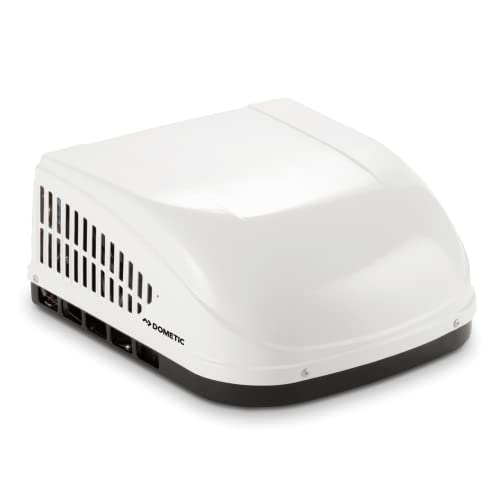
The Dometic Brisk II is a 15,000 BTU rooftop air conditioner with 410A refrigerant, built around an EPP foam housing that lowers weight and improves cooling. Larger air openings promote strong airflow, and a high-performance motor and fan sit inside the shroud, tuned for a steady stream of air. The maker positions the design as best in class for airflow and weight.

It carries the Dometic name and the dealer network behind it, which matters when a part or a technician is needed on a trip far from home or across state lines, and the parts are easy to find. Top of the price list in this guide, the Brisk II spends the money on a proven design with easy installation and maintenance.

The foam housing keeps the weight lower than a plain plastic shell, which helps on any roof that lifts or folds. The unit also serves as a like-for-like swap for owners upgrading an older Dometic, so the existing cutout can often be reused.

What works

  • Foam housing lowers weight and aids cooling
  • Strong airflow from larger openings
  • Backed by the Dometic dealer network
  • Easy installation and maintenance

Watch out for

  • Most expensive pick in this guide
  • Needs 115V shore power or a generator

Methodology

How We Built This Shortlist

Each pick was assessed across 5 criteria weighted for real-world use.

01

Weight and roof load

Each listing was read for stated weight and housing material, since a pop-up roof carries far less than a hard-shell trailer. The Xenjum's 43 pounds and the Brisk II's foam housing earned credit. Units with no stated weight are flagged as a buyer tip, because an unknown weight is a risk on a roof this light and a reason to ask the seller before ordering.

02

Mounting and fit

We compared roof opening sizes, wall-mount ability and install effort. A pop-up's lift mechanism restricts where a unit can sit. Units that fit the standard 14.25 inch opening or state a clear install path scored higher.

03

Power source

We separated 12V DC units from 115V shore-power models and noted the battery sizes the makers quote. For pop-ups at primitive sites, a 12V unit with a stated bank size is more useful than a vague runtime claim. Every score is an editorial assessment based on product specs.

04

Capacity and rig size

We matched stated BTU and square footage against pop-up interiors. A soft-sided camper loses cold air quickly, but an oversized unit still wastes weight and power. The 16 to 24 foot rating on the TOSOT and the 680 square foot rating on the Arsenda show how large these units are.

05

Price position inside the shortlist

We ranked the five units by relative cost and tied each step to a mechanism, like a heat pump or a name-brand service network. Budget units stayed in only when their stated weight and mounting held up. Our approach is explained on the How We Review page, and no pick was ranked on popularity or brand fame, only on stated specs and the mechanism that explains each step in cost.

Decision guide

Match a Budget RV Air Conditioner for a Pop-Up Camper to Your RV

By Camper Weight Limit

The roof or wall load limit is the first filter for a pop-up.

Your camperRecommended pickWhy
Lightest pop-upXenjum 12V43 pounds and a slim 6.1 inch body
Light pop-up with a big bankOutEquip 10000Stated runtime on 480Ah and 600Ah
Hard-roof hybridDometic Brisk IIFoam housing lowers weight
Large hybrid on pedestal powerTOSOT 16000Sized for 16 to 24 foot rigs
Big reinforced roofArsenda 18000Biggest capacity here

By Budget

Position in the shortlist, with what each step buys.

Price bandRecommended pickWhat the money buys
Entry of this shortlistXenjum 12VLightest body and 12V operation
Entry of this shortlistArsenda 18000Biggest capacity and a heat pump
Mid of this shortlistOutEquip 10000Weatherproof build and stated runtime
Top of this shortlistTOSOT 16000Quiet heat pump with app control
Top of this shortlistDometic Brisk IIBrand service and a foam housing

12V Battery vs 115V Shore Power

Where you camp decides which power source makes sense.

12V battery

The Xenjum 12V and OutEquip 10000 run from the battery, which suits primitive sites, and each quotes a runtime against a stated bank.

115V shore power

The Arsenda 18000, TOSOT 16000 and Dometic Brisk II need a pedestal or generator but offer far more capacity and heat pump warmth.

Primitive sites favor the Xenjum 12V, and powered campgrounds favor the TOSOT 16000.

By Season of Use

Cold nights change the value of a built-in heater.

When you campRecommended pickWhy
Summer onlyXenjum 12VCooling plus a light PTC heater
Spring to fallTOSOT 16000Heat pump from 23 degrees Fahrenheit up
Hot and cold extremesArsenda 18000Heat pump with a 23 to 115 degree range
Quiet nights in any seasonOutEquip 10000Dual brushless fans and spring mounts

For a Light Lift-Up Roof Specifically

A pop-up asks for different traits than a hard-sided trailer.

Look for

A stated weight, a slim profile, a 12V option for primitive sites and a mounting spot away from the lift hinges, as the Xenjum 12V shows.

In this comparison

The Xenjum 12V states its 43 pound weight, the Dometic Brisk II uses an EPP foam housing, and the OutEquip 10000 states runtime.

When to Spend More

Spending up makes sense only for certain pop-ups.

Spend more if

You have a large hybrid on hookups and want the TOSOT 16000 for quiet heat pump running, or the Dometic Brisk II for brand support.

Save if

Your pop-up is light and you camp off-grid, where the Xenjum 12V gives the lowest weight and no generator need.

FAQ

Before You Bring One Home

Can a pop-up camper roof carry a rooftop air conditioner?

It depends on the model. Pop-up roofs are light and fold, so ask the manufacturer about the allowed load and whether a reinforced mount is needed. A light unit such as the Xenjum 12V at 43 pounds is easier to justify. A wall or hard-roof section can sometimes be a better location.

How big a unit does a pop-up need?

Most pop-ups do well with a unit in the 10,000 to 11,000 BTU range, such as the OutEquip 10000 or Xenjum 12V. Soft sides lose cold air, but oversized units add weight and draw. Larger units like the Arsenda 18000 suit big hybrids with 680 square feet to cool.

Will a 12V air conditioner run on my pop-up battery?

A single battery will not carry it for long. The OutEquip 10000 quotes eight hours on a 480Ah bank, and a typical unit draws tens of amps. Plan a lithium bank or camp on hookups.

Is the Dometic Brisk II worth the cost on a pop-up?

It makes sense when you are replacing an existing Dometic on a hard-roof hybrid. Its foam housing lowers weight, and the dealer network helps with parts. For a light pop-up that camps off-grid, the Xenjum 12V costs noticeably less and weighs less.

Does a pop-up air conditioner need ducts?

No. Ducted or non-ducted depends on your ceiling assembly, and pop-ups rarely have ducts. The Arsenda 18000 and TOSOT 16000 are non-ducted and fit the standard 14.25 inch opening. Confirm the opening before purchase.

Can I use a heat pump in cold weather?

Heat pumps work best in mild conditions. The TOSOT 16000 and Arsenda 18000 list operation from 23 degrees Fahrenheit, but efficiency falls as it gets colder. Keep a furnace or heater for hard freezes.

Bottom line

The short version

Browse more budget rv air conditioners for a pop-up camper on Amazon →
Bowen Higgins, RV Editor at RV Gear Lab

About the author

Bowen Higgins

RV Editor at RV Gear Lab

Bowen covers RV power, water systems, towing and leveling, upkeep and interior comfort, with a focus on matching gear to the rig, the hookups and the way you actually travel.

More from Bowen →Editorial standards

Keep reading

Related guides