

We research everything we recommend. When you buy through our links, we may earn a commission. Learn more

Buying guide · 11 min read · Updated October 2, 2026

6 Best Budget RV Space Heaters in 2026: A Practical RV Guide

Six budget electric space heaters for RV living rooms and bedrooms, compared on element type, thermostat control and tip-over stability.

Bowen HigginsBy Bowen HigginsRV Editor at RV Gear Lab6 products comparedSpec-sheet researched

At a glance

Our top picks

A budget RV space heater is judged on three things the spec sheet rarely headlines: what kind of element makes the heat, how the thermostat behaves once the cabin is warm, and whether the body stays upright when somebody walks past with a laundry basket. Everything else on a cheap heater is decoration. A 1500 watt rating is common to nearly every plug-in model, so it separates nothing.

This shortlist runs from a wall-mounted unit built for coaches to a handful of ceramic towers that cost less than a tank of fuel. The cheap end is crowded with near-identical ceramic heaters, so the useful question is which of them adds a control or a stability feature the others skip, and which buyer should pay for a purpose-built RV unit instead.

Comfort heating is the job here: a cabin where people are awake and moving around. Heaters for freezing protection in a parked rig, for a 30 amp budget, or for propane are covered in their own guides linked at the bottom, so this page stays on element type, thermostat behaviour and how steady each heater sits on the floor.

RV Gear Lab field notes

The Rig Fit Check

Start with the job
Suburban Wall Mount RV Electric Heater, Thin Design, Black (2691ABK) leads this shortlist for Owners who want a fixed, floor-free heater mounted on a cabin wall.. Use that fit as a reference point, then compare the alternatives against your own space and workload.
Specs that separate the picks
The first details to compare are 13 x 5 x 17 inch wall unit, Two heat settings, Fan only, 1300W and 1500W levels. Confirm the exact model and included components before ordering.
Trade-off to plan for
Needs a permanent mounting spot

Before you buy

What Matters Before You Choose a Budget RV Space Heater

Key buying criteria so you get the right fit the first time.

  1. 01

    Element type

    The element is the part that makes heat, and the common budget choices are PTC ceramic and a wire coil. A ceramic PTC element rises to temperature quickly and limits its own heat, which keeps the grille cooler. A wire element is cheaper and runs hotter at the grille. In an RV, where the heater sits close to bedding and cabinets, the cooler grille is a practical advantage. Confirm the words PTC or ceramic in the listing title or first bullet.

  2. 02

    Thermostat behaviour

    A thermostat lets the heater cycle off at a chosen temperature rather than running flat out all night. In a small RV cabin, a heater without one can push the room past comfortable within half an hour and leave you throwing off blankets. An ECO mode that cycles the element does the same job. Confirm the listing says adjustable thermostat, not just heat levels, since a high and low switch is not a thermostat.

  3. 03

    Tip-over and overheat protection

    A switch cuts power when the heater leans past a set angle, and an overheat cutout shuts the element down if internal temperature climbs. Both matter more in a coach, where floors flex and a slide-out can nudge a heater. Seek both named on the listing, and prefer a stated UL or ETL listing, because a listing is how those switches get verified rather than simply claimed.

  4. 04

    Body shape and stability

    A tall oscillating tower has a narrow base, and a bump from a pet or a passing elbow can send it over before the shutoff does its job. A low box or a wall-mounted unit has a much lower center of gravity. Match the shape to the traffic around it: towers suit a nightstand or a shelf, while boxes and wall mounts suit a floor in a busy aisle.

  5. 05

    Noise at night

    RV cabins are small, so a heater is often within an arm's reach of a bed. A fan that whirs at 50 decibels is a real sleep problem, while a quiet one disappears. Seek a stated decibel figure, a quiet-intake design, or a brushless motor. A single-speed gentle fan, like the one on a wall unit, also tends to stay out of the way at night.

  6. 06

    Footprint and portability

    Floor space is the scarcest resource in a coach, so how a heater parks matters as much as how it heats. A wall mount takes none. A nightstand tower takes a corner of a shelf. A carry handle lets one heater serve two rooms. Check the stated dimensions rather than guessing, because a heater that looks small in a photo can block a narrow aisle.

Our standards

Why You Can Trust RV Gear Lab

At RV Gear Lab, we compare products based on rig fit and power or hookup compatibility, verified specifications, usability, setup requirements, weight, durability, and real-world trade-offs. We do not rank products purely on marketing claims or commission rates.

We have not personally tested every product listed. Where hands-on testing is not available, recommendations are based on verified manufacturer specifications, product documentation, use-case fit, and comparative research.

How we review RV gear →

Detailed reviews

The 6 best budget rv space heaters, explained

01
Best for: Owners who want a fixed, floor-free heater mounted on a cabin wall.

Our take

Pick it for a rig that gets lived in through winter and has a spare wall panel near an outlet.

Why it made the shortlist

The Suburban Wall Mount is a 13 by 5 by 17 inch electric heater that screws to a wall and plugs into a standard 120 volt outlet through a 6 foot grounded cord. Its profile stays under 5 inches deep, so it takes no floor space in a narrow aisle. Its stated draw is 11 amps and 1325 watts.

Placing the heater on the wall removes the tip-over question completely, which is the biggest stability argument any heater in this guide can make. An adjustable thermostat and variable heat settings sit alongside a single-speed fan that moves air gently, so the cabin warms without a blast of noise. On price it sits at the top of this shortlist on price.

A UL approval is stated on the listing and a one-year limited warranty backs it, which suits a permanent install better than a heater that gets moved weekly.

What works

  • Wall mount frees the floor completely
  • Adjustable thermostat plus variable heat
  • Slim profile under 5 inches deep
  • UL approval stated on the listing

Watch out for

  • Needs a permanent mounting spot
  • Draws a hefty 11 amps
02
Best for: Boat, cabin and RV owners who want a portable heater with a low, stable base.

Our take

Choose this one when the heater will live on the floor of a small coach and get bumped by pets, kids or slide-out traffic.

Why it made the shortlist

The Xtreme Heaters Cabin heater is a portable unit designed for boats, cabins and RVs, with two heat settings and a 6 foot power cord. It draws air in through the top instead of the back, so it can sit against a wall or on carpet without the intake choking. The low profile keeps its center of gravity close to the floor.

Next to the ceramic towers further down this list, it leans on a stable base and a UL 1278 listing for its safety story rather than on remotes and timers. An automatic overheat cutout and tip-over shutoff are both stated on the listing, and the quiet top intake suits a cabin where somebody is sleeping or watching a show.

Priced toward the high end of the shortlist, it buys the low stance and the listing that names an RV as the intended home.

What works

  • Top air intake allows wall and carpet placement
  • Low, stable base resists tipping
  • Tip-over and overheat protection both stated
  • UL 1278 standard named on listing

Watch out for

  • Costs several times the ceramic towers
  • No remote or timer
03
BEYOND HEAT 1500W Milkhouse Space Heater with Thermostat
  • Fan only, 1300W and 1500W levels
  • Built-in thermostat
  • Carry handle, box shape
Check price on Amazon for BEYOND HEAT 1500W Milkhouse Space Heater with Thermostat (opens in a new tab)
Best for: Buyers who want a rugged box heater that doubles as a summer fan.

Our take

Price is a small step above the entry towers and well below the RV-specific units.

Why it made the shortlist

A solid carry handle makes it easy to move from the bedroom end of a coach to the living area. The heavy-duty housing is built in the milkhouse tradition, a design meant to survive barns and workshops.

A tip-over switch and overheat protection are both stated on the listing, and the compact box shape sits low and wide on the floor.

A camper after a tough, no-nonsense heater with a thermostat, who will also use it as a circulation fan in shoulder seasons, is the buyer here.

What works

  • Fan-only mode for mild weather
  • Tip-over switch and overheat protection
  • Rugged box shape sits low and wide
  • Easy carry handle

Watch out for

  • Basic controls, no remote
  • Wire-style heat feels harsher than ceramic
04
KopBeau Space Heater for Indoor Use with Adjustable Thermostat
  • 1500W PTC ceramic element
  • High, middle, low, fan modes
  • Overheat and tip-over protection
Check price on Amazon for KopBeau Space Heater for Indoor Use with Adjustable Thermostat (opens in a new tab)
Best for: Cabin occupants who want four plain modes and an adjustable thermostat.

Our take

It fits a buyer who wants a ceramic heater under a desk-height table or beside the bed and values simple dials over features.

Why it made the shortlist

An adjustable thermostat lets the heater cycle off once the cabin reaches the chosen temperature. It is light enough to carry in one hand from the bedroom to the dinette.

Overheat protection and a tip-over switch are both listed, so the safety basics are covered at the entry end of the range.

Among the towers it sits at the entry end of this shortlist on price, a clean way to get PTC heat and a real thermostat.

What works

  • Four plain modes, easy to learn
  • PTC ceramic element self-limits
  • Adjustable thermostat included
  • Light and compact for small spaces

Watch out for

  • No remote or oscillation
  • Plain tower body
05
WINHL Space Heater with 70 Degree Oscillation, Thermostat and Remote
  • 1500W PTC ceramic, 70 degree oscillation
  • Remote, thermostat, 12 hour timer
  • About 5.9 in deep, 9.9 in tall
Check price on Amazon for WINHL Space Heater with 70 Degree Oscillation, Thermostat and Remote (opens in a new tab)
Best for: Open-plan coaches where one heater has to warm a lounge and a bed.

Our take

Beside the KopBeau, the WINHL adds oscillation, a remote and a timer for about the same outlay, which makes it the better pick for a larger open-plan living area.

Why it made the shortlist

The WINHL is a 1500 watt PTC ceramic tower that starts blowing warm air within seconds. A 70 degree oscillation sweeps heat from side to side, so a sofa and a bed corner get warmth instead of one hot spot. At roughly 5.9 inches deep and 9.9 inches tall, it fits on a nightstand or a bathroom counter.

The remote controls temperature, mode and a 12 hour timer, and in ECO mode the thermostat cycles the heater to hold the room steady. A tip-over shutoff and overheat cutout are both stated, and the listing carries an ETL safety listing.

It lands at the entry end of this shortlist on price, so the extras come close to free.

What works

  • Oscillation spreads heat across the room
  • Remote, timer and ECO mode included
  • ETL listed for safety
  • Compact enough for a nightstand

Watch out for

  • Tall narrow tower can be bumped over
  • More menus than a dial heater
06
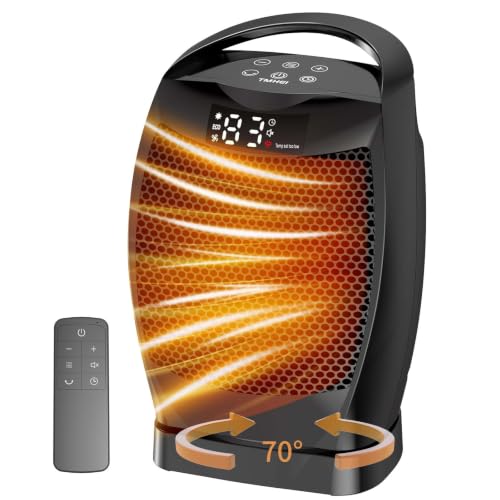
TMHEI 1500W PTC Ceramic Space Heater with Thermostat and Remote
  • 750, 1000 and 1500W levels
  • Under 40 dB, 70 degree oscillation
  • ETL listed, 12 month warranty
Check price on Amazon for TMHEI 1500W PTC Ceramic Space Heater with Thermostat and Remote (opens in a new tab)
Best for: First-time RV owners who want three power steps and a quiet bedroom heater.

Our take

Entry pick of this shortlist on price, backed by an ETL listing and a 12 month warranty.

Why it made the shortlist

The TMHEI offers three heating levels at 750, 1000 and 1500 watts from a PTC ceramic element, with a thermostat, a remote and 70 degree oscillation. Touch-sensitive buttons control power, and a sturdy built-in handle makes it easy to move between rooms. The housing is built from flame-retardant material.

Three steps give a finer grip on comfort than the two-step heaters above, which matters in a small cabin that overheats fast on a full 1500 watt setting. Noise stays below 40 decibels on the listing, which suits a bedroom, and an integrated overheat device is stated.

A first-time owner gets a remote, three power steps and quiet running without spending more than a few cartons of groceries.

What works

  • Three power steps for finer control
  • Quiet enough for a bedroom
  • ETL listing and 12 month warranty
  • Flame-retardant housing

Watch out for

  • Touch buttons can be fiddly
  • Tall tower shape tips easier than a box

Methodology

How We Built This Shortlist

Each pick was assessed across 5 criteria weighted for real-world use.

01

Element type and heat character

We read every listing to see whether each heater uses PTC ceramic, a wire element or a wall-fan design. Ceramic elements reach temperature quickly and self-limit, while wire elements run hotter at the grille. The element decides how the warmth feels in a tight cabin, so it carries real weight in our analysis.

02

Thermostat behaviour

A thermostat that cycles the heater off once the cabin is warm saves both energy and sleep. We looked for stated adjustable thermostats and for ECO or cycling modes rather than a bare high/low switch. Heaters without any thermostat were treated as manual-only products.

03

Stability and shutoffs

Based on product specs, we looked for tip-over shutoff, overheat cutout and a stated safety listing such as UL or ETL. A stated listing is worth more than a marketing line. Body shape also counted, since a low box is steadier than a tall tower on a moving floor.

04

Fit for RV living

We weighed footprint, weight and noise against the realities of coach life: narrow aisles, slide-out traffic and sleeping quarters a few feet from the heater. A wall-mounted unit solves floor space entirely, while a nightstand tower solves portability.

05

Price position

Every pick is placed by its position within this shortlist rather than a quoted figure, because listing prices change. We looked at what each step up in cost actually buys, whether that is a wall mount, a stable base or a remote and timer.

Decision guide

Match a Budget RV Space Heater to Your RV

By Cabin Layout

The shape of your living space decides where a heater can sit safely, so start with the floor plan.

LayoutBest pick
Narrow aisle, no floor to spareSuburban Wall Mount
Open lounge plus bed cornerWINHL Oscillating Tower
Floor heater in a busy walkwayXtreme Heaters Cabin
Nightstand or shelf useKopBeau Ceramic
Shoulder-season circulationBeyond Heat Milkhouse

By Budget

Position on this shortlist tells you what each step up in cost buys.

Price bandBest pick
Entry of this shortlistTMHEI Ceramic
Still entry, with oscillationWINHL Oscillating Tower
A small step up for a rugged boxBeyond Heat Milkhouse
Several times the entry pick for a stable RV baseXtreme Heaters Cabin
Top of this shortlist for a fixed installSuburban Wall Mount

Ceramic Tower vs Rugged Box

These two shapes dominate the budget end and trade comfort features against stability.

Ceramic tower

Quick PTC warmth, a remote, a timer and oscillation come with the tower shape, which suits a nightstand. The TMHEI Ceramic, WINHL Oscillating Tower and KopBeau Ceramic all fall in this group.

Rugged box

A low, wide body sits steadier on a moving floor and survives knocks, with plainer controls in return. The Beyond Heat Milkhouse and Xtreme Heaters Cabin fall in this group.

Pick a tower for a shelf or bedroom, and a box for the floor of a busy coach.

By Control Style

How you want to adjust the heater changes which model feels right at 2 a.m.

Control preferenceBest pick
Remote from bedWINHL Oscillating Tower
Plain dials and four modesKopBeau Ceramic
Three power steps, touch controlsTMHEI Ceramic
Set-and-forget wall thermostatSuburban Wall Mount

For Sleeping Quarters Specifically

A heater near a bed needs to be quiet, steady and shut itself off when things go wrong.

Look for

A stated decibel figure or quiet intake, a thermostat that cycles, and both tip-over and overheat protection.

In this comparison

The TMHEI Ceramic states under 40 decibels, and the Xtreme Heaters Cabin uses a quiet top intake. The Suburban Wall Mount adds a gentle single-speed fan.

When to Spend More

Moving beyond a ceramic tower is about stability and install, not heat output.

Spend more if

The heater sits in a traffic path or the rig is lived in all winter. The Xtreme Heaters Cabin buys a low stable base and a UL 1278 listing, and the Suburban Wall Mount removes floor use altogether.

Save if

The heater lives on a shelf or nightstand for a few cold nights a year. The TMHEI Ceramic and KopBeau Ceramic cover the basics for very little.

FAQ

Before You Bring One Home

Is a ceramic heater better than a wire-element heater in an RV?

For most small cabins, yes. A PTC ceramic element reaches temperature fast and limits its own heat, which keeps the grille cooler near bedding and cabinets. Wire-element heaters cost less and run hotter at the grille. The KopBeau, WINHL and TMHEI use ceramic, while the Beyond Heat Milkhouse is a rugged box style.

Do I need a thermostat on a budget RV heater?

A thermostat is worth having because it lets the heater cycle off once the cabin is warm, instead of running flat out until you notice. A small RV overheats quickly on a full 1500 watt setting. All six have a thermostat or a variable setting, but a plain high and low switch is not a thermostat.

Can I use a wall-mounted heater instead of a portable one?

If you have a clear wall panel near an outlet, a wall mount like the Suburban removes the tip-over risk and takes no floor space. It does need a permanent spot and a screwdriver. A portable heater is easier if you move it between rooms or want it out of sight in summer.

How do I keep a tall heater from tipping in a moving rig?

Never leave a tower heater running or standing loose in a rig that is being driven. Stow it, or choose a low, wide model like the Xtreme Heaters Cabin that sits steady. A tip-over switch is a backstop, not a license to place a tall tower in a walkway.

Is an ETL or UL listing important on a cheap heater?

Yes. A listing means a third party tested the tip-over and overheat protections, rather than the manufacturer simply asserting them. Find the listing in the title or bullets, as on the Xtreme Heaters Cabin, WINHL and TMHEI. A named listing is worth more than a phrase like safe design.

Is the more expensive RV-specific heater worth it over a ceramic tower?

Your rig's daily routine decides it. Extra spend buys a stable base or a permanent mount, which matters for full-time living and busy aisles. For a few cold weekends a year, the cheaper ceramic towers do the same warming job at a fraction of the cost.

Bottom line

The short version

Browse more budget rv space heaters on Amazon →
Bowen Higgins, RV Editor at RV Gear Lab

About the author

Bowen Higgins

RV Editor at RV Gear Lab

Bowen covers RV power, water systems, towing and leveling, upkeep and interior comfort, with a focus on matching gear to the rig, the hookups and the way you actually travel.

More from Bowen →Editorial standards

Keep reading

Related guides