

We research everything we recommend. When you buy through our links, we may earn a commission. Learn more

Buying guide · 11 min read · Updated October 2, 2026

6 Best Budget 100 Amp RV Converters in 2026: A Practical RV Guide

Six 100 amp RV converter chargers compared on lithium modes, fan behavior and drop-in fit, for owners with big battery banks who want the output.

Bowen HigginsBy Bowen HigginsRV Editor at RV Gear Lab6 products comparedSpec-sheet researched

At a glance

Our top picks

At a glance · 6 picks

A 100 amp rating is the top of the converter ladder, and it only earns its place when the battery bank is big enough to absorb it. Think of a lithium bank in the 300Ah range or several AGM batteries wired in parallel: that is where 100 amps of output turns a long overnight recharge into a few hours at the pedestal. On a small rig it simply sits idle, so this guide starts with the bank, not the badge.

Budget 100 amp units have become surprisingly capable. The cheapest picks here still bring reverse polarity, overload and thermal protection, and several add a dedicated lithium mode or an adjustable voltage window. What the lower price tends to drop is the brand name on the warranty claim and the paperwork around certifications, so each pick below is described by what its listing actually spells out.

Because a converter this size can pull a serious amount of AC current when it runs flat out, the electrical side of the install matters as much as the unit. A 100 amp output at 12 volts is on the order of 1,200 watts of DC power, which means a dedicated, correctly sized AC circuit. We weighed these listings on staging, voltage range, fan behavior and fit, and ranked them for owners who really need this much output.

RV Gear Lab field notes

The Rig Fit Check

Start with the job
MWXNE 100 Amp RV Power Converter, 120V AC to 12V DC Battery Charger with Multi Smart Charging Modes leads this shortlist for Lithium-bank owners who want a switchable charge profile at 100 amps.. Use that fit as a reference point, then compare the alternatives against your own space and workload.
Specs that separate the picks
The first details to compare are 100A, 120V AC to 12V DC, 100A DC output, 100A, 105-130 VAC input. Confirm the exact model and included components before ordering.
Trade-off to plan for
Brand has a short track record

Before you buy

What Matters Before You Choose a Budget 100 Amp RV Converter

Key buying criteria so you get the right fit the first time.

  1. 01

    Bank size that justifies 100 amps

    A converter's amperage is shared between the 12V loads running in the rig and the current going into the batteries, and only the leftover recharges the bank. Because lead-acid is treated as about half usable and lithium closer to all of it, a 300Ah lithium bank has far more room to absorb 100 amps than a pair of small AGM batteries. Add up the amp-hours you will replace, then divide by the amps left after loads to estimate recharge time. If that math gives a few hours on a smaller unit, you are paying for output you cannot use.

  2. 02

    Lithium profile and how it switches

    LiFePO4 wants a higher absorption setpoint, typically in the 14.4 to 14.6V range, and no long float taper that holds the bank at a partial state. Some converters change profile with a button or jumper, while others only offer an adjustable fixed voltage that you set by hand. Naming a LiFePO4 mode and listing 14.6V is clearer than the bare phrase lithium compatible. Compare the setpoint with your battery maker's charging figure before you buy.

  3. 03

    AC input current and circuit sizing

    A converter making 100 amps at 12V is moving on the order of 1,200 to 1,440 watts, which means roughly 12 to 14 amps of AC draw before losses. That is a big share of a 15 amp branch if the microwave or air conditioner shares it. Check the input voltage range in the listing, such as 105 to 130 VAC, and plan a dedicated circuit with the wire gauge your old unit used. A shortlist full of 100 amp boxes still depends on a sound feed.

  4. 04

    Cooling design and noise

    Heat is the enemy of a converter, and a fan that runs constantly becomes the sound of your bedroom. Look for fans that stay off until the load calls for them or that ramp proportionally, plus a metal housing and a thermal shutdown. The listing should describe the fan behavior in words, not just claim quiet operation. Leave the clearances shown in the manual, because a boxed-in converter throttles itself in summer.

  5. 05

    Protection and certification wording

    Reverse polarity, overload, short circuit, overheating and over or under voltage protection each guard against a different failure, such as a swapped wire or a stalled fan. A UL or ETL claim in the listing is a helpful signal, but treat it as a claim until you see a mark on the unit. Prefer listings that name the protections one by one over those that only say safe. This matters more at 100 amps than it does on a 35 amp box.

  6. 06

    Fit, wiring and replacement path

    A deck-mount converter has to match the old cutout, the DC output location and the wire gauge, so a listing that names PM3-100 or WF68100 compatibility saves a lot of guessing. Measure the old unit, count the DC output studs, and compare against the dimensions in the listing. Replacement units that keep your existing wiring keep the job to an hour. A mismatch can force new cable runs, which can cost more than the converter itself.

Our standards

Why You Can Trust RV Gear Lab

At RV Gear Lab, we compare products based on rig fit and power or hookup compatibility, verified specifications, usability, setup requirements, weight, durability, and real-world trade-offs. We do not rank products purely on marketing claims or commission rates.

We have not personally tested every product listed. Where hands-on testing is not available, recommendations are based on verified manufacturer specifications, product documentation, use-case fit, and comparative research.

How we review RV gear →

Detailed reviews

The 6 best budget 100 amp rv converters, explained

01
Best for: Lithium-bank owners who want a switchable charge profile at 100 amps.

Our take

Protection covers short circuit, overload, thermal shutdown, under and over voltage and reverse polarity.

Why it made the shortlist

That makes this the 100 amp unit built around a mode switch. One press selects a dedicated lead-acid or LiFePO4 charging profile, and a fixed-voltage mode offers 13.0V, 14.6V or 16.5V settings, so the same box can run an AGM bank today and a lithium upgrade next season.

Next to the plain three-stage units in this list, the MWXNE adds the profile selection that a lithium bank needs and describes its Boost, Normal and Trickle stages clearly. The metal housing and temperature-managed fan suit an enclosed compartment where heat builds, and it sits at the high end of this shortlist on price.

That makes it the sensible choice for a 300Ah-class lithium bank, or for anyone who wants one converter that will not need replacing when the batteries change.

What works

  • Switchable lead-acid and lithium charge profiles
  • Three clear automatic charging stages
  • Metal housing with temperature-managed fan
  • Full set of electrical protections

Watch out for

  • Brand has a short track record
02
100 Amp RV Power Converter Built-in 3 Stage Smart Charger
  • 100A DC output
  • Built-in 3-stage smart charger
  • Reverse polarity, overload, thermal protection
Check price on Amazon for 100 Amp RV Power Converter Built-in 3 Stage Smart Charger (opens in a new tab)
Best for: Owners replacing a failed 100 amp lead-acid converter with a simple three-stage unit.

Our take

It makes sense for a rig that already runs flooded or AGM batteries and just needs working 100 amp output again.

Why it made the shortlist

Straight three-stage charging at 100 amps is what this unit delivers, converting 120V shore power to 12V DC while it charges the battery and runs the low-voltage lights and appliances at the same time. That dual role is exactly what a converter in a trailer does all day.

Against the MWXNE 100A above it, this one drops the lithium switch and the adjustable voltage window and keeps the core job: a smart three-stage profile, reverse polarity, overload and thermal protection. It sits level with the top of the shortlist on price, so the argument for it is availability and a no-fuss spec.

Owners with a lead-acid bank get the profile they need and nothing they would never use.

What works

  • Charges and powers loads at once
  • Plain three-stage profile for lead-acid
  • Standard protections included
  • Simple, familiar spec

Watch out for

  • No stated lithium mode
  • Few details on fan or housing
03
Best for: Rigs with a PM3-100 or WF68100 deck-mount converter that needs a like-for-like swap.

Our take

A rig with a failed deck-mount converter and a lead-acid battery bank is the textbook use.

Why it made the shortlist

Its listing names the unit it replaces: the PM3-100 and the WF68100 deck-mount converters.

In this shortlist it is priced in the same band as the other generic 100A units, with fitment as its real selling point.

Standard protections cover reverse polarity, overload and heat, so the swap restores the original behavior of the system.

What works

  • Names the exact models it replaces
  • Wide 105-130 VAC input window
  • Three-stage charging built in
  • Standard electrical protections

Watch out for

  • No lithium profile described
  • Little detail on fan noise
04
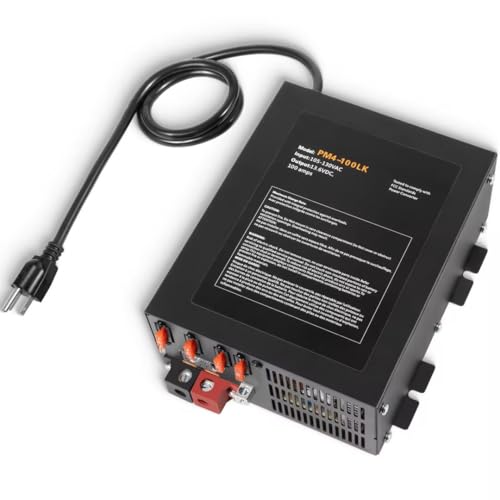
PM4 100 Amp RV Power Converter with Built-in 4 Stage Smart Battery Charger
  • 100A, 110-120V AC input
  • 12V to 16.5V DC output range
  • 4-stage smart charger, fan on demand
Check price on Amazon for PM4 100 Amp RV Power Converter with Built-in 4 Stage Smart Battery Charger (opens in a new tab)
Best for: Trailer owners who sleep near the converter and want the fan silent until the load calls for it.

Our take

Installation guidance is spelled out too: disconnect power, tighten every wire, and give each connection a tug.

Why it made the shortlist

Output covers 110 to 120V AC in and 12 to 16.5V DC out at 100 amps, with a four-stage smart charger and electronic current limiting that shuts power down on overload or short circuit. Against the MWXNE 100A it gives up the lithium switch, yet it lands noticeably lower on price and the listing cites UL approval.

A mid-pack choice for a lead-acid or AGM bank that wants a calm, simple 100 amp supply.

What works

  • Fan stays off until the load needs it
  • Current limiting on overload and short
  • Listing cites UL approval

Watch out for

  • No dedicated lithium mode described
  • Four-stage wording is loosely explained
05
Hoiedt PM3-100LK 100 Amp/PM4-100 RV Power Converter 100a Charger
  • 100A, up to 1440W
  • Boost 14.4V, absorption 13.6V, float 13.2V
  • 13.0-16.5V adjustable, UL claim
Check price on Amazon for Hoiedt PM3-100LK 100 Amp/PM4-100 RV Power Converter 100a Charger (opens in a new tab)
Best for: Buyers who want exact stage voltages and a stated power ceiling before committing.

Our take

Because it claims fit for lithium and lead-acid batteries, it works for a mixed upgrade path.

Why it made the shortlist

Few budget listings give numbers this plainly. Boost sits at 14.4V, absorption at 13.6V and float at 13.2V, the output window runs 13.0 to 16.5V, and the maximum power is stated as 1440W, so a buyer can match the profile to a battery maker's charging sheet.

Where the PM4-100 relies on a quiet fan that starts late, this one uses a proportional-speed fan that ramps with load, and it carries a UL certification claim along with reverse polarity, short circuit, overcurrent and overheating protection. It sits in the lower half of the shortlist on price.

What works

  • Stage voltages stated in the listing
  • Proportional fan runs only as needed
  • Lithium and lead-acid fit claimed

Watch out for

  • Float stage is not ideal for lithium
  • Lesser-known brand
06
100 Amp RV Power Converter Charger 110VAC to 12VDC, Lithium Compatible
  • 100A, 110-120V AC to 12-16.5V DC
  • Boost, Normal, Storage stages
  • Lithium compatible, 3 protections
Check price on Amazon for 100 Amp RV Power Converter Charger 110VAC to 12VDC, Lithium Compatible (opens in a new tab)
Best for: Budget-first owners with a big bank who still want lithium compatibility.

Our take

It works well as a first lithium upgrade on a tight budget or as the converter for a rig that sees heavy loads and a large bank.

Why it made the shortlist

Here is the entry pick in the guide and the cheapest way to get 100 amps with a lithium-compatible claim. It converts 110 to 120V AC to a 12 to 16.5V DC range and delivers up to 100 amps of current with a built-in three-stage charger.

The saving over the MWXNE 100A is large, and what the money skips is the dedicated mode switch.

The adjustable voltage window gives room to match a battery maker's charging figure.

What works

  • Lithium compatibility stated up front
  • Adjustable voltage window
  • Familiar three-stage structure

Watch out for

  • No dedicated mode switch
  • Sparse manufacturer detail
The catch
Stages run Boost for a fast charge, Normal for a standard charge and Storage for a trickle, the same shape as the more expensive units above, and reverse polarity, overload and thermal protection come with it.

Methodology

How We Built This Shortlist

Each pick was assessed across 5 criteria weighted for real-world use.

01

Output matched to the title

Every pick was compared against the 100 amp claim in its own listing. Units that sold a different rating, or a power center without a stated output, were set aside so the shortlist keeps the promise in its title. This is an assessment of product specs, not bench measurement.

02

Charge profile

We compared how each listing describes its stages, whether a lithium option is named, and how clearly the voltages are stated. A unit that spells out its setpoints scored higher than one that only says smart charging. Float behavior mattered because it decides how a lithium bank is held at the pedestal.

03

Fan and heat management

At 100 amps a converter makes real heat, so the cooling design carries weight. We looked for fans that start on demand or scale with load, plus metal housings and thermal shutdown. Those details were weighed against how close the unit usually lives to a bed or a closet.

04

Protection and certification claims

We treated reverse polarity, overload, short circuit and thermal protection as the baseline. Claims of UL certification or approval were noted when a listing made them, and we did not credit any listing that was silent. Read as stated, not as independently confirmed.

05

Fit and price position

Replacement listings that name the model they fit scored well for owners swapping a failed unit. Price was judged as a position within this shortlist and what each step up adds, such as a mode switch or documented voltages. No figure is quoted, since listing prices change.

Decision guide

Match a Budget 100 Amp RV Converter to Your RV

By Battery Bank Size

Recharge speed depends on the bank, so start there and let the bank pick the converter class.

BankRecommended pickWhy
Large lithium bank, 300Ah or moreMWXNE 100ADedicated lithium mode and fixed 14.6V setting suit a big LiFePO4 bank
Large AGM or flooded bankPM4-100Four-stage charger and on-demand fan suit lead-acid held at float
Mixed or upgrading bankHoiedt PM3-100LKStated stage voltages let you match the profile to the battery sheet
Replacing a failed deck unitPM3-100 ReplacementNames PM3-100 and WF68100, so the cutout and wiring carry over
Big bank on a tight budgetLithium-Compatible 100ACheapest way to 100 amps with lithium compatibility stated

By Budget

All six picks are close in cost, so the bands show what each step up adds.

Price bandRecommended pickWhat the step buys
Entry of this shortlistLithium-Compatible 100AThe 100 amps and a lithium claim at the lowest cost here
Lower mid of this shortlistHoiedt PM3-100LKStated voltages, proportional fan and a UL claim
Mid of this shortlistPM4-100Late-start fan and four-stage wording
Upper band of this shortlistPM3-100 ReplacementA named drop-in fit for PM3-100 and WF68100 units
Top of this shortlistMWXNE 100AA real mode switch and metal housing with managed fan

Switchable Profile vs Fixed Three-Stage

The first fork is whether the converter adapts to the battery or expects you to match it.

Switchable profile

MWXNE 100A and Hoiedt PM3-100LK let you pick or set the voltage for lithium or lead-acid, which suits a bank you may change later. The mechanism is a selectable setpoint, so the absorption voltage follows the battery.

Fixed three-stage

Built-In 3-Stage and PM3-100 Replacement run a set lead-acid style sequence with boost, normal and float. The mechanism is simple and predictable, which is ideal if the bank will stay AGM or flooded.

Buying for lithium now or soon points to MWXNE 100A, while a settled lead-acid bank is fine with Built-In 3-Stage.

By Where the Converter Lives

Noise and heat depend on the compartment, and the fan design decides how well each pick copes.

LocationRecommended pickWhy
Under a bed or bunkPM4-100Fan stays off until load calls for it, so the float period is quiet
Closed closet or cabinetMWXNE 100AMetal housing and temperature-managed fan handle trapped heat
Open basement bayHoiedt PM3-100LKProportional-speed fan scales with load in a ventilated space
Existing deck cutoutPM3-100 ReplacementFits the footprint of the PM3-100 and WF68100 it replaces

For Lithium Upgrades Specifically

If a LiFePO4 swap is on the horizon, the charge profile decides how much of the upgrade you get.

Look for

A named LiFePO4 mode, a 14.6V setting and a way to avoid a long float. MWXNE 100A lists those, and Lithium-Compatible 100A offers an adjustable voltage window at a lower cost.

In this comparison

MWXNE 100A is the cleanest fit, Hoiedt PM3-100LK documents its voltages, and Lithium-Compatible 100A is the budget route. PM4-100 and Built-In 3-Stage suit lead-acid.

When to Spend More

Most of this shortlist sits close together, so the decision is about features, not raw output.

Spend more if

You run a large lithium bank and want a switch instead of a manual voltage. MWXNE 100A is the step up, and Hoiedt PM3-100LK is the middle route with stated voltages and a UL claim.

Save if

Your bank is lead-acid or you can set voltage by hand. Lithium-Compatible 100A and PM4-100 give the output and the protections at a lower band, and Built-In 3-Stage keeps it basic.

FAQ

Before You Bring One Home

How big a battery bank justifies a 100 amp converter?

A bank of roughly 300Ah of lithium, or several AGM batteries in parallel, can use the output. The converter's amps are shared with the 12V loads, so only the remainder recharges the batteries. On a single 100Ah battery, a 45 or 55 amp unit finishes the same job with less cost and heat. Do the math before paying for output you cannot absorb.

Can a 100 amp converter overcharge my batteries?

A converter supplies what the batteries and loads will accept, up to its rating, so a larger unit does not force more current in. What matters is the voltage profile. A lead-acid profile held on a lithium bank, or a too-high fixed voltage left on, can harm the bank. Match the setpoint to the battery maker's sheet.

Is the lithium-compatible 100A unit worth it over the MWXNE?

It delivers the same 100 amps and a stated lithium compatibility at a much lower position in this shortlist. What you give up is the dedicated mode switch and some detail on the housing. If you are comfortable setting an adjustable voltage once and leaving it, the saving is real. If you want to flip between profiles, take the MWXNE.

How do I install a 100 amp converter safely?

Disconnect AC and DC power first, then mount the unit with the clearance the manual shows, and tighten every connection firmly. Use the wire gauge the old unit used or heavier, and give the converter a dedicated AC circuit. Wiring and fusing remain the owner's responsibility, so a licensed electrician is a fair call if you are unsure.

Will a 100 amp converter run on a 15 amp pedestal?

At full output it draws roughly 12 to 14 amps of AC, so it can load a 15 amp branch heavily. In practice the converter rarely runs flat out for long, but pairing it with an air conditioner or microwave on the same branch can trip a breaker. A 30 amp or 50 amp service gives far more room, and a dedicated circuit helps.

Do I need to replace the converter when I switch to lithium?

Not always. A three-stage lead-acid converter will charge a lithium bank, but its float stage and lower absorption setpoint can leave the bank partly charged. A unit with a LiFePO4 mode or a 14.6V fixed setting does the job properly. Many owners upgrade the converter at the same time as the batteries.

Bottom line

The short version

Browse more budget 100 amp rv converters on Amazon →
Bowen Higgins, RV Editor at RV Gear Lab

About the author

Bowen Higgins

RV Editor at RV Gear Lab

Bowen covers RV power, water systems, towing and leveling, upkeep and interior comfort, with a focus on matching gear to the rig, the hookups and the way you actually travel.

More from Bowen →Editorial standards

Keep reading

Related guides