

We research everything we recommend. When you buy through our links, we may earn a commission. Learn more

Buying guide · 11 min read · Updated October 2, 2026

6 Best 24V Lithium Batteries for RV in 2026: A Practical RV Guide

Six true 24V (25.6V) LiFePO4 batteries for RV and off-grid bank use compared on kWh cost, BMS amps, cold limits and 12V-load compatibility, $320 to $1,200.

Bowen HigginsBy Bowen HigginsRV Editor at RV Gear Lab6 products comparedSpec-sheet researched

At a glance

Our top picks

Almost every towable and most motorhomes run their house loads at 12 volts, so a 24V lithium battery is a deliberate system choice, not a drop-in swap. It makes sense when you already have a 24V inverter-charger or solar controller, when you are building a big bank where cable size matters, or when a van or coach conversion was designed around 24 volts. The same 2,000 watts is about 83 amps at 24V against roughly 167 amps at 12V, which is why larger builds move up.

We compared six batteries rated at 25.6V nominal (the 24V LiFePO4 standard) priced from $319.99 to $1,199.99. The cost per nominal kilowatt-hour runs from about $118 to $167, but the picks differ more in what surrounds the battery: a 29.2V charge profile, a way to power 12V devices, cold-weather charging, and whether the BMS current can feed the inverter you plan to use.

RV Gear Lab field notes

The Rig Fit Check

Start with the job
Dyness 24V 100Ah LiFePO4 Lithium Battery with Bluetooth, Smart BMS, 2560Wh leads this shortlist for first 24V module with documented cold limits. Use that fit as a reference point, then compare the alternatives against your own space and workload.
Specs that separate the picks
The first details to compare are 25.6V 100Ah, 2,560Wh, 25.6V 100Ah with Bluetooth, 25.6V 100Ah, 41.67 lb. Confirm the exact model and included components before ordering.
Trade-off to plan for
100A BMS supports about 2,560W, so large inverters need two

Before you buy

What Matters Before You Choose a 24V Lithium Battery for RV

Key buying criteria so you get the right fit the first time.

  1. 01

    Is it really a 24V system?

    A 24V lithium iron phosphate battery is made of eight cells in series, which gives 25.6V nominal and about 29.2V when full. Some listings that mention 24V are trolling motor batteries or are meant for 12V to 24V use only, so check the title and bullets for 25.6V and 29.2V. If a listing says 12V or does not list the nominal voltage, it is not a 24V battery.

  2. 02

    System voltage compatibility

    Every charging source in the RV has to match the battery voltage: the converter or inverter-charger, the solar charge controller and any alternator charger. A standard 12V RV converter will not charge it, and a 12V fridge, pump or lighting circuit needs a 24V-to-12V DC converter sized for those loads. List your loads in amps at 12V and confirm the converter can pass them continuously.

  3. 03

    BMS amps converted to watts

    A 100A BMS at 25.6V supports about 2,560 watts, and a 200A BMS about 5,120 watts. A 3,000W inverter will draw around 125A at 24V, which exceeds a 100A BMS and trips the battery. Find the continuous rating in the bullet points, and keep inverter surge in mind since motors and compressors start at two to three times their running load.

  4. 04

    Conversion losses

    The nominal rating can mislead when power passes through a DC converter: a 24V-to-12V converter wastes some energy as heat, and an inverter wastes some more. A 12V load run from a 24V battery through a converter loses a few percent or more, so size the bank with margin. Look for converter efficiency on its own listing, rather than assuming the battery's watt-hour rating is fully usable.

  5. 05

    Charge profile

    A 24V LiFePO4 battery charges at about 29.2V, and a lead-acid profile at 28.8V with float can undercharge or hold it too high. Choose a charger or controller with a lithium setting or a user-set absorption voltage, and disable float or equalization. Check the listing for the stated charge voltage and the charger's own settings page.

  6. 06

    Series and parallel limits

    Each listing sets how many units can be combined, such as 2S4P for eight batteries or 4P2S, and mixing models or ages can unbalance the bank. Capacity in parallel adds amp-hours, and series adds voltage, so 51.2V needs two 24V batteries in series. Buy matching units, and confirm the warranty covers multi-battery banks.

Our standards

Why You Can Trust RV Gear Lab

At RV Gear Lab, we compare products based on rig fit and power or hookup compatibility, verified specifications, usability, setup requirements, weight, durability, and real-world trade-offs. We do not rank products purely on marketing claims or commission rates.

We have not personally tested every product listed. Where hands-on testing is not available, recommendations are based on verified manufacturer specifications, product documentation, use-case fit, and comparative research.

How we review RV gear →

Detailed reviews

The 6 best 24v lithium batteries for rv, explained

01
Best for: First 24V module with documented cold limits

Our take

Choose it if you want a documented 2.56kWh module you can add to later.

Why it made the shortlist

The Dyness 24V 100Ah is rated 25.6V, 100Ah and 2,560Wh. Its listing gives a 100A smart BMS, Bluetooth monitoring through the Dyness app, charging that stops below 32°F and resumes above 41°F, discharge protection below minus 4°F, and 4,000 plus cycles at 100 percent depth of discharge. It can be expanded to eight identical units in a 4P2S arrangement for 51.2V and 400Ah, and the listing says to use a 29.2V LiFePO4 charger.

What works

  • Published thresholds: charge stops at 32°F, resumes at 41°F
  • Bluetooth shows capacity from your phone
  • Expandable to 51.2V and 400Ah with identical units
  • 4,000 cycles claimed at full depth of discharge

Watch out for

  • 100A BMS supports about 2,560W, so large inverters need two
  • Costs $49.99 more than the app-equipped MEYULMOL
02
Best for: Budget 24V banks that want phone monitoring

Our take

Pick it for the lowest entry cost into a 24V system with phone monitoring.

Why it made the shortlist

The MEYULMOL 24V 100Ah is a 2,560Wh battery priced at $319.99, or about $125 per nominal kilowatt-hour. It lists Bluetooth app monitoring on Android and iOS, a 100A intelligent BMS, a low-temperature cutoff at 0°C (32°F), A-grade cells rated above 5,000 cycles, and expansion to 2S4P. The listing says it pauses discharge below minus 4°F and resumes charging above 32°F.

It ranks second: it is $49.99 below the Dyness and $39.97 below the Dumfume, and both of them offer a longer stated warranty trail or more documentation, while this one gives an app at the lowest 100Ah price. Against the CYCCLEVOLT it costs $299.01 less for half the capacity.

What works

  • App works on both Android and iOS phones
  • Cold cutoff stated at 0°C for charging
  • More than 5,000 cycles claimed from A-grade cells

Watch out for

  • Warranty length is not stated
  • Same 100A limit as the others, about 2,560W
The catch
The caveat is a lesser-known brand and a listing that does not state a warranty length, so check the terms on the product page.
03
Best for: Shunt-monitored banks wanting a clear warranty

Our take

Choose it if you will add a shunt anyway and want a documented five-year warranty.

Why it made the shortlist

The Dumfume 25.6V 100Ah delivers 2.56kWh and weighs 41.67 pounds, about one third of a comparable lead-acid unit according to the listing. It has a Grade-A cell, 100A BMS that protects against overcharge, over-discharge, overcurrent, high temperature and short circuits, supports up to 2S4P with eight batteries, and carries a five-year warranty. The listing describes up to 2,560W continuous output and notes that a 24V bank needs less current than a 12V system for the same power.

It does cost $39.97 more than the MEYULMOL, whose price includes an app. What it offers is the clearest warranty and weight data.

What works

  • Weight stated at 41.67 pounds, about one third of lead-acid
  • Five-year warranty is stated right in the listing
  • Supports up to eight batteries in 2S4P

Watch out for

  • No app or Bluetooth monitoring is included
  • Low-temperature charge cutoff is not stated
04
Best for: Larger 24V banks feeding a mid-size inverter

Our take

Pick it for a larger 24V house bank with a 200A BMS that can feed a 4,000W inverter.

Why it made the shortlist

The CYCCLEVOLT 24V is built on 205Ah Gen2 Grade A cells, which the listing says gives 5,248Wh, or 130Wh more than a standard 24V 200Ah battery. It has a 200A Bluetooth BMS with a state-of-charge, cell-voltage, current and fault-code app, a low-temperature cutoff, and a rating of over 5,000 cycles at 100 percent depth of discharge and up to 8,000 at 60 percent. It can be series or parallel connected to as much as 42kWh, in 24V or 48V.

What works

  • 200A BMS supports roughly 5,120W at 25.6V
  • App shows cell voltage and fault codes
  • Expandable to 42kWh in 24V or 48V

Watch out for

  • No heater and no stated cold-charge temperature
  • Heavier and larger than the 100Ah modules
05
Best for: Cold-climate 24V banks in unheated bays

Our take

Choose it for winter use where the bank sits in an unheated bay and you want charging to continue.

Why it made the shortlist

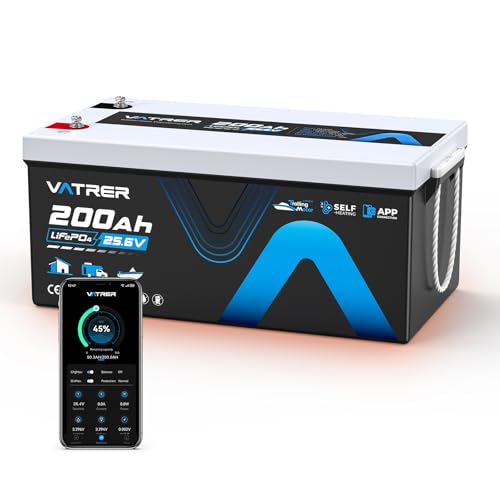
The VATRER POWER 24V 200Ah has a 200A BMS, a self-heating function that starts when a charger is connected below 32°F and stops at 41°F, and app monitoring. Its listing also describes a high-temperature cutoff above 167°F, a rating of 5,000 plus cycles, and automotive-grade cells. At 200Ah and 25.6V that is about 5,120Wh.

It ranks fifth: at $854.99 it is $235.99 above the CYCCLEVOLT, and the heater is the main difference. Per kilowatt-hour it is the most expensive here at about $167.

What works

  • Self-heating starts below 32°F while charging
  • 200A BMS supports about 5,120W continuous
  • High-temperature cutoff above 167°F is stated
  • App monitors the battery from your phone

Watch out for

  • Highest cost per kilowatt-hour here, about $167
  • Heater only works while a charger is connected
06
Best for: Big 24V systems that charge in the cold

Our take

Pick it when one battery needs to cover a full day of 24V inverter use and winter charging.

Why it made the shortlist

The Repower Flow 24V is a 25.6V 320Ah battery with 8,192Wh, a 200A continuous and 300A surge BMS, Bluetooth monitoring and an automatic heater that activates in cold weather. The listing rates 6,000 plus cycles at 80 percent depth of discharge, allows up to four units for as much as 1,280Ah in 24V, 48V or 51.2V, and carries a five-year warranty. It works with 29.2V LiFePO4 chargers.

Against the VATRER it gives 3,072Wh more and the stated surge rating, and its cost per kilowatt-hour of about $146.5 is lower than the VATRER's $167.

What works

  • 8,192Wh in one battery cuts parallel wiring
  • 200A continuous with 300A surge for inverter startup
  • Heater activates automatically in cold weather
  • Five-year warranty and expansion to 1,280Ah

Watch out for

  • Most expensive pick here at $1,199.99 per battery
  • Heater draw is not stated

Methodology

How We Built This Shortlist

Each pick was assessed across 5 criteria weighted for real-world use.

01

True 24V rating

We kept only batteries listed at 25.6V nominal with a 29.2V full-charge profile, and excluded 12V units and chargers that only mention 24V in a title.

02

BMS current against inverter size

We converted BMS amps to watts at 25.6V, so 100A is about 2,560W and 200A is about 5,120W, and compared that with common RV inverter sizes.

03

Cost per nominal kilowatt-hour

We divided price by nominal energy, using 2.56kWh for 100Ah modules and the listed 5,248Wh and 8,192Wh for the larger ones.

04

Cold-weather behavior

We separated stated charge cutoffs, stated heaters and listings that say nothing, since each one needs a different installation location.

05

System fit

We noted each listing's charger voltage, expansion limit and monitoring, because a 24V battery also needs a 24V charger, controller and a way to power 12V loads.

Decision guide

Match a 24V Lithium Battery for RV to Your RV

By Inverter or Load Size

Your situationRecommended pickWhy
Inverter up to about 2,000W, light daily loadsDyness 24V 100Ah100A BMS covers about 2,560W with documented limits
Small 24V bank on the lowest budgetMEYULMOL 24V 100Ah$319.99 with app, same 100A BMS
Inverter 3,000W to 4,000WCYCCLEVOLT 24V200A BMS supports about 5,120W
Heavy loads, winter charging, big inverterRepower Flow 24V200A continuous and 300A surge with a heater
Shunt-monitored bank, warranty mattersDumfume 25.6VFive-year warranty and stated weight

By Budget

BudgetRecommended pick
Under $330MEYULMOL 24V 100Ah ($319.99)
$330 to $400Dumfume 25.6V ($359.96) or Dyness 24V 100Ah ($369.98)
$600 to $650CYCCLEVOLT 24V 205Ah ($619)
$850 to $900VATRER 24V 200Ah self-heating ($854.99)
Around $1,200Repower Flow 24V 320Ah ($1,199.99)

One 24V Battery vs Two 12V in Series

One 24V battery

A single 25.6V battery has one BMS, one set of terminals and no balancing between two separate batteries, and it halves the current for the same power. All six picks here are single 24V batteries, and the Dyness, MEYULMOL and Dumfume start at 2,560Wh.

Two 12V batteries in series

Two matched 12V batteries wired in series also give 24V and let you reuse a 12V battery you already own, but each has its own BMS and they must be identical in age and model. You can also split them back to 12V later, which a sealed 24V battery such as the Dyness 24V 100Ah cannot do.

If the system will stay 24V, a single 24V battery is simpler. If you may return to 12V, two 12V batteries keep that option.

By Cold-Weather Charging

Where the bank sitsRecommended pick
Unheated bay, charging below freezingVATRER 24V 200Ah or Repower Flow 24V (both self-heat)
Documented cutoff, heated spaceDyness 24V 100Ah (stops below 32°F, resumes above 41°F)
Heated cabinet, big capacityCYCCLEVOLT 24V
Interior install, lowest costMEYULMOL 24V 100Ah or Dumfume 25.6V

For a 12V RV Converting Loads Specifically

Look for

A 24V to 12V DC converter sized for your 12V loads, a 24V-capable inverter-charger, and a solar controller with a 24V LiFePO4 profile. A typical RV 12V converter-charger and a 12V alternator will not charge a 24V battery, and a 12V fridge or pump cannot run directly from it.

In this comparison

All six use a 29.2V full-charge profile. The Dyness 24V 100Ah and MEYULMOL 24V 100Ah suit a small 24V inverter bank, and the Repower Flow 24V suits a large one, but none of them removes the need for a 24V-to-12V converter.

When to Spend More

Spend more if

You run a 3,000W or larger inverter or charge in freezing weather: the CYCCLEVOLT 24V has the 200A BMS, the VATRER 24V adds a heater, and the Repower Flow 24V adds both plus 8,192Wh.

Save if

Your loads stay under 2,000W in a heated space: the MEYULMOL 24V 100Ah at $319.99 gives 2,560Wh and an app, and a second one doubles it later.

FAQ

Before You Bring One Home

Can a 24V lithium battery power my 12V RV appliances?

Not directly. You need a 24V-to-12V DC converter sized for the total current of your 12V loads, or a 24V inverter feeding AC loads. The converter wastes some energy as heat, so size the battery with margin.

Will my RV converter charge a 24V lithium battery?

No. A converter that outputs 13.6V or 14.6V charges a 12V battery only. A 24V battery needs a 24V lithium charger around 29.2V, or an inverter-charger or solar controller set for 24V.

Is a 24V battery worth it over 12V for an RV?

Only when the system is large. The same power takes half the current at 24V, so cables can be thinner and losses are lower, which pays off for inverters near 3,000W or a long cable run. In a small trailer, 12V is simpler.

How do I wire two 24V batteries for 48V?

Connect the positive of one to the negative of the other (series), and use the remaining two terminals as the 51.2V output. Use identical batteries, the listing's stated series limit, and a 48V charger.

Does the battery need a heater?

Only if you charge in freezing temperatures. A battery without a heater stops charging below about 32°F and resumes when it warms. The VATRER 24V and Repower Flow 24V heat themselves, while the others rely on a heated space.

How long will a 24V 100Ah battery run an RV?

Divide 2,560 watt-hours by your load. A 100W average load runs about 25 hours before converter and inverter losses, and a 500W microwave-and-lights load about 5 hours. Add a margin for losses.

Bottom line

The short version

Browse more 24v lithium batteries for rv on Amazon →
Bowen Higgins, RV Editor at RV Gear Lab

About the author

Bowen Higgins

RV Editor at RV Gear Lab

Bowen covers RV power, water systems, towing and leveling, upkeep and interior comfort, with a focus on matching gear to the rig, the hookups and the way you actually travel.

More from Bowen →Editorial standards

Keep reading

Related guides