

We research everything we recommend. When you buy through our links, we may earn a commission. Learn more

Buying guide · 11 min read · Updated October 2, 2026

6 Best 200Ah Lithium RV Batteries in 2026: A Practical RV Guide

Six 12V 200Ah LiFePO4 RV batteries compared on 2,560Wh cost per kWh, cold-weather charging limits, BMS current, size and warranty, from $318 to $783.

Bowen HigginsBy Bowen HigginsRV Editor at RV Gear Lab6 products comparedSpec-sheet researched

At a glance

Our top picks

A 12V 200Ah lithium battery holds about 2,560 watt-hours on paper, which is the same energy as two 100Ah batteries wired together in one box. For an RV that means roughly a day or two of lights, a compressor fridge, water pump and phone charging without shore power, and that is why it is the most popular single-battery size for travel trailers. The catch is that identical capacity numbers hide very different cold-weather behavior, current limits and prices.

We compared six 200Ah LiFePO4 batteries priced from $318 to $783 on cost per nominal kilowatt-hour, low-temperature protection, the continuous current the battery management system allows, physical size, and the warranty. The price spread is about 2.5 times for the same nominal capacity, and the picks below explain what the extra money actually buys.

RV Gear Lab field notes

The Rig Fit Check

Start with the job
LiTime 12V 200Ah Mini LiFePO4 Battery with Bluetooth (Group 31+) leads this shortlist for most trailers wanting a documented, compact 200Ah. Use that fit as a reference point, then compare the alternatives against your own space and workload.
Specs that separate the picks
The first details to compare are 2,560Wh nominal, 200A BMS, Self-heating with Bluetooth, 200Ah, low-temp cut-off. Confirm the exact model and included components before ordering.
Trade-off to plan for
No heater, so it will not charge in a freeze

Before you buy

What Matters Before You Choose a 200Ah Lithium RV Battery

Key buying criteria so you get the right fit the first time.

  1. 01

    Usable energy and cost per kWh

    A 12.8V 200Ah battery stores about 2,560 watt-hours nominally, but the energy you actually use depends on depth of discharge and any inverter losses. Dividing the price by 2.56 gives cost per kilowatt-hour, which here ranges from about $124 to $306. Compare that figure across listings, and read whether the stated cycle count assumes 100 percent or 80 percent depth of discharge.

  2. 02

    Low-temperature charging limit

    Charging a lithium iron phosphate battery below freezing can cause permanent plating damage, so a good battery management system stops charging near 32°F. That is protection, not a heater, so it means you will not be able to charge in the cold unless the battery has a heater. Look for the exact temperature in the bullet points, and ask whether charging resumes automatically when the cells warm.

  3. 03

    BMS continuous current

    The battery management system limits how many amps the battery can deliver, and a 200A BMS at 12.8V supports about 2,500 watts at full load. If you run a 2000W inverter, you will draw close to 190A, so a lower rating can cause a shutdown. Find the continuous amps rating, not just a peak figure lasting a few seconds, and treat contradictory listings as a reason to ask.

  4. 04

    Physical size and mounting

    Battery sizes such as Group 31+ define length, width and height, and a 200Ah mini may be much smaller than a traditional 200Ah lead-acid. Fit matters more than capacity in a cramped bay, and an IP65 or IP67 rating tells you how well the case resists dust and water. Measure your compartment and compare it with the listing's dimensions before ordering.

  5. 05

    Series and parallel limits

    Most 200Ah batteries can be connected with others to build a bigger bank, commonly up to four in parallel for 800Ah or in series for 24V or 48V. Exceeding that limit can unbalance the batteries and void the warranty. Check the maximum configuration printed in the listing, and match batteries of the same age and brand when expanding.

  6. 06

    Warranty and support

    A five-year warranty is common here, but terms differ on what counts as misuse, such as charging below freezing or exceeding current limits. Support quality is hard to see from a listing, so a longer written warranty is the best proxy. Read the warranty bullet, and confirm that replacement shipping is covered.

Our standards

Why You Can Trust RV Gear Lab

At RV Gear Lab, we compare products based on rig fit and power or hookup compatibility, verified specifications, usability, setup requirements, weight, durability, and real-world trade-offs. We do not rank products purely on marketing claims or commission rates.

We have not personally tested every product listed. Where hands-on testing is not available, recommendations are based on verified manufacturer specifications, product documentation, use-case fit, and comparative research.

How we review RV gear →

Detailed reviews

The 6 best 200ah lithium rv batteries, explained

01
Best for: Most trailers wanting a documented, compact 200Ah

Our take

Pick this if you want a compact 200Ah that fits a Group 31+ space and a verifiable spec sheet, and your trips seldom involve charging below freezing.

Why it made the shortlist

The LiTime 12V 200Ah Mini is billed as the first 200Ah LiFePO4 battery in the Group 31+ size, and it weighs 44.5 pounds. Its listing publishes more of the numbers that matter than most: 6,000 deep cycles at 100 percent depth of discharge, Bluetooth 5.0 monitoring, a 200A battery management system, and low-temperature protection that stops charging below 32°F and stops discharging below minus 4°F. It also states compliance with the ABYC E-13 standard.

It ranks first over the Renogy 200Ah Pro because it costs $153 less while still documenting the low-temperature thresholds in plain numbers. It gives up the active heater the Renogy Pro has, so charging stops in a freeze rather than warming the cells.

What works

  • Spec sheet states cutoffs: no charging below 32°F
  • 6,000 cycles at 100 percent depth of discharge
  • Bluetooth app shows charge level and current
  • Weighs 44.5 pounds, about 65 percent lighter than lead-acid

Watch out for

  • No heater, so it will not charge in a freeze
  • Costs about twice the cheapest 200Ah options
02
Best for: Winter campers and unheated battery bays

Our take

Choose it for winter camping, snowbird travel or any rig where the battery sits in an unheated bay.

Why it made the shortlist

The Renogy 200Ah Pro adds an active heater to the usual 200Ah package. Its listing describes self-heating with overheat protection, built-in Bluetooth, more than 60 BMS protections, an IP67 dust-tight and waterproof case, a UL94 V-0 fire-retardant casing, an internal structure designed to resist vibration, and an ISO 9227 corrosion-resistance certification. It is listed for 5,000 plus deep cycles.

It is second because it is the most expensive battery here at $782.79, which is $153 more than the LiTime.

What works

  • Heater lets charging continue below freezing temperatures
  • Fire-retardant UL94 V-0 casing for added safety
  • IP67 dust-tight, waterproof case suits outdoor bays
  • More than 60 BMS protections and alerts

Watch out for

  • Most expensive 200Ah here at $782.79
  • Heater draw adds to energy use in cold
The catch
Against the Renogy Core Mini it adds the heater and Bluetooth, but the Core Mini is smaller and $129 cheaper.
03

Best Compact With Shunt Monitoring · 3 of 6

Renogy 12V 200Ah Core Mini LiFePO4 Lithium Battery, Mini Size

Renogy 12V 200Ah Core Mini LiFePO4 Lithium Battery, Mini Size
  • 200Ah, low-temp cut-off
  • IP65, five-year warranty
  • Works with Renogy 300A shunt
Check price on Amazon for Renogy 12V 200Ah Core Mini LiFePO4 Lithium Battery, Mini Size (opens in a new tab)
Best for: Tight bays and owners wanting a longer warranty

Our take

Pick it if you have a tight battery compartment and want a known brand with a longer warranty.

Why it made the shortlist

The listing shows a 200A BMS with low-temperature cut-off, an IP65 waterproof and vibration-resistant case, FCC, UN38.3, ROHS and UKCA certifications, a five-year limited warranty, and compatibility with the Renogy 300A battery shunt for monitoring through the Renogy app.

In exchange it offers a five-year warranty and shunt compatibility, which suits owners who already track charge with a shunt.

What works

  • One third smaller than a lead-acid 200Ah
  • Five-year warranty is among the longest here
  • Pairs with Renogy shunt for accurate charge tracking
  • IP65 case resists water and vibration

Watch out for

  • Listing shows both 100A and 200A BMS figures
  • No heater and no built-in Bluetooth
The catch
The Renogy 12V 200Ah Core Mini is described as one third smaller than a standard 200Ah lead-acid battery.
04
Best for: Budget buyers who want an app and heated storage

Our take

This fits budget builds where an app view matters and the battery lives in a heated space.

Why it made the shortlist

The PUPVWMHB 12V 200Ah Mini costs $329 and includes Bluetooth monitoring, a 200A BMS, a low-temperature cut-off, a claimed up to 15,000 cycles, and a five-year warranty. The listing says up to four can be connected in series and parallel to reach 800Ah at 51.2V, or about 40.96kWh at maximum.

What works

  • Expandable to 800Ah in series and parallel
  • Mini case saves space versus a standard 200Ah

Watch out for

  • Cut-off temperature is not stated
  • Cycle claim is up-to with no stated conditions
05
Best for: Cost-per-kWh shoppers who will add a shunt

Our take

Choose it for the lowest cost per kilowatt-hour and plain, documented protection in a heated space.

Why it made the shortlist

The dumfume 12V 200Ah is the cheapest battery here at $317.98, which works out to about $124 per nominal kilowatt-hour. The listing gives 2,560Wh, a 200A BMS that cuts off above 200A, low-temperature protection with charging stopping below 32°F (0°C) and discharge allowed down to minus 4°F (minus 20°C), an IP65 rating, UL and UN38.3 certification, a claimed 15,000 cycles, and a five-year warranty.

What works

  • Exact cold thresholds are published in the listing
  • IP65 case with UL and UN38.3 certification

Watch out for

  • No app or Bluetooth monitoring included
  • Lesser-known brand with less service history
The catch
Against the PUPVWMHB it lacks Bluetooth but states exact thresholds.
06

Best Documented Certifications · 6 of 6

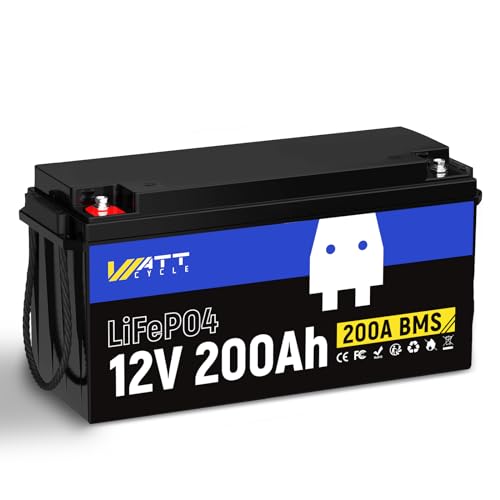
Wattcycle 12.8V 200Ah LiFePO4 Battery, 200A BMS

Wattcycle 12.8V 200Ah LiFePO4 Battery, 200A BMS
  • 200Ah, 15,000 cycles claimed
  • SDS, UN38.3, FCC, CE, ROHS
  • Expands to 40.96kWh
Check price on Amazon for Wattcycle 12.8V 200Ah LiFePO4 Battery, 200A BMS (opens in a new tab)
Best for: Heated-space installs needing certification papers

Our take

Choose Wattcycle 12.8V 200Ah LiFePO4 Battery, 200A BMS for a+ grade cells with up-to 15,000 cycles claimed.

Why it made the shortlist

The Wattcycle 12.8V 200Ah lists a claimed 15,000 cycles, A+ grade cells, a built-in 200A BMS, SDS, UN38.3, FCC, CE and ROHS certifications, and expansion of up to four batteries in series or parallel for 40.96kWh. It measures about 9.4 inches tall by 19 inches wide according to the listing.

It does carry a longer certification list than the others and sells for $200 less than the LiTime.

What works

  • A+ grade cells with up-to 15,000 cycles claimed
  • Series or parallel expansion up to four units

Watch out for

  • BMS current wording says 100A, which is unclear

Methodology

How We Built This Shortlist

Each pick was assessed across 5 criteria weighted for real-world use.

01

Cost per usable energy

We divided each price by the nominal 2,560Wh to compare cost per kilowatt-hour, then read how much of that capacity the listing actually claims to deliver.

02

Cold-weather charging behavior

We looked for the temperatures where charging stops, whether a heater exists, and whether those numbers are published or only implied.

03

BMS current and protections

We checked the continuous and surge current the battery management system allows, and flagged listings that contradict themselves on the number.

04

Size, mounting and enclosure

We compared case size class, weight and the IP rating, since a 200Ah battery that does not fit your bay or take vibration is no bargain.

05

Warranty and monitoring

We weighed warranty length against price and noted whether Bluetooth or a shunt is available for watching state of charge.

Decision guide

Match a 200Ah Lithium RV Battery to Your RV

By Where the Battery Lives

Your situationRecommended pickWhy
Unheated bay, winter camping or snowbird tripsRenogy 200Ah ProSelf-heating keeps charging possible below freezing
Heated cabin or interior cabinetdumfume 200AhLowest price, published cold thresholds
Under-bed or tight compartmentRenogy Core MiniOne third smaller than lead-acid 200Ah
Group 31+ box or standard battery trayLiTime 200Ah MiniGroup 31+ size, 44.5 lb
Garage-stored trailer, mild climateWattcycle 200AhCertified and cheaper than LiTime

By Budget

BudgetRecommended pick
Under $330dumfume 200Ah or PUPVWMHB 200Ah
$430Wattcycle 200Ah
$630 to $660LiTime 200Ah Mini or Renogy Core Mini
Around $780Renogy 200Ah Pro

Self-Heating vs Low-Temp Cut-Off

Self-heating

A built-in heater warms the cells so charging can continue when it is freezing outside, which suits winter use. In this comparison only the Renogy 200Ah Pro has one.

Low-temp cut-off only

The battery simply stops charging below about 32°F and resumes when it warms up, which protects the cells but leaves you without charging. The LiTime, dumfume, Renogy Core Mini and PUPVWMHB work this way.

Most trailers parked in mild winters do fine with a cut-off; choose self-heating only if you regularly charge below freezing.

By Monitoring Preference

How you want to watch chargeRecommended pick
Phone app built into the batteryLiTime 200Ah Mini or PUPVWMHB 200Ah
Accurate shunt-based readoutRenogy Core Mini with the Renogy 300A shunt
App plus heater in one batteryRenogy 200Ah Pro
No app, plan to add your own shunt laterdumfume 200Ah

For Replacing Two 100Ah Batteries Specifically

Look for

A 200A BMS that can support your inverter's full load, plus dimensions that fit in the space two 100Ah batteries occupied. 200Ah at 12.8V is about 2,560Wh, and an example 60W average load would run roughly 42 hours before inverter losses.

In this comparison

The Renogy Core Mini and LiTime 200Ah Mini are the compact choices for a tight bay, while the dumfume 200Ah is the budget way to replace a pair.

When to Spend More

Spend more if

You charge in freezing weather or want strong documentation; the Renogy 200Ah Pro heats the cells itself, and the LiTime 200Ah Mini states cutoffs and the ABYC E-13 standard.

Save if

The battery stays in a heated space; the dumfume 200Ah costs about half the LiTime and still publishes its cold-weather limits.

FAQ

Before You Bring One Home

Is one 200Ah battery better than two 100Ah batteries?

A single 200Ah battery has fewer connections and one battery management system to fail, and it fits a single space. Two 100Ah batteries let you split the load or replace one at a time. If your inverter draws near 190A, one 200A BMS handles it, while two 100A batteries share the load.

Will a 200Ah lithium battery charge from my RV's converter?

Often yes, but many older converters use a lead-acid profile that undercharges lithium. Look for a converter with a lithium mode or Auto-Detect, and charge at 14.2 to 14.6 volts if the battery maker specifies it. Our converter guides cover lithium-ready options.

Is the Renogy 200Ah Pro worth the extra money?

Only if you charge below freezing. The heater is the real difference, and in a heated space the LiTime Mini or dumfume costs far less for similar capacity. For winter camping or an unheated bay, the Pro solves a problem the cheaper ones cannot.

How do I install a 200Ah lithium battery safely?

Switch off all loads, remove the old battery negative first, mount the new battery securely, connect positive then negative with properly sized cable, and add a fuse near the positive terminal. Torque terminals to the maker's figure and verify the voltage with a meter.

How long will 200Ah power my RV?

Divide 2,560 watt-hours by your average load in watts. A 60W average load, for example, gives roughly 42 hours before inverter losses, and a 200W load about 12 hours. Add up your own devices to get a realistic figure.

Can I store a lithium battery over winter?

Yes. Store it at roughly 50 to 80 percent charge, disconnected from loads, in a cool dry place above the low-temperature limit if possible. Check it every couple of months, and recharge before it falls too low.

Bottom line

The short version

Browse more 200ah lithium rv batteries on Amazon →
Bowen Higgins, RV Editor at RV Gear Lab

About the author

Bowen Higgins

RV Editor at RV Gear Lab

Bowen covers RV power, water systems, towing and leveling, upkeep and interior comfort, with a focus on matching gear to the rig, the hookups and the way you actually travel.

More from Bowen →Editorial standards

Keep reading

Related guides