

We research everything we recommend. When you buy through our links, we may earn a commission. Learn more

Buying guide · 12 min read · Updated October 2, 2026

6 Best 3000 Watt Portable Power Stations in 2026: A Practical RV Guide

Six portable power stations with a rated 3000W AC output compared on TT-30 RV outlets, real Wh, recharge speed, expansion and warranty, $899 to $2,599.

Bowen HigginsBy Bowen HigginsRV Editor at RV Gear Lab6 products comparedSpec-sheet researched

At a glance

Our top picks

A 3000 watt portable power station is the first class that can plausibly stand in for a generator at a campsite: it can run an RV roof air conditioner on a hot afternoon, a microwave and a coffee maker together, or a fridge, TV and laptop all at once. Three of the six here also have a built-in 30-amp TT-30 outlet, the plug an RV shore cord uses, which is the detail most competitor roundups skip. Be careful with the label: several 3000W stations on Amazon are really 2000W continuous with a 3000W peak, and we left those out.

We compared six stations from $899 to $2,599 that list 3000W as the rated AC output, and checked stored watt-hours, TT-30 availability, AC input speed, expansion, cycle rating and warranty, noting plainly where a listing leaves a number out. The batteries run from 2,042Wh to 3,072Wh, so even at 3000W the runtime is short: about 40 minutes at full load, and hours at a normal camper load. If you only need 2000W, the 2000 watt guide is cheaper.

RV Gear Lab field notes

The Rig Fit Check

Start with the job
DABBSSON Portable Power Station 3000L, 3072Wh, 3000W AC Output leads this shortlist for an RV that needs the most Wh per dollar. Use that fit as a reference point, then compare the alternatives against your own space and workload.
Specs that separate the picks
The first details to compare are 3,072Wh, 3000W, TT-30, 2,048Wh LiFePO4, 3000W. Confirm the exact model and included components before ordering.
Trade-off to plan for
Listing gives no weight or AC input speed

Before you buy

What Matters Before You Choose a 3000 Watt Portable Power Station

Key buying criteria so you get the right fit the first time.

  1. 01

    Rated versus peak 3000W

    Some stations are sold as 3000W but are 2000W continuous with a 3000W peak, and we excluded those. A true 3000W rating lets an air conditioner and another appliance run together. Look for the word rated or continuous beside 3000W.

  2. 02

    TT-30 outlet

    A 30-amp TT-30 plug matches an RV shore cord, so the station can feed the camper's panel directly. Without it you plug appliances into household outlets one at a time. Look for TT-30 or NEMA TT-30 in the port list.

  3. 03

    Stored watt-hours

    At 3000W the battery runs down in under an hour, so 3,072Wh is meaningfully better than 2,042Wh. Compare Wh and divide price by it. Treat runtime as an estimate.

  4. 04

    Recharge speed and sources

    AC input claims run from 43 to 55 minutes to 80 percent, but they need a strong circuit. Solar and alternator charging fill the gaps. Check the input wattage and the solar voltage window.

  5. 05

    Expansion and ecosystem

    Expansion battery packs are sold separately and only work with the matching main unit. Parallel systems can double the output to 6000W. Confirm pack prices before counting on expansion.

  6. 06

    Warranty and documentation

    Stated warranties here run from 5 years to 7 years of support, and some listings give none. A heavy 3000W station needs a clear warranty. Look for the term and the weight.

Our standards

Why You Can Trust RV Gear Lab

At RV Gear Lab, we compare products based on rig fit and power or hookup compatibility, verified specifications, usability, setup requirements, weight, durability, and real-world trade-offs. We do not rank products purely on marketing claims or commission rates.

We have not personally tested every product listed. Where hands-on testing is not available, recommendations are based on verified manufacturer specifications, product documentation, use-case fit, and comparative research.

How we review RV gear →

Detailed reviews

The 6 best 3000 watt portable power stations, explained

01
Best for: An RV that needs the most Wh per dollar

Our take

Pick it as the default 3000W for an RV: biggest battery per dollar, a TT-30 outlet and a clear warranty.

Why it made the shortlist

The Dabbsson 3000L stores 3,072Wh and lists a rated 3000W AC output with a 3,600W Power Boost mode for compatible appliances. Its built-in TT-30 outlet is aimed at RV setups, and it recharges from the wall, compatible solar panels or a supported vehicle source, with an app for level, input and output power.

At $1,029 it costs about $0.33 per watt-hour, the lowest in this guide, and holds 1,024Wh more than the AFERIY P300 and the DELTA 3 Max Plus for $130 less than the DELTA 3 Max Plus at $1,149. It is $180 cheaper than the Dabbsson with Charger S, which adds an alternator charger. The listing says nothing about AC input speed, which AFERIY and EcoFlow publish.

What works

  • Built-in TT-30 outlet for RV connections
  • 3,072Wh, the largest battery besides Gendome
  • Five-year warranty stated in the listing

Watch out for

  • Listing gives no weight or AC input speed
  • Power Boost covers only compatible appliances
02
AFERIY 2048Wh Portable Power Station 3000W Solar Generator
  • 2,048Wh LiFePO4, 3000W
  • TT-30 socket, 15 ports
  • 1,800W AC input, expands to 10kWh
Check price on Amazon for AFERIY 2048Wh Portable Power Station 3000W Solar Generator (opens in a new tab)
Best for: The lowest-cost 3000W with TT-30

Our take

Choose it if you want TT-30 and 3000W at the lowest price and can live with 2,048Wh.

Why it made the shortlist

The AFERIY P300 stores 2,048Wh of LiFePO4 rated for 4,000 plus cycles and delivers a 3000W output through dual pure sine wave inverters, with 15 output ports including a NEMA TT-30 socket and a 140W USB-C. It takes 1,800W of AC input to reach 80 percent in 55 minutes, accepts dual solar inputs, expands to 10kWh, switches over in under 10ms as a UPS, and carries a 7-year support period.

Per watt-hour it is about $0.44. Against the DELTA 3 Max Plus it is $250 cheaper for the same 2,048Wh and also has a TT-30 socket. The listing gives no weight.

What works

  • TT-30 socket plus 15 output ports
  • 0 to 80 percent in 55 minutes at 1,800W
  • Expands up to 10kWh with battery packs

Watch out for

  • 2,048Wh is 1,024Wh less than the Dabbsson
  • Listing gives no weight, so carry effort is unknown
03
Best for: EcoFlow owners who want fast charging

Our take

Buy it if you already use EcoFlow gear or want 43-minute charging with smart load control.

Why it made the shortlist

The EcoFlow DELTA 3 Max Plus stores 2,048Wh of LiFePO4 and outputs 3000W, with an X-Boost mode up to 3,800W for resistive loads, a switchover under 10ms, an app, and five recharge methods that reach 80 percent in 43 minutes. It expands from 2kWh to 10kWh with extra batteries and carries a 5-year service period.

At $1,149 it costs $250 more than the AFERIY P300 for the same 2,048Wh and $120 more than the Dabbsson 3000L, which holds 1,024Wh more.

What works

  • Charges to 80 percent in about 43 minutes
  • Switches to battery in under 10ms
  • Expands from 2kWh up to 10kWh
  • Five-year service period in the listing

Watch out for

  • Costs $250 more than AFERIY for the same Wh
  • No TT-30 outlet or weight in the listing
04
Best for: Travelers who drive between campsites daily

Our take

Pick it if you drive daily between sites and want to refill the station on the road.

Why it made the shortlist

This bundle pairs the 3,072Wh Dabbsson 3000L with the Charger S, a 560W alternator charger that the listing says charges up to 6 times faster than a 12V cigarette lighter charger while you drive. It keeps the 3000W rated output, the 3,600W P-Boost, the TT-30 for RV charging, 6 AC outlets, a 100W USB-C, under 15ms EPS switchover and 4,000 plus cycles, with the same 5-year warranty.

At $1,208 the Charger S costs $179 over the standalone 3000L at $1,029, which makes the bundle about $0.39 per Wh. The Charger S ships separately per the listing.

What works

  • Charger S alternator charger refills while you drive
  • Six AC outlets plus a TT-30 socket
  • Same 5-year warranty as the standalone model

Watch out for

  • Costs $179 more than the standalone 3000L
  • Alternator charger needs vehicle wiring not covered here
05
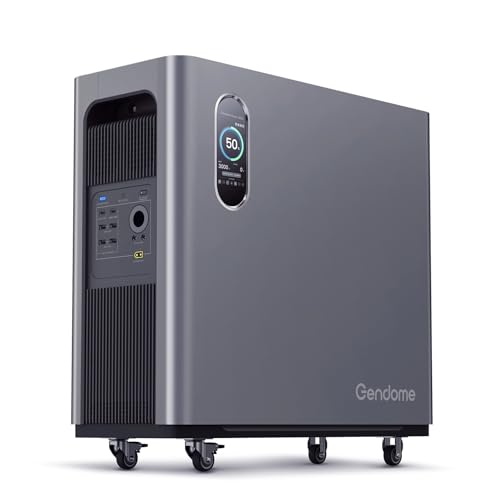
Gendome Portable Power Station Home3000, 3072Wh LiFePO4, 3000W AC
  • 3,072Wh LiFePO4, 3000W
  • 17 ports, two 140W USB-C
  • 1800W wall charge in 50 minutes
Check price on Amazon for Gendome Portable Power Station Home3000, 3072Wh LiFePO4, 3000W AC (opens in a new tab)
Best for: Home backup with many ports

Our take

Gendome Portable Power Station Home3000, 3072Wh LiFePO4, 3000W AC makes the shortlist because 17 output ports with two 140W USB-C.

Why it made the shortlist

The Gendome Home3000 stores 3,072Wh of EV-grade LiFePO4 rated for more than 6,500 cycles to 60 percent capacity, and delivers 3000W AC through 17 output ports including two PD 3.1 140W USB-C and two wireless pads. A wall outlet at 1800W reaches 80 percent in 50 minutes, and it accepts solar and wind input, with an app that logs history.

At $2,448.59 it costs $1,419.59 more than the Dabbsson 3000L for the same 3,072Wh, about $0.80 per Wh, so the extra buys a longer stated cycle rating, more ports and wind input. Against the Jackery Explorer 2000 Plus kit at $2,599 it is $150.41 cheaper with 1,030Wh more.

What works

  • 17 output ports with two 140W USB-C
  • Rated for 6,500 plus cycles to 60 percent
  • Reaches 80 percent in 50 minutes from 1800W
  • Takes both solar and wind input

Watch out for

  • Costs $1,419.59 more than the Dabbsson 3000L
  • No TT-30, weight or warranty in the listing
06
Best for: Scaling later to a 6000W system

Our take

Buy it if you intend to scale to two stations for 6000W and trust the Jackery brand.

Why it made the shortlist

The Jackery Explorer 2000 Plus Kit bundles a 2,042Wh LiFePO4 station rated 3000W with two 100W mini solar panels. It expands to 12kWh with up to five battery packs, or to 24kWh and 6000W by connecting two stations in parallel, charges at about 30 dB, and carries a 5-year warranty and a 10-year battery life claim. The listing says a full charge takes about 2 hours from a wall outlet or six 200W panels, and gives no TT-30 outlet or weight.

At $2,599 it is the most expensive pick, about $1.27 per Wh with panels, $1,570 above the Dabbsson 3000L and $150.41 above the Gendome Home3000. The two 100W panels add little energy to a 2,042Wh battery, so the money mostly buys the Jackery's expansion and parallel system.

What works

  • Two stations in parallel reach 6000W
  • Charges quietly at about 30 dB
  • Includes two 100W solar panels in the box
  • Five-year warranty and 10-year life claim

Watch out for

  • Costs $1,570 more than the Dabbsson 3000L
  • No TT-30 outlet or weight in the listing
The catch
The caveat is the price and the lack of a TT-30.

Methodology

How We Built This Shortlist

Each pick was assessed across 5 criteria weighted for real-world use.

01

Rated AC output

We kept only listings whose rated AC output is 3000W and excluded stations that are 2000W continuous with a 3000W peak, along with boost modes that are not continuous.

02

TT-30 and RV hookup

We checked which listings name a built-in TT-30 outlet, since that is the plug an RV shore cord uses and it changes whether the station can feed the camper.

03

Stored energy and cost

We compared 2,042Wh to 3,072Wh and divided price by Wh, from about $0.33 up to about $1.27 when panels are bundled.

04

Recharge and expansion

We compared AC input claims such as 43, 50 and 55 minutes to 80 percent and which units expand to 10kWh or more.

05

Warranty and cycle rating

We noted the stated warranty and cycle rating, and flagged listings that publish neither a weight nor a warranty.

Decision guide

Match a 3000 Watt Portable Power Station to Your RV

By Your RV Setup

At 3000W the plug and the battery matter as much as the inverter.

Your situationRecommended pickWhy
TT-30 plug and the biggest battery per dollarDabbsson 3000L3,072Wh with TT-30 at $1,029
TT-30 on the lowest budgetAFERIY P300$899 with a NEMA TT-30 socket
Refill the station while drivingDabbsson Charger S560W alternator charger included
Fast charging and an expansion ecosystemDELTA 3 Max Plus80 percent in about 43 minutes
Home backup with many portsGendome Home300017 ports, 6,500 cycle claim
Plan to scale to 6000W laterJackery 2000 Plus KitTwo units in parallel reach 6000W

Estimate: a 3,000W load drains 3,072Wh in roughly 55 minutes after losses.

By Budget

BudgetRecommended pick
Under $950AFERIY P300 at $899
$1,000 to $1,250Dabbsson 3000L at $1,029, DELTA 3 Max Plus at $1,149 or Dabbsson Charger S at $1,208
Above $2,400Gendome Home3000 at $2,448.59 or Jackery 2000 Plus Kit at $2,599

TT-30 Outlet vs Standard AC Outlets

TT-30 outlet

A 30-amp RV plug that lets the station feed the camper's shore connection. The Dabbsson 3000L, Dabbsson Charger S and AFERIY P300 list one.

Standard outlets only

The DELTA 3 Max Plus, Gendome Home3000 and Jackery 2000 Plus Kit do not mention a TT-30 in the listings, so appliances plug into household outlets individually.

Most RV owners should default to a TT-30 unit unless the station is mainly for home backup.

By Recharge and Expansion

PriorityRecommended pick
Fastest claimed AC chargeDELTA 3 Max Plus (80 percent in about 43 minutes)
Strong AC input at a lower priceAFERIY P300 (80 percent in 55 minutes)
Expand to 10kWhAFERIY P300 or DELTA 3 Max Plus
Parallel to 6000WJackery 2000 Plus Kit

For Running an RV Air Conditioner Specifically

Look for

A rated 3000W output to cover startup surge, and a TT-30 for the connection. A typical roof air conditioner draws on the order of 1,500W to 2,000W running, which would drain 3,072Wh in roughly 1.5 to 2 hours as an estimate.

In this comparison

The Dabbsson 3000L has the most Wh with TT-30, and the Charger S version can refill on the road. Plan on a generator or shore power for all-night cooling.

When to Spend More

Spend more if

You want battery size or driving refills: the Dabbsson 3000L adds 1,024Wh over the AFERIY for $130, and the Charger S adds alternator charging for $179.

Save if

You need TT-30 at the lowest cost: the AFERIY P300 at $899 delivers 3000W and a TT-30 for less than every other unit here.

FAQ

Before You Bring One Home

What can a 3000 watt portable power station run in an RV?

A roof air conditioner, microwave, coffee maker, fridge and TV can run together if the combined load stays under 3000W. A TT-30 unit can feed the camper's circuit. Watch the battery, because 3000W drains it in under an hour.

What is a TT-30 and why does it matter?

TT-30 is the 30-amp, 120V plug used on many RV shore cords. A station with one can connect to the camper's panel. The Dabbsson 3000L and AFERIY P300 list one.

Is the Dabbsson 3000L worth $130 more than the AFERIY?

If you want 1,024Wh more battery, yes. If you only run short bursts, the AFERIY at $899 gives 3000W and a TT-30 for less. The Dabbsson gives a 5-year warranty.

Can I recharge it while driving?

The Dabbsson bundle with the 560W Charger S is built for it, while others rely on the 12V socket or solar. Alternator charging needs correct wiring.

How long does 3,072Wh last at 1,500W?

Roughly 1.7 hours after losses, as an estimate. A 100W camper load lasts about a day and a half.

How do I store it?

Keep it indoors at a partial charge and top it up every few months. Avoid heat.

Bottom line

The short version

Browse more 3000 watt portable power stations on Amazon →
Bowen Higgins, RV Editor at RV Gear Lab

About the author

Bowen Higgins

RV Editor at RV Gear Lab

Bowen covers RV power, water systems, towing and leveling, upkeep and interior comfort, with a focus on matching gear to the rig, the hookups and the way you actually travel.

More from Bowen →Editorial standards

Keep reading

Related guides