

We research everything we recommend. When you buy through our links, we may earn a commission. Learn more

Buying guide · 12 min read · Updated October 2, 2026

6 Best 3000 Watt RV Inverters in 2026: A Practical RV Guide

Six 3000W 12V RV inverters compared on 250A-plus battery draw, listed certifications, charger options and transfer switches, from $179.99 to $798.

Bowen HigginsBy Bowen HigginsRV Editor at RV Gear Lab6 products comparedSpec-sheet researched

At a glance

Our top picks

A 3000W inverter on a 12V system is a heavy-duty machine: at full load it draws about 250A, roughly 280A after conversion losses. That much current needs welding-grade cable, a large DC fuse, and a battery bank whose management system can deliver it, which rules out most single batteries. The AC side is also demanding, since 3000W at 120V is 25A, more than a standard 15A or 20A household circuit.

We compared six 3000W pure sine units priced from $179.99 to $798. Four are plain inverters and two add a charger and transfer switch. The decision is less about the wattage, which is the same in all six, and more about certification, what the listing says about surge, whether you need a charger, and whether your 12V battery system can support this size at all.

RV Gear Lab field notes

The Rig Fit Check

Start with the job
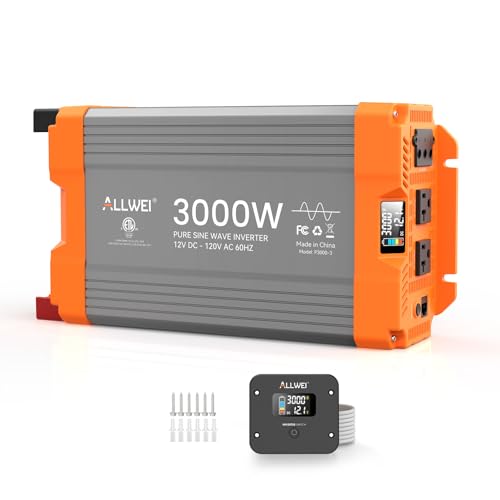
ALLWEI 3000 Watt Pure Sine Wave Inverter, 12V DC to 120V AC Converter leads this shortlist for large lithium banks on a sensible budget. Use that fit as a reference point, then compare the alternatives against your own space and workload.
Specs that separate the picks
The first details to compare are 3000W, 6000W surge, 3000W, 6000W peak. Confirm the exact model and included components before ordering.
Trade-off to plan for
Surge duration for 6000W is not stated

Before you buy

What Matters Before You Choose a 3000 Watt RV Inverter

Key buying criteria so you get the right fit the first time.

  1. 01

    Battery bank current capability

    At 3000W a 12V inverter draws about 250A, and roughly 280A with conversion losses. A single lithium battery with a 100A or 200A BMS will shut down, so you need parallel batteries or a 300A-class BMS. Compare the inverter's full-load amps with the combined continuous rating of your bank.

  2. 02

    Cable, fuse and busbar

    Carrying 280A needs very thick cable, such as the 1AWG-class pairs that ship with some 3000W models, a large DC fuse and a bus bar rated for it. Undersized cable heats up, drops voltage and trips the low-voltage cutoff. Keep the cable run to a couple of feet and follow the manual.

  3. 03

    Surge duration

    A 6000W rating suits a window air conditioner or compressor start, but only for a moment. No listing in this guide gives the duration, so a motor that struggles might fault the inverter. Ask the seller for the surge time before depending on it.

  4. 04

    Certification

    UL 458 is the standard for power converters in vehicles, and CSA C22.2 No. 107.1 is its Canadian counterpart. A named standard gives insurers and installers something to check. Look for the standard in the listing text, and treat claims without names as unverified.

  5. 05

    Charger and transfer switch

    An inverter charger replaces both a converter and a transfer switch, but charge amps and chemistry matter. The ACOPOWER listing says 120A in the title and 50A in a bullet, which shows why you should confirm. Look for the stated amps and a lithium profile.

  6. 06

    AC circuit capacity

    3000W at 120V is 25A, more than a 15A or 20A household circuit. The unit's outlets are typically 20A each, so the total depends on the terminals and wiring. Plan separate circuits or a terminal block, and have a qualified installer wire it.

Our standards

Why You Can Trust RV Gear Lab

At RV Gear Lab, we compare products based on rig fit and power or hookup compatibility, verified specifications, usability, setup requirements, weight, durability, and real-world trade-offs. We do not rank products purely on marketing claims or commission rates.

We have not personally tested every product listed. Where hands-on testing is not available, recommendations are based on verified manufacturer specifications, product documentation, use-case fit, and comparative research.

How we review RV gear →

Detailed reviews

The 6 best 3000 watt rv inverters, explained

01
Best for: Large lithium banks on a sensible budget

Our take

Pick it if you want a clean 3000W inverter at the lowest price that still has real protections.

Why it made the shortlist

The ALLWEI 3000W provides 3000W continuous pure sine power with 6000W surge on startup, aimed at heavy loads such as a window air conditioner. The listing describes ultra-low no-load loss, eight-fold protection covering low and high voltage, over and under temperature and overload, an LCD for input and output voltage, battery level and output power, and auto fans in an aluminum alloy housing. It notes that power readings can deviate slightly.

It ranks first because at $199.99 it is $20 more than the DEECHI 3000W and $122.99 less than the Renogy P2. It is also $90 less than the ZETAWALE 3000W.

What works

  • Eight protections including over and under temperature
  • LCD shows input, output and battery level
  • Fans change speed with load and temperature

Watch out for

  • Surge duration for 6000W is not stated
  • Certification wording is not shown for this model
The catch
In exchange for the lower price it lacks the Renogy's explicit UL 458 and CSA certification text, though the ALLWEI 1000W sibling states an ETL listing.
02
Best for: Installs where a named certification matters

Our take

Choose it if a named standard matters to you or to an installer.

Why it made the shortlist

The Renogy P2 3000W is a pure sine inverter with 6000W peak surge, a stated conversion efficiency above 90 percent, three AC outlets and an AC terminal block, a built-in 5V/2.1A USB port and a 16.4ft wired remote. It is listed as UL 458 and CSA C22.2 No. 107.1 certified, has a metal housing and high-speed ventilation fans, and shows LED indicators for under and over voltage, over-temperature, overload and short circuit.

Against the DEECHI it costs $142.99 more. You are paying for the standard names in the listing and for a brand that publishes manuals, not for extra features. The terminal block is useful for hardwiring.

What works

  • UL 458 and CSA C22.2 No. 107.1 are named
  • Over 90 percent efficiency is stated
  • AC terminal block allows hardwired installs
  • A 16.4ft wired remote is included in the box

Watch out for

  • Costs $122.99 more than the ALLWEI 3000W
  • USB port is slow at 5V/2.1A
03
Best for: Buyers comparing capacity, compatibility, included components and storage needs

Our take

Pick it if you want the lowest price and a hardwire option.

Why it made the shortlist

The DEECHI 3000W is a pure sine inverter with 3000W continuous and 6000W peak in a sturdy aircraft aluminum shell. It has four standard North American AC outlets, two USB ports, an 18W Type-C port and a hardwire kit, dual intelligent temperature-controlled fans, and a 16.5ft wired remote with a color display. It works with 12V or 12.8V batteries and is described as designed for 24/7 uninterrupted use.

It ranks third because it is the cheapest pick here at $179.99, which is $20 less than the ALLWEI 3000W, and it has more outlets and a hardwire kit.

What works

  • Cheapest 3000W pure sine at $179.99
  • Four AC outlets plus a hardwire kit
  • Color display on a 16.5ft remote
  • Dual temperature-controlled fans help reduce heat buildup

Watch out for

  • Certification is not named in the listing
  • Surge duration and no-load draw are not given
04
Best for: Hardwired setups with a remote readout

Our take

Choose it if you like its remote layout and already own the sibling ZETAWALE 1500W.

Why it made the shortlist

The ZETAWALE 3000W is a pure sine inverter with 3000W continuous and 6000W peak output and four AC outlets, USB and Type-C ports, and heavy-duty AC terminal blocks. A 14.76ft wired remote displays battery voltage, AC output voltage and load wattage, and the listing names overload, over-voltage, low voltage, over-temperature and short circuit protection. It is intended for power outages, RV travel and off-grid solar.

Its edge is the terminal blocks together with four outlets, yet the DEECHI offers a hardwire kit for less.

What works

  • Heavy-duty AC terminal blocks for hardwiring
  • Four outlets plus USB and Type-C
  • Remote shows voltage and load wattage
  • Five protections are named in the listing

Watch out for

  • Costs $90 more than the ALLWEI 3000W
  • No certification or efficiency figure in the listing
The catch
The caveat is the price premium for no stated advantage.
05
Best for: Lead-acid banks wanting an all-in-one

Our take

Pick it if you need one box to invert, charge and switch on a lead-acid or AGM bank.

Why it made the shortlist

The Femotic 3000W is a pure sine inverter charger with an automatic transfer switch, 3000W continuous and a 6000W capacity for surge. The listing says it can drive appliances such as air conditioners, works with gel, AGM, SLA and other battery types, has a full set of protections, and an LCD with real-time input and output voltage, battery status and charging information.

It ranks fifth because it brings charging at $399.99, which is $398.01 less than the ACOPOWER 3000W and $77.01 more than the Renogy P2. Versus the ZETAWALE it costs $110 more, and that buys the charger and transfer switch.

What works

  • Charger and automatic transfer switch built in
  • Pure sine with 6000W surge capacity
  • LCD shows charging information and battery status
  • Costs $398.01 less than the ACOPOWER

Watch out for

  • Charge amps and lithium support are not stated
  • Costs $110 more than the ZETAWALE for added features
The catch
The excerpt does not list lithium compatibility or charge amps.
06
Best for: Permanent lithium installs with shore power

Our take

Choose it for a permanent lithium system with shore power.

Why it made the shortlist

The ACOPOWER 3000W is a three-in-one pure sine inverter, adjustable battery charger and automatic transfer switch. The listing names lithium, gel, AGM and flooded charging plus programmable settings, and says it transfers between AC input and inverter power automatically for RVs, cabins and boats.

It ranks last because it costs $798, $398.01 above the Femotic and $598.01 above the ALLWEI 3000W. What you pay for is lithium charging, programmable profiles and a bidirectional design. The conflicting 120A and 50A figures are a flag.

What works

  • Lithium and flooded charging with programmable settings
  • Charger and transfer switch in one compact unit
  • Pure sine output for sensitive electronics
  • Suited to RVs, cabins, boats and backup

Watch out for

  • Charger amps conflict: 120A in title, 50A in bullet
  • Costs $598.01 more than the ALLWEI 3000W

Methodology

How We Built This Shortlist

Each pick was assessed across 5 criteria weighted for real-world use.

01

Battery current and bank match

We estimated about 250A at full load, nearer 280A with losses, and flagged units that need a bank with a 300A-class BMS.

02

Surge claims

We separated the 6000W peak from continuous output and noted that no listing states how long the surge lasts.

03

Certification and documentation

We looked for named standards such as UL 458 and CSA, and for efficiency, no-load and warranty numbers.

04

Charger and transfer features

We compared charge chemistry, stated amps and automatic transfer for the two inverter chargers.

05

Installation hardware

We compared terminal blocks, hardwire kits, outlet count and remotes, which decide how the unit is mounted and wired.

Decision guide

Match a 3000 Watt RV Inverter to Your RV

By Installation Need

Your situationRecommended pickWhy
Lowest cost pure sine, plug-inALLWEI 3000W$199.99 with eight protections
Named certification mattersRenogy P2UL 458 and CSA C22.2 No. 107.1
Cheapest with a hardwire kitDEECHI 3000W$179.99 plus kit and four outlets
Hardwired with terminal blocksZETAWALE 3000WTerminal blocks and 14.76ft remote
Charger and transfer switch on lead-acidFemotic 3000WAuto transfer switch built in
Lithium charger and programmable profilesACOPOWER 3000WLithium and flooded charging

By Budget

BudgetRecommended pick
Under $200DEECHI 3000W or ALLWEI 3000W
$290 to $325ZETAWALE 3000W or Renogy P2
Around $400Femotic 3000W
Around $800ACOPOWER 3000W

Inverter Only vs Inverter Charger

Inverter only

The ALLWEI, Renogy P2, DEECHI and ZETAWALE only invert, so you keep your converter or charger for the battery. It is cheaper and simpler to replace.

Inverter charger

The Femotic 3000W and ACOPOWER 3000W add charging and transfer, which saves wiring but costs $200 to $600 more.

Most RVs with a working converter charger should default to an inverter-only unit.

By Battery Bank

Your bankRecommended pickWhy
Two 200Ah lithium, 200A BMS eachALLWEI 3000WParallel banks can share about 280A
Single large 400Ah batteryRenogy P2Documented efficiency over 90 percent
Lead-acid bank with shore powerFemotic 3000WGel, AGM and SLA support
Lithium bank with shore powerACOPOWER 3000WLithium charging profile

For Running a Window Air Conditioner Specifically

Look for

A 6000W surge rating, pure sine output and a battery bank able to supply about 280A. A window air conditioner's startup draw can last several seconds, so ask the seller about surge duration.

In this comparison

The ALLWEI 3000W listing mentions heavy loads like window air conditioners, and the Femotic 3000W lists air conditioners as a use. None gives a surge duration, so verify before relying on it.

When to Spend More

Spend more if

You want a named standard or a built-in charger; the Renogy P2 costs $122.99 more than the ALLWEI for UL 458, and the Femotic 3000W adds a charger and transfer switch.

Save if

Your bank and wiring are sound; the DEECHI 3000W at $179.99 is the cheapest way to get 3000W pure sine.

FAQ

Before You Bring One Home

Can a 3000W inverter run an RV air conditioner?

Often a 13,500 BTU unit on a soft start, but not always. Check the running and starting watts on the label and whether the surge exceeds 6000W. Many owners need a soft-start device.

How big a battery bank does a 3000W inverter need?

Plan for about 280A at full load, so two 200Ah lithium batteries with 200A BMS each in parallel is a reasonable start. A single 100Ah battery is not enough.

Is the Renogy P2 worth $122.99 more than the ALLWEI?

If you want UL 458 and CSA named in the listing and a brand with published manuals, yes. If not, the ALLWEI has similar output and protections for less.

Do I need 24V for 3000W?

Many installers prefer 24V or 48V above 2000W because current halves. These units are 12V only, so you accept about 280A. If you are building a new system, consider a higher voltage design.

What is the difference between an inverter and an inverter charger?

An inverter only makes AC from the battery. An inverter charger like the Femotic 3000W also charges the battery from shore power and switches over automatically.

How do I wire a 3000W inverter safely?

Use the manufacturer's cable gauge, a fuse near the battery rated for the load, short runs and torqued lugs. Hardwiring to AC circuits should be done by a licensed electrician.

Bottom line

The short version

Browse more 3000 watt rv inverters on Amazon →
Bowen Higgins, RV Editor at RV Gear Lab

About the author

Bowen Higgins

RV Editor at RV Gear Lab

Bowen covers RV power, water systems, towing and leveling, upkeep and interior comfort, with a focus on matching gear to the rig, the hookups and the way you actually travel.

More from Bowen →Editorial standards

Keep reading

Related guides