

We research everything we recommend. When you buy through our links, we may earn a commission. Learn more

Buying guide · 12 min read · Updated October 2, 2026

6 Best 400Ah Lithium RV Batteries in 2026: A Practical RV Guide

Six ways to get 12V 400Ah of LiFePO4 for an RV, one single battery and five 2-pack or 4-pack kits, compared on BMS amps, weight and cost, $540 to $1,560.

Bowen HigginsBy Bowen HigginsRV Editor at RV Gear Lab6 products comparedSpec-sheet researched

At a glance

Our top picks

A 12V 400Ah lithium bank holds about 5,120 watt-hours, enough to run a compressor fridge, lights, a water pump and a laptop for several days or to power a 2,000-watt inverter for roughly two and a half hours. Very few makers sell a single 400Ah battery, so this size is usually reached by wiring batteries in parallel. We therefore state clearly what you get in each pick: one of the six here is a single 400Ah battery, three are two-battery 200Ah kits, and two are four-battery 100Ah kits.

We compared them on cost per nominal kilowatt-hour, the BMS current that each battery can pass, weight per battery, mounting shape and how the listing handles cold weather. They range from $539.99 to $1,559.96, and the price per kilowatt-hour runs from about $105 to $305. A bank of several batteries adds wiring, fuses and balancing considerations that a single battery does not, and each pick below spells those out.

RV Gear Lab field notes

The Rig Fit Check

Start with the job
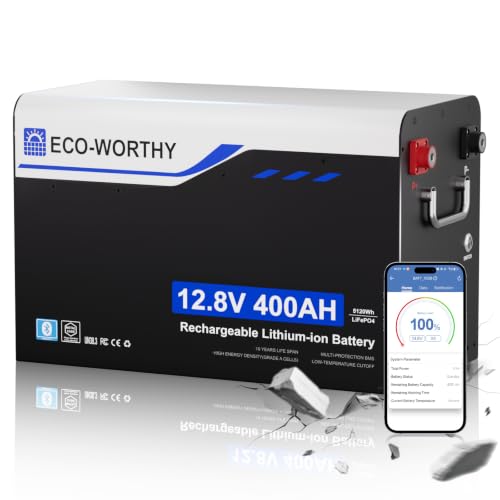
ECO-WORTHY 12V 400Ah Metal Case LiFePO4 Lithium Battery with Bluetooth, 250A BMS (single battery) leads this shortlist for one-battery 400Ah installs with simple wiring. Use that fit as a reference point, then compare the alternatives against your own space and workload.
Specs that separate the picks
The first details to compare are Single 12V 400Ah, 5,120Wh, Kit: 4 x 12V 100Ah, Kit: 2 x 12V 200Ah. Confirm the exact model and included components before ordering.
Trade-off to plan for
Weight and dimensions are not stated

Before you buy

What Matters Before You Choose a 400Ah Lithium RV Battery

Key buying criteria so you get the right fit the first time.

  1. 01

    Single battery or parallel kit

    A 400Ah bank is either one battery or several wired in parallel, and the two behave differently. A kit gives you more connections, more BMS units and a need to balance current, while a single battery has one failure point. Count the batteries in the title and bullets, and check that the total adds up to 400Ah.

  2. 02

    Parallel wiring and current sharing

    When batteries are in parallel, each takes a share of the load, but unequal cable length or resistance makes one work harder. A 100A BMS on each of four batteries can trip if one carries more than its share. Use equal-length cables of the same gauge, connect the load at opposite ends of the bank, and fuse each battery or the main lead as the maker recommends.

  3. 03

    BMS amps converted to watts

    A BMS rated 100A at 12.8V supports about 1,280 watts, 150A about 1,920, 200A about 2,560 and 250A about 3,200. A 3,000-watt inverter pulls roughly 250A, so a single 100A battery would shut down but two 200A batteries share it comfortably. Read the continuous rating and divide it by the number of batteries sharing the load.

  4. 04

    Usable energy at your discharge rate

    5,120Wh is nominal, and you do not get all of it at high load or low cutoff voltage. At a heavy 2,000W load, inverter efficiency, wiring losses and the BMS cutoff reduce the energy you can use, so plan on perhaps 85 to 90 percent in practice. Check the cycle claim's depth of discharge and treat any claim at 60 percent as less demanding.

  5. 05

    Weight and mounting

    Weight matters at 400Ah: four 100Ah batteries are about 79 pounds in total at 19.73 pounds each, two 200Ah batteries are about 101 to 118 pounds, and the single 400Ah battery's weight is not stated. Check the tray capacity, your tongue weight or axle limits, and whether the case suits strap-down mounting. A kit of small modules can spread weight across several bays.

  6. 06

    Cold-weather charge cutoff

    LiFePO4 cells should not be charged below freezing, and some listings state it while others only say low-temperature protection. ECOBOSS gives 32°F with restart at 41°F, Paoweric allows charging from 0°C, and ECO-WORTHY says charging stops in freezing conditions. Pick a heated bay or ask the seller for the exact cutoff in writing.

Our standards

Why You Can Trust RV Gear Lab

At RV Gear Lab, we compare products based on rig fit and power or hookup compatibility, verified specifications, usability, setup requirements, weight, durability, and real-world trade-offs. We do not rank products purely on marketing claims or commission rates.

We have not personally tested every product listed. Where hands-on testing is not available, recommendations are based on verified manufacturer specifications, product documentation, use-case fit, and comparative research.

How we review RV gear →

Detailed reviews

The 6 best 400ah lithium rv batteries, explained

01
Best for: One-battery 400Ah installs with simple wiring

Our take

Pick it if you want one battery, one set of cables and a metal case for an RV.

Why it made the shortlist

This is one 12V 400Ah battery, not a kit. Its 250A battery management system, Bluetooth app and low-temperature charging protection are listed, and the title states 5,120Wh. The steel shell and internal cell brackets are described as resisting road vibration.

It ranks first because a single 400Ah removes the parallel wiring that every other pick here needs, and its 250A BMS supports about 3,200W at 12.8V. It is $130 below the Redodo kit.

What works

  • One battery: no parallel wiring or balancing to manage
  • 250A BMS supports about 3,200W at 12.8V
  • Metal case mounts directly, no separate battery box
  • Weak-current switch cuts output safely for service

Watch out for

  • Weight and dimensions are not stated
  • A single battery fault takes out all 400Ah
02
Best for: Owners who want light, replaceable battery modules

Our take

The strongest case for HumsiENK 4 Pack 12V 100Ah LiFePO4 Battery with 100A Smart BMS (kit: 4 x 100Ah = 400Ah) is each battery weighs only 19.73 pounds for one-person lifts.

Why it made the shortlist

This is a kit of four 12V 100Ah batteries, which wired in parallel give 400Ah and 5,120Wh. Each battery is Group 24 to 31 sized at 8.4 by 6.6 by 10.2 inches and 19.73 pounds, has its own 100A smart BMS that disconnects above about 300A, an IP67 rating, and operation from minus 4°F to 158°F with shutdown below minus 4°F. The listing says each supports 5,000 cycles at 100 percent depth of discharge and up to four in series or parallel.

It is second at $751.99 because it is $8 cheaper than the ECO-WORTHY and $127.70 above the yeagulch, while being modular: you can carry or replace one 19.73-pound battery at a time. It costs $807.97 less than the ECOBOSS four-pack, which is the slim-case version.

What works

  • Each battery weighs only 19.73 pounds for one-person lifts
  • Losing one battery leaves 300Ah still running
  • Each unit has a 100A BMS that disconnects near 300A

Watch out for

  • Four batteries need a busbar, fuses and equal cables
  • Each BMS is limited to 100A, so uneven sharing is a risk
The catch
The cost is four BMS units, each limited to 100A, so the bank as a whole supports about 400A only if the current shares evenly.
03
Best for: Two-battery banks with a heavy inverter load

Our take

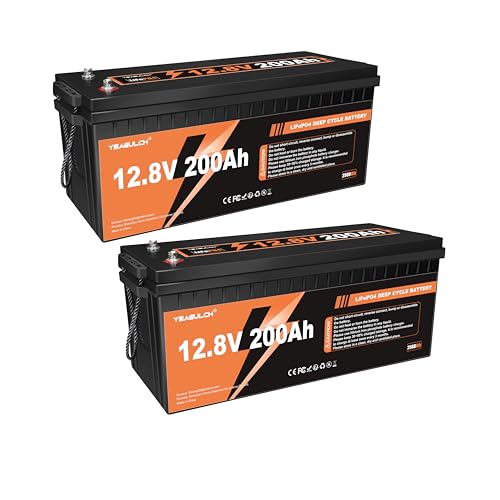
Pick it for a two-battery bank with a 200A BMS in each and a price under $630.

Why it made the shortlist

This is a kit of two 12V 200Ah batteries that give 400Ah and 5,120Wh when connected in parallel. Each weighs 58.86 pounds, has a 200A BMS, an ABS case with an IP67 rating, and an automatic high and low temperature cutoff. The listing gives 4,000 cycles at 100 percent depth of discharge and 6,000 at 80 percent, and says the batteries can be expanded in parallel or series.

It ranks third at $624.29, $135.70 below the ECO-WORTHY single battery and $127.70 below the HumsiENK four-pack, while giving each battery a 200A BMS so the pair can pass up to about 400A. It costs $84.30 more than the Paoweric kit, which has a 150A BMS in each battery.

What works

  • Two batteries mean only one parallel connection to make
  • 200A BMS in each battery for large inverter loads
  • IP67 ABS case on both batteries
  • Cheaper per kilowatt-hour than the single 400Ah

Watch out for

  • Each battery weighs 58.86 pounds, two-person carry in tight bays
  • Cold cutoff temperatures are not stated
The catch
It does not state exact cold-weather thresholds the way ECOBOSS does.
04
Best for: Lowest-cost 400Ah in a heated space

Our take

Pick it for the lowest cost to reach 400Ah where the inverter stays below about 3,500 watts.

Why it made the shortlist

This kit holds two 12V 200Ah batteries, 2.56kWh each, for 400Ah and 5.12kWh together at $539.99, or about $105 per nominal kilowatt-hour. Each is listed at 50.5 pounds and 15.2 by 7.6 by 9.8 inches, with a 150A BMS rated for up to 1,920W.

It costs $84.30 less than the yeagulch and $220 less than the ECO-WORTHY.

What works

  • Charge and discharge temperature ranges are published
  • Size and weight stated: 15.2 x 7.6 x 9.8 inches
  • Weight is 50.5 pounds each, lighter than yeagulch

Watch out for

  • 150A BMS limits each battery to about 1,920W
  • Cannot be paralleled with other brands
05
Best for: Owners who may later rewire to a 24V system

Our take

Choose it if you may rebuild as 24V later or want the charge guidance spelled out.

Why it made the shortlist

The Redodo is a two-pack of 12V 200Ah batteries, 5,120Wh in total, and the listing states you can build a 12V 400Ah or a 24V 200Ah system from it. Each has a 200A BMS rated for 2,560W, a 15,000-cycle claim and a ten-year life. It can be expanded to 16 units in 4P4S for 51.2V and 800Ah, and the listing recommends charging at 0.2C with a 40A LiFePO4 charger, about a five-hour recharge. The listing warns that the two items may ship separately.

It ranks fifth because it costs $889.99, which is $265.70 more than the yeagulch kit with the same 200A BMS, and $130 more than the ECO-WORTHY single battery. What it adds is the clearer charging and expansion documentation, including the 40A charger recommendation, and the choice of a 24V build later.

What works

  • Can be wired as 12V 400Ah or 24V 200Ah
  • Charging guidance stated: 0.2C with a 40A charger
  • Expands to 16 units for 40.96kWh per 4P4S set
  • A 200A BMS in each of the two batteries

Watch out for

  • Weight and cold cutoff are not in the listing text
06
Best for: Flat, shallow spaces under beds or panels

Our take

The strongest case for ECOBOSS 4 Packs 12V 100Ah LiFePO4 Battery, Slim 2.76 in Design (kit: 4 x 100Ah = 400Ah) is only 2.76 inches thick, fits under beds and panels.

Why it made the shortlist

This kit has four slim 12V 100Ah batteries, each 18.9 by 11.02 by 2.76 inches, which total 400Ah and 5,120Wh in parallel. Each has a 100A smart BMS and 1,280Wh. The listing states a 32°F low-temperature cutoff that stops charging below 32°F and resumes at 41°F, and rates them for up to 15,000 deep cycles.

It ranks last because $1,559.96 is $807.97 more than the HumsiENK four-pack and about $305 per nominal kilowatt-hour, nearly three times the Paoweric.

What works

  • Only 2.76 inches thick, fits under beds and panels
  • Charging stops at 32°F and resumes at 41°F
  • Each of four batteries has its own 100A BMS
  • Up to 15,000 cycles claimed for each battery

Watch out for

  • Costs $807.97 more than the HumsiENK four-pack
  • Four batteries need busbars, fuses and equal cables

Methodology

How We Built This Shortlist

Each pick was assessed across 5 criteria weighted for real-world use.

01

Single battery or kit, stated plainly

We counted exactly what each listing ships, one 400Ah battery, two 200Ah batteries or four 100Ah batteries, and checked that the parallel total comes to 400Ah.

02

BMS current per battery and in total

We converted BMS amps to watts at 12.8V and noted that parallel batteries only share current evenly if the cabling is balanced.

03

Cost per nominal kilowatt-hour

We divided each full price by 5.12kWh, using the price of the whole kit rather than a single battery.

04

Weight, size and mounting shape

We compared stated weight per battery and case shape, since a 20-pound module, a 59-pound block and a flat 2.76-inch panel suit very different installs.

05

Cold weather and documentation

We looked for stated charge cutoffs, and treated a listing that only mentions temperature protection as less documented than one that gives the degrees.

Decision guide

Match a 400Ah Lithium RV Battery to Your RV

By Number of Batteries You Want to Wire

Your situationRecommended pickWhy
One battery, minimal wiringECO-WORTHY 400AhSingle 400Ah battery with a 250A BMS
Two batteries, one parallel connection, heavy inverteryeagulch 2x200Ah200A BMS in each of two batteries at $624.29
Two batteries at the lowest pricePaoweric 2x200Ah$539.99 and about $105 per kilowatt-hour
Two batteries with 24V option laterRedodo 2x200AhWireable as 12V 400Ah or 24V 200Ah
Four small batteries, easy to liftHumsiENK 4-pack19.73 pounds each
Four batteries in a flat spaceECOBOSS 4-pack2.76 inches thick each

By Budget

BudgetRecommended pick
Under $600Paoweric 2x200Ah ($539.99)
$600 to $650yeagulch 2x200Ah ($624.29)
$750 to $760HumsiENK 4-pack ($751.99) or ECO-WORTHY 400Ah ($759.99)
Around $890Redodo 2x200Ah ($889.99)
Over $1,500ECOBOSS 4-pack ($1,559.96)

One Big Battery vs Several in Parallel

One battery

A single battery means one BMS, one set of terminals and no balancing between units, which is why the ECO-WORTHY 400Ah is the simplest install. The tradeoff is a single point of failure and a heavy battery to lift.

Several in parallel

Two or four batteries let you carry smaller units and keep partial capacity if one fails, as with the yeagulch, Paoweric, Redodo, HumsiENK and ECOBOSS kits. The tradeoff is more cabling, fuses, a busbar and matched wiring length so that current shares evenly.

If you are comfortable wiring a busbar, two 200Ah batteries are a good middle path. Otherwise the single ECO-WORTHY is simpler.

By Inverter Size

Your inverterRecommended pick
Up to about 2,000WPaoweric 2x200Ah (150A BMS in each battery)
2,000W to 3,000WECO-WORTHY 400Ah (250A BMS supports about 3,200W)
3,000W to 5,000W on a two-battery bankyeagulch 2x200Ah or Redodo 2x200Ah
Four-battery bank with a mid-size inverterHumsiENK 4-pack, with equal-length cables

For Replacing Lead-Acid Group 31 Batteries Specifically

Look for

Four 100Ah lithium batteries replace the usable energy of eight 100Ah lead-acid batteries, since lead-acid is only usable to about half depth. Check each battery's size against the tray, and total the weight, since a 400Ah bank can run from about 79 pounds in four small units to about 118 pounds in two.

In this comparison

HumsiENK 4-pack batteries are 8.4 by 6.6 by 10.2 inches and 19.73 pounds each, so they fit small trays. The ECOBOSS 4-pack suits a flat space, and the yeagulch 2x200Ah suits one larger bay.

When to Spend More

Spend more if

You want one battery with a metal case or a very flat profile: ECO-WORTHY 400Ah is $8 above the HumsiENK four-pack and removes the parallel wiring, and ECOBOSS 4-pack costs far more to fit a 2.76-inch gap.

Save if

You can wire two batteries in a heated space: Paoweric 2x200Ah at $539.99 gives the same 5.12kWh for $220 less than the ECO-WORTHY.

FAQ

Before You Bring One Home

Is one 400Ah battery better than four 100Ah batteries?

A single battery is simpler to wire and has one BMS, but it is one failure point and heavy. Four 100Ah batteries are lighter to carry and keep running if one fails, but they need a busbar, fuses and equal cable lengths.

How do I wire batteries in parallel for 400Ah?

Connect all positive terminals together and all negative terminals together with equal-length cables, then take the load from the positive of the first battery and the negative of the last. Fuse the main positive and use a busbar for four batteries.

Do all the batteries need to be identical?

Yes. Use the same brand, model, capacity and age, and charge them together once before wiring. Paoweric states that expansion is limited to identical units, and mixing batteries can unbalance the bank.

Is a 400Ah battery enough for an RV air conditioner?

Check the running watts on your air conditioner label, then divide. As an example estimate, an assumed 1,500-watt running load drains 5,120 watt-hours in about 3.4 hours before inverter losses, and the startup surge is higher, so you need an inverter sized for it and ideally a soft-start device.

How long does 400Ah last?

Divide 5,120 watt-hours by your average load. A 100W load runs about 51 hours, and a 300W load about 17 hours before inverter losses. Add up your own appliances to get a realistic figure.

Do I need a separate monitor for a bank of batteries?

A shunt-based monitor on the main negative shows the whole bank, while each battery's Bluetooth app shows only that battery. For a kit of two or four batteries, a shunt is the better way to see overall state of charge.

Bottom line

The short version

Browse more 400ah lithium rv batteries on Amazon →
Bowen Higgins, RV Editor at RV Gear Lab

About the author

Bowen Higgins

RV Editor at RV Gear Lab

Bowen covers RV power, water systems, towing and leveling, upkeep and interior comfort, with a focus on matching gear to the rig, the hookups and the way you actually travel.

More from Bowen →Editorial standards

Keep reading

Related guides