

We research everything we recommend. When you buy through our links, we may earn a commission. Learn more

Buying guide · 11 min read · Updated October 2, 2026

6 Best 500 Watt Portable Power Stations in 2026: A Practical RV Guide

Six 500W portable power stations with about 512Wh compared on weight, sine wave type, cycle life, recharge time and cost per Wh, from $169 to $359.

Bowen HigginsBy Bowen HigginsRV Editor at RV Gear Lab6 products comparedSpec-sheet researched

At a glance

Our top picks

At 500 watts a portable power station stops being a phone charger and starts running real RV loads: a 12V-class compressor fridge through an AC adapter, a laptop and router, a TV, a CPAP with its humidifier, and a small fan or blender. The catch is that 500W is a line, not a target. Crossing it for even a moment, with a coffee maker or a space heater, trips the inverter, and the listings that pad the figure with a 1,000W surge number are describing a half-second, not a load you can run.

We compared six stations priced from $169 to $359, each with a rated AC output of 500W and roughly 500Wh of storage, on weight, whether the inverter is pure or modified sine wave, number of AC outlets, rated cycle life, recharge time from a wall outlet and cost per watt-hour. The spread in price per watt-hour is more than double, from about $0.33 to $0.70, and that gap, not the wattage, is where most of the buying decision sits. If you need a bigger inverter for a microwave or kettle, jump to the 1000 watt guide.

RV Gear Lab field notes

The Rig Fit Check

Start with the job
Jackery Explorer 500 v2 Portable Power Station, 512Wh, 500W AC leads this shortlist for frequent cycling and quiet bedside CPAP use. Use that fit as a reference point, then compare the alternatives against your own space and workload.
Specs that separate the picks
The first details to compare are 512Wh LiFePO4, 500W. Confirm the exact model and included components before ordering.
Trade-off to plan for
Costs $189.01 more than the cheapest 512Wh pick

Before you buy

What Matters Before You Choose a 500 Watt Portable Power Station

Key buying criteria so you get the right fit the first time.

  1. 01

    Continuous versus surge wattage

    A 500W station can hold 500 watts continuously, while the 1,000W surge number covers a motor start for a moment. Going over the continuous figure shuts the inverter off, usually when a coffee maker or hair dryer starts. Look for the word rated or continuous next to the number and add the running watts of everything you plan to run at once.

  2. 02

    Waveform type

    Pure sine wave matches household power, while modified sine wave is a stepped approximation. A CPAP, a laptop brick or an appliance with a motor can overheat, hum or fail on modified sine wave. Check the listing for the words pure sine wave, and treat an unstated waveform as a question for the seller.

  3. 03

    Battery chemistry and cycles

    LiFePO4 cells are rated for thousands of cycles and handle heat better than NCM cells, which wear faster. A station used weekly at 3,000 cycles lasts decades, but at several hundred it can wear out in a few years. Look for the chemistry name and a cycle count, and note when the listing gives neither.

  4. 04

    Watt-hours per dollar

    The 500W figure is the inverter, while Wh is the fuel tank, so divide price by Wh to compare. Here that ranges from about $0.33 to $0.70, so the same 512Wh costs $189.01 more on the Jackery than on the ANTPO. Compare the Wh in the bullet points and the title, since a few listings quote both 500Wh and 512Wh.

  5. 05

    Weight and carry

    At 13 to 14.1 pounds these units are heavier than the 300W class, and a handle that digs in matters when you carry one up RV steps. A pound or two will not matter if it stays on a shelf. Check the listed weight, the handle type and whether a carrying strap is included.

  6. 06

    Recharge speed and sources

    Recharge claims run from about 1 hour to 80 percent up to 6 to 7 hours for a full wall charge, and solar adds 6 to 9 hours with a 100W panel. Slow charging matters when you have a short window between trips. Look for the AC input wattage and the solar voltage limit, such as the 23V cap on the EBL.

Our standards

Why You Can Trust RV Gear Lab

At RV Gear Lab, we compare products based on rig fit and power or hookup compatibility, verified specifications, usability, setup requirements, weight, durability, and real-world trade-offs. We do not rank products purely on marketing claims or commission rates.

We have not personally tested every product listed. Where hands-on testing is not available, recommendations are based on verified manufacturer specifications, product documentation, use-case fit, and comparative research.

How we review RV gear →

Detailed reviews

The 6 best 500 watt portable power stations, explained

01
Best for: Frequent cycling and quiet bedside CPAP use

Our take

Choose it for a camper that cycles the battery often, or for a bedside CPAP that you want near silent.

Why it made the shortlist

The Jackery Explorer 500 v2 holds 512Wh in a LiFePO4 pack rated for 6,000 charge cycles and delivers 500W rated (1,000W surge) through two pure sine wave AC outlets. It weighs 14 pounds, runs as quiet as 28 dB, has a 10ms UPS switchover with bypass charging, and recharges from 0 to 80 percent in about 52 minutes on AC. The listing cites low self-discharge, 5 percent after half a year in storage, and ships a 16.4 foot extension cable.

At $359 it is the most expensive pick, about $0.70 per watt-hour, which is $189.01 more than the ANTPO 500W for 12Wh more storage. What that money buys is the longest cycle rating here, 6,000 against ANTPO's 3,500 plus and the ALLWEI's 3,000, along with the fast 52-minute 80 percent charge.

What works

  • Runs as quiet as 28 dB
  • 52-minute 0 to 80 percent AC recharge
  • 10ms UPS switchover with bypass charging

Watch out for

  • Costs $189.01 more than the cheapest 512Wh pick
  • Listing does not state a warranty length
The catch
The listing does not state a warranty length.
02
Best for: Best energy per dollar with pure sine wave

Our take

Buy it if you want pure sine wave power, LiFePO4 and a 24-month warranty at the lowest price.

Why it made the shortlist

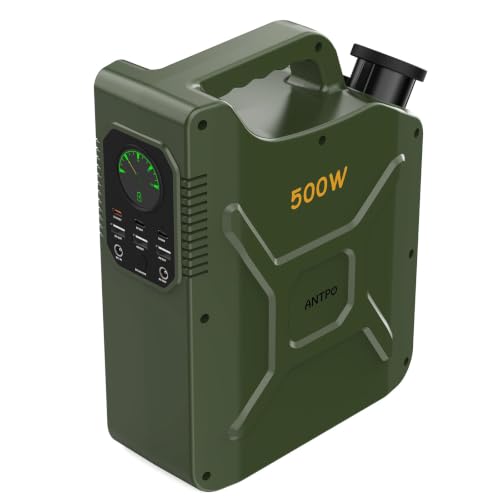
The ANTPO 500W puts a Grade-A LiFePO4 pack, listed as 512Wh in the bullet points and 500Wh in the title, behind a 500W pure sine wave inverter with a 1,000W surge. It is rated for more than 3,500 cycles, weighs 13.2 pounds with a retro fuel-can shape and handle, and the listing claims 0 to 80 percent in 1 hour from a 500W wall input. A 200W panel recharge is quoted at 8 to 9 hours, and the warranty is 24 months.

At $169.99 it costs about $0.33 per watt-hour, the lowest among the units with a full 512Wh. Against the Jackery it gives up 2,500 cycles and quiet 28 dB operation.

What works

  • About $0.33 per Wh, cheapest 512Wh option
  • 24-month warranty stated in the listing
  • Claims 0 to 80 percent in about 1 hour

Watch out for

  • Title says 500Wh while bullets say 512Wh
  • Warranty is shorter than some larger-brand stations
03
Best for: Desk setups that need a 100W USB-C and UPS

Our take

Pick this if you also run a desk setup in the camper and want a 100W USB-C and a UPS behind the router.

Why it made the shortlist

The ALLWEI 500W stores 512Wh in LiFePO4 cells rated for 3,000 cycles to 70 percent capacity, roughly 10 years by its own claim. It has two 500W AC outlets, a 100W USB-C, a 36W USB-C, two USB-A, two DC5521 ports and a car port, measures 11.6 by 7.5 by 7.6 inches, and weighs 13 pounds. The listing claims a full AC recharge in 2.5 hours in Q mode and about 6.5 hours with a 100W panel.

The 100W USB-C means a laptop charges without a brick, and the UPS function protects a desktop PC or file server.

What works

  • 100W USB-C plus a second 36W USB-C
  • UPS function protects a PC or router
  • Full AC recharge claim of 2.5 hours
  • Weighs 13 pounds, the lightest 512Wh here

Watch out for

  • Listing does not state a warranty length
  • Costs $99.01 more than the ANTPO for similar Wh
04

Best Budget Pure Sine Wave · 4 of 6

GRECELL 500W Portable Power Station, 519.48Wh

GRECELL 500W Portable Power Station, 519.48Wh
  • 519.48Wh lithium, 500W
  • Two AC, wireless pad
  • 14.1 lb, 6-hour wall charge
Check price on Amazon for GRECELL 500W Portable Power Station, 519.48Wh (opens in a new tab)
Best for: Occasional backup on a budget

Our take

Choose it for the lowest price on a pure sine wave unit with a wireless pad, used as an occasional storm and camping backup.

Why it made the shortlist

The GRECELL 500W lists 519.48Wh with two pure sine wave AC outlets rated 500W total, a 60W USB-C PD, three USB-A QC3.0 ports, two DC ports, a car port and a 10W wireless charging pad. It weighs 14.1 pounds and includes a strobe and SOS flashlight. The listing says the cell chemistry is simply a reliable lithium battery, with no cycle rating published, and warns not to run devices above 500 watts.

The EBL 500W below it has the same 519.48Wh and weight at $120.02 more, so the GRECELL is the cheaper way to get that body.

What works

  • Two pure sine wave AC outlets at $179.97
  • 10W wireless pad and 60W USB-C PD
  • Built-in SOS flashlight with strobe mode
  • Charges up to 10 devices at the same time

Watch out for

  • AC recharge takes 6 to 7 hours
05
Best for: Buyers comparing capacity, compatibility, included components and storage needs

Our take

EBL 500W Portable Power Station (1000W Peak), 10-Output is the better fit when buyers comparing capacity, compatibility, included components and storage needs.

Why it made the shortlist

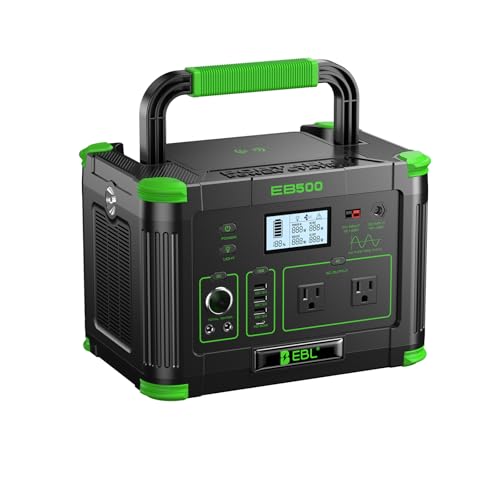
The EBL 500W uses NCM lithium cells, the same energy-dense chemistry as most laptop and EV packs, at 519.48Wh and 14.1 pounds. It has two 120V pure sine wave AC outlets sharing 500W, a 60W USB-C PD, three 18W USB-A ports, two DC outputs, a car socket and a 10W wireless pad. The listing says not to exceed 500W continuous or 23V solar input, and to recharge every 90 days in storage for a battery life of 5 plus years.

At $299.99 it is about $0.58 per watt-hour, $120.02 above the GRECELL for the same 519.48Wh and 14.1 pound body, and $59.01 below the Jackery with a much lower stated life. The ALLWEI at $269 has LiFePO4, a 3,000 cycle rating and a 100W USB-C for $30.99 less. The EBL's real strength is the clearest operating limits in the listing.

What works

  • Publishes a 23V solar input limit
  • Two pure sine wave AC outlets, 10 outputs total
  • States a 90-day storage recharge schedule
  • 60W USB-C PD charges most laptops

Watch out for

  • NCM chemistry with a shorter life than LiFePO4
  • Costs $120.02 more than the same-capacity GRECELL
06
Best for: Simple resistive loads like lamps and chargers

Our take

Choose Antosynate 500Wh LiFePO4 Portable Power Station, 500W for cheapest of the six at $169.

Why it made the shortlist

The Antosynate lists 500Wh of LiFePO4 and a 500W AC output, a single 110V outlet, a 60W USB-C PD, QC3.0 USB and a 12V car outlet. It lists three recharge methods and claims thousands of cycles without a number.

At $169 it is the cheapest of the six, about $0.34 per watt-hour, $0.99 under the ANTPO 500W at $169.99. Against the GRECELL at $179.97 it has half as many AC outlets.

What works

  • Cheapest of the six at $169
  • LiFePO4 chemistry stated in the title
  • 60W USB-C PD charges a laptop
  • Three recharge methods including solar and car

Watch out for

  • Modified sine wave, risky for CPAPs and electronics
  • Single AC outlet and no cycle number or warranty listed

Methodology

How We Built This Shortlist

Each pick was assessed across 5 criteria weighted for real-world use.

01

Rated AC output

We kept only listings whose rated AC output is 500W, and we separated the 1,000W surge figure from continuous power so a half-second boost is not counted as capacity.

02

Waveform and chemistry

We checked whether the inverter is pure or modified sine wave and which battery chemistry the listing names, since those two facts decide whether a CPAP or a laptop is safe on it.

03

Weight and handling

We compared listed weights from 13 to 14.1 pounds and dimensions, because 500W units are the point where a one-person carry into a camper gets awkward.

04

Recharge speed

We compared wall, car and solar recharge claims, from about 1 hour to 80 percent up to 6 to 7 hours for a full charge.

05

Cost per watt-hour

We divided price by listed Wh, from about $0.33 to $0.70, and noted what the extra money buys in cycle life, ports or warranty.

Decision guide

Match a 500 Watt Portable Power Station to Your RV

By What You Run

The same 500W label hides big differences in waveform and runtime, so start from the load.

Your situationRecommended pickWhy
CPAP with heated humidifier overnightJackery 500 v228 dB, pure sine wave, 512Wh
Laptop desk setup with a routerALLWEI 500W100W USB-C, UPS and 2 AC outlets
Weekend camping lights, fan and phonesANTPO 500W512Wh at the lowest pure sine price
Occasional storm backup, rarely cycledGRECELL 519WhTwo pure sine AC outlets for $179.97
Wireless pad and clear limits wantedEBL 500WPublished 23V solar limit and 90-day care
Lamps and chargers only, lowest priceAntosynate 500Wh$169, modified sine wave

As a rough estimate, a 60W load on 512Wh runs about 7 hours before inverter losses.

By Budget

BudgetRecommended pick
Under $175ANTPO 500W at $169.99 or Antosynate 500Wh at $169
$175 to $200GRECELL 519Wh at $179.97
$265 to $300ALLWEI 500W at $269 or EBL 500W at $299.99
Around $360Jackery 500 v2 at $359

Pure Sine Wave vs Modified Sine Wave

Pure sine wave

Matches grid power, so CPAPs, laptop adapters and anything with a motor controller behave normally. The Jackery 500 v2, ANTPO 500W, ALLWEI 500W, GRECELL 519Wh and EBL 500W all state pure sine wave.

Modified sine wave

A stepped approximation that works for lamps and resistive chargers but can cause heat, buzz or failures in electronics. The Antosynate 500Wh is the only one here that states it.

For an RV used with a CPAP, laptops or a fridge, default to pure sine wave unless you only plug in simple chargers.

By How Often You Cycle It

Usage patternRecommended pick
Daily or near-daily cyclingJackery 500 v2 (6,000 cycles)
Weekly use on camping weekendsANTPO 500W (3,500 plus) or ALLWEI 500W (3,000)
A few times a year, storm kitGRECELL 519Wh
Low-cost spare in a tow vehicleAntosynate 500Wh

For Bedside CPAP in a Camper Specifically

Look for

A pure sine wave inverter, a fanless or very quiet design, and at least 400Wh. A 60W CPAP with humidifier uses roughly 480Wh over 8 hours before losses, so plan for about 512Wh if the humidifier runs all night.

In this comparison

The Jackery 500 v2 runs as quiet as 28 dB and has a 10ms UPS, while the ANTPO 500W is the cheaper pure sine alternative. Avoid the Antosynate 500Wh for this use.

When to Spend More

Spend more if

You cycle often or want quiet and speed: the Jackery 500 v2 at $359 adds a 6,000 cycle rating and a 52-minute 80 percent recharge, and the ALLWEI 500W at $269 adds a 100W USB-C and UPS.

Save if

The unit mostly waits for storms: the ANTPO 500W at $169.99 gives 512Wh of pure sine wave and a 24-month warranty for $189.01 less than the Jackery.

FAQ

Before You Bring One Home

What can a 500 watt portable power station run in an RV?

Laptops, TVs, routers, phone charging, lights, a CPAP and small appliances such as a blender or a compact fridge fit under 500W. A microwave, kettle, hair dryer or air conditioner will trip it. Add up the running wattage on each device label and keep the total under 500W.

Is modified sine wave okay for a CPAP?

Many CPAP makers recommend pure sine wave, and some warn against modified sine wave because it can damage the motor or humidifier. The Antosynate listing itself says to confirm CPAP use with the manufacturer. Choose a pure sine wave unit such as the Jackery 500 v2 or ANTPO 500W for medical equipment.

Is the Jackery 500 v2 worth $189 more than the ANTPO?

If you cycle the battery often, yes: 6,000 cycles against 3,500 plus, 28 dB operation and a faster 52-minute 80 percent charge. For a storm kit or weekend use, the ANTPO covers most needs at $169.99. The Jackery listing does not state a warranty.

How long does 512Wh last at 60 watts?

Divide 512 by 60 for roughly 8.5 hours as an upper bound, then subtract 10 to 15 percent for inverter losses, giving about 7 hours. Heated humidifiers and fridges draw more, so measure with a plug-in watt meter. This is an estimate, not a listing claim.

Can I charge it from my RV's solar panels?

Yes if the panel voltage stays under the station's input limit, which the EBL lists as 23V. Match the open-circuit voltage to the limit before wiring, and use a 100W panel for 6 to 9 hour recharges in full sun. Check the listing's solar input range before buying a panel.

How should I store a 500W station over winter?

Store it indoors at about half to 70 percent charge with AC output off, and top up every 90 days as the EBL listing advises, or every three months per the GRECELL listing. A closed camper in summer or freezing weather is hard on any battery.

Bottom line

The short version

Browse more 500 watt portable power stations on Amazon →
Bowen Higgins, RV Editor at RV Gear Lab

About the author

Bowen Higgins

RV Editor at RV Gear Lab

Bowen covers RV power, water systems, towing and leveling, upkeep and interior comfort, with a focus on matching gear to the rig, the hookups and the way you actually travel.

More from Bowen →Editorial standards

Keep reading

Related guides