

We research everything we recommend. When you buy through our links, we may earn a commission. Learn more

Buying guide · 10 min read · Updated October 2, 2026

5 Best 5000 Watt RV Inverters in 2026: A Practical RV Guide

Five 12V 5000W continuous RV inverters compared on sine wave output, outlets, remote control and battery current needs, from $240 to $396.

Bowen HigginsBy Bowen HigginsRV Editor at RV Gear Lab5 products comparedSpec-sheet researched

At a glance

Our top picks

A 5000 watt inverter on a 12 volt battery bank is a different animal from the 2000 watt units most RVs carry. At full load it pulls about 417 amps from the battery before conversion losses, and closer to 460 amps once you assume a typical 90 percent efficiency. That is an estimate from simple division, but it explains why the cable, fuse and battery decide whether this inverter works, far more than the badge on the case.

We compared five 12V inverters that list 5,000 watts of continuous output and 10,000 watts of surge, priced from $239.90 to $395.99. We ranked them on whether the listing states pure sine wave, the outlets and hardwire terminal, remote and display, and how clearly protections are named. Two listings do not state the waveform, and one is a modified sine unit, which is ranked last.

RV Gear Lab field notes

The Rig Fit Check

Start with the job
SUNIVORA 5000W Pure Sine Wave Power Inverter 12V DC to 120V AC leads this shortlist for buyers comparing capacity, compatibility, included components and storage needs. Use that fit as a reference point, then compare the alternatives against your own space and workload.
Specs that separate the picks
The first details to compare are 5,000W continuous pure sine, 5,000W continuous, 10,000W peak. Confirm the exact model and included components before ordering.
Trade-off to plan for
Cable and fuse sizing is not in the listing

Before you buy

What Matters Before You Choose a 5000 Watt RV Inverter

Key buying criteria so you get the right fit the first time.

  1. 01

    Continuous vs surge rating

    Continuous watts are what the inverter can supply for hours, while peak watts are a brief surge. Some inverters advertise 5000W but deliver it only as a peak, with a continuous rating of 2,300 or less. Find the word continuous next to 5,000 in the listing, and treat anything that only says peak as a smaller inverter.

  2. 02

    Pure sine vs modified sine

    A pure sine inverter makes the same smooth wave as a wall outlet, while a modified sine inverter makes a stepped wave that some devices dislike. Microwaves can run louder and hotter, and laptops and variable speed motors may misbehave. Look for the words pure sine wave in the listing, and treat silence on waveform as a reason to ask.

  3. 03

    Battery current at 12 volts

    At 5,000 watts and 12 volts the inverter pulls about 417 amps before losses, and nearer 460 amps at 90 percent efficiency, which is an estimate from division. Few single 12V batteries can supply that. Check the continuous discharge rating of your battery bank, and consider whether a 24V or 48V system suits your load better.

  4. 04

    Cable gauge and fuse

    High current needs thick short cables and a properly rated fuse near the battery, otherwise voltage drop wastes power and cables overheat. The listings here rarely state the exact gauge needed. Read the manual for the required cable size and fuse, and keep cable runs as short as possible.

  5. 05

    Hardwire terminal and outlets

    Four household outlets on one inverter are limited by the circuit they share, and 5,000 watts at 120V is about 41.7 amps, more than a standard outlet carries. A hardwire terminal block lets an electrician feed a panel directly. Check for hardwire terminals and plan the wiring accordingly.

  6. 06

    Protections and cooling

    Low voltage, overload, short circuit, overheating and reverse polarity protection prevent damage when something goes wrong. The LVYUAN 249 states its fan starts above 104°F or 45 percent load. Look for named protections and cooling behavior, and give the unit ventilation space in the install.

Our standards

Why You Can Trust RV Gear Lab

At RV Gear Lab, we compare products based on rig fit and power or hookup compatibility, verified specifications, usability, setup requirements, weight, durability, and real-world trade-offs. We do not rank products purely on marketing claims or commission rates.

We have not personally tested every product listed. Where hands-on testing is not available, recommendations are based on verified manufacturer specifications, product documentation, use-case fit, and comparative research.

How we review RV gear →

Detailed reviews

The 5 best 5000 watt rv inverters, explained

01
SUNIVORA 5000W Pure Sine Wave Power Inverter 12V DC to 120V AC
  • 5,000W continuous pure sine
  • 10,000W peak, 165 ft remote
  • Four AC outlets plus hardwire
Check price on Amazon for SUNIVORA 5000W Pure Sine Wave Power Inverter 12V DC to 120V AC (opens in a new tab)
Best for: Buyers comparing capacity, compatibility, included components and storage needs

Our take

Pick it if you have a 12V battery bank that can supply several hundred amps and you want clean power for electronics and a microwave.

Why it made the shortlist

The Sunivora lists 5,000 watts of continuous pure sine wave output and 10,000 watts of peak power, with four AC outlets, a 5V 4A USB port and a hardwired terminal block for high loads. A wireless remote works from up to 165 feet, an LCD shows input and output voltage, and built-in protections cover undervoltage, overvoltage, overload, overheating, short circuit and reverse polarity. The case is aluminum.

It ranks first because it states the waveform and the 5,000 continuous rating clearly at $279.99, which is $116 less than the LVYUAN pure sine unit that lists the same output. It costs $30 more than the LVYUAN 249.99 and $40.09 more than the modified sine VEVOR, and for that money it names pure sine wave, which the cheaper units do not.

What works

  • States pure sine wave and 5,000W continuous clearly
  • Hardwire terminal block handles the highest loads
  • Remote works up to 165 feet away

Watch out for

  • Cable and fuse sizing is not in the listing
  • Needs a battery bank delivering several hundred amps
02
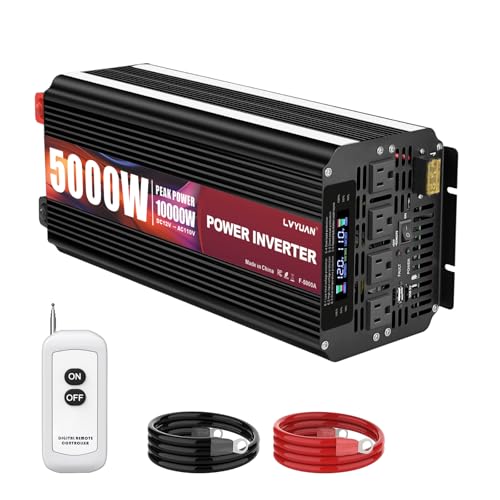
LVYUAN 5000W Heavy Duty Pure Sine Wave Power Inverter 12V DC to 120V AC
  • 5,000W continuous pure sine
  • Wired or wireless LCD remote
  • Heavy-duty cables included
Check price on Amazon for LVYUAN 5000W Heavy Duty Pure Sine Wave Power Inverter 12V DC to 120V AC (opens in a new tab)
Best for: Buyers who want cables and a wired remote included

Our take

Choose it if you want the cabling in the box and the choice of a wired remote.

Why it made the shortlist

The LVYUAN pure sine unit lists true 5,000 watts continuous and 10,000 watts peak, four US outlets, a USB port and a hardwire port.

It ranks second because it costs $395.99, which is $116 more than the Sunivora for the same stated output. The difference is the included heavy-duty cabling and the wired option on the remote. Against the LVYUAN 249.99 it adds a stated pure sine wave for $146.

What works

  • Heavy-duty combined cables come included in the box
  • Wired or wireless remote with LCD
  • Leakage protection plus six other safeguards listed
  • Pure sine wave stated with 10,000W peak

Watch out for

  • Costs $116 more than the Sunivora for equal output
  • Remote can use only wired or wireless at once
03
Best for: Budget buyers who will confirm the waveform first

Our take

LVYUAN 5000 Watt Power Inverter 12V to 120V with 4 AC Outlets, LCD and Wireless Remote is the better fit when budget buyers who will confirm the waveform first.

Why it made the shortlist

It ranks third at $249.99, which is $30 below the Sunivora and $146 below the LVYUAN pure sine.

What works

  • Fan runs only above 104°F or 45% load
  • Four AC outlets plus a hardwire terminal
  • LCD shows voltage, battery level and load

Watch out for

  • Waveform is not stated
  • No cabling or fuse sizing details given
04
TOPBULL 5000 Watt Power Inverter 12V DC to 120V AC for Vehicles
  • 5,000W continuous, 10,000W peak
  • Color display and remote
  • Ten protections listed
Check price on Amazon for TOPBULL 5000 Watt Power Inverter 12V DC to 120V AC for Vehicles (opens in a new tab)
Best for: Buyers who value a clear status display

Our take

Choose it if you want the clearest status display at a budget price.

Why it made the shortlist

The TOPBULL lists a continuous 5,000 watts and 10,000 watts of peak power, a high-definition color display showing voltage, power and working state, a remote control, and ten stated protections including low voltage, high voltage, overload and short circuit. The listing says it uses high-frequency transformers and pure copper flexible cables.

It ranks fourth at $249.99, the same price as the LVYUAN 249.99, and $30 below the Sunivora.

What works

  • Color display shows voltage, power and state
  • Ten protections including low and high voltage
  • Pure copper flexible cables are described

Watch out for

  • Waveform and outlet count are not stated
  • Described for vehicles more than for RV banks
05
Best for: Simple tools and resistive loads only

Our take

VEVOR 5000W Modified Sine Wave Inverter, DC 12V to AC 120V with Remote makes the shortlist because waveform is clearly labelled as modified sine.

Why it made the shortlist

The VEVOR is a modified sine wave inverter that lists 5,000 watts continuous and 10,000 watts peak, an aluminum alloy shell, a remote controller with LCD, a temperature-controlled cooling fan and protections for the battery and appliances. It costs $239.90, the lowest here.

It ranks last because modified sine wave output is rougher than pure sine, so it is the wrong choice for many electronics. It costs $40.09 less than the Sunivora, which is the whole argument for it, and $10.09 less than the LVYUAN 249.99 and TOPBULL.

What works

  • Waveform is clearly labelled as modified sine
  • Aluminum alloy shell with temperature-controlled fan
  • Remote controller with LCD comes in the box

Watch out for

  • Modified sine can stress sensitive electronics
  • Not suited to microwaves or variable speed motors
The catch
Pick it only for simple resistive loads and tools you know tolerate modified sine.

Methodology

How We Built This Shortlist

Each pick was assessed across 5 criteria weighted for real-world use.

01

Waveform stated

We favored listings that state pure sine wave output and flagged modified sine or unstated waveforms, since the waveform decides what you can plug in.

02

Continuous vs peak

We confirmed each lists 5,000 watts continuous and 10,000 watts peak, and rejected any that reached 5000 only as a surge.

03

Outlets and hardwire

We counted AC outlets and checked for a hardwire terminal block, because 5,000 watts is more than a household outlet can carry.

04

Controls and display

We compared remotes, LCDs and fan behavior as listed by the manufacturer.

05

Protections named

We counted named protections such as reverse polarity, low voltage and overload, as stated in each listing.

Decision guide

Match a 5000 Watt RV Inverter to Your RV

By Waveform and Load Type

Your situationRecommended pickWhy
Laptops, TV and microwave, best valueSunivora 5000Pure sine, 5,000W continuous at $279.99
Want cables included and a wired remoteLVYUAN Pure SineHeavy-duty cables, wired or wireless remote
Cheapest, will confirm waveformLVYUAN 249Waveform not stated, $249.99
Want a detailed color displayTOPBULL 5000Color display, ten protections listed
Only resistive tools, lowest costVEVOR ModifiedModified sine, $239.90

By Budget

BudgetRecommended pick
Under $245VEVOR Modified at $239.90
$250LVYUAN 249 or TOPBULL 5000
$280Sunivora 5000
Around $396LVYUAN Pure Sine

Pure Sine vs Modified Sine

Pure sine

Pure sine wave output matches household power and is the safe default for electronics, microwaves and motors. The Sunivora 5000 and LVYUAN Pure Sine state it in the listing.

Modified sine

Modified sine is a stepped approximation that costs less. The VEVOR Modified at $239.90 is the only labelled example here; it is fine for simple heaters and tools but can overheat or buzz with sensitive loads.

Most RV owners should default to pure sine, such as the Sunivora 5000, unless every load is a simple resistive tool.

By Battery Bank Capability

What your bank can deliverRecommended pick
Several hundred amps with heavy cabling already installedSunivora 5000
Starting from scratch and wanting cables in the boxLVYUAN Pure Sine
Part-time use under 2,500 watts with a smaller bankLVYUAN 249 (fan starts at 45% load)
Resistive loads only on a modest bankVEVOR Modified

For Running a Microwave and AC Together Specifically

Look for

Listed pure sine wave output and a hardwire terminal. A 1,500 watt microwave plus a 1,440 watt air conditioner is about 2,940 watts by simple addition, which is why surge capacity and battery current matter.

In this comparison

The Sunivora 5000 and LVYUAN Pure Sine both state pure sine and a hardwire terminal, and the Sunivora is $116 cheaper. The LVYUAN 249 and TOPBULL 5000 need the waveform confirmed first.

When to Spend More

Spend more if

You want cabling and a wired remote in the box; the LVYUAN Pure Sine at $395.99 includes heavy-duty combined cables.

Save if

You already own cables and a fuse; the Sunivora 5000 at $279.99 states the same 5,000 watts and pure sine for $116 less.

FAQ

Before You Bring One Home

Can a 12V battery run a 5000 watt inverter?

Only with a bank that supplies roughly 400 to 460 amps at full load. Most RVs never push the inverter that hard, but the battery and cabling must be sized for the worst case.

Is pure sine wave worth paying for?

For electronics, microwaves and motors, yes. The Sunivora 5000 states pure sine at $279.99, only $40.09 above the modified sine VEVOR.

Why does the LVYUAN Pure Sine cost $116 more than the Sunivora?

The listing adds heavy-duty cables and a wired or wireless remote. The stated output is the same, so it pays only if you need those extras.

How do I install a 5000W inverter?

Mount it in a ventilated spot close to the battery, use the manual's cable gauge and a fuse near the positive terminal, and connect the negative last. Test at low load before running big appliances.

Do I need a 48V system instead?

For loads regularly above 3,000 watts, a higher voltage reduces current and cable size. A 12V 5,000 watt inverter works, but the current is very high.

Bottom line

The short version

Browse more 5000 watt rv inverters on Amazon →
Bowen Higgins, RV Editor at RV Gear Lab

About the author

Bowen Higgins

RV Editor at RV Gear Lab

Bowen covers RV power, water systems, towing and leveling, upkeep and interior comfort, with a focus on matching gear to the rig, the hookups and the way you actually travel.

More from Bowen →Editorial standards

Keep reading

Related guides