

We research everything we recommend. When you buy through our links, we may earn a commission. Learn more

Buying guide · 10 min read · Updated October 1, 2026

6 Best AGM RV Batteries in 2026: A Practical RV Guide

We compared 12V AGM RV batteries from 90Ah to 200Ah by usable capacity, size, cold weather behavior, and dual-purpose ability for house and starting use.

Bowen HigginsBy Bowen HigginsRV Editor at RV Gear Lab6 products comparedSpec-sheet researched

At a glance

Our top picks

AGM batteries remain the easy upgrade for RVers who want sealed, spill-proof power without switching to lithium. They need no watering, tolerate freezing nights better than LiFePO4 when charging, and work with nearly every stock RV converter, which is why many rigs still ship with them.

This roundup compares 12V AGM batteries from Renogy, Interstate, Weize, and Mighty Max, covering pure deep cycle house batteries and dual-purpose units that can also crank an engine. We evaluated rated capacity, physical group size, published temperature ranges, warranty length, and buyer feedback, keeping in mind that you should only use about half of an AGM's rated amp-hours if you want it to last.

RV Gear Lab field notes

The Rig Fit Check

Start with the job
Renogy 12V 200Ah Deep Cycle AGM Battery leads this shortlist for Motorhomes with a large bay wanting one big sealed battery. Use that fit as a reference point, then compare the alternatives against your own space and workload.
Specs that separate the picks
The first details to compare are 12V 200Ah at C20, 12V 100Ah, group 31, 12V 100Ah, 12.99 x 6.73 x 8.43 in. Confirm the exact model and included components before ordering.
Trade-off to plan for
Very heavy for a single battery

Before you buy

What Matters Before You Choose an AGM RV Battery

Key buying criteria so you get the right fit the first time.

  1. 01

    Plan for 50% Usable Capacity

    AGM batteries are lead acid, and regularly draining them below about half charge sharply shortens their life. A 100Ah AGM therefore delivers about 50Ah in daily use, while a 200Ah gives about 100Ah. When comparing listings, halve the rated amp-hours to estimate how long your loads will really run.

  2. 02

    Match the Group Size

    BCI group size describes the case footprint, and RV trays are usually sized for group 24, 27, or 31. A battery that is even half an inch too long will not fit under the hold-down strap. Check the listed length, width, and height against your tray before buying, and do not assume all 100Ah batteries are the same size.

  3. 03

    Deep Cycle vs Dual Purpose Plates

    Dual purpose batteries list CCA and MCA because they are built to start engines as well as cycle. Pure deep cycle batteries usually skip those ratings and focus on cycle life. If the battery will only power your trailer, prioritize a published cycle count or reserve capacity over CCA.

  4. 04

    Charging Voltage and Converter Settings

    AGM batteries generally want an absorption charge around 14.4V; many older RV converters stop near 13.6V and never fully charge them. Chronic undercharging slowly sulfates the plates and reduces capacity. Look for a recommended charge voltage in the listing and compare it with your converter's spec, or plan to upgrade to a converter with an AGM setting.

  5. 05

    Cold Weather Ratings

    Unlike lithium, AGM can usually be charged below freezing, which is a real advantage for winter campers. Ranges vary, though, so a battery rated to charge at 14F is better suited to frosty nights than one with no published range. Look for separate charge and discharge temperature ranges in the specs.

  6. 06

    Weight and Installation

    A 100Ah AGM typically weighs around 60 to 70 pounds, and a 200Ah can be much heavier. That weight counts against your trailer's tongue weight and makes installation harder. Check the listed weight and consider two smaller batteries if lifting one large one is not practical.

Our standards

Why You Can Trust RV Gear Lab

At RV Gear Lab, we compare products based on rig fit and power or hookup compatibility, verified specifications, usability, setup requirements, weight, durability, and real-world trade-offs. We do not rank products purely on marketing claims or commission rates.

We have not personally tested every product listed. Where hands-on testing is not available, recommendations are based on verified manufacturer specifications, product documentation, use-case fit, and comparative research.

How we review RV gear →

Detailed reviews

The 6 best agm rv batteries, explained

01
Renogy 12V 200Ah Deep Cycle AGM Battery
  • 12V 200Ah at C20
  • Under 3% monthly self-discharge
  • Rated for use below 32F
Check price on Amazon for Renogy 12V 200Ah Deep Cycle AGM Battery (opens in a new tab)
Best for: Motorhomes with a large bay wanting one big sealed battery

Our take

Best for Class A and fifth-wheel owners with a basement battery bay who want maximum sealed capacity.

Why it made the shortlist

Renogy's 200Ah AGM puts the capacity of two 100Ah batteries into a single sealed case. Renogy publishes a full capacity table, from 152.9Ah at the 3-hour rate up to 200Ah at the 20-hour rate, and quotes monthly self-discharge below 3% at 77F.

What works

  • 200Ah in one case means fewer interconnects
  • Self-discharge under 3% suits stored rigs
  • Discharges well in freezing temperatures

Watch out for

  • Very heavy for a single battery
  • Should not be installed upside down
  • Larger than most group 27 or 31 trays
The catch
The tradeoff is physical: it is far larger and heavier than a group 31, so it will not fit a typical tongue box.
02
Best for: Motorhomes needing one battery for starting and house loads

Our take

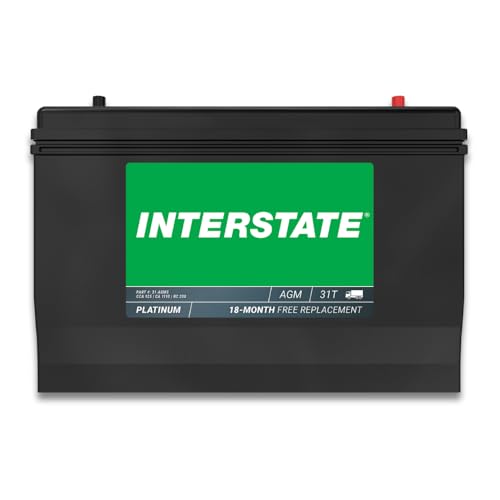
Interstate 31-AGM5 12V 100Ah Group 31 AGM Marine/RV Battery makes the shortlist because pure lead plates for long deep-cycle life.

Why it made the shortlist

Interstate's 31-AGM5 is a pure lead AGM in group 31 size, rated 100Ah with 925 cold cranking amps and 1110 cranking amps.

It sits second because it does two jobs well: deep cycling for house loads and enough cranking power to start an engine.

What works

  • Pure lead plates for long deep-cycle life
  • 925 CCA can start a motorhome engine
  • Standard group 31 size fits many trays
  • Retail network for warranty and recycling

Watch out for

  • Pricier per amp-hour than the Renogy 200Ah
  • Marketing is focused on boats rather than RVs
03
Weize 12V 100Ah Deep Cycle AGM Battery
  • 12V 100Ah, 12.99 x 6.73 x 8.43 in
  • Charges from 14F to 122F
  • 1100A 5-second max discharge
Check price on Amazon for Weize 12V 100Ah Deep Cycle AGM Battery (opens in a new tab)
Best for: Budget-minded campers replacing a stock 12V battery

Our take

Best for weekend trailer owners who want a sealed upgrade from a worn stock battery without spending much.

Why it made the shortlist

Weize's 100Ah AGM is a straightforward sealed deep cycle battery measuring 12.99 x 6.73 x 8.43 inches. It lists a charging range of 14F to 122F and a discharging range of 5F to 122F, plus a 1100A five-second maximum discharge.

What works

  • Published charging range down to 14F
  • Self-discharge of 1 to 3% per month
  • Compact enough for most group 31 trays

Watch out for

  • Only a one year warranty
  • Returns go through the seller, not Amazon
The catch
It undercuts the Interstate above by a wide margin on price for the same 100Ah rating, though it lacks pure lead plates and cranking ratings.
04
Best for: Owners who want extra amp-hours in a standard group 31 tray

Our take

Best for travel trailer owners with a group 31 box who want the most sealed capacity without changing trays.

Why it made the shortlist

The MM-G31M squeezes 110Ah into a group 31M case measuring 13.00 x 6.81 x 8.35 inches, with 825 CCA and 240 minutes of reserve capacity. Mighty Max publishes up to 700 cycles at 50% depth of discharge and backs it with a two-year warranty.

Compared with the Interstate group 31, it gives more amp-hours for less money, while Interstate wins on pure lead construction and retail support.

What works

  • 110Ah is the most capacity in a group 31 here
  • Published 700 cycles at 50% depth of discharge
  • Backed by a two-year limited warranty
  • Rugged ABS case resists heat and impact

Watch out for

  • 70.7 lbs is heavy to lift into a tray
  • Reserve and cranking specs aimed at boats
The catch
It ranks behind the Weize because it costs more, but it offers 10Ah more capacity, a real cycle-life figure, and double the warranty.
05
Renogy 12V 100Ah Deep Cycle AGM Battery (2 Pack)
  • Two 12V 100Ah batteries
  • Rated -4F to 140F discharge
  • 2-year warranty
Check price on Amazon for Renogy 12V 100Ah Deep Cycle AGM Battery (2 Pack) (opens in a new tab)
Best for: Trailers with dual group 31 trays wanting a matched sealed bank

Our take

Best for travel trailers with two side-by-side battery trays.

Why it made the shortlist

This Renogy two-pack gives you a matched pair of 12V 100Ah AGM batteries, which is the safest way to build a parallel bank since both start with identical age and chemistry. Renogy rates discharge performance from -4F to 140F and covers both batteries with a two-year warranty.

The upside versus the single battery is handling: each 100Ah unit is much lighter to install, and the pair fits the dual tray many trailers already have.

What works

  • Matched pair for a 200Ah parallel bank
  • Published discharge range from -4F to 140F
  • Two-year materials and workmanship warranty
  • Two smaller batteries are easier to lift

Watch out for

  • Needs space and cables for two batteries
The catch
It ranks below the single Renogy 200Ah because it costs more for the same total capacity and needs extra cabling.
06
Best for: Small trailers and pop-ups with a group 24 battery box

Our take

Weize Group 24M Dual Purpose AGM Battery, 12V 90Ah, 550 CCA makes the shortlist because group 24 size fits smaller trailer trays.

Why it made the shortlist

Weize's group 24M is a 90Ah dual purpose AGM with 550 CCA and 150 minutes of reserve capacity. Weize recommends charging at 14.4V with up to 15.8A, and backs this model with a two-year warranty.

What works

  • Group 24 size fits smaller trailer trays
  • Dual purpose for starting and house loads
  • 2-year warranty, double Weize's 100Ah model
  • Charges up to five times faster than flooded

Watch out for

  • Least capacity among the picks
  • Needs a 14.4V charge setting for best results
The catch
It ranks last on capacity, but it is the only pick that fits a group 24 box, which is common on smaller travel trailers and pop-ups.

Methodology

How We Built This Shortlist

Each pick was assessed across 5 criteria weighted for real-world use.

01

Rated Capacity at the 20-Hour Rate

We compared amp-hour ratings at the standard 20-hour rate and noted when makers also published faster-rate capacities, which are more realistic for inverter loads.

02

Group Size and Weight

We matched each battery to common RV tray sizes (24, 31, and larger) and noted weights, since AGM batteries of similar capacity can differ by 10 pounds or more.

03

Temperature Behavior

We checked published charge and discharge temperature ranges, because cold weather capacity is one of AGM's main advantages over lithium.

04

Dual Purpose vs Deep Cycle

We separated batteries with cranking ratings from pure deep cycle models so you can match the battery to its job.

05

Warranty Length

We compared warranty terms, which range from one to two years here and signal how confident the maker is in cycle life.

Decision guide

Match an AGM RV Battery to Your RV

By Battery Tray Size

Tray or bayRecommended pick
Group 24 box on a small trailerWeize Group 24M
Single group 31 trayMighty Max MM-G31M
Two group 31 traysRenogy 100Ah AGM 2 Pack
Large basement bayRenogy 200Ah AGM

By Budget

BudgetRecommended pick
Under $180Weize 100Ah AGM
$180 to $250Weize Group 24M or Mighty Max MM-G31M
$250 to $300Renogy 200Ah AGM or Interstate 31-AGM5
About $370Renogy 100Ah AGM 2 Pack

Deep Cycle vs Dual Purpose

Pure deep cycle

Thicker plates designed for long, slow discharges like running lights and a furnace overnight. No meaningful cranking rating. In this roundup: Renogy 200Ah AGM, Weize 100Ah AGM, Renogy 100Ah AGM 2 Pack.

Dual purpose

Plates balanced between short high-current bursts for engine starting and moderate deep cycling. Useful where one battery does both jobs. In this roundup: Interstate 31-AGM5, Mighty Max MM-G31M, Weize Group 24M.

Trailer owners should default to pure deep cycle; choose dual purpose only if the battery may also start an engine or generator.

By Climate

Where you campRecommended pick
Below freezing nights oftenRenogy 100Ah AGM 2 Pack (rated to -4F)
Cold mornings, needs to charge coldWeize 100Ah AGM (charges from 14F)
Mostly mild weatherRenogy 200Ah AGM
Cold starts for a motorhome engineInterstate 31-AGM5 (925 CCA)

For Long-Term Storage Specifically

Look for

A published monthly self-discharge rate of 3% or less, so the battery holds charge through months of storage without a maintainer.

In this comparison

The Renogy 200Ah AGM lists self-discharge below 3% per month at 77F, so a rig parked for a season will still have usable charge, though a maintainer is still smart.

When to Spend More

Spend more if

Your motorhome needs one battery that can crank the engine and run house loads, which justifies the Interstate 31-AGM5's pure lead plates.

Save if

You only need a sealed house battery for weekend trips, where the Weize 100Ah AGM does the job for much less.

FAQ

Before You Bring One Home

Can I use an AGM battery with my stock RV converter?

Usually yes, since AGM is lead acid and most converters charge it adequately. However, many older converters charge at a lower voltage than AGM prefers, so the battery may never reach full charge. If your converter has a selectable profile, set it to AGM; if not, consider a converter upgrade.

What mistake shortens AGM battery life the most?

Repeatedly running it nearly flat. Discharging below about 50% regularly, or leaving it discharged for days, causes sulfation that permanently reduces capacity. Recharge promptly after each trip and use a battery monitor to watch state of charge.

Is AGM worth it over flooded lead acid?

For most RVers, yes, if you value no maintenance and no venting. AGM costs more per amp-hour but needs no watering and can be mounted in enclosed spaces. Flooded batteries remain cheaper and tolerant, but only if you will check water levels regularly.

How do I connect two AGM batteries in parallel?

Connect positive to positive and negative to negative using equal length heavy gauge cables. Take the RV's main positive from one battery and the main negative from the other, so both share the load evenly. Always use two identical batteries of the same age, like the Renogy two-pack.

Is AGM or lithium better for an RV?

Lithium offers far more usable capacity, lighter weight, and longer life, but costs more and needs heating or protection to charge below freezing. AGM is cheaper upfront, works with almost any converter, and handles cold charging better. If you camp mostly at hookups or in winter, AGM still makes sense.

How should I store an AGM battery over winter?

Charge it fully, disconnect it or switch off the battery disconnect, and keep it somewhere it will not get extremely hot. With low self-discharge, a quality AGM can sit for months, but topping it up every two to three months, or using a maintainer, keeps it healthy.

Bottom line

The short version

Browse more agm rv batteries on Amazon →
Bowen Higgins, RV Editor at RV Gear Lab

About the author

Bowen Higgins

RV Editor at RV Gear Lab

Bowen covers RV power, water systems, towing and leveling, upkeep and interior comfort, with a focus on matching gear to the rig, the hookups and the way you actually travel.

More from Bowen →Editorial standards

Keep reading

Related guides