

We research everything we recommend. When you buy through our links, we may earn a commission. Learn more

Buying guide · 10 min read · Updated October 1, 2026

7 Best RV Batteries for the Money in 2026: A Practical RV Guide

We compared budget lithium and AGM RV batteries by cost per usable amp-hour, warranty, and features to find the best value from $130 to $310 in 2026.

Bowen HigginsBy Bowen HigginsRV Editor at RV Gear Lab7 products comparedSpec-sheet researched

At a glance

Our top picks

The cheapest RV battery is rarely the best value. A $130 lithium that lasts thousands of cycles can cost less per year than a $190 AGM that wears out in a few seasons, while a bargain battery with no cold protection can fail the first frosty morning you charge it.

So we ranked these picks on cost per usable amp-hour and what you get for the money: warranty, low-temperature protection, Bluetooth, and fit. The lineup mixes budget LiFePO4 from RVLithTime, LIPULS, CYCLENBATT, and LiTime with value AGM options from Weize, Mighty Max, and Newport, spanning roughly $130 to $310, with buyer feedback factored in.

RV Gear Lab field notes

The Rig Fit Check

Start with the job
RVLithTime 12V 100Ah Mini Group 24 LiFePO4 Battery leads this shortlist for First-time lithium buyers on a tight budget. Use that fit as a reference point, then compare the alternatives against your own space and workload.
Specs that separate the picks
The first details to compare are 12V 100Ah, 1280Wh, 12V 100Ah, group 24, 12V 100Ah, group 27. Confirm the exact model and included components before ordering.
Trade-off to plan for
No published low-temp cutoff, charge only above 32F

Before you buy

What Matters Before You Choose an RV Battery for the Money

Key buying criteria so you get the right fit the first time.

  1. 01

    Cost per Usable Amp-Hour

    Sticker price hides a lot, because AGM batteries should only be drained to about 50% while LiFePO4 can use most of its capacity. Divide the price by usable amp-hours: a $190 92Ah AGM costs about $4 per usable Ah, while a $130 100Ah lithium costs about $1.30. Do this math with the capacity in each listing.

  2. 02

    Lifetime Cycle Cost

    A battery that lasts 700 cycles costs far more per use than one rated for 4000. Divide the price by rated cycles at a given depth of discharge to compare. Look for cycle counts tied to a specific depth of discharge, since a number with no DoD is not comparable.

  3. 03

    Hidden Charging Upgrade Costs

    Lithium batteries charge best with a lithium profile, and some older RV converters lack one. If you need a new converter or charger, add that to the battery's price. Check your converter's label or manual for a lithium setting before deciding a cheap lithium is the better deal.

  4. 04

    Included Protections

    Budget lithium batteries vary in what their BMS covers, especially low-temperature charge protection. Without it, charging on a freezing morning can damage cells and wipe out your savings. Look for an explicit cutoff temperature in the listing, such as stops charging below 32F.

  5. 05

    Warranty Value

    Warranty length is part of value, and in this price range it ranges from one to five years. A longer warranty from a seller that handles returns protects your investment. Check both the warranty term and who handles claims, since Amazon often does not process battery returns.

Our standards

Why You Can Trust RV Gear Lab

At RV Gear Lab, we compare products based on rig fit and power or hookup compatibility, verified specifications, usability, setup requirements, weight, durability, and real-world trade-offs. We do not rank products purely on marketing claims or commission rates.

We have not personally tested every product listed. Where hands-on testing is not available, recommendations are based on verified manufacturer specifications, product documentation, use-case fit, and comparative research.

How we review RV gear →

Detailed reviews

The 7 best rv batteries for the money, explained

01
Best for: First-time lithium buyers on a tight budget

Our take

Best for budget buyers upgrading from a worn lead acid battery.

Why it made the shortlist

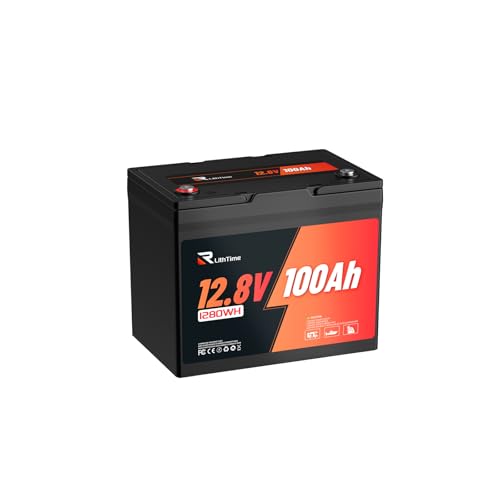
RVLithTime's Mini is a 12V 100Ah LiFePO4 battery measuring 10.2 x 6.65 x 8.39 inches, with a 100A BMS and 1280Wh of energy. The maker rates it for 4000 cycles at 100% depth of discharge and 6000+ at 80%, and lists a charging range of 32F to 113F.

What works

  • 4000 cycles at 100% depth of discharge
  • Small enough for tight group 24 boxes
  • Expands to a 51.2V 400Ah system

Watch out for

  • No published low-temp cutoff, charge only above 32F
  • No Bluetooth or listed warranty term
The catch
Compared with the LIPULS below, it is cheaper and slightly smaller, but the LIPULS spells out its protections more clearly.
02
Best for: Value buyers wanting a well-documented group 24 lithium

Our take

Best for buyers who want a no-frills lithium that drops into nearly any tray.

Why it made the shortlist

LIPULS builds this 100Ah group 24 battery (10.23 x 6.61 x 8.30 inches) with cylindrical Grade A cells and a 100A smart BMS. It weighs 22.57 pounds and the maker claims 2.8 times the energy density of group 27 lead acid.

What works

  • Group 24 case also works in group 27 and 31 trays
  • Cylindrical cells improve heat management
  • About two-thirds lighter than lead acid
  • Expands to 400Ah and 51.2V

Watch out for

  • No Bluetooth app for monitoring charge
03
Best for: Buyers who want Bluetooth and cold protection on a budget

Our take

Best for value hunters who would otherwise buy a separate battery monitor.

Why it made the shortlist

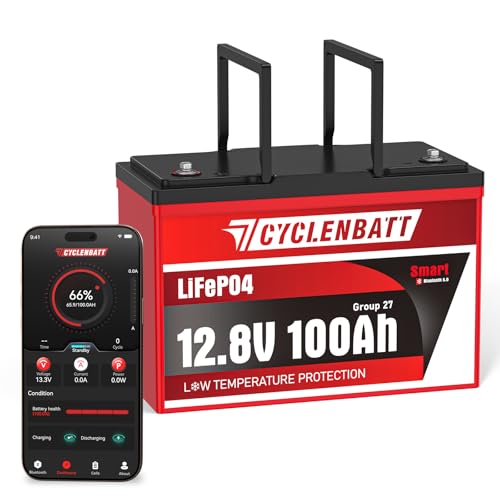
CYCLENBATT's Bluetooth model is a group 27 LiFePO4 weighing 21.49 pounds, with a BMS that cuts charging below 32F and discharging below -4F. Bluetooth 5.0 lets you check state of charge from your phone, and it carries a five-year warranty with CYCLENBATT covering return costs for quality issues.

Compared with the LiTime below, it costs about $100 less with a similar feature set.

What works

  • Charge cutoff below 32F protects cells
  • 5-year warranty with covered return costs
  • 21.49 lbs for a group 27 battery

Watch out for

  • Costs about $80 more than the RVLithTime
  • Over 5000 cycles, fewer than some rivals claim
The catch
It ranks third on price, but it packs the most features per dollar: Bluetooth, cold protection, and a long warranty, which the two cheaper lithium picks lack.
04
Best for: Buyers comparing capacity, compatibility, included components and storage needs

Our take

Best for buyers who see brand support as part of the value.

Why it made the shortlist

LiTime's group 24 battery weighs 21.9 pounds, fits group 24, 27, and 31 boxes, and includes Bluetooth monitoring with cutoffs that stop charging below 32F and discharging below -4F. LiTime rates it for up to 15,000 cycles and covers it with product liability insurance.

Compared with the CYCLENBATT above, you pay about $100 more for similar features from a better-known RV brand.

What works

  • Established brand with strong RV following
  • Fits group 24, 27, and 31 boxes
  • Charge cutoff at 32F, discharge cutoff at -4F
  • Covered by product liability insurance

Watch out for

  • Most expensive pick in this roundup
  • Same 100Ah as cheaper options
The catch
It ranks fourth because it costs more than double the RVLithTime for the same 100Ah, but brand reputation and support are part of value.
05
Best for: Cold-weather campers who want to avoid charging upgrades

Our take

Best for owners with older converters or winter campers who do not want to deal with lithium charging limits.

Why it made the shortlist

Weize's group 27M is a 92Ah dual purpose AGM with 580 CCA and 175 minutes of reserve capacity, backed by a two-year warranty. Weize recommends charging at 14.4V with up to 18.4A.

What it offers in return is compatibility: no lithium profile is needed, and lead acid can be charged in cold weather.

What works

  • Works with any stock RV converter
  • Charges in cold weather unlike most lithium
  • Starts engines and runs house loads

Watch out for

  • Only about 46Ah usable for long life
  • Heavier and shorter-lived than lithium
The catch
The caveat is lifespan; expect fewer seasons than any of the lithium picks.
06
Best for: Small trailers needing a cheap sealed replacement battery

Our take

Best for small trailer owners replacing a stock group 24 battery cheaply.

Why it made the shortlist

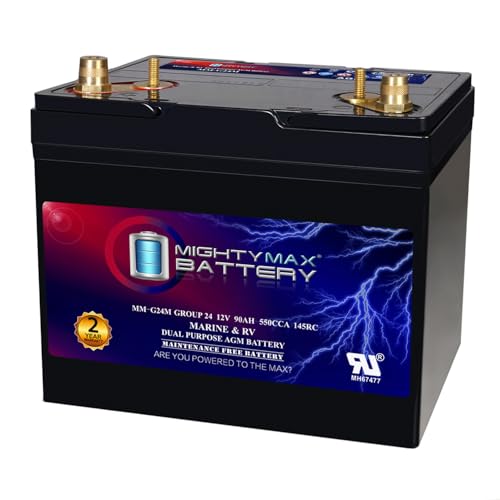
The MM-G24M is a 90Ah group 24M dual purpose AGM, with 550 CCA and 145 minutes of reserve capacity. It measures 10.25 x 6.63 x 8.63 inches, weighs 52.2 pounds, and Mighty Max publishes up to 700 cycles at 50% depth of discharge with a two-year warranty.

What works

  • Publishes 700 cycles at 50% depth of discharge
  • Group 24 size fits small trailer boxes
  • Spill-proof ABS case resists heat and impact
  • Backed by a two-year limited warranty

Watch out for

  • 52.2 lbs is more than twice lithium's weight
  • Lower capacity than the Weize 27M
The catch
It ranks sixth because it costs about the same as the Weize 27M while offering 2Ah less, but it fits a smaller group 24 tray and comes with a published cycle-life figure.
07
Best for: Pop-ups and teardrops with minimal 12V loads

Our take

Best for teardrop and pop-up owners running a few lights and a water pump.

Why it made the shortlist

Newport's 50Ah sealed AGM weighs 32 pounds and is the cheapest way to get a usable house battery into a small camper. Its sealed, leak-proof build needs no watering.

It ranks last because its cost per usable amp-hour is the worst here: at about 25Ah of daily use, the RVLithTime gives roughly four times the usable energy for the same money.

What works

  • 32 lbs is light for AGM
  • Sealed, leak-proof design needs no watering
  • Fine for occasional lights and water pump use

Watch out for

  • Only about 25Ah usable per night
  • Marketed for boats, little RV guidance
The catch
It earns a spot for owners who truly need only a small battery.

Methodology

How We Built This Shortlist

Each pick was assessed across 5 criteria weighted for real-world use.

01

Cost per Usable Amp-Hour

We divided price by usable capacity, about 80 to 100% for LiFePO4 and 50% for AGM, so batteries of different chemistries compare fairly.

02

Lifetime Cost

We weighed published cycle life, since a battery that lasts ten times longer can be cheaper even at a higher upfront price.

03

Features per Dollar

We credited Bluetooth, low-temperature cutoffs, and warranty length that come included at no extra cost.

04

Compatibility Costs

We considered whether a battery requires a converter or charger upgrade, which can add to the real price.

05

Fit and Weight

We checked group sizes so value picks will drop into existing trays without modification.

Decision guide

Match an RV Battery for the Money to Your RV

By What You Value Most

PriorityRecommended pick
Lowest cost per usable amp-hourRVLithTime 100Ah Mini
Built-in monitoring on a budgetCYCLENBATT 100Ah Bluetooth
Known brand supportLiTime 100Ah Group 24
No charging system changesWeize Group 27M

By Budget

BudgetRecommended pick
About $130RVLithTime 100Ah Mini or Newport 50Ah
About $166LIPULS 100Ah
$190 to $210Weize Group 27M, Mighty Max MM-G24M, or CYCLENBATT 100Ah Bluetooth
About $310LiTime 100Ah Group 24

Budget Lithium vs Budget AGM

Budget lithium

Costs about the same as AGM upfront but gives roughly double the usable energy and thousands more cycles; needs a lithium charging profile and protection from freezing charges. In this roundup: RVLithTime 100Ah Mini, LIPULS 100Ah, CYCLENBATT 100Ah Bluetooth, LiTime 100Ah Group 24.

Budget AGM

Works with any converter and charges in the cold, but only about half its capacity is usable and it wears out sooner. In this roundup: Weize Group 27M, Mighty Max MM-G24M, Newport 50Ah.

Most buyers get more for their money from budget lithium, unless their converter cannot charge lithium or they charge in freezing weather.

By Converter Type

Your charging setupRecommended pick
Converter with lithium modeRVLithTime 100Ah Mini
Lithium mode plus cold morningsCYCLENBATT 100Ah Bluetooth
Older lead acid only converterWeize Group 27M
Must also start an engineMighty Max MM-G24M

For Weekend Campground Use Specifically

Look for

Enough capacity for one night off hookups, roughly 40 to 60Ah usable, in a battery that fits your existing tray.

In this comparison

The LIPULS 100Ah delivers most of its 100Ah rating and fits group 24, 27, and 31 trays, covering overnight stops without changing hardware.

When to Spend More

Spend more if

You want Bluetooth and cold-charge protection, which makes the CYCLENBATT 100Ah Bluetooth or LiTime 100Ah Group 24 worth the extra cost.

Save if

You mostly camp at hookups in mild weather, where the RVLithTime 100Ah Mini gives the most for the least.

FAQ

Before You Bring One Home

Is a cheap lithium battery safe for my RV?

LiFePO4 chemistry is generally stable, and every lithium pick here includes a BMS with overcharge and short circuit protection. The main risk with budget models is charging below freezing without a cutoff. Choose a battery with a stated low-temperature cutoff if you camp in cold weather.

What is the most common mistake when buying a budget RV battery?

Comparing sticker prices instead of usable capacity. A cheap AGM may look like a deal, but only half its rating is usable and it wears out sooner. Compare cost per usable amp-hour and cycle life instead.

Is a $300 lithium worth it over a $130 one?

Sometimes. A pricier battery like the LiTime adds Bluetooth, clearly stated cold cutoffs, and brand support, which the RVLithTime lacks. If you camp in cold weather or value monitoring, the extra may be worth it; for mild-weather use, the cheaper battery delivers the same energy.

How do I switch from lead acid to a budget lithium battery?

Check that the new battery fits your tray, then set your converter or solar controller to a lithium profile if it has one. Disconnect negative first when removing the old battery, connect positive first on the new one, and secure it firmly. If your converter has no lithium setting, consider upgrading it.

Should I buy one 100Ah lithium or two cheap AGMs?

One 100Ah lithium typically gives about the same usable energy as two 100Ah AGMs, at a fraction of the weight and often a similar price. Lithium also lasts many more cycles. Two AGMs make sense only if you need cold charging without heated batteries or have an older converter.

How do I make a budget battery last longer?

Avoid deep discharges on AGM, keep lithium above freezing when charging, and use correct charge settings. Store lithium partially charged and disconnected, and keep AGM fully charged with periodic top-ups. A battery monitor helps you avoid accidental deep drains.

Bottom line

The short version

Browse more rv batteries for the money on Amazon →
Bowen Higgins, RV Editor at RV Gear Lab

About the author

Bowen Higgins

RV Editor at RV Gear Lab

Bowen covers RV power, water systems, towing and leveling, upkeep and interior comfort, with a focus on matching gear to the rig, the hookups and the way you actually travel.

More from Bowen →Editorial standards

Keep reading

Related guides