

We research everything we recommend. When you buy through our links, we may earn a commission. Learn more

Buying guide · 11 min read · Updated October 2, 2026

6 Best Budget 35 Amp RV Converters in 2026: A Practical RV Guide

Six 35 amp RV converters for pop-ups, teardrops and small trailers, compared on charge modes, input draw and drop-in fit, so a small rig gets the right output.

Bowen HigginsBy Bowen HigginsRV Editor at RV Gear Lab6 products comparedSpec-sheet researched

At a glance

Our top picks

At a glance · 6 picks

Open a small trailer's lid at a campground and count the loads: a few LED lights, a water pump, a furnace blower, a phone charger. Together they rarely pull more than a handful of amps, and that is why 35 amps remains the standard converter size for pop-ups, teardrops and compact travel trailers. This output is a shared pool, with the 12V loads served first and the battery getting what is left over.

That pool arithmetic is the key to buying well at this size. A 35 amp unit with 8 amps of lights and fans running leaves roughly 27 amps for recharging, which refills a single group 24 or 27 battery overnight but would crawl on a big lithium bank. If your rig has one or two batteries and modest loads, you are in the right class, and the savings here are real.

Cheap 35 amp converters differ less in output than in how they treat the battery. Some are fixed lead-acid profiles, some have lithium modes or adjustable voltage, and one pick is a full power center rather than a bare converter. Those differences and fit decide the ranking, so the pick matches both your battery and your cutout.

RV Gear Lab field notes

The Rig Fit Check

Start with the job
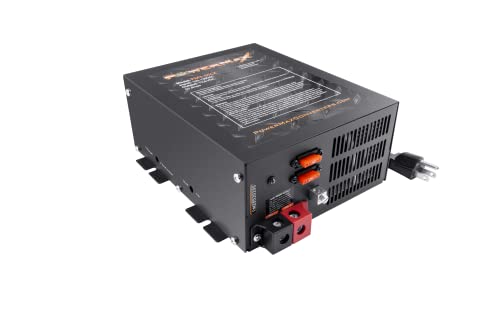
PowerMax PM3-35-SME 35A RV Converter Charger, 12V Power Supply, LCD Display leads this shortlist for Small-rig owners who want to see and set output voltage on a live display.. Use that fit as a reference point, then compare the alternatives against your own space and workload.
Specs that separate the picks
The first details to compare are 35A output, 120V AC input, 35A, 8A max AC input, 35A DC, 595W rated. Confirm the exact model and included components before ordering.
Trade-off to plan for
Chemistry is not auto-detected

Before you buy

What Matters Before You Choose a Budget 35 Amp RV Converter

Key buying criteria so you get the right fit the first time.

  1. 01

    How much is left for the battery

    Output on a 35 amp converter is shared, so the running lights, pump and fans come out of the total before the battery sees a single amp. With 8 amps of loads on, about 27 amps remain for recharging, which refills a typical single battery overnight. Total the load you actually run in the evening and subtract it from 35 to find your real recharge rate. If the remainder is under 15 amps, step up a class.

  2. 02

    Who sets the charge profile

    Some converters pick the battery profile automatically, some offer a button, and some expect you to dial in a voltage. The difference matters because lead-acid and LiFePO4 want different absorption setpoints, typically 14.4V for flooded and AGM and 14.4 to 14.6V for lithium. Honest wording says outright that chemistry is not auto-detected. Read how your pick selects the profile, and set it once.

  3. 03

    Converter or power center

    Bare converters only change AC to DC and charges the battery. A power center also holds AC breakers and DC fuse circuits, so swapping one for the other changes how your trailer is wired. Look for terms like 6 DC circuits and 5 AC circuits in a listing, and compare them with the layout you have. Buying the wrong style turns a quick swap into a rewiring job.

  4. 04

    AC draw on the branch

    This class of converter makes around 420 to 500 watts of DC, which means a few amps of AC from the pedestal or a generator. One listing here states a maximum AC input of 8 amps, a number worth finding before you share the circuit with a microwave. Small generators feel this draw, so a stated figure helps. If a listing gives only a wattage, divide by 120 for a rough amp figure.

  5. 05

    Output voltage window

    Converters that advertise 13V to 16.5V can act as an adjustable power supply, which helps if you set a lithium voltage from the battery sheet. The window also hides a trap: leaving a 16.5V setting on a 12V battery will overcharge it. Confirm a clear statement of the stages and setpoints, and keep the default mode unless you know the target. A narrow, fixed window is safer for a set-and-forget owner.

  6. 06

    Fit, clearances and cutout

    A deck-mount unit has to match the cutout, the output wiring and the clearance around its fan. One listing here gives 7.8 by 9.5 by 3.5 inches and a 7 pound weight, which is enough to compare against your old box. Measure first, and leave the free air the manual calls for at each end. Fitting without new holes is worth a little extra.

Our standards

Why You Can Trust RV Gear Lab

At RV Gear Lab, we compare products based on rig fit and power or hookup compatibility, verified specifications, usability, setup requirements, weight, durability, and real-world trade-offs. We do not rank products purely on marketing claims or commission rates.

We have not personally tested every product listed. Where hands-on testing is not available, recommendations are based on verified manufacturer specifications, product documentation, use-case fit, and comparative research.

How we review RV gear →

Detailed reviews

The 6 best budget 35 amp rv converters, explained

01
PowerMax PM3-35-SME 35A RV Converter Charger, 12V Power Supply, LCD Display
  • 35A output, 120V AC input
  • 13V to 16V adjustable, LCD readout
  • Fixed, 2-stage or 3-stage modes
Check price on Amazon for PowerMax PM3-35-SME 35A RV Converter Charger, 12V Power Supply, LCD Display (opens in a new tab)
Best for: Small-rig owners who want to see and set output voltage on a live display.

Our take

It sits near the upper end of this shortlist on price, and the step up from the cheapest units buys the display and a stable, brand-name platform.

Why it made the shortlist

A built-in LCD sets this PowerMax apart. Output voltage is adjustable from 13V to 16V and shown on screen, so the number you set is the number you can read, and charging can be set to Fixed, 2-Stage or 3-Stage for lithium, AGM, gel or flooded batteries.

Up to 35 amps flows from 120V AC shore or suitable generator power, shared between the DC loads and the battery. Electrical protection covers reverse polarity, overload, thermal and short circuit, and a proportional fan runs as needed instead of constantly.

A good match for an owner who is thinking about a lithium upgrade and wants to dial in a voltage from the manufacturer sheet.

What works

  • LCD shows the output voltage live
  • Fixed, two-stage and three-stage modes
  • Works with lithium, AGM, gel, flooded
  • Proportional fan runs as needed

Watch out for

  • Chemistry is not auto-detected
  • Sits at the high end of this shortlist
02
Best for: Deck-mount swaps where the listing's dimensions and AC draw settle the fit.

Our take

Mid-to-upper on price, it is a step under the PM3-35-SME that drops the LCD and keeps the PowerMax body.

Why it made the shortlist

Dimensions and weight are in the listing: 7.8 by 9.5 by 3.5 inches, 7 pounds, with mounting flanges. Maximum AC input is stated at 8 amps, which tells you exactly how much load it adds to the branch circuit it shares.

Factory mode runs a three-step Boost, Normal and Storage sequence at about 14.6V, 13.6V and 13.2V, and a fixed mode turns it into an adjustable 13.0 to 16.5V power supply for lithium setups with the maker's voltage dialed in. The fan runs on demand, with the usual reverse polarity, overload and thermal protection.

Best for a mid-size install where the owner wants a published footprint and a clear AC figure.

What works

  • Listing gives size, weight and AC draw
  • Adjustable fixed mode for lithium
  • Fan runs only when needed
  • Mounting flanges simplify install

Watch out for

  • Factory mode is a lead-acid profile
  • No display for voltage
03
Best for: WF-8735 owners who want the same model back with stated stage voltages.

Our take

Anyone with a WF-8735-AD that has quit, a lead-acid battery and a taste for simple matching will find it easy to buy.

Why it made the shortlist

Rated at 35 amps DC and 595W on a 105 to 130V AC input, this is a straight replacement for the WF-8735-AD family. The listing lays out its stages as 13.2V float, 13.6V absorption and 14.4V for the high-capacity mode.

Protection runs through overload, short circuit, over-voltage, over-current and over-temperature, and the unit shuts off power in abnormal conditions. Landing in the middle of the shortlist, it asks about the same as the PowerMax units while sticking to a classic three-stage lead-acid approach.

Travel trailers, campers and caravans are the stated fit.

What works

  • Stage voltages are clearly stated
  • Wide AC input window
  • Five distinct protections listed
  • Direct fit for the 8735 family

Watch out for

  • Lead-acid profile, no lithium mode
04
WF-8735-AD 30 Amp RV Converter Charger Power Center, Auto Detect, 35 Amp
  • 35A DC, 595W, 105-130 VAC
  • 6 DC circuits and 5 AC circuits
  • Auto-detect 3-stage charging
Check price on Amazon for WF-8735-AD 30 Amp RV Converter Charger Power Center, Auto Detect, 35 Amp (opens in a new tab)
Best for: Trailers that need AC breakers, DC fuses and a converter in a single replacement block.

Our take

Sitting in the same price band as the Gecious WF-8735-AD, it adds the distribution hardware, which is the reason to pick it.

Why it made the shortlist

This listing goes beyond a bare converter. It is described with a 30A main circuit, 6 DC circuits and 5 AC circuits, which makes it a power center that distributes shore power and 12V fuses while it converts and charges.

Charging is three-stage with auto-detect technology that recognizes the battery type, running 13.2V float, 13.6V absorption and 14.4V bulk, with a 105 to 130 VAC input and 35A DC output at 595W. A smart chip adds protection against overcharge, short circuit and over-temperature.

A small to mid-size trailer with a worn-out center benefits most from the single-box swap.

What works

  • Converter plus AC and DC distribution
  • Auto-detect picks the battery profile
  • Smart chip protection suite

Watch out for

  • Must match the existing circuit layout
05
Best for: PM3-35 owners swapping a failed lower tray without touching the factory wiring.

Our take

Plan for a like-for-like swap rather than a battery upgrade.

Why it made the shortlist

Fit for the PowerMax PM3-35 is the headline. Its label states it works with factory-standard wiring and needs no high-power circuit modifications, and its compact, lightweight body goes into tight RV spaces.

Output is 35 amps across a 13V to 16.5V range on 110V input, rated at 700 to 800 watts, and an electroplating coating guards the body against corrosion and oxidation. It stands as the second-lowest position in this shortlist on price, a clear step under the PowerMax units.

What works

  • Uses the factory-standard wiring
  • Compact, light, easy to place
  • Corrosion-resistant plated body
  • Low position on this shortlist

Watch out for

  • Few charging-stage details given
  • No lithium mode described
06
Best for: Buyers comparing capacity, compatibility, included components and storage needs

Our take

Sitting at the entry of this shortlist and a clear step under both PowerMax units, it gives a small rig a modern profile for little money.

Why it made the shortlist

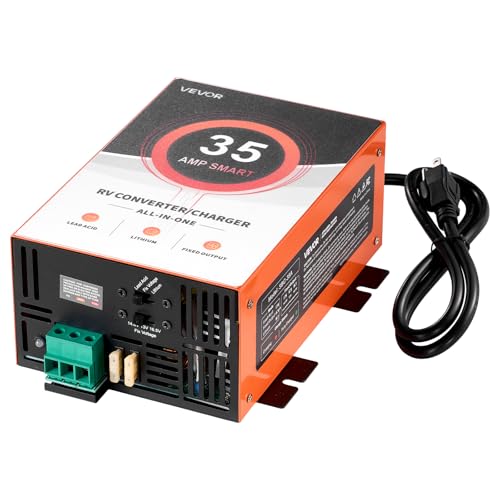
Lowest on this list, the VEVOR 35A still carries dedicated modes for lead-acid and LiFePO4 batteries plus a fixed-voltage mode with 13.0V, 14.6V or 16.5V options. That mix is the reason it earns a spot above the plain replacement units.

Charging is multi-stage with a temperature-triggered fan, and six protections cover short circuit, over temperature, overload, low voltage, overvoltage and reverse polarity. The listing frames 35 amps as suited to small-capacity battery banks and light loads such as lights and speakers.

Weekend campers with a single battery, or a small lithium bank, are the target.

What works

  • Dedicated lithium and lead-acid modes
  • Six named protections
  • Temperature-triggered fan

Watch out for

  • No display for voltage
  • Newer brand, thinner track record

Methodology

How We Built This Shortlist

Each pick was assessed across 5 criteria weighted for real-world use.

01

A genuine 35 amp rating

Each pick states 35 amps of output in its own listing, and the picks with a 30 amp label in the title were kept only because the body of the listing gives 35 amps DC. We read specs, not marketing headlines. Units that blurred the rating were set aside.

02

Treatment of the battery

We compared how each unit charges: fixed lead-acid sequence, selectable modes, adjustable voltage or auto-detect. A listing that names the setpoints scored higher than one that says smart charging alone. Lithium handling was judged as stated, with no assumption beyond the text.

03

Converter or full power center

One pick bundles AC breakers and DC fuses with the converter, so we separated bare converters from distribution blocks. The question was which one a buyer is actually replacing. Mixing the two types would send readers to the wrong part.

04

Fit information

Dimensions, weight, input draw and named replacement models all help a buyer avoid a bad swap. We favored listings that give those details and noted when a listing named the exact model it fits. Fit claims are read as stated.

05

Price position

We placed each pick as entry, mid or top within this shortlist and asked what each step up adds, such as a display, a power center or a lithium switch. No price figures appear here because listing prices move. This is an editorial assessment of product specs.

Decision guide

Match a Budget 35 Amp RV Converter to Your RV

By Rig Type

Most 35 amp buyers have one of four small rigs, and each points to a different pick.

RigRecommended pickWhy
Pop-up or teardrop with one batteryVEVOR 35ALithium and lead-acid modes at the lowest position on the list
Small trailer, lithium upgrade plannedPowerMax PM3-35-SMELCD and adjustable 13V to 16V output let you dial a setpoint
Older trailer with a dead 8735 centerWF-8735 Power CenterReplaces converter plus AC and DC distribution in one block
Older trailer with a dead PM3-35 trayFexhull PM3-35Fits factory wiring for the PM3-35 lower tray
Deck-mount swap with fit worriesPowerMax PM3-35LKPublished size, weight and 8A AC draw settle the fit

By Budget

Bands show how far the cost climbs and what each step adds on this shortlist.

Price bandRecommended pickWhat the step buys
Entry of this shortlistVEVOR 35ALithium mode and six named protections for the least spent
Low band, a small step upFexhull PM3-35Direct fit for a PM3-35 tray with plated body
Mid of this shortlistGecious WF-8735-ADStated stage voltages on a classic 8735 replacement
Mid-upper, near the GeciousWF-8735 Power CenterAdds AC breakers and DC fuse circuits
Top of this shortlistPowerMax PM3-35-SMELCD, adjustable output and multi-chemistry modes

Fixed Profile vs Adjustable Voltage

The big fork is whether the unit decides the voltage or lets you decide it.

Fixed profile

Gecious WF-8735-AD and WF-8735 Power Center run set 13.2V, 13.6V and 14.4V stages. The mechanism is a fixed lead-acid sequence, which is dependable for flooded and AGM batteries and asks nothing of the owner.

Adjustable voltage

PowerMax PM3-35-SME, PowerMax PM3-35LK and VEVOR 35A let you set 13.0V to 16.5V or pick a lithium mode. The mechanism is a user-set output, which is how a lithium or mixed bank gets the right absorption voltage.

Lead-acid and no tinkering points to Gecious WF-8735-AD, while any lithium plan points to PowerMax PM3-35-SME or VEVOR 35A.

By What You Are Replacing

Fit decides the job more than output does, so start with the label on your old unit.

Existing unitRecommended pickWhy
PM3-35 lower trayFexhull PM3-35Listing states fit and reuse of factory wiring
WF-8735-AD converterGecious WF-8735-ADSame model family with 105-130V input and 595W rating
WF-8735 power centerWF-8735 Power CenterCarries 6 DC and 5 AC circuits like the original
Unknown 35A deck unitPowerMax PM3-35LKPublished dimensions let you compare to the cutout

For Small Lithium Banks Specifically

A small LiFePO4 bank still needs the correct profile, even at 35 amps.

Look for

A named LiFePO4 mode or an adjustable fixed voltage near 14.6V, plus clear wording that the setpoint is yours to set. VEVOR 35A names the mode and PowerMax PM3-35-SME shows the voltage on screen.

In this comparison

VEVOR 35A is the budget route, PowerMax PM3-35-SME is the polished one, and PowerMax PM3-35LK is the documented one. Gecious WF-8735-AD and the Fexhull PM3-35 suit lead-acid.

When to Spend More

The spread on this list is modest, so the money buys features rather than amps.

Spend more if

You want to read the voltage and change chemistry later. PowerMax PM3-35-SME is the step up, with PowerMax PM3-35LK a notch below it with a published spec sheet.

Save if

Your rig has one battery and light loads. VEVOR 35A and Fexhull PM3-35 do the same 35 amp job for the least spent, and Gecious WF-8735-AD sits in the middle.

FAQ

Before You Bring One Home

Is 35 amps enough for a travel trailer?

For a compact trailer with one or two batteries and LED lighting, yes. The output is shared with the 12V loads, so a furnace blower and water pump reduce what reaches the battery. A larger rig with a big bank or many always-on loads should look at 45 or 55 amps. Count the evening loads first.

Can I put a 35 amp converter in place of a 30 amp one?

Two of these listings are titled 30 Amp yet describe 35 amps of DC output, so the labels are loose. The AC side deserves attention: confirm the new unit's input draw suits the circuit that fed the old one. The DC side is covered by the wire gauge the old converter already used.

Does a cheap 35 amp converter work with lithium batteries?

Some do. VEVOR 35A names a LiFePO4 mode, and the PowerMax units offer a lithium-compatible adjustable setting. A plain three-stage unit like the Gecious WF-8735-AD will still charge a lithium battery, but its float stage and lower setpoint can leave it short of full. Pick a lithium-aware unit if you plan to go lithium.

What does the PowerMax LCD actually give me?

It shows the output voltage and lets you adjust it from 13V to 16V. That means you can match a battery maker's number and read it back, instead of trusting a switch position. It is useful with lithium or gel batteries, which are fussier than flooded cells. A basic AGM rig gets little from it.

How do I know if I need a power center instead of a converter?

Open the lower section of your trailer's electrical panel. If the converter, breakers and fuses are one block, you have a power center and need the matching replacement. If the converter is a separate deck-mounted box, a bare converter is the right part. Photograph the old unit and match the circuit counts.

How long will 35 amps take to recharge my battery?

A rough rule: amp-hours to replace, divided by amps left after loads. A single 100Ah lead-acid battery used to half capacity needs about 50Ah, and with 8 amps of loads running that is close to two hours of bulk charging. The final top-off stages take longer than the math implies. Larger banks scale up fast.

Bottom line

The short version

Browse more budget 35 amp rv converters on Amazon →
Bowen Higgins, RV Editor at RV Gear Lab

About the author

Bowen Higgins

RV Editor at RV Gear Lab

Bowen covers RV power, water systems, towing and leveling, upkeep and interior comfort, with a focus on matching gear to the rig, the hookups and the way you actually travel.

More from Bowen →Editorial standards

Keep reading

Related guides