

We research everything we recommend. When you buy through our links, we may earn a commission. Learn more

Buying guide · 11 min read · Updated October 2, 2026

6 Best Budget 40 Amp Solar Charge Controllers in 2026: A Practical RV Guide

Six budget 40 amp solar charge controllers for RV and camper rigs, compared on max PV input voltage, battery support, lithium profiles and monitoring.

Bowen HigginsBy Bowen HigginsRV Editor at RV Gear Lab6 products comparedSpec-sheet researched

At a glance

Our top picks

At a glance · 6 picks

A 40 amp controller is the size most owners reach for when a single roof grows past two or three panels. The rating describes the current delivered into the battery, so on a 12 volt bank it works out to roughly 500 to 570 watts of panels, and on a 24 volt bank about twice that. Sizing a 40 amp unit is therefore a question about your array and your bank voltage, and the number on the box answers only half of it. Everything else comes down to input voltage, chemistry support and how you read the numbers.

Budget buyers can land a genuine 40 amp MPPT unit for far less than the brand-name Rover that most roof guides recommend. What the savings remove is easy to name: a rugged enclosure with published cold-weather behavior, a polished app, and in the cheapest case the high-voltage input that makes MPPT worth having. What stays is the part that does the work, a tracked charge into a 12 volt or 24 volt battery at up to 40 amps. For a trailer with a modest roof, that is often all the controller needs to be.

We compared listings on the specs that decide whether a unit survives a real roof: the stated maximum PV input voltage, tracking claims, supported battery chemistries and how the settings are reached. Each pick below states its own 40 amp rating, and the ordering reflects who should stop at this price and who should step up. Where a listing leaves a spec unpublished, the entry says what to ask before ordering, so a gap never turns into a surprise on installation day or on the first frosty morning of the season.

RV Gear Lab field notes

The Rig Fit Check

Start with the job
Renogy Solar Charge Controller Rover 40A 12V/24V Auto Parameter DC Input MPPT Charge Controllers for Solar Panels Adjustable LCD for Gel Sealed Flooded Lithium Battery leads this shortlist for Cold-climate RV roofs with lithium banks and a 12V or 24V system.. Use that fit as a reference point, then compare the alternatives against your own space and workload.
Specs that separate the picks
The first details to compare are 40A MPPT, 12V/24V auto-detect, 40A MPPT, 12V to 48V auto-detect, 40A MPPT, 150V max PV input. Confirm the exact model and included components before ordering.
Trade-off to plan for
Max PV input voltage is not in the listing text

Before you buy

What Matters Before You Choose a Budget 40 Amp Solar Charge Controller

Key buying criteria so you get the right fit the first time.

  1. 01

    What the 40 Amp Rating Really Caps

    The 40 amps is the current the controller can push into the battery, not the wattage of the panels you can connect. Multiply it by the battery voltage and you get the output ceiling, which is roughly 500 to 570 watts at 12 volts and about double at 24 volts. Panels beyond that ceiling are clipped, so extra wattage on a 12 volt bank is wasted money rather than extra charging. Planned array watts divided by the battery voltage give the amps, so leave around 25 percent of margin before choosing the rating.

  2. 02

    Max PV Input and Cold-Morning Voltage

    The maximum PV input voltage is the figure that actually destroys a controller when it is exceeded. A panel's open-circuit voltage rises as temperature falls, so a string that is safe in July can spike past the limit on a frosty morning. Multiply the string's rated open-circuit voltage by the panel's cold correction factor, which comes from the panel datasheet, and keep the result below the controller's stated ceiling. A 23 volt cap on a 12 volt battery, as on the iSunergy, allows one panel and nothing wired in series.

  3. 03

    Spotting a Real MPPT Listing

    MPPT is widely used as a sticker on cheap boxes that behave like PWM units. A genuine tracking controller publishes a high PV ceiling, often 100 volts or more, and a tracking efficiency figure of about 99 percent. If a unit lists neither, or caps panel voltage barely above the battery's, it cannot trade extra panel voltage for extra charge current. Look for the PV ceiling and the efficiency claim in the title or bullets rather than trusting the word MPPT alone.

  4. 04

    Battery Voltage and Lithium Profile

    Confirm that the controller supports your bank voltage, because a 12 volt and 24 volt unit will not run a 48 volt system. For lithium, the listing should name a lithium setting or allow user-defined voltages, since a lead-acid routine can undercharge a LiFePO4 pack or run an equalization stage it should never see. Lithium needs no equalization, and a low-temperature cutoff only works if the controller reads the battery's own temperature. The listing's chemistry line tells you which of these you are getting.

  5. 05

    Temperature Range and Cooling

    A 40 amp controller moves enough current to warm itself, and roofs and wiring bays add more heat. A published operating range tells you how the unit behaves when it is freezing or baking, and a die-cast body or fan shows that the maker planned for dissipation. Mounting space around the unit still matters, since a controller crammed beside the inverter will derate no matter its rating. Check whether the listing quotes both a cold and a hot limit before you pick one for a four-season rig.

  6. 06

    Monitoring: Screen, App or Neither

    An LCD lets you read charge current and voltage on the wall beside the batteries, which suits a quick walk-by check. An app shows history and faults from your seat, but it adds a dependence on Bluetooth range and phone updates. Some units leave a monitoring port that accepts a separate module, which keeps the unit simple and lets you add a screen later. Decide where you will actually look at the numbers, then pick the form that matches.

Our standards

Why You Can Trust RV Gear Lab

At RV Gear Lab, we compare products based on rig fit and power or hookup compatibility, verified specifications, usability, setup requirements, weight, durability, and real-world trade-offs. We do not rank products purely on marketing claims or commission rates.

We have not personally tested every product listed. Where hands-on testing is not available, recommendations are based on verified manufacturer specifications, product documentation, use-case fit, and comparative research.

How we review RV gear →

Detailed reviews

The 6 best budget 40 amp solar charge controllers, explained

01
Best for: Cold-climate RV roofs with lithium banks and a 12V or 24V system.

Our take

The app also supplies real-time data and a 30-day history, and the build adds reverse polarity, overcharge, short-circuit and reverse current protection.

Why it made the shortlist

The Rover 40A is a 12V and 24V auto-detecting MPPT controller that lists 98% conversion and 99% tracking efficiency. It carries four-stage charging for lead-acid batteries and a dedicated two-stage routine for lithium, so the same unit suits a flooded bank today and a LiFePO4 swap later without replacing the controller. Rust and corrosion resistant construction is part of the build, which helps on a roof.

Its distinguishing detail is the stated operating range of -40F to 149F, with built-in low-temperature protection whose cutoff can be adjusted in the Renogy DC Home app. No other pick in this guide publishes a cold-weather limit that low, which is the number that matters for a winter trailer parked under snow load, where a lithium battery must not be charged below its own safe temperature.

Buy it when the controller will live on the roof of a rig used year-round and a recognizable brand makes warranty questions simple. Owners who travel through all four seasons get the most from every feature it carries.

What works

  • Cold-weather range published down to -40F
  • Adjustable low-temperature lithium cutoff
  • 99% tracking and 98% conversion listed
  • Full protection suite plus app history

Watch out for

  • Max PV input voltage is not in the listing text
  • Most expensive pick in this guide
  • Handles 12V and 24V banks only
02
Best for: Lithium rigs where phone monitoring and BMS wake-up matter most.

Our take

Monitoring runs through the Noi Solar app on iOS and Android over WiFi and Bluetooth, covering PV input, battery percentage, charge state and fault history.

Why it made the shortlist

This controller auto-detects 12V, 24V, 36V and 48V banks and delivers the full 40 amps without a manual voltage setting. It accepts up to 120V of PV input, with recommended array sizes of 390W at 12V, 780W at 24V, 975W at 36V and 1040W at 48V, so the numbers for sizing a string are printed in plain terms.

The standout feature is 0V LiFePO4 activation: if a battery management system shuts a pack down on low voltage, the controller can wake it using solar input alone, with no second battery or charger. Reverse polarity is detected on both the battery and PV connections before any circuit is energized, and a clear fault is shown instead of a silent failure.

The body has no screen at all, which suits a unit tucked into a wiring bay that is checked from a phone. Local Bluetooth handles setup at the rig, and WiFi covers the rest.

What works

  • Wakes a BMS-tripped LiFePO4 battery from solar
  • Handles 12V through 48V banks automatically
  • Fault history and live data in the app
  • Reverse polarity caught before power-up

Watch out for

  • No onboard display for quick checks
  • Three-stage charging with no four-stage option
  • Setup and monitoring depend on the phone app
03
Best for: Long series strings and 24V or 48V banks on a tight budget.

Our take

An RS485 port is available for Wi-Fi remote monitoring through an optional module, so an app can be added later without replacing the controller.

Why it made the shortlist

The OAE 40A takes a 150V maximum PV input, which is the highest ceiling in this guide short of the 160V OOYCYOO. That headroom lets panels be wired in longer series strings, where thinner and cheaper cable carries the current from the roof, and it leaves comfortable margin on a cold morning when open-circuit voltage climbs.

Sizing is printed for every bank voltage: 570W at 12V, 1130W at 24V, 1710W at 36V and 2270W at 48V, with automatic detection across all four. Battery temperature compensation is listed, which trims the charge voltage as the battery warms, and sealed, gel, flooded and lithium chemistries are all supported by the same controller, so one unit covers any bank.

It sits below the Noi 40A on price while matching it on bank flexibility, and it is the pick for anyone who wants high-voltage input without paying for a brand name. Owners planning to grow from a small roof to a bigger one will appreciate that the same unit keeps working as the array expands.

What works

  • 150V PV ceiling allows long series strings
  • Sizing printed for 12V through 48V banks
  • Battery temperature compensation is listed
  • RS485 port leaves room for Wi-Fi later

Watch out for

  • Wi-Fi monitoring is a separate purchase
  • Few extras beyond the core controller
  • Tracking efficiency is not quoted
04
Best for: Rigs with a 500W-plus array that need a documented input window.

Our take

Heat is handled by a die-cast aluminum body plus a fan that switches on above 45C and off below 40C, which keeps the unit working through a summer roof or a hot battery bay.

Why it made the shortlist

OOYCYOO publishes the most complete input window of the six: 160V maximum PV, with a recommended 500W and a 20V to 80V string on a 12V system, then 1000W on a 24V system. A buyer can match a planned panel string against those figures on paper before spending anything, which removes most of the guesswork from a first solar install.

Charging follows a four-stage routine of bulk, boost, float and equalization, and parameters can be preset or defined by the user for lead-acid, sealed, gel, flooded and LiFePO4 batteries. The listing quotes 99% tracking, and negative grounding is part of the design, which matches the wiring convention used on most RV chassis and keeps the install straightforward for a first-time builder.

An LCD shows the working data, making this the strongest all-round unit among the mid-priced picks for a 12V to 48V build with a sizable array.

What works

  • Published input window is easy to size against
  • User-defined charge parameters for lithium
  • Die-cast aluminum body with a cooling fan
  • LCD for quick checks at the controller

Watch out for

  • Fan adds one more moving part
  • No app or Bluetooth is listed
  • Fan adds a little noise under heavy load
05
Best for: A single 12V or 24V roof system that wants real MPPT at the lowest sensible cost.

Our take

Against the OOYCYOO 40A it steps down to a 100V ceiling and a 12V or 24V bank, which is exactly the envelope most RV roofs with two to four panels live inside.

Why it made the shortlist

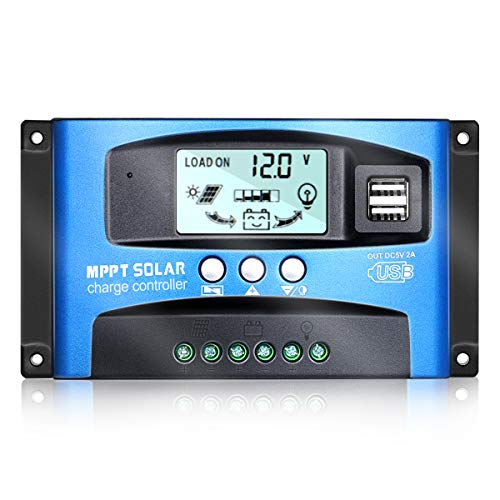
The GM-D40 delivers 40 amps with a 100V maximum PV input, sized for up to 480W on a 12V bank or 960W on a 24V bank. Those are the figures a true MPPT unit should publish, and they put it clearly on the right side of the line that separates tracking controllers from relabeled PWM boxes. The LCD shows live data at a glance.

It lists 99.9% tracking efficiency with 98% conversion, an operating range of 14F to 149F, and seven protections covering short circuit, over-discharge, overcharge and over-current. A dual USB port on the side charges a phone straight from the controller. Magnetic rings and capacitors in the design are credited with steady operation, which suits an owner who wants a plain, reliable box.

The saving is meaningful, so it is the sensible stop for an owner who wants tracked charging without paying for flexibility they will not use.

What works

  • Real MPPT figures published: 100V and 99.9%
  • Sized clearly for 480W on 12V
  • USB ports top up a phone at the roof
  • Sensible seven-way protection list

Watch out for

  • Handles 12V and 24V banks only
  • No app or Bluetooth is listed
  • Freezing range stops at 14F
06
Best for: One or two 12V panels wired in parallel on a lead-acid bank.

Our take

The listing states that a 12V battery accepts at most 23V of panel voltage, which defines the use case precisely: one 12V-class panel, or several wired in parallel.

Why it made the shortlist

The iSunergy 40A is the entry pick here and the cheapest way to get a 40 amp rating with an LCD. The screen shows charging and discharging current, cumulative generation and temperature, and the controller adds light control with a delay timer and adjustable charge and discharge parameters, which makes it handy for a shed light or a small outbuilding.

It lists tracking efficiency of 99.5% or better with a maximum conversion efficiency of 98%, and two USB outputs rated at up to 2.5A for phones. Short-circuit, open-circuit, reverse, overload and reverse-current protection are all included, with self-recovery after a fault, so a wiring slip during a first install is far less likely to end the unit.

Within that scope it gives a cheap, readable and well-protected controller, a good fit for a small trailer, a camper shed or a spare battery bank that sees light daily use.

What works

  • Screen shows current, generation and temperature
  • Two USB ports for phones
  • Self-recovering protection circuits

Watch out for

  • 23V panel limit on a 12V battery
  • Series panel strings are ruled out
  • Framed for lead-acid batteries

Methodology

How We Built This Shortlist

Each pick was assessed across 5 criteria weighted for real-world use.

01

Stated Charge Rating

We started with the amp figure, because the number in the title is a checkable claim. Only listings that state a 40 amp rating for the unit itself were kept, and we noted which ones also give the array watts that rating supports at 12V and 24V. A rating without matching wattage guidance is harder to size a roof around.

02

Maximum PV Input Voltage

We compared the stated PV ceiling of each unit, since that is the figure that protects the controller when cold panels spike above their rated voltage. A genuine MPPT unit publishes a ceiling well above battery voltage. We treated a ceiling barely above one panel's open-circuit voltage as a PWM-class limit regardless of the MPPT label.

03

Tracking and Conversion Claims

We looked for a stated tracking efficiency and a stated conversion efficiency, which are different numbers. Tracking describes how well the unit finds the array's best operating point, while conversion describes losses in the electronics. We based this on product specs and gave more credit to listings that publish both.

04

Battery Chemistry and Voltage Support

We checked which bank voltages each controller auto-detects and whether lithium is supported by a real profile or only by a user-adjustable setting. Temperature compensation and low-temperature handling were noted where stated. We evaluated this on listing details alone.

05

Monitoring and Value

We compared screens, USB ports, app support and expansion ports, then positioned each pick within the shortlist by price band. The question for each step up was what the money buys: a higher PV ceiling, an app, a wider temperature range or a better-known warranty. Price figures were used for ordering only.

Decision guide

Match a Budget 40 Amp Solar Charge Controller to Your RV

By Array Size and Bank Voltage

The array you plan to connect decides which of these six makes sense, so start by writing down your panel watts and bank voltage.

Your arrayBest pickWhy
One or two 12V panels in paralleliSunergy 40AIts 23V panel limit suits parallel 12V panels exactly
Two to four panels, 12V or 24V bankSolaMr GM-D40100V ceiling and 480W at 12V cover a typical roof
About 500W on a 12V roofOOYCYOO 40APublishes a 500W and 20V to 80V window
Long series string or a 24V to 48V bankOAE 40A150V ceiling and sizing for every bank voltage
Cold winter use with a lithium bankRenogy Rover 40Cold range to -40F and an adjustable cutoff

By Budget

The price ladder here mostly buys PV voltage headroom and extras, since every pick carries the same 40 amp rating.

Budget bandBest pickWhat it buys
Entry of this shortlistiSunergy 40AAn LCD and a 40 amp rating for a single 12V panel setup
Low-mid of this shortlistSolaMr GM-D40Real MPPT with a 100V ceiling and dual USB
Mid of this shortlistOOYCYOO 40AA 160V window, user-defined parameters and a cooling fan
Upper-mid of this shortlistNoi 40AA WiFi and Bluetooth app plus 0V LiFePO4 recovery
Top of this shortlistRenogy Rover 40Published -40F range and a known brand behind it

Fixed Panel Voltage vs High-Voltage Strings

The real design choice is whether the panels are wired so each one sees battery-class voltage, or whether they are strung together to push higher voltage down thin cable.

Low-voltage parallel panels

The iSunergy 40A and, to a lesser extent, the SolaMr GM-D40 suit panels wired in parallel at 12V-class voltage. Cable runs are short on a van or small trailer, so the thicker wire this demands is not a problem.

High-voltage series strings

The OOYCYOO 40A, OAE 40A and Noi 40A accept 120V to 160V, so panels can be wired in series and the current on the roof cable drops. The step suits a long run from a fifth-wheel roof to a basement battery bay.

Pick the SolaMr GM-D40 for a short, simple roof, or the OAE 40A when the cable run is long.

By Battery Chemistry and Monitoring

Chemistry and how you read the numbers are separate decisions, and each pick answers them differently.

What you care aboutBest pickWhy
Reviving a BMS-tripped LiFePO4 packNoi 40A0V activation wakes the BMS from solar input
Setting custom lithium voltagesOOYCYOO 40ACharging parameters can be preset or user-defined
Temperature-compensated chargingOAE 40ABattery temperature compensation is listed
Cold-weather lithium chargingRenogy Rover 40Low-temperature protection with an adjustable cutoff
A basic lead-acid bank with a screeniSunergy 40ALead-acid framing, LCD with charge and discharge current

For RV Roofs and Van Builds Specifically

Roof space is the constraint on a rig, so the controller has to fit the array that actually fits on the roof.

Look for

A stated PV ceiling above your string's cold open-circuit voltage, bank-voltage support that matches your system, and a lithium option if you run LiFePO4. A published temperature range matters on a rig that sees winter, as the Renogy Rover 40 shows.

In this comparison

The SolaMr GM-D40 fits a typical two to four panel roof, the Noi 40A suits a lithium rig where the controller hides behind a panel, and the Renogy Rover 40 suits a trailer that stays out through winter.

When to Spend More

Moving up the shortlist buys voltage headroom, lithium handling or climate toughness, so spend where your rig is most exposed.

Spend more if

Your rig sees freezing weather, runs a lithium bank or sits far from its batteries. The Renogy Rover 40 adds the published cold range, and the Noi 40A adds BMS wake-up and app history.

Save if

You run a small lead-acid system with one or two panels and check it at the wall. The iSunergy 40A or SolaMr GM-D40 covers that job, and the savings can go toward a second panel or heavier cable.

FAQ

Before You Bring One Home

How many watts of solar can a 40 amp controller handle?

Multiply 40 amps by your battery voltage for the output ceiling. That is roughly 500 to 570 watts on a 12 volt bank and about double on 24 volts. Panels beyond that are clipped rather than damaged, though the input voltage limit still applies. Leave around 25 percent of margin when you size an array.

Why does the iSunergy 40A cap panel voltage at 23 volts?

The listing states a 23 volt panel maximum on a 12 volt battery, which is the voltage of a single 12 volt-class panel. That is why it suits one panel or panels wired in parallel. A series pair would exceed the stated limit, so treat it as a small-roof controller regardless of the MPPT label.

Is a 150V or 160V input worth paying for on a small RV?

It is worth it when your panels are wired in series or the controller sits far from the roof. Higher voltage means lower current and thinner cable for the same power. A two-panel roof on a short run does well with the 100V SolaMr GM-D40, which is the sensible value choice.

Can these controllers charge a LiFePO4 battery safely?

Each listing names lithium support, but the depth varies. The OOYCYOO 40A allows user-defined parameters, the Noi 40A can wake a BMS-tripped pack, and the Renogy Rover 40 has an adjustable low-temperature cutoff. Set the absorption voltage to your battery maker's figure and disable any equalization stage for lithium.

Do I need an app, or is an LCD enough?

An LCD is enough if you can see the controller from where you work, and it never needs a phone to function. An app such as Noi's or Renogy's adds history and fault alerts, which helps with a hard-to-reach install. The OAE 40A can add Wi-Fi later through its RS485 port.

Which wiring order should I follow when connecting a controller?

Connect the battery first, then the solar panels, then any load, because the controller reads the bank voltage when it powers on. Auto-detecting units such as the Noi 40A and the OAE 40A depend on that order. Use a fuse or breaker between controller and battery sized for 40 amps.

Bottom line

The short version

Browse more budget 40 amp solar charge controllers on Amazon →
Bowen Higgins, RV Editor at RV Gear Lab

About the author

Bowen Higgins

RV Editor at RV Gear Lab

Bowen covers RV power, water systems, towing and leveling, upkeep and interior comfort, with a focus on matching gear to the rig, the hookups and the way you actually travel.

More from Bowen →Editorial standards

Keep reading

Related guides