

We research everything we recommend. When you buy through our links, we may earn a commission. Learn more

Buying guide · 11 min read · Updated October 2, 2026

6 Best Budget 80 Amp MPPT Solar Charge Controllers in 2026: A Practical RV Guide

Six budget 80 amp MPPT solar charge controllers judged on what a real tracking unit publishes: PV voltage ceiling, working window and efficiency figures.

Bowen HigginsBy Bowen HigginsRV Editor at RV Gear Lab6 products comparedSpec-sheet researched

At a glance

Our top picks

At a glance · 6 picks

The reason to buy MPPT is a simple piece of physics. A panel rated around 18 volts at its best operating point is forced down to the battery's 13 or 14 volts by a PWM controller, and the difference is thrown away as heat. A tracking controller keeps the panel at its ideal voltage and converts the surplus into extra charging current, so the same roof puts more amps into the bank. The effect is largest in cold weather and when panel voltage sits well above battery voltage, which is exactly the situation on a big RV roof in spring.

That advantage only exists if the unit really is a tracker. Cheap controllers carry an MPPT sticker on hardware that behaves like PWM, and the tell is in the specifications. A genuine unit publishes a maximum PV input far above battery voltage, ideally with a working window and a tracking efficiency figure, while one that lists neither is very likely PWM with a new label. Every pick below was chosen because its own listing states an 80 amp rating and publishes real input figures that can be checked against the panels you plan to buy.

We compared how completely each listing documents its tracking, then weighed the stated PV ceiling, battery profiles and expansion support. The shortlist runs from a modest 160 volt entry unit up to controllers that print their exact operating window by bank voltage. Use it to buy the harvest you are paying for, rather than the word MPPT in a title, and to decide which tier of documentation your own system actually needs, whether that is a bare ceiling or a full printed window with efficiency figures for both tracking and conversion.

RV Gear Lab field notes

The Rig Fit Check

Start with the job
EPEVER 80A MPPT Solar Charge Controller, 12V 24V 48V, LiFePO4, Off-Grid, 150V max PV (size to 100V), solar controller for off grid RV cabin boat leads this shortlist for Cold-climate lithium rigs that want honest voltage guidance printed up front.. Use that fit as a reference point, then compare the alternatives against your own space and workload.
Specs that separate the picks
The first details to compare are 80A MPPT, 150V max PV, size to 100V, 80A MPPT, 150V max PV input. Confirm the exact model and included components before ordering.
Trade-off to plan for
Tracking efficiency is not quoted

Before you buy

What Matters Before You Choose a Budget 80 Amp MPPT Solar Charge Controller

Key buying criteria so you get the right fit the first time.

  1. 01

    How MPPT Turns Volts into Amps

    A panel's best operating voltage is usually well above the battery's, and a PWM controller wastes the gap while an MPPT converter reclaims it as charging current. The gain is largest when panel voltage is far above battery voltage and in cold weather, when panel voltage rises further. On a small panel in warm sun the difference can be modest, which is why the benefit grows with array size. At 80 amps you are typically running a large enough array for the extra harvest to be worth paying for.

  2. 02

    What a Real MPPT Listing Publishes

    A genuine tracking controller publishes a maximum PV input voltage well above the bank voltage and usually a tracking efficiency figure of about 99 percent. A unit that lists neither, or caps panel voltage barely above the battery's, is very likely PWM with an MPPT sticker. Look for the PV ceiling and recommended array watts per bank voltage in the title or bullets. The more of those numbers a listing prints, the less you are trusting a marketing word.

  3. 03

    Tracking Versus Conversion Efficiency

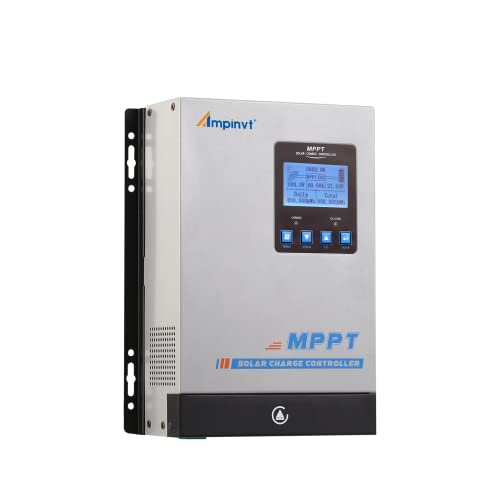
    Tracking efficiency describes how accurately the controller holds the panel at its maximum power point, while conversion efficiency describes losses as power is stepped down to the battery. They are separate numbers, and a listing that quotes both, as the Ampinvt 80A does, is more informative than one quoting a single high efficiency line. Both are manufacturer claims, not measurements you can verify at home. Treat them as a way to compare how carefully each listing documents itself.

  4. 04

    Operating Window and Start-Up Voltage

    A tracker works inside a voltage range, and your string has to sit in it to harvest well. The Ampinvt 80A prints a best range of DC18V to DC80V for a 12V bank, DC30V to DC100V for 24V and DC65V to DC150V for 48V. If your string falls below the window, the tracker may not start, and if it is too close to the ceiling you risk a cold-morning overvoltage. Match the string to the window rather than only to the maximum.

  5. 05

    Cold-Weather Gain and Cold Voc Risk

    Panels produce more voltage when cold, which helps a tracker harvest but also raises the open-circuit voltage that can exceed the controller's ceiling. Take the string's open-circuit voltage times the panel datasheet's cold correction to find the worst-case morning figure. EPEVER advises keeping a string at 100V or under against a 150V ceiling for exactly this reason. A generous ceiling, such as 160V, gives more margin for longer strings.

  6. 06

    Charge Profile for Your Chemistry

    A tracking controller only helps if it charges your battery correctly. Lithium needs a true lithium profile with no equalization, and an absorption voltage near the maker's figure, while flooded lead-acid benefits from a full four-stage routine. A label saying lithium compatible can hide a lack of a real lithium mode, so look for named profiles or a user mode with adjustable voltages. The charge stages listed tell you which battery the maker had in mind.

Our standards

Why You Can Trust RV Gear Lab

At RV Gear Lab, we compare products based on rig fit and power or hookup compatibility, verified specifications, usability, setup requirements, weight, durability, and real-world trade-offs. We do not rank products purely on marketing claims or commission rates.

We have not personally tested every product listed. Where hands-on testing is not available, recommendations are based on verified manufacturer specifications, product documentation, use-case fit, and comparative research.

How we review RV gear →

Detailed reviews

The 6 best budget 80 amp mppt solar charge controllers, explained

01
Best for: Cold-climate lithium rigs that want honest voltage guidance printed up front.

Our take

Chemistry handling is thorough, with AGM, gel and flooded settings plus LFP selections such as LFP4S for a 12V pack, and RS485 and BMS ports allow battery communication.

Why it made the shortlist

The EPEVER 80A states exactly what a tracking controller should: 150V maximum PV input, with array sizes of 1,040W at 12V, 2,080W at 24V and 4,160W at 48V. Those figures show the unit converts high panel voltage into charging current, which is the entire point of MPPT, and they let a buyer check a string on paper.

The listing goes further than most by telling owners to size strings by open-circuit voltage and keep them at 100V or under, so cold-morning spikes stay below the ceiling. That is the kind of practical guidance that protects the controller and shows how the harvest advantage is supposed to be used rather than just advertised, and it comes straight from the people who built the unit.

A two-chamber design and automatic derating above 113F protect it on a hot roof, which makes it the strongest all-round tracking unit here for a lithium rig that sees a wide range of weather.

What works

  • Prints watts for 12V, 24V and 48V banks
  • Cold-morning Voc sizing advice built in
  • BMS and RS485 ports for lithium packs
  • Derates above 113F instead of failing

Watch out for

  • Tracking efficiency is not quoted
  • Costs far more than the entry picks
  • WiFi and Bluetooth are separate dongles
02
Best for: Planners who want the exact best-working voltage range for each bank.

Our take

A large LCD displays operating data, daily generation counts and real-time energy statistics, with several load control modes.

Why it made the shortlist

Ampinvt prints the most complete operating picture of the six: 150V maximum PV input, array sizes from 1,140W at 12V to 4,540W at 48V, and a best working voltage range for each bank. That range runs DC18V to DC80V for 12V, DC30V to DC100V for 24V and DC65V to DC150V for 48V, which tells a buyer where the tracker works at its best.

It lists maximum power tracking of at least 99% and a conversion rate above 98%, with automatic control that limits charging power and current to the rated value. Both numbers are given separately, which is how a genuine tracking unit should describe itself and is the opposite of a vague high efficiency line that gives a buyer nothing to compare.

Lead-acid chemistries are built in and lithium is handled through a user profile, so a LiFePO4 bank is set up by hand. It suits an owner who builds a system with a spreadsheet and wants the datasheet to match.

What works

  • Best working window printed per bank voltage
  • Tracking and conversion listed separately
  • Daily generation and energy stats on the LCD
  • Auto-limits power to its rated current

Watch out for

  • Lithium needs a user-defined profile
  • Interface is dense for a first-timer
03
Best for: Straightforward 12V to 48V builds that want 150V headroom and no extras.

Our take

The recommended array sizes match those of the Ampinvt 80A at the same top rating, so a string planned for one transfers directly to the other.

Why it made the shortlist

The OAE 80A keeps its spec sheet short and useful: 150V maximum open-circuit input, efficiency up to 99%, and array sizes of 1,140W at 12V, 2,260W at 24V, 3,420W at 36V and 4,540W at 48V. The 150V figure is what places it in genuine tracking territory, and the wattage table covers every bank voltage a builder is likely to use.

It auto-detects 12V, 24V, 36V and 48V systems and supports sealed, gel, flooded and lithium batteries, so one unit follows a rig from a lead-acid start to a lithium upgrade without being replaced. Overcharge, over-discharge, overheat, reverse, overload and short-circuit protection are all listed in a single line, which makes the safety coverage easy to read.

The OAE presents the same numbers with a plainer feature set, which makes it the clean choice for a builder who wants the tracking advantage, the 150V ceiling and nothing else to configure.

What works

  • 150V ceiling with sizing for each voltage
  • Auto-detects banks from 12V to 48V
  • Sealed, gel, flooded and lithium supported
  • Six protections listed in one line

Watch out for

  • No working voltage range is printed
  • Few extras beyond the core controller
  • Lithium is listed without a named profile
04
Best for: Lead-acid banks that want a full four-level routine with equalization.

Our take

An LCD with four buttons displays system data dynamically and adjusts settings, so the controller can be configured without a phone or any extra software.

Why it made the shortlist

POWLAND pairs an 80 amp charge rating with a 150V maximum input and a four-level charging algorithm of bulk, boost, float and equalization. That full routine is what a flooded or AGM bank needs to avoid sulfation, and it sits alongside automatic detection of 12V, 24V, 36V and 48V systems, so the unit fits whichever bank voltage a rig already runs.

The tracking logic is described as quickly following the array's maximum power point in changing conditions, which is the behavior that makes a controller useful under passing clouds and partial shade. The unit lists short-circuit, open-circuit, reverse and overload protection, so common wiring slips are handled in hardware instead of by luck during a busy installation day.

It sits between the two PowMr listings and the EPEVER 80A on price, which makes it a sensible middle step for a lead-acid owner who wants equalization included in the box.

What works

  • Full four-level charge with equalization
  • 150V ceiling for series strings
  • Auto-detects 12V through 48V banks
  • Settings adjustable from the LCD buttons

Watch out for

  • No tracking efficiency figure is quoted
  • Lithium handling is not detailed
  • Few listed expansion options
05
Best for: Budget builds that want a 160V ceiling and parallel growth.

Our take

Protection is spelled out in unusual detail: PV array short circuit, PV input over-current, load short circuit, PV polarity reversal and battery polarity reversal.

Why it made the shortlist

This PowMr is the entry pick, yet it publishes a 160V maximum PV input, the highest ceiling among the six. That headroom is the heart of the tracking advantage, because it lets panels be strung in series for higher voltage and lower roof cable current, and it leaves generous margin on the coldest mornings of the season.

It supports up to 12 units in parallel, so a second or third controller can share the bank as the array expands, and it works with lead-acid, sealed, gel, AGM, flooded, lithium and user-defined batteries. The listing gives recommended input power for each bank voltage, which lets a string be planned ahead of the purchase.

An LCD shows the working data, and the price places it at the lowest rung of the shortlist, a strong value for an owner whose first roof is modest and who still wants genuine high-voltage tracking.

What works

  • 160V ceiling is the highest in this guide
  • Up to 12 units can run in parallel
  • Protection list names five specific circuits

Watch out for

  • No tracking efficiency figure is quoted
  • Parallel setup adds wiring complexity
  • No battery communication port is listed
06
Best for: Owners who will bolt on more panels and want to keep adding controllers.

Our take

It costs about the same as the other PowMr, so the choice between the two comes down to which listing's feature detail you prefer, and this one is clearer about its charge stages and its user-defined battery mode for lithium.

Why it made the shortlist

This listing leads with parallel support for up to 12 units and a 160V maximum PV input. For an owner who plans to grow, that pairing means the tracking advantage scales: each added controller brings its own 80 amps and handles its own panel string, all sharing one bank, so the system can start small and stay efficient as it expands.

Three integrated charge modes of bulk, boost and float run the battery, and auto-detection covers 12V, 24V, 36V and 48V systems. Lead-acid, sealed, gel, AGM, flooded and lithium chemistries are supported, with a user mode for custom voltages, so a lithium bank can be dialed in to the battery maker's published charging figures without guesswork.

What works

  • Parallel support scales the harvest later
  • 160V ceiling for long series strings
  • User mode for custom lithium voltages
  • Auto-detects banks from 12V to 48V

Watch out for

  • Three-stage routine skips equalization
  • No tracking efficiency figure is quoted

Methodology

How We Built This Shortlist

Each pick was assessed across 5 criteria weighted for real-world use.

01

A Stated 80 Amp Charge Rating

We kept only listings that state an 80 amp rating for the unit itself, because the amp figure in a title is a claim a buyer can hold the seller to. The rating describes charge current into the battery rather than panel wattage. We based this step on the listing text and product specs.

02

Is the MPPT Claim Documented?

We checked whether each listing publishes a maximum PV input well above battery voltage, since that is what separates a tracker from a relabeled PWM unit. Listings with a high ceiling, array wattage per bank voltage and ideally a working window earned the most credit. A bare MPPT label with no figures earned none.

03

Efficiency Figures

We looked for a tracking efficiency and a conversion efficiency, which measure different things. Tracking describes how well the unit follows the array's best operating point, while conversion covers electrical losses. We treated these as stated claims rather than measurements and noted where a listing quotes neither.

04

Operating Window and Cold Behavior

We compared published voltage windows, cold-morning guidance and derating notes. A tracker only earns its keep when the string voltage sits inside its working range, so a listing that prints the range is easier to plan around. We evaluated these as buyer-facing information.

05

Value Within This Shortlist

We placed each pick in a price band and asked what each step up buys: a published window, battery communication, four-stage charging or a higher PV ceiling. Price figures were used for ordering only. The result separates entry picks that suit a first build from controllers worth the extra for a larger system.

Decision guide

Match a Budget 80 Amp MPPT Solar Charge Controller to Your RV

By What the Listing Publishes

Because MPPT is easy to claim, the most reliable way to choose is by how much real data each listing prints.

If you wantBest pickWhy
An exact best-working voltage range per bankAmpinvt 80APrints 18V to 80V at 12V, 30V to 100V at 24V
Cold-morning Voc guidance and BMS portsEPEVER 80AAdvises sizing to 100V and offers RS485 and BMS
The highest PV ceiling at the lowest costPowMr 80A 160V160V maximum input at the entry of the shortlist
A plain 150V sheet with efficiency up to 99%OAE 80AWattage printed for 12V through 48V banks
Four-level charging with equalizationPOWLAND 80ABulk, boost, float and equalization in one routine

By Budget

Every unit here is a genuine high-voltage tracker, so the price steps buy documentation, communication and charge stages more than raw capability.

Budget bandBest pickWhat it buys
Entry of this shortlistPowMr 80A 160VA 160V ceiling and parallel growth at the lowest price
Low-mid of this shortlistPowMr 80A ParallelThe same ceiling with clearer three-stage and user mode detail
Mid of this shortlistPOWLAND 80AA full four-level routine with equalization
Upper-mid of this shortlistEPEVER 80ABMS communication, cold-morning guidance and derating
Top of this shortlistAmpinvt 80AA printed working window and separate efficiency figures, with the OAE 80A as the plainer alternative

High-Voltage Series Strings vs Moderate Strings

How you wire panels decides how much of the tracking advantage you capture and how much headroom you need.

Long series strings

The PowMr 80A 160V, PowMr 80A Parallel and EPEVER 80A suit strings that approach the top of the range. The 160V ceiling on the PowMr units leaves the most margin against cold-morning spikes.

Moderate strings

The OAE 80A, POWLAND 80A and Ampinvt 80A fit strings that stay comfortably inside a 150V ceiling and, for the Ampinvt, inside its printed window. Two or three panels in series on a 12V bank is a typical case.

Pick the PowMr 80A 160V for the longest strings, or the Ampinvt 80A when you want the window printed.

By Battery Chemistry

A tracker only helps if the charge profile fits the battery, so match the pick to what sits in the bank.

Battery in your bankBest pickWhy
LiFePO4 with a BMSEPEVER 80ALFP selections plus RS485 and BMS ports
Lithium with custom voltagesPowMr 80A ParallelA user battery mode for the maker's figures
Flooded or AGM needing equalizationPOWLAND 80AFour-level charging includes equalization
A mixed or changing bankOAE 80ASealed, gel, flooded and lithium from one unit
Lead-acid today, lithium via user modeAmpinvt 80AFour profile types, with lithium set by hand

For Cold-Climate and Shoulder-Season Camping Specifically

Cold mornings are where a tracker earns its price and where an under-specified one gets damaged.

Look for

A PV ceiling comfortably above your string's cold open-circuit voltage, guidance about that spike, and a published operating window. The EPEVER 80A prints that guidance, sizing strings to 100V against a 150V ceiling.

In this comparison

The EPEVER 80A leads for a winter lithium rig, the PowMr 80A 160V suits a long string that needs maximum margin, and the Ampinvt 80A suits a planner who wants the window in writing.

When to Spend More

The cheapest picks here are real trackers already, so extra spend should buy documentation or communication.

Spend more if

You run lithium with a BMS or want exact voltage windows. The EPEVER 80A adds communication and cold guidance, and the Ampinvt 80A adds a printed range by bank voltage.

Save if

You run a simple bank and plan the string yourself. The PowMr 80A 160V or PowMr 80A Parallel delivers a 160V ceiling and parallel growth, and the saving is better spent on cable and a breaker.

FAQ

Before You Bring One Home

How much more does MPPT harvest than PWM?

The gain depends on panel voltage, temperature and shading, so there is no single figure. It is largest when panel voltage is well above battery voltage and in cold weather. On a small 100 to 150 watt panel in warm sun PWM can be adequate. At 80 amps you normally have a large enough array that tracking pays for itself.

How can I tell whether an MPPT label is genuine?

Read the input specifications. A real tracker publishes a maximum PV input far above battery voltage, often 100V or more, and quotes a tracking efficiency. A unit that lists neither, or caps panel voltage barely above the battery's, is very likely PWM with an MPPT sticker.

What does a best working voltage range mean?

It is the string voltage band where the tracker harvests at its best. The Ampinvt 80A lists DC18V to DC80V for a 12V bank, for example. Strings below the band may not start the tracker, and strings near the ceiling risk overvoltage on a cold morning, so aim for the middle of the range.

Is a 99 percent tracking efficiency believable?

It is a manufacturer claim about how well the unit holds the panel at its best operating point. Conversion efficiency, a separate figure, covers electrical losses and is lower. Treat both as ways to compare how well listings document themselves, since real harvest also depends on shade and temperature.

Do I need MPPT for only one or two panels on a 12V bank?

Not always. A single 12V-class panel in warm sun gains little from tracking, and a smaller PWM or low-amp MPPT unit is often enough. An 80 amp MPPT controller makes sense for a large array, a 24V or 48V bank or a cold-climate rig. Buy the rating your array needs.

Does MPPT change the amp rating I need?

Yes, because the controller turns panel watts into battery amps. Array watts over battery voltage give the charge current, and leave around 25 percent margin. A tracker can deliver more amps than a PWM unit from the same panels, so size by array watts rather than by panel amps.

Bottom line

The short version

Browse more budget 80 amp mppt solar charge controllers on Amazon →
Bowen Higgins, RV Editor at RV Gear Lab

About the author

Bowen Higgins

RV Editor at RV Gear Lab

Bowen covers RV power, water systems, towing and leveling, upkeep and interior comfort, with a focus on matching gear to the rig, the hookups and the way you actually travel.

More from Bowen →Editorial standards

Keep reading

Related guides