

We research everything we recommend. When you buy through our links, we may earn a commission. Learn more

Buying guide · 11 min read · Updated October 2, 2026

6 Best Budget Inverter Generators with CO Shutoff in 2026: A Practical RV Guide

Six budget inverter generators with a CO shutoff sensor, explained by what the sensor does, where it falls short and why it never replaces a cabin alarm.

Bowen HigginsBy Bowen HigginsRV Editor at RV Gear Lab6 products comparedSpec-sheet researched

At a glance

Our top picks

Carbon monoxide has no smell, no color and no warning, and a generator is the most common way it reaches a camper. A CO shutoff is a sensor built into the generator that watches for dangerous levels near the unit and stops the engine when it sees them. The result is a real safety gain that costs little at this tier, and it is the reason this guide ranks the six picks on how they implement it, how they pair it with other protections and how they let you place the unit well away from where you sleep.

The sensor has limits that listings rarely spell out. It sits on the generator, so it responds to gas near the generator, which is not always where a sleeping person is breathing, and gas can pool in a bunk or closet before the sensor ever sees it. A shutoff is also no placement fix: a unit run beside an open window, under an awning or in a storage bay can fill a space with exhaust faster than a sensor reacts. And it is never a substitute for a battery-powered CO alarm inside the cabin.

Listings and specs were the source rather than bench runs, and every pick here names a CO sensor or auto-shutoff in its own text. Beyond that, the guide looks at certification wording, companion protections such as GFCI and low-oil shutdown, and the practical details of moving a unit away from the rig, because distance is the habit that protects you most. Price appears as a band only, as a position within the shortlist, because a printed figure goes stale while the safety reasoning does not, so read the placement advice before you compare watts.

RV Gear Lab field notes

The Rig Fit Check

Start with the job
Aceup Energy 6500 Watt Portable Gas Inverter Generator with CO Watchdog leads this shortlist for Large trailer and fifth wheel owners who want CO monitoring and 240V capability.. Use that fit as a reference point, then compare the alternatives against your own space and workload.
Specs that separate the picks
The first details to compare are 5200 W rated, 6500 W peak, 3500 W rated, 4500 W surge, Gas 11.5 hours, propane 34 hours. Confirm the exact model and included components before ordering.
Trade-off to plan for
Most expensive pick in this guide

Before you buy

What Matters Before You Choose a Budget Inverter Generator with CO Shutoff

Key buying criteria so you get the right fit the first time.

  1. 01

    What the CO Shutoff Actually Does

    A CO shutoff is a sensor on the generator that detects carbon monoxide near the unit and stops the engine when a dangerous level appears. It reacts to gas that has already built up next to the machine, so it works as a last line of defense rather than a prevention method. Look for wording such as auto shutoff or shutdown sensor in the title or bullets. Plain wording about the action reassures more than a bare badge does.

  2. 02

    Placement and the Open Window Problem

    Exhaust that drifts through an open window, a vent or a storage bay can reach people before the sensor on the generator sees enough gas to react. A generator run under an awning, inside a garage or in a compartment builds up exhaust quickly. The reliable habit is to place the unit in open air, well away from windows, doors and vents, with the exhaust pointed away from the rig. Weight and wheels make that easier, so check how each pick moves.

  3. 03

    A Shutoff Is Not a Cabin Alarm

    The sensor on the generator protects the machine's surroundings, while a CO alarm inside the cabin protects the people sleeping there. They guard different places, and one cannot stand in for the other. A battery-powered CO alarm near the sleeping area, with fresh batteries, is the piece that wakes you if exhaust finds its way inside. Treat the generator sensor as a bonus layer and never as a reason to run the unit close to the rig.

  4. 04

    Certification Wording

    Listings that cite UL 2201 and ANSI/PGMA G300, as the PowerSmart 3800W does, give buyers named standards to look up. EPA compliance appears on several listings and relates to engine exhaust, which is a separate matter from the CO sensor. Wording like safe or protected gives you no standard to trace. Prefer a listing that states the sensor and the standard together.

  5. 05

    Companion Protections

    Low-oil shutdown stops the engine before oil starvation damages it, and overload protection stops the unit from being run past its rating. A GFCI-protected outlet, as on the Aceup 6500W, adds shock protection at wet campsites. These protections are cheap compared with a repair, and a unit that lists several of them has had more thought put into its safety. Look for them among the listing's feature lines, since the title seldom names them all.

  6. 06

    Starting Method and Where the Unit Sits

    A remote key fob, an electric start button or a recoil pull decides how far from the rig you are willing to place the generator. Starting from inside the RV, as on the AIVOLT 4300W, removes the temptation to park the unit near the door in bad weather. A heavy unit without wheels tends to stay close because moving it is a chore. Think about the start routine on a wet night before choosing.

Our standards

Why You Can Trust RV Gear Lab

At RV Gear Lab, we compare products based on rig fit and power or hookup compatibility, verified specifications, usability, setup requirements, weight, durability, and real-world trade-offs. We do not rank products purely on marketing claims or commission rates.

We have not personally tested every product listed. Where hands-on testing is not available, recommendations are based on verified manufacturer specifications, product documentation, use-case fit, and comparative research.

How we review RV gear →

Detailed reviews

The 6 best budget inverter generators with co shutoff, explained

01
Aceup Energy 6500 Watt Portable Gas Inverter Generator with CO Watchdog
  • 5200 W rated, 6500 W peak
  • CO monitoring with auto shutdown
  • 120/240V 30A and 30A RV outlets
Check price on Amazon for Aceup Energy 6500 Watt Portable Gas Inverter Generator with CO Watchdog (opens in a new tab)
Best for: Large trailer and fifth wheel owners who want CO monitoring and 240V capability.

Our take

A digital display reports fuel level, load percentage, output wattage, voltage, runtime and total runtime, so you can watch the load stay within bounds and spot trouble early.

Why it made the shortlist

The Aceup 6500W is the heavyweight here, with a 223cc OHV engine delivering 6500 peak and 5200 rated watts at under 3 percent distortion. Built-in CO monitoring detects elevated carbon monoxide and shuts the generator down automatically, and a GFCI-protected 20A outlet adds shock protection for wet campsites. Safety sits alongside real capacity for a rig with two air conditioners.

Where the WEN 56450iX offers one 30 amp receptacle, this Aceup lists a 120/240V 30A twist-lock outlet and a 30A RV outlet, and the 30A outlets are compatible with GenerLink transfer equipment, a convenience for owners who plan home backup too. An electric-start button, a recoil starter and Eco Mode cover the starting options, while a 2.6 gallon tank feeds the engine through a long evening.

Together with a fuel shut-off, those details make this the most complete safety and monitoring package on the list, and it sits at the top of the shortlist on price.

What works

  • Highest output on this shortlist
  • CO monitoring plus GFCI protection
  • Electric start and recoil backup
  • Display shows load, fuel and runtime

Watch out for

  • Most expensive pick in this guide
  • GFCI outlet is incompatible with GenerLink
02
WEN 56450iX Dual Super Quiet 4500-Watt RV-Ready Portable Inverter Generator
  • 3500 W rated, 4500 W surge
  • 58 dBA at quarter load, 22 ft
  • Wheels, handle and TT-30R outlet
Check price on Amazon for WEN 56450iX Dual Super Quiet 4500-Watt RV-Ready Portable Inverter Generator (opens in a new tab)
Best for: RV owners who want a wheeled, quiet unit with a CO Watchdog sensor.

Our take

The outlets include two 120V receptacles, a TT-30R RV receptacle, a 12V DC port and a 5V USB port, and a digital display shows load and fuel.

Why it made the shortlist

The WEN 56450iX uses a 212cc engine to deliver 4500 surge and 3500 rated watts, and the listing quotes 58 dBA at quarter load at 22 feet. Its Watchdog CO Shutdown Sensor turns the generator off automatically if dangerous levels of carbon monoxide are detected, which is the core promise of this guide delivered in a trailer-friendly package.

Below the Aceup 6500W on output and price, it keeps the same shutoff philosophy, plus onboard wheels and a carrying handle for moving the unit well away from the rig and over uneven ground. A fuel shut-off burns the remaining fuel in the carburetor before stopping, which reduces storage problems between trips and keeps the carburetor clean.

Clean power protects phones, tablets and laptops, so one unit covers the whole campsite. Buy it when you want a sensible trailer generator with a sensor and wheels at a price just under the top of the shortlist.

What works

  • Watchdog CO sensor shuts the engine down
  • Wheels make it easy to place far away
  • Direct TT-30R receptacle for RV cords
  • Fuel shut-off protects the carburetor

Watch out for

  • Noise quoted at quarter load, 22 feet
03
AIVOLT 4300W Dual Fuel Inverter Generator
  • Gas 11.5 hours, propane 34 hours
  • 53 dBA, key fob remote start
  • 64 lb with wheels and handle
Check price on Amazon for AIVOLT 4300W Dual Fuel Inverter Generator (opens in a new tab)
Best for: Campers who want to start the unit from the couch and run propane overnight.

Our take

A dedicated 30A outlet powers air conditioners and microwaves, and the listing describes electric start as well as remote.

Why it made the shortlist

AIVOLT lists carbon monoxide auto-shutoff and low oil protection, with UL 2201 and EPA certification named, on a 4300 surge watt dual fuel inverter. A key fob remote start lets you fire it up from inside the RV, so the unit can sit well away from the awning while you stay warm and dry through a rainy night.

In place of the WEN 56450iX, it adds propane capability, with runtimes quoted at 11.5 hours on gasoline and 34 hours on propane at 25 percent load, and a noise figure of 53 dBA. The 64 pound body rides on built-in wheels with a telescoping handle, which makes a distant parking spot practical on rough ground, grass or gravel.

Propane burns in the same engine and still produces carbon monoxide, so the sensor matters on both fuels. Owners after certifications, long runtime and convenience from one machine will like it at an upper-mid price, with room to grow through remote start.

What works

  • UL 2201 and EPA certification named
  • Remote start from inside the RV
  • Propane runtime of 34 hours at 25% load
  • Wheels and a telescoping handle

Watch out for

  • Sixty-four pounds is a lot to lift
  • Noise figure gives no load or distance
04
Westinghouse iGen2800DFc Dual Fuel Portable Inverter Generator
  • 2200 W gas, 1980 W propane running
  • TT-30R and 5-20R outlets
  • 12 hours at 25% load
Check price on Amazon for Westinghouse iGen2800DFc Dual Fuel Portable Inverter Generator (opens in a new tab)
Best for: Smaller trailer owners who want propane, a CO sensor and a TT-30R outlet.

Our take

For buyers who care mostly about the sensor and want a recognizable brand and a direct RV outlet, this pick sits in the middle of the shortlist on price and keeps the output modest and the footprint small.

Why it made the shortlist

The Westinghouse iGen2800DFc is rated at 2800 peak and 2200 running watts on gasoline and 2520 peak and 1980 running watts on propane, and its title names a CO sensor. A TT-30R 30 amp outlet sits next to a 5-20R duplex, so a 30 amp shore cord plugs in directly, and the listing quotes up to 12 hours at 25 percent load.

Versus the PowerSmart 3800W, it brings a compact output class for lights, a refrigerator and electronics, with an Eco Mode that matches engine speed to demand, which saves fuel overnight and keeps the engine calm, and total harmonic distortion under 3 percent. Paralleling two units works through compatible Westinghouse cables when a trip needs full 30 amp capacity.

It suits a small trailer or a camper van that never runs an air conditioner, and propane gives a second fuel when gas is far away.

What works

  • CO sensor named in the title
  • TT-30R plugs a 30 amp cord in
  • Propane as a second fuel
  • Parallel with a compatible Westinghouse

Watch out for

  • Too small for a rooftop air conditioner
  • Propane drops rated output by 220 watts
05
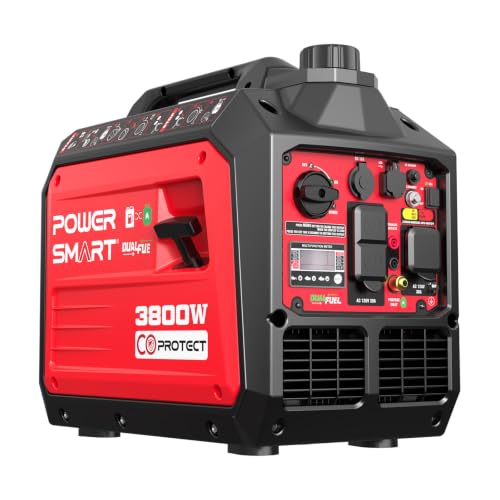
PowerSmart 3800 Watt Dual Fuel Inverter Generator with CO Protect
  • 3300 W gas, 3100 W propane running
  • Meets ANSI/PGMA G300 and UL 2201
  • 8 hours gas, 24 hours propane
Check price on Amazon for PowerSmart 3800 Watt Dual Fuel Inverter Generator with CO Protect (opens in a new tab)
Best for: Budget buyers who want the safety certifications spelled out and long propane runtime.

Our take

The panel carries a 120V 30A twist-lock, a 5-20R household duplex, a 12V 8A port and two USB ports.

Why it made the shortlist

PowerSmart lists 3800 starting and 3300 running watts on gasoline and 3500 starting and 3100 running watts on propane, with overload, short-circuit and carbon monoxide sensor protection plus low-oil shutdown on the same unit. ANSI/PGMA G300, ANSI/UL 2201 and EPA certifications are all named, which makes the safety claims easy to trace back to named documents.

Against the AIVOLT 4300W, the PowerSmart gives up remote start and wheels while keeping the dual fuel layout at a lower price, and it keeps the same CO protection. Eight hours at 25 percent load is quoted on its 1.3 gallon tank, or up to 24 hours on a standard 20 pound propane cylinder, and noise is listed at 59 dBA in Eco mode.

A buyer who wants a documented CO sensor, a decent 30 amp output and propane for storage will find it a strong value in the lower-middle of the shortlist, with parallel readiness named in the title for adding a second unit later.

What works

  • Certifications named in the listing
  • CO sensor, overload and low-oil protection
  • Long propane runtime on a 20 lb cylinder

Watch out for

  • Twist-lock 30 amp needs an RV adapter
  • No wheels or remote start
06

Best Entry Price · 6 of 6

AIVOLT 1750W Inverter Generator

AIVOLT 1750W Inverter Generator
  • 1350 W running, 1750 W peak
  • 26.5 lb, one-hand carry
  • 52 dBA, 7 hours at 25% load
Check price on Amazon for AIVOLT 1750W Inverter Generator (opens in a new tab)
Best for: Tent and van campers who want a CO sensor in a one-hand carry.

Our take

At this weight a camper can carry the unit to the far corner of a site and run a long cord back, which is the single best habit for carbon monoxide safety.

Why it made the shortlist

The AIVOLT 1750W is the entry point of the shortlist, delivering 1350 running and 1750 peak watts at under 3 percent distortion in a 26.5 pound body. A professional CO detection sensor automatically shuts the unit down if unsafe carbon monoxide builds up, which puts the headline safety feature on the cheapest generator here and removes any need to pay extra for it.

Against the Westinghouse iGen2800, it trades propane and 30 amp output for a much lower weight and a lower price, and that swap suits light loads. The 0.66 gallon tank is quoted at 7 hours at 25 percent load, and ECO mode throttles the engine to the demand. A 52 dBA rating suits quiet campsites and keeps a neighbor's evening intact.

It fits tents, vans and teardrops with light loads, where a few chargers, lights and a fan are the whole electrical story, and a small tank refills in seconds.

What works

  • CO auto shutoff on the lightest unit
  • One-hand carry reaches a distant spot
  • Cheapest way into this shortlist
  • Clean power under 3 percent distortion

Watch out for

  • Too small for any air conditioner
  • Small tank means frequent refills

Methodology

How We Built This Shortlist

Each pick was assessed across 5 criteria weighted for real-world use.

01

CO sensor and shutoff wording

Each listing was read for how it describes carbon monoxide protection, whether it names a sensor, a shutoff and the automatic behavior. Listings that explain the action in plain terms earned more credit than a badge alone. Listings and product specs were the source, so no sensor was bench tested.

02

Certifications named

We noted where a listing cites UL 2201, ANSI/PGMA G300 or EPA compliance, since those give a buyer something to look up. A certification is a claim about the product, and a clear one is more useful than a vague safety line. Absent claims were left blank rather than assumed.

03

Companion protections

Low-oil shutdown, overload and short-circuit protection and GFCI outlets were counted as part of the safety picture. A generator that watches several hazards earns a stronger score. A fuel shut-off was credited for easing storage.

04

Placement and mobility

A sensor works best when the unit sits far from the rig, so weight, wheels, handles and remote start were weighed. Distance is the best safety measure a camper controls. Cord length and outlet type were noted as practical constraints.

05

Output, noise and price position

Output was matched to typical rigs, noise figures were read with their distance and load, and price was used only to rank the picks and describe the step between them. No price figures were printed. Warranty and runtime details were recorded where stated.

Decision guide

Match a Budget Inverter Generator with CO Shutoff to Your RV

By How You Place the Generator

Distance from the rig is the best safety habit, so choose the pick you will actually move.

Placement situationRecommended pickWhy
Carry far from a tent or van by handAIVOLT 1750W26.5 lb body with a sturdy top handle and a CO sensor
Roll it across gravel or grassWEN 56450iXOnboard wheels and a carrying handle
Start it from inside in bad weatherAIVOLT 4300WKey fob remote start and a wheels kit
Large rig, unit parked beside a padAceup 6500WElectric start and a digital display of load and fuel
Compact unit for a small trailerWestinghouse iGen2800Light output class with a TT-30R outlet

By Budget

The picks span a wide range, and each band shows what the extra spend adds.

Price bandRecommended pickWhat the step buys
Entry of this shortlistAIVOLT 1750WA CO sensor in a one-hand carry
Lower mid of this shortlistPowerSmart 3800WNamed certifications and long propane runtime
Mid of this shortlistWestinghouse iGen2800Propane and a TT-30R outlet from a known brand
Upper mid of this shortlistAIVOLT 4300WRemote start, wheels and 34 hour propane runtime
Top of this shortlistAceup 6500W and WEN 56450iXHigher output, GFCI, wheels and a fuel shut-off

Gasoline Only vs Dual Fuel

Three picks burn gasoline alone and three add propane, and the sensor matters on both fuels.

Gasoline only

Aceup 6500W, WEN 56450iX and AIVOLT 1750W run on gasoline. The mechanism is a simple fuel path with a fuel shut-off on the first two, and the higher outputs suit larger rigs.

Dual fuel

AIVOLT 4300W, Westinghouse iGen2800 and PowerSmart 3800W add propane, which stores for years. Propane still produces carbon monoxide in the same engine, so the sensor is as important on propane as on gasoline.

Choose dual fuel such as the PowerSmart 3800W for storage and flexibility, and gasoline such as the WEN 56450iX for higher output.

By Other Protections Listed

A CO sensor is one layer, so compare what each listing names beside it.

Protection wantedRecommended pickWhat the listing says
Shock protection at wet sitesAceup 6500WA GFCI-protected 20A outlet
Named safety standardsPowerSmart 3800WANSI/PGMA G300, ANSI/UL 2201 and EPA
Certification plus unattended useAIVOLT 4300WUL 2201 and EPA with low oil protection
Fuel shut-off for storageWEN 56450iXBurns remaining carburetor fuel before shutdown
Sensor named in the titleWestinghouse iGen2800CO Sensor appears in the product title

For Overnight Running Specifically

Running through the night is when a sensor and a cabin alarm both earn their keep.

Look for

A unit light or wheeled enough to sit far from the rig, a runtime that covers the night so you never refuel in the dark and a CO sensor that is plainly named, as on AIVOLT 1750W with its 7 hours at 25 percent load.

In this comparison

AIVOLT 4300W quotes 34 hours on propane, PowerSmart 3800W quotes 24 hours on a 20 lb cylinder and Westinghouse iGen2800 quotes 12 hours. Pair any of them with a battery CO alarm inside the cabin.

When to Spend More

The step up buys output and convenience, while the basic sensor is already present at the entry end.

Spend more if

You need to run big loads or want comfort features. Aceup 6500W gives 5200 rated watts with GFCI and electric start, and AIVOLT 4300W adds remote start and wheels.

Save if

Your loads are light and you carry the unit. AIVOLT 1750W puts the sensor on the cheapest, lightest unit, and PowerSmart 3800W gives named certifications at a modest step up.

FAQ

Before You Bring One Home

Can I run a generator with CO shutoff close to my RV?

No. The sensor reacts to gas near the generator after it has built up, which is too late if exhaust has already entered a window or vent. Place the unit in open air well away from the rig, with the exhaust pointing away, and follow the distance in the manual. Treat the shutoff as a second layer, not permission to move the unit closer.

Do I still need a CO alarm inside the RV?

Yes. The sensor on the generator protects the area around the machine, while a battery-powered alarm in the cabin protects the people sleeping there. They guard different places. Put an alarm near the sleeping area, test it before every trip and replace its batteries on schedule, because that alarm is the one that wakes you.

What should I do if the generator shuts off in the night?

Treat it as a warning and not as a nuisance. Make sure everyone is awake and breathing fresh air, move the generator farther from the rig, and look at whether exhaust could be reaching a window or vent. Restart only after you have fixed the placement. A shutdown can also come from low oil or overload, so check those too.

Is CO shutoff worth paying more for?

It is already present on every pick here, including the cheapest AIVOLT 1750W, so it is no reason to pay a premium. What the higher tiers buy is output, wheels, remote start and extras such as the GFCI outlet on the Aceup 6500W. Choose the tier by your loads and by how far you will move the unit.

Which certification names should I look for on a listing?

The PowerSmart 3800W cites ANSI/PGMA G300, ANSI/UL 2201 and EPA, and the AIVOLT 4300W cites UL 2201 and EPA. EPA compliance concerns engine emissions in general, while the UL and ANSI names are standards you can look up. Nothing comes up to trace on a listing that names none, so lean toward the ones that cite them.

Which pick suits a small camper who wants CO protection?

The AIVOLT 1750W puts the sensor on a 26.5 pound unit with a 7 hour run at 25 percent load, ideal for tents and vans with light loads. If you need a 30 amp outlet and propane, the Westinghouse iGen2800 is the next step. Either one should sit far from the sleeping area, with an alarm inside.

Bottom line

The short version

Browse more budget inverter generators with co shutoff on Amazon →
Bowen Higgins, RV Editor at RV Gear Lab

About the author

Bowen Higgins

RV Editor at RV Gear Lab

Bowen covers RV power, water systems, towing and leveling, upkeep and interior comfort, with a focus on matching gear to the rig, the hookups and the way you actually travel.

More from Bowen →Editorial standards

Keep reading

Related guides