

We research everything we recommend. When you buy through our links, we may earn a commission. Learn more

Buying guide · 12 min read · Updated October 2, 2026

6 Best Inverter Generators with a 240V Outlet in 2026: A Practical RV Guide

Six inverter generators with a real 120/240V outlet compared on amps at 240 volts, shared watts and neutral setup, so the nominal rating does not mislead you.

Bowen HigginsBy Bowen HigginsRV Editor at RV Gear Lab6 products comparedSpec-sheet researched

At a glance

Our top picks

A 240 volt outlet on a generator does not add power, it reorganizes it. The same running watts feed the 120V receptacles and the 240V one, so a 5,250 watt unit can deliver about 21.9 amps at 240V only if nothing else is running, and every watt taken from a 120V outlet comes off that budget. The "30A" on a twist-lock label is a socket rating, not a promise, and the real limit is the running watts divided by 240, which we label as an estimate below.

We compared six inverter generators from $549.99 to $2,299 whose listings name a 120/240V receptacle: an L14-30R, a 120V/240V 23A twist lock or a 14-50R. We read running watts, outlet type, runtime, noise, weight and what the listing says about neutral configuration, since a well pump, an EV charger or a transfer switch each ask different things of the outlet.

RV Gear Lab field notes

The Rig Fit Check

Start with the job
Genkins 8000W Portable Quiet Inverter Generator for Home, Electric Start leads this shortlist for 240V well pumps and quiet backup. Use that fit as a reference point, then compare the alternatives against your own space and workload.
Specs that separate the picks
The first details to compare are 6,500W rated, 8,000W peak, 5,250W rated, 6,000W peak, 7,000W rated, 8,750W surge. Confirm the exact model and included components before ordering.
Trade-off to plan for
No 50A outlet for large transfer inlets

Before you buy

What Matters Before You Choose an Inverter Generator with a 240V Outlet

Key buying criteria so you get the right fit the first time.

  1. 01

    Amps at 240V from running watts

    A 240V outlet draws from the same running watts as the 120V outlets, so the available amps are the running watts divided by 240. A 5,250 watt unit gives about 21.9 amps, and a 30A label does not change that. Divide the listed running watts by 240, subtract any 120V loads in watts, and compare the rest to your load's nameplate amps.

  2. 02

    Outlet type and inlet match

    Generators use an L14-30R, a 23A twist lock or a 14-50R, and these do not interchange. A mismatched inlet forces an adapter, and adapters cannot raise the amps. Read the receptacle name in the feature text, such as the LIFAN 6900's 23A twist lock versus the Genkins 8000's L14-30R, and compare it to the plug on your cord or transfer switch.

  3. 03

    Starting current of the 240V load

    A well pump or compressor can draw several times its running amps for a moment at startup, and the generator must cover it. If the surge exceeds the peak rating the unit stalls or trips. Look up the pump's locked-rotor or starting amps and compare them to the peak watts on the listing divided by 240, such as the WEN GN875i's 8,750 surge.

  4. 04

    Neutral configuration

    Some generators bond the neutral to the frame and others float it, and the choice affects how a transfer switch or EV charger is wired. A wrong match can disable a GFCI or confuse a car charger. The WEN 13000 listing states a bonded-neutral 240V configuration, so ask the maker or check the manual for the others before connecting.

  5. 05

    Noise at night

    A 240V pump or EV charge may run for hours, and open frame units are louder than enclosed ones. The listings differ in whether they publish a figure at all, so an unpublished dBA is a reason to assume it is loud. Look for a dBA number with a distance, as on the Genkins 8000 and LIFAN 6900, and keep the unit as far from sleeping areas as the cords allow.

  6. 06

    Weight and runtime

    A 240V-capable generator is usually 100 lb or more, such as 106.9 lb for the GENMAX 6000 and 112 lb for the Genkins 8000, and tank size sets the refuel interval. Half-load figures like the WEN GN875i's 6.7 hours mean a night of pumping needs a refill. Compare runtime at a stated load and decide whether you can move and refuel it alone.

Our standards

Why You Can Trust RV Gear Lab

At RV Gear Lab, we compare products based on rig fit and power or hookup compatibility, verified specifications, usability, setup requirements, weight, durability, and real-world trade-offs. We do not rank products purely on marketing claims or commission rates.

We have not personally tested every product listed. Where hands-on testing is not available, recommendations are based on verified manufacturer specifications, product documentation, use-case fit, and comparative research.

How we review RV gear →

Detailed reviews

The 6 best inverter generators with a 240v outlet, explained

01
Best for: 240V well pumps and quiet backup

Our take

Pick it if your 240V need is a well pump, a small shop compressor or a transfer switch inlet and you care about noise.

Why it made the shortlist

The Genkins 8000W lists 8,000 peak and 6,500 rated watts from a 327 cc engine at 2 percent THD or less, a 4 gallon tank claimed at 8 hours at 50 percent load and 16 hours at 25 percent, and 62 dBA at 23 feet. Outlets are one 240V L14-30R, one 120V L5-30R and two 120V 5-20R. It weighs 112 lb with a telescoping handle and two never-flat tires, with electric start and a digital display.

It ranks first because it combines 6,500 running watts, a published 62 dBA figure and both a 240V and a 30A 120V outlet at $839, which is $19.01 above the LIFAN 6900 and $289.01 above the GENMAX 6000. By our arithmetic 6,500 watts is about 27.1 amps at 240V.

What works

  • 6,500 rated watts at 2% THD or less
  • Lists an L14-30R 240V and an L5-30R outlet
  • Stated 62 dBA at 23 feet
  • Runs 16 hours at 25% load on 4 gallons

Watch out for

  • No 50A outlet for large transfer inlets
  • Costs $289.01 more than the GENMAX 6000
The catch
Against the WEN GN875i it costs $60.99 less, runs enclosed and quieter, but has 500 fewer rated watts.
02
Best for: Cheapest way to get a 240V outlet

Our take

Choose it if you want a 240V outlet at the lowest price for a small pump or a transfer switch circuit that draws well under 5,000 watts.

Why it made the shortlist

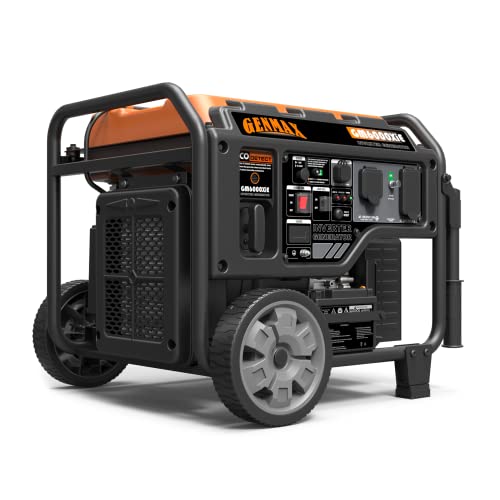
The GENMAX GM6000XiE lists 6,000 peak and 5,250 rated watts from a 312 cc engine at under 3 percent THD. Its covered outlets include a 120/240V 30A locking outlet (L14-30R) and 120V receptacles, and it has electric start with a battery and cold start technology, a steel handle and two wheels, and a claim of up to 9 hours at 50 percent load on a 3.8 gallon tank. The listing gives its weight as 106.9 lb.

It ranks second because it is the cheapest 240V pick at $549.99, $270.00 below the LIFAN 6900 and $289.01 below the Genkins 8000. It does make a 240V outlet affordable.

What works

  • Lists a 120/240V 30A locking outlet
  • Electric start with cold start technology
  • Weighs 106.9 lb on a steel handle

Watch out for

  • Lowest rated output of the six at 5,250W
  • No noise figure on an open frame unit
The catch
By our arithmetic its 5,250 watts is about 21.9 amps at 240V, the lowest here, and it is an open frame design with no stated noise figure.
03
Best for: 240V twist lock plus RV outlet in one unit

Our take

Choose it if you need both a 240V twist lock and a TT-30R RV outlet at one price.

Why it made the shortlist

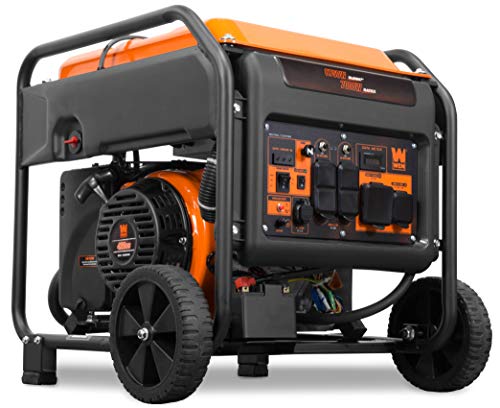
The WEN GN875i lists 8,750 surge and 7,000 rated watts from a 420 cc engine. It has four 120V NEMA 5-20R receptacles, two 5V USB ports, one 120V/240V transfer-switch-ready L14-30R twist lock and one 120V TT-30R RV outlet, with electric start, a 4.2 gallon tank claimed at 6.7 hours at half load and a body the listing says weighs 30 percent less than a traditional 8,750 watt unit.

It ranks third because it offers the highest rated watts under $900 at $899.99, with 7,000 rated watts or about 29.2 amps at 240V by our arithmetic.

What works

  • 7,000 rated watts is the highest under $900
  • Has an L14-30R 240V twist lock and TT-30R
  • Four 5-20R household outlets are included
  • Electric start with a 420 cc engine

Watch out for

  • Open frame design with no noise figure
  • Half-load runtime of 6.7 hours is short
The catch
The caveat is the open frame noise and no stated warranty term in the feature text.
04
Best for: Enclosed quiet unit with remote start

Our take

Pick it if you want an enclosed, quieter mid-size unit with remote start for a home inlet.

Why it made the shortlist

The LIFAN 6900W lists 6,900 peak and 5,500 rated watts from a 312 cc engine, with a 120V/240V 23A twist lock outlet, two 120V 20A household outlets and USB ports. It is a fully enclosed design with a 62 dB figure at 25 percent load, ECO mode, pure sine wave under 3 percent THD and a key fob that starts it from up to 50 ft. The listing calls the twist lock transfer switch ready.

It ranks fourth because the 240V outlet is a 23A twist lock rather than a 30A, which is consistent with its 5,500 rated watts and about 22.9 amps at 240V by our arithmetic. In exchange for those watts you get an enclosed case and a remote start.

What works

  • Fully enclosed body at 62 dB per the listing
  • Key fob starts it from 50 feet
  • Lists a transfer switch ready twist lock
  • ECO mode lowers engine speed under light loads

Watch out for

  • 240V outlet is 23A rather than 30A
  • Costs $270.00 more than the GENMAX 6000
05
Best for: Propane-fueled 240V backup

Our take

Choose it if you need propane as a 240V fuel and may want to parallel a second unit later.

Why it made the shortlist

The Pulsar 7,250 lists gasoline output of 7,250 peak and 6,000 running watts and propane output of 6,500 and 5,500, supports 120 and 240 volt output, and carries an L14-30R 120V/240V outlet, a TT-30 RV outlet, two GFCI 5-20R outlets and USB A and C ports. It has a 312 cc engine with an enclosed frame, parallel capability, remote, electric and recoil start, a digital display and CO detection.

What works

  • Runs 240V loads on gasoline or propane
  • Lists a CO detection safety feature
  • Includes USB A and USB C ports
  • Parallel capability lets a second unit double output

Watch out for

  • No runtime or noise figure in the listing
  • Costs $359.95 more than the Genkins 8000
The catch
Compared with the Genkins 8000 it costs $359.95 more and lists 500 fewer running watts.
06
Best for: EV charging and whole-home transfer switches

Our take

Choose it if you plan to charge an electric vehicle at 240V or feed a whole-home transfer switch.

Why it made the shortlist

The WEN TF1300iX lists 13,000 surge and 10,500 running watts on gasoline, 11,250 and 9,000 on propane and 10,000 and 8,000 on natural gas from a 550 cc engine. It has a bonded-neutral 120V/240V configuration the listing calls suited to transfer switches, emergency backup and Level 2 charging for battery and hybrid electric vehicles, and outlets include a 14-50R, an L5-30R, a 10-50R, two 5-20R, 12V DC and USB. The 7.1 gallon tank is claimed at 7.7 hours at half load.

It ranks last because at $2,299 it is $1,100.05 above the Pulsar 7250 and the half-load runtime of 7.7 hours is modest for the tank. Its case rests on the highest running watts (about 43.8 amps at 240V on gasoline by our arithmetic) and the explicit bonded-neutral statement, which none of the other listings make.

What works

  • Listing names bonded-neutral 120/240V for Level 2 charging
  • Runs on gasoline, propane or natural gas
  • Includes a 14-50R and a 10-50R outlet
  • Three-year limited warranty is stated on the listing

Watch out for

  • Costs $1,100.05 more than the Pulsar 7250
  • Half-load runtime of 7.7 hours is short

Methodology

How We Built This Shortlist

Each pick was assessed across 5 criteria weighted for real-world use.

01

A named 120/240V outlet

We checked for an L14-30R, a 23A twist lock or a 14-50R by name in the feature text, since a title that says 240V does not prove a 240V receptacle is on the panel.

02

Amps available at 240 volts

Rated watts divided by 240 gave an estimate of amps at 240V, such as about 21.9 for 5,250 watts, and we labelled that as our own arithmetic rather than a manufacturer figure.

03

Shared watts across outlets

Because 120V and 240V receptacles draw from one running-watt budget, we noted where the listing separates them and where it does not.

04

Neutral and transfer switch fit

We flagged bonded-neutral and transfer-switch-ready language, since a floating or bonded neutral can matter for a transfer switch or EV charger.

05

Noise, weight and runtime

Stated dBA, weight and hours at a stated load were compared, noting where an open frame design leaves them unpublished.

Decision guide

Match an Inverter Generator with a 240V Outlet to Your RV

By 240V Load

Match the 240V load's running amps to the estimated amps at 240V for each unit, which is rated watts divided by 240.

Your situationRecommended pickWhy
Small 240V pump, under about 15A runningGENMAX 6000About 21.9 amps at 240V at the lowest price
Well pump plus household circuitsGenkins 80006,500 rated watts, about 27.1 amps at 240V
Larger 240V shop tool or compressorWEN GN875i7,000 rated watts, about 29.2 amps at 240V
240V loads while running on propanePulsar 72505,500W on propane, about 22.9 amps at 240V
Level 2 EV charging or whole-home inletWEN 1300010,500W gasoline, bonded neutral, 14-50R

By Budget

BudgetRecommended pick
Under $600GENMAX 6000
$800 to $900LIFAN 6900, Genkins 8000 or WEN GN875i
$1,100 to $1,300Pulsar 7250
Above $2,000WEN 13000

Open Frame vs Enclosed Casing

Open frame

The GENMAX 6000 and WEN GN875i leave the engine more exposed, which keeps the price down and cooling simple. Neither listing gives a dBA figure, so plan for louder operation.

Enclosed

The LIFAN 6900 lists 62 dB at 25 percent load and the Genkins 8000 lists 62 dBA at 23 feet. They cost $19.01 to $270.00 more than the open frame GENMAX 6000, and cut the noise at the neighbor's fence.

If the generator will run at night within earshot of a house, pay for an enclosed unit such as the Genkins 8000, and use open frame units for jobsites and outbuildings.

By Connector Type You Already Own

Your inlet or cordRecommended pickWhy
L14-30 inlet on a transfer switchGenkins 8000Lists an L14-30R 240V receptacle
L14-30 inlet and a 30A RV cord tooWEN GN875iLists an L14-30R and a TT-30R
23A twist lock inletLIFAN 6900Lists a 120V/240V 23A twist lock
14-50 inlet or Level 2 EV cordWEN 13000Lists a 14-50R and a 10-50R
L14-30 inlet, propane preferredPulsar 7250L14-30R with propane at 5,500W

For Well Pump Owners Specifically

Look for

A 240V outlet with enough amps for the pump's starting current, which can be several times the running current, plus a margin for any 120V loads running at the same time.

In this comparison

The Genkins 8000 gives about 27.1 amps at 240V and the WEN GN875i about 29.2, both enough for a typical residential pump with room for a refrigerator. The GENMAX 6000 at about 21.9 amps suits only a small pump.

When to Spend More

Spend more if

You need propane at 240V, a 14-50R or EV charging; the Pulsar 7250 at $1,198.95 or the WEN 13000 at $2,299 have those, while the cheaper units do not.

Save if

Your 240V load is a small pump or a single tool; the GENMAX 6000 at $549.99 has an L14-30R and the Genkins 8000 at $839 adds quiet operation.

FAQ

Before You Bring One Home

Can I run 120V and 240V loads at the same time?

Yes, but they share one running-watt budget. A 6,500 watt unit running 1,500 watts of lights on 120V leaves about 5,000 watts, or roughly 20.8 amps, for the 240V outlet.

Is a 30A 240V outlet really 30 amps?

Only if the generator has the watts behind it. A 30A twist lock at 240V is 7,200 watts, which is above the rated output of every unit here except the WEN 13000, so the practical limit is the rated watts divided by 240.

Is the Genkins 8000 worth $289.01 more than the GENMAX 6000?

If noise and extra output matter, yes. The Genkins gives 6,500 rated watts and a 62 dBA figure, while the GENMAX is open frame with 5,250 rated watts and no stated noise.

How do I power a 240V well pump?

Use a cord or transfer switch matched to the L14-30R or other receptacle, start the generator first, and then switch on the pump. Confirm the pump's starting amps against the generator's peak rating before connecting.

Can I charge an electric car with these?

Only with care. The WEN 13000 lists bonded-neutral 240V for Level 2 charging, while others do not say. Charging draws steady load for hours, so size the generator well above the charger's rating.

Do I need a different cord for 240V?

Yes. A 240V load uses a cord with four conductors for an L14-30 or three for a 10-50 or 14-50 pattern, rated for the amps. A household extension cord is not suitable.

Bottom line

The short version

Browse more inverter generators with a 240v outlet on Amazon →
Bowen Higgins, RV Editor at RV Gear Lab

About the author

Bowen Higgins

RV Editor at RV Gear Lab

Bowen covers RV power, water systems, towing and leveling, upkeep and interior comfort, with a focus on matching gear to the rig, the hookups and the way you actually travel.

More from Bowen →Editorial standards

Keep reading

Related guides