

We research everything we recommend. When you buy through our links, we may earn a commission. Learn more

Buying guide · 10 min read · Updated October 2, 2026

6 Best Lightweight Solar Panel For RV in 2026: A Practical RV Guide

Best lightweight solar panels for RV roofs compared by weight, daily watt-hours, controller limits and total cost, from $35 kits to a 400W pair.

Bowen HigginsBy Bowen HigginsRV Editor at RV Gear Lab6 products comparedSpec-sheet researched

At a glance

Our top picks

Lightweight is the claim most solar listings make and the spec fewest of them prove. Of the six picks here only the Callsun lists a panel weight, 23.8 lbs each at 51.3 by 30.3 by 1.4 inches, while Renogy says its 200W N-Type panel is 11.7% lighter than the model it replaces without giving a figure.

Nameplate watts also overstate what lands in the battery. As a rule of thumb, multiply watts by sun hours and by about 0.75 for wiring and heat losses: a 200W panel gives roughly 750Wh on a 5 sun hour day, and a 20W maintainer gives about 75Wh. We ranked on that arithmetic, the listed weights and what each kit includes.

RV Gear Lab field notes

The Rig Fit Check

Start with the job
Renogy Solar Panels 200 Watt N-Type leads this shortlist for One person roof installs. Use that fit as a reference point, then compare the alternatives against your own space and workload.
Specs that separate the picks
The first details to compare are 200W N-type, 25% efficiency, 2 x 200W bifacial, 100W with MPPT controller. Confirm the exact model and included components before ordering.
Trade-off to plan for
Weight is not given as a number

Before you buy

What Matters Before You Choose a Lightweight Solar Panel For RV

Key buying criteria so you get the right fit the first time.

  1. 01

    Watts to daily watt-hours

    Nameplate watts are a lab figure, not what reaches the battery. Multiply watts by sun hours and by about 0.75 for losses: 200W over 5 sun hours is roughly 750Wh. Add up your daily loads in watt-hours and compare, instead of buying on the wattage alone.

  2. 02

    Weight per panel

    Lightweight only matters if one person can lift it onto the roof. Callsun lists 23.8 lbs per 200W panel, but Renogy only says its panel is 11.7% lighter than before. Look for a weight in pounds in the title, bullets or spec table, and treat a missing weight as unknown.

  3. 03

    Controller voltage headroom

    A solar controller has a maximum input voltage, and cold weather raises panel voltage. Two Callsun panels in series reach 54.62V Voc, which cold weather can push higher. Check the controller's maximum input against your panel Voc plus a cold margin before wiring panels in series.

  4. 04

    Roof area and mounting

    A 200W Callsun panel measures 51.3 by 30.3 inches, about 10.8 square feet each. Vents, AC units and skylights shrink usable roof, and some mounts need pre drilled holes. Measure the clear space and check whether the listing includes Z brackets, as SOLPERK and Renogy list.

  5. 05

    Included hardware and total cost

    The sticker price rarely covers the controller, cable and roof entry gland. SOLPERK's 100W kit includes a 10A MPPT controller, while the Renogy 200W and 50W panels do not. Add the cost of anything missing before comparing dollars per watt.

  6. 06

    Shade and bypass design

    On a roof, a single shaded cell can drag down a whole string. Callsun splits each panel into two sections, and Renogy lists bypass diodes on the 50W. Look for bypass diodes or a split cell design in the listing if vents or an AC unit shade part of the roof.

Our standards

Why You Can Trust RV Gear Lab

At RV Gear Lab, we compare products based on rig fit and power or hookup compatibility, verified specifications, usability, setup requirements, weight, durability, and real-world trade-offs. We do not rank products purely on marketing claims or commission rates.

We have not personally tested every product listed. Where hands-on testing is not available, recommendations are based on verified manufacturer specifications, product documentation, use-case fit, and comparative research.

How we review RV gear →

Detailed reviews

The 6 best lightweight solar panel for rv, explained

01
Renogy Solar Panels 200 Watt N-Type
  • 200W N-type, 25% efficiency
  • 16BB cells, 24V
  • 11.7% lighter than prior
Check price on Amazon for Renogy Solar Panels 200 Watt N-Type (opens in a new tab)
Best for: One person roof installs

Our take

Pick this if you want a roof panel you can handle alone and a long written warranty.

Why it made the shortlist

It is a 24V panel compatible with 12V and 24V systems, with a 10 year output and workmanship commitment and a low temperature coefficient that helps on hot roofs.

At $152.99 one panel works out to about $0.76 per watt, against $0.80 per watt for the Callsun pair at $319.99 for 400W.

What works

  • 25% cell efficiency in a smaller panel
  • 10 year output and workmanship commitment
  • Low temperature coefficient helps on hot roofs
  • Works with both 12V and 24V systems

Watch out for

  • Weight is not given as a number
  • Controller is not included in the listing
02

Best for Shaded Roofs · 2 of 6

Callsun N-Type 16BB 400W Bifacial Solar Panel

Best for: Shaded roofs needing 400W

Our take

Pick this if you have a long, shade prone roof or a portable power station that wants 47V input.

Why it made the shortlist

The Callsun set is two 200W bifacial N-Type panels, each 51.3 by 30.3 by 1.4 inches and 23.8 lbs. Wired in series they reach 400W at 47.48V Vmp and 54.62V Voc with 8.43A.

It trades weight and price for the best shade behavior in the group and a documented weight, which no other pick here gives.

What works

  • Two panels give 400W from one purchase
  • TwinCell design keeps working under partial shade
  • Listed weight is 23.8 lbs per panel
  • N-Type cells rated at 25.6% efficiency

Watch out for

  • Pair weighs about 47.6 lbs in total
  • 54.62V Voc needs a high voltage controller
  • Bifacial gain is small on a flat roof
03
Best for: First solar kit for one battery

Our take

Pick this if you want a plug and play 12V charger for one battery and have no controller yet.

Why it made the shortlist

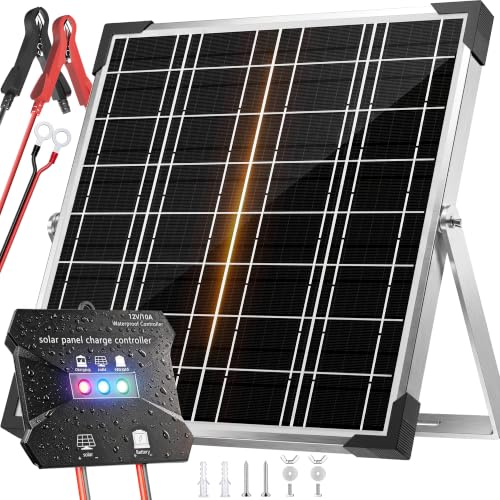
The SOLPERK 100W kit includes a monocrystalline panel, a 10A MPPT charge controller, alligator clips, mounting hardware and pre drilled holes. The seller claims 400Wh per day from four hours of full sun, which is the nameplate figure with no losses taken out.

What works

  • Kit includes a 10A MPPT controller
  • Pre drilled holes and Z brackets included
  • Waterproof controller with plug and play cables

Watch out for

  • Seller's 400Wh a day claim is nameplate only
  • Panel weight is missing from the listing
04

Best Small Add On · 4 of 6

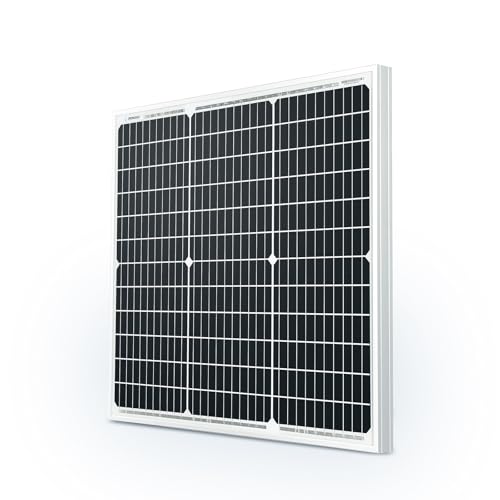
Renogy Solar Panels 50 Watt

Renogy Solar Panels 50 Watt
  • 50W monocrystalline
  • 22% efficiency
  • Aluminum frame, bypass diodes
Check price on Amazon for Renogy Solar Panels 50 Watt (opens in a new tab)
Best for: Topping up an existing system

Our take

Pick this if you are extending an existing system with a controller already installed.

Why it made the shortlist

The Renogy 50W monocrystalline panel is 22% efficient, with a corrosion resistant aluminum frame, tempered low iron glass, an IP65 junction box and bypass diodes. It is rated for 2400Pa wind and 5400Pa snow load, and the pre drilled holes accept Renogy Z brackets, pole and tilt mounts.

It is the better pick for a trailer that needs a small top up on an existing system, while the SOLPERK 100W kit is the better pick for a complete starter set.

What works

  • 22% efficiency in a small 50W panel
  • IP65 junction box and bypass diodes for shade
  • Built to 2400Pa wind and 5400Pa snow loads
  • Fits Renogy Z, pole and tilt mounts

Watch out for

  • No charge controller is included in the listing
  • Only about 190Wh on a 5 sun hour day
05
Best for: Stored trailers kept outdoors

Our take

Pick this if the goal is keeping a stored trailer's battery topped up, not running anything.

Why it made the shortlist

The Voltset 20W is a trickle charge kit with an MPPT controller, built in protection against overcharge, over discharge and reverse polarity, and an IP67 rating. It works with LiFePO4, AGM, Gel and flooded batteries, and the listing promises a 30 second plug and play setup with pre drilled mounting holes.

At $39.99 it costs $5.00 more than the SOLPERK 20W kit at $34.99, and the extra buys the IP67 rating, the wider list of supported chemistries and the MPPT claim. Neither gives meaningful power for daily use: roughly 75Wh a day on a good 5 sun hour day.

What works

  • Supports LiFePO4, AGM, Gel and flooded batteries
  • Protects against overcharge and reverse polarity
  • Tool free mounting with pre drilled holes

Watch out for

  • Only about 75Wh a day, maintenance duty
  • Costs $5.00 more than SOLPERK 20W
06
Best for: Buyers comparing capacity, compatibility, included components and storage needs

Our take

Pick this if you want the lowest cost battery maintainer for a stored RV and like aiming the panel at the sun.

Why it made the shortlist

The SOLPERK 20W kit pairs a monocrystalline panel with an 8A smart controller using three stage charging. It has a 360 degree adjustable mount, low iron tempered glass and an aluminum frame, and it charges LiFePO4, lithium and other 12V batteries.

At $34.99 it is the cheapest pick here, $5.00 under the Voltset 20W and $13.33 under the Renogy 50W.

What works

  • Cheapest way to keep a stored RV battery topped up
  • 360 degree adjustable bracket for aiming
  • 8A controller with three stage charging
  • Low iron tempered glass and aluminum frame

Watch out for

  • Only 20W, about 75Wh on a good day

Methodology

How We Built This Shortlist

Each pick was assessed across 4 criteria weighted for real-world use.

01

Daily energy

We converted watts to expected watt-hours using sun hours and a 0.75 loss factor instead of repeating nameplate figures.

02

Weight and liftability

We recorded listed weights and flagged every pick where the weight is not given as a number.

03

Controller and voltage

We noted included controllers and the Voc where it is listed, since it decides which controller can be used.

04

Total cost

Prices are compared per watt and with the cost of any controller the listing leaves out.

Decision guide

Match a Lightweight Solar Panel For RV to Your RV

By Daily Energy Need

Your situationRecommended pickWhy
Fridge and lights, about 750Wh a dayRenogy 200W N-Type200W x 5 sun hours x 0.75
Fridge, fans and laptop, about 1,500Wh a dayCallsun 400W Pair400W x 5 sun hours x 0.75
Small battery top up, about 300Wh a daySOLPERK 100W Kit100W x 4 sun hours x 0.75 with a controller included
Light top up of about 190Wh a dayRenogy 50W Panel50W x 5 sun hours x 0.75
Storage maintenance of about 75Wh a dayVoltset 20W Charger20W is enough to offset self discharge

By Budget

BudgetRecommended pick
$30 to $40SOLPERK 20W Kit or Voltset 20W Charger
$40 to $150Renogy 50W Panel or SOLPERK 100W Kit
$150 to $320Renogy 200W N-Type or Callsun 400W Pair

Single Panel vs Pair

One 200W panel

Renogy 200W N-Type is one lift, one set of roof penetrations and $152.99, but one shaded corner affects the whole panel.

Two 200W panels

Callsun 400W Pair gives 400W for $319.99 and splits each panel into sections for shade tolerance, but the pair weighs 47.6 lbs and needs more roof.

Most small trailers should start with one Renogy 200W N-Type and add a second panel later if the battery stays low.

By Roof Situation

RoofRecommended pick
Shaded by an AC unit or ventsCallsun 400W Pair
Space for one full size panelRenogy 200W N-Type
Almost no spare roofRenogy 50W Panel
Stored outdoors under a coverSOLPERK 20W Kit

For One Person Lifting Panels Specifically

Look for

A weight per panel in the listing, and a figure you can comfortably lift onto a roof alone.

In this comparison

Callsun 400W Pair lists 23.8 lbs per panel, the only weight given here. Renogy 200W N-Type is called 11.7% lighter than its predecessor but gives no number, so confirm it before ordering.

When to Spend More

Spend more if

Spend more on Callsun 400W Pair at $319.99, $167.00 above the Renogy 200W N-Type, when shade falls on the roof and you need 400W.

Save if

Save with SOLPERK 100W Kit at $149.99, which includes a controller, or with SOLPERK 20W Kit at $34.99 if the RV only needs battery maintenance.

FAQ

Before You Bring One Home

How many watts of solar does a small RV need?

It depends on your daily watt-hours. A fridge, lights and phone charging often total 600 to 1,000Wh, which a 200W panel can roughly cover at 750Wh on a 5 sun hour day. Add up your own loads before choosing.

Is a 20W panel enough to run an RV?

No. A 20W panel such as the Voltset or SOLPERK makes about 75Wh a day, enough to keep a stored battery topped up but not to run a fridge. Choose a larger panel for any real load.

Do I need an MPPT controller?

The SOLPERK 100W kit includes a 10A MPPT controller and Voltset lists MPPT as well, but the Renogy 200W and 50W panels do not include one. MPPT gets more from a panel in cool weather, but check the controller's voltage limits first.

Can I wire the Callsun panels in series?

Yes, the listing says two panels in series reach 400W at 47.48V Vmp and 54.62V Voc. Check that your controller or power station accepts that input with a cold weather margin, or wire in parallel instead.

Where should I mount lightweight panels?

Choose a clear part of the roof away from vents and the AC unit, and use the mounting hardware in the kit. Pre drilled holes and Z brackets are listed for SOLPERK and Renogy, and sealing the screw holes against leaks matters more than the panel brand.

Bottom line

The short version

Browse more lightweight solar panel for rv on Amazon →
Bowen Higgins, RV Editor at RV Gear Lab

About the author

Bowen Higgins

RV Editor at RV Gear Lab

Bowen covers RV power, water systems, towing and leveling, upkeep and interior comfort, with a focus on matching gear to the rig, the hookups and the way you actually travel.

More from Bowen →Editorial standards

Keep reading

Related guides