

We research everything we recommend. When you buy through our links, we may earn a commission. Learn more

Buying guide · 10 min read · Updated October 2, 2026

5 Best Lithium RV Battery For Boondocking in 2026: A Practical RV Guide

Five lithium RV batteries for boondocking compared on usable kWh, BMS limits, expansion and price, so your fridge survives days without a hookup.

Bowen HigginsBy Bowen HigginsRV Editor at RV Gear Lab5 products comparedSpec-sheet researched

At a glance

Our top picks

Boondocking is an energy budget problem, and the budget is measured in kilowatt hours, not amp hours alone. A fridge, fans and a laptop can use around 1 kWh a day, so a 4 kWh battery buys four days before recharge. We compared five lithium picks on stated capacity, BMS limits, expansion options and price, then ranked them by how many dry camping days each can realistically deliver per dollar.

RV Gear Lab field notes

The Rig Fit Check

Start with the job
Redodo 12V 320Ah Mini LiFePO4 RV Battery leads this shortlist for weekend to week trips. Use that fit as a reference point, then compare the alternatives against your own space and workload.
Specs that separate the picks
The first details to compare are 12V 320Ah mini, 12V 400Ah, about 5120Wh. Confirm the exact model and included components before ordering.
Trade-off to plan for
Costs $30.00 more than the Power Queen 320Ah

Before you buy

What Matters Before You Choose a Lithium RV Battery For Boondocking

Key buying criteria so you get the right fit the first time.

  1. 01

    Daily kWh versus capacity

    A fridge, fans, lights and chargers can use about 1kWh a day, and a 4096Wh battery gives roughly four days before recharge. Using less than 80% depth of discharge extends life. Add up your daily watt hours and compare to the listed Wh.

  2. 02

    Charging speed and source

    A 20A charger needs about 16 hours to fill a 320Ah battery, so without strong solar you wait. Solar of 600W can top up faster in sun. Check the charging section and match it to your array.

  3. 03

    BMS continuous amps

    A 200A BMS supports roughly 2400W at 12V, while 250A reaches 3000W. A coffee maker plus microwave may trip a smaller BMS. Find the continuous amp number in the listing.

  4. 04

    Low temperature protection

    Charging below 32F damages LiFePO4 cells, and winter boondocking often sits near freezing. A battery that cuts off charge will stop your solar. Look for a stated cutoff or a heating option.

  5. 05

    Expandability limits

    Some listings support 4S4P, which means four in series and four in parallel. If you may add batteries later, this protects your investment. Check the stated limits before buying a single unit.

Our standards

Why You Can Trust RV Gear Lab

At RV Gear Lab, we compare products based on rig fit and power or hookup compatibility, verified specifications, usability, setup requirements, weight, durability, and real-world trade-offs. We do not rank products purely on marketing claims or commission rates.

We have not personally tested every product listed. Where hands-on testing is not available, recommendations are based on verified manufacturer specifications, product documentation, use-case fit, and comparative research.

How we review RV gear →

Detailed reviews

The 5 best lithium rv battery for boondocking, explained

01
Best for: Weekend to week trips

Our take

Versus the ECO-WORTHY 400Ah at $759.99 you save $70.00 and give up 80Ah.

Why it made the shortlist

The listing says it supports 1kWh per day for 4 days and replaces six 12V 100Ah lead-acid batteries. At $689.99 it balances size and capacity well.

Versus Power Queen 320Ah at $659.99 you pay $30.00 more for a different brand and app. Pick this if you want a proven mini footprint.

What works

  • Listing frames about four dry camping days at 1kWh daily
  • Mini case frees space compared with standard 320Ah
  • Bluetooth app shows real time battery status

Watch out for

  • Costs $30.00 more than the Power Queen 320Ah
  • Capacity cap means big rigs need a second unit
The catch
The Redodo 12V 320Ah Mini is described as 32% smaller than a standard 320Ah, with Bluetooth monitoring.
02
Best for: Long stays with an inverter

Our take

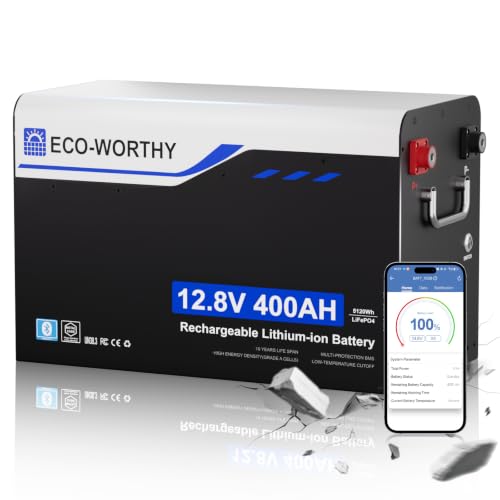
It costs $70.00 more than the Redodo 320Ah and adds 80Ah and a stronger BMS.

Why it made the shortlist

The ECO-WORTHY 12V 400Ah has a metal case, a 250A BMS, Bluetooth, low temperature protection and a dedicated safety switch. That is roughly 5120Wh at 12.8V nominal. At $759.99 it is the highest capacity single battery in this group.

Pick this if you run an inverter for coffee makers or a microwave while off grid.

What works

  • Largest single battery capacity in this roundup
  • 250A BMS supports heavier inverter loads
  • Safety switch lets you disconnect output quickly

Watch out for

  • Heavy metal case needs strong mounting
03
Best for: Growing off grid system

Our take

Compared with the GOKWH 320Ah at $402.91, it costs $257.08 more for a stated 2560W output and a mini case.

Why it made the shortlist

The Power Queen 12V 320Ah Mini lists 2560W output, Bluetooth 5.0 and expansion up to 4P4S for a 51.2V 1280Ah system. It also has low temperature cutoff and overload protection. At $659.99 it is a strong feature set for the price.

Pick this if you want to grow into a larger bank later.

What works

  • 2560W output runs fridge and small appliances
  • Expandable to a 51.2V 1280Ah system
  • Low temp cutoff and overload protection included

Watch out for

  • Costs $257.08 more than GOKWH 320Ah
  • Large for rigs with small battery bays
04
Best for: Dry camping on a budget

Our take

Pick this if you want maximum dry camping time for the money.

Why it made the shortlist

The GOKWH 12V 320Ah delivers 4096Wh with a 200A BMS, Bluetooth app and a claim of 8000 deep cycles. It can expand to 4 batteries in series and 4 in parallel. At $402.91 it is the cheapest high capacity battery here.

What works

  • 4096Wh at about $403 is excellent value
  • Supports 4S4P expansion for larger banks
  • 200A BMS runs an inverter without tripping

Watch out for

  • 20A charger needs about 16 hours for a full charge
  • Brand has less track record than larger names
05

Best Modular · 5 of 5

12V 100Ah LiFePO4 Battery

12V 100Ah LiFePO4 Battery
  • 2 x 12V 100Ah Group 24
  • 21.6 lb each
  • 14.4 to 14.6V charge profile
Check price on Amazon for 12V 100Ah LiFePO4 Battery (opens in a new tab)
Best for: Easy install in small trays

Our take

Pick this if you want easier lifting or have two Group 24 trays.

Why it made the shortlist

The Super Empower set includes two 12V 100Ah Group 24 batteries at 21.6 lb each, 6.49 x 10.24 x 8.98 in. It lists a 14.4 to 14.6V CC/CV charge profile. At $349.99 it is the cheapest route to 2560Wh.

What works

  • Two light batteries are easier to install alone
  • Group 24 size replaces standard lead-acid trays
  • Lists the correct lithium charge voltage window

Watch out for

  • Needs parallel wiring and fusing for both batteries
  • Smaller BMS per unit limits heavy loads

Methodology

How We Built This Shortlist

Each pick was assessed across 4 criteria weighted for real-world use.

01

Energy per day

We converted stated capacity to watt hours and compared it with a 1kWh daily boondocking budget.

02

BMS headroom

We checked continuous amp ratings against an inverter running a coffee maker or microwave.

03

Expansion path

We looked for stated series and parallel limits for adding batteries later.

04

Cost per kWh

We divided price by stated capacity to compare real dry camping value.

Decision guide

Match a Lithium RV Battery For Boondocking to Your RV

By Days Off Grid

Your situationRecommended pickWhy
2 to 3 days with a small fridgeSuper Empower Pair2560Wh of storage
4 days at about 1kWh per dayRedodo 320Ah MiniListing claims four days
Week long stays with an inverterECO-WORTHY 400AhAbout 5120Wh and 250A BMS
Maximum capacity on a budgetGOKWH 320Ah4096Wh at $402.91

By Budget

BudgetRecommended pick
$340 to $410Super Empower Pair or GOKWH 320Ah
$650 to $690Power Queen 320Ah or Redodo 320Ah Mini
$750 to $760ECO-WORTHY 400Ah

One Big Battery vs Two Smaller Ones

One big battery

Simpler wiring, fewer connections, but harder to lift. Redodo 320Ah, ECO-WORTHY 400Ah, Power Queen 320Ah and GOKWH 320Ah belong here.

Two smaller batteries

Lighter to carry and easier to place, with more cables. Super Empower Pair is the example.

Default to one big battery unless weight or tray size prevents it.

By Charging Source

Best pickRecommended pick
Solar plus alternatorPower Queen 320Ah
Generator top ups onlyGOKWH 320Ah
Big solar array and inverterECO-WORTHY 400Ah
Small solar panelSuper Empower Pair

For Winter Boondocking Specifically

Look for

A stated low temperature charge cutoff and heater or protection details.

In this comparison

ECO-WORTHY 400Ah and Power Queen 320Ah both list low temperature protection, so either can guard cells in a cold rig.

When to Spend More

Spend more if

Spend more on the ECO-WORTHY 400Ah if you use an inverter daily and need a 250A BMS.

Save if

Save with the GOKWH 320Ah, which provides 4096Wh for $402.91 and leaves money for solar.

FAQ

Before You Bring One Home

How many days can a 320Ah lithium battery last boondocking?

At about 1kWh a day, a 4096Wh battery lasts roughly four days. Heavy loads like an inverter or air conditioner shorten that.

Do I need solar for boondocking with lithium?

A 20A charger needs about 16 hours for a full charge, so solar or a generator is essential for long stays.

Is a 400Ah battery worth the extra cost?

If you run an inverter daily, the ECO-WORTHY 400Ah adds capacity and a 250A BMS for $70.00 over the Redodo.

Can I mix lithium batteries from different brands?

It is not recommended, since BMS behavior differs. Buy matching units for expansion.

Bottom line

The short version

Browse more lithium rv battery for boondocking on Amazon →
Bowen Higgins, RV Editor at RV Gear Lab

About the author

Bowen Higgins

RV Editor at RV Gear Lab

Bowen covers RV power, water systems, towing and leveling, upkeep and interior comfort, with a focus on matching gear to the rig, the hookups and the way you actually travel.

More from Bowen →Editorial standards

Keep reading

Related guides