

We research everything we recommend. When you buy through our links, we may earn a commission. Learn more

Buying guide · 10 min read · Updated October 2, 2026

4 Best Lithium RV Battery For RV Solar System in 2026: A Practical RV Guide

Four 12V LiFePO4 batteries for RV solar systems compared on series and parallel limits, BMS amps, cold charging and price for a clean upgrade.

Bowen HigginsBy Bowen HigginsRV Editor at RV Gear Lab4 products comparedSpec-sheet researched

At a glance

Our top picks

An RV solar bank succeeds or fails on how batteries combine, not on one headline number. Series and parallel limits, BMS current and cold charge cutoffs decide whether panels fill the pack or sit idle. We compared four 12V picks on expansion rules, usable energy, size and price, then ranked them by how cleanly each plugs into a typical RV solar charge controller setup.

RV Gear Lab field notes

The Rig Fit Check

Start with the job
2 Packs 12V 150Ah Max LiFePO4 Battery With 100A BMS 15000+ Deep Cycles leads this shortlist for expandable solar bank. Use that fit as a reference point, then compare the alternatives against your own space and workload.
Specs that separate the picks
The first details to compare are 2 x 12V 150Ah, 2 x 12V 100Ah Group 31, 12V 200Ah, 200A BMS. Confirm the exact model and included components before ordering.
Trade-off to plan for
100A BMS per unit limits large inverters

Before you buy

What Matters Before You Choose a Lithium RV Battery For RV Solar System

Key buying criteria so you get the right fit the first time.

  1. 01

    Series and parallel limits

    Series raises voltage and parallel raises capacity, and listings state how many units you can combine. Exceeding the limit can unbalance the pack. Check for text like 4S4P in the listing before planning expansion.

  2. 02

    BMS amps versus inverter size

    A 100A BMS handles about 1200W at 12V, while a 200A BMS handles about 2400W. A 2000W inverter on a 100A battery will trip. Match the BMS number to your largest inverter.

  3. 03

    Solar charge cutoff in cold

    LiFePO4 cannot be charged safely below 32F, so solar stops in freezing weather. Without protection, cells can be damaged. Look for a stated low temperature charge protection feature.

  4. 04

    Charge controller voltage

    Lithium needs a charge profile near 14.4 to 14.6V. A lead-acid profile may undercharge. Set your controller to a LiFePO4 profile and confirm the listing voltage.

  5. 05

    Weight and mounting

    The yeagulch 200Ah weighs about 58.86 lb, while each dumfume weighs 43.0 lb. Heavy batteries need strong brackets and may be hard to lift alone. Check listed weight against your install plan.

Our standards

Why You Can Trust RV Gear Lab

At RV Gear Lab, we compare products based on rig fit and power or hookup compatibility, verified specifications, usability, setup requirements, weight, durability, and real-world trade-offs. We do not rank products purely on marketing claims or commission rates.

We have not personally tested every product listed. Where hands-on testing is not available, recommendations are based on verified manufacturer specifications, product documentation, use-case fit, and comparative research.

How we review RV gear →

Detailed reviews

The 4 best lithium rv battery for rv solar system, explained

01
Best for: Expandable solar bank

Our take

Versus the Dyness 100Ah pair at $325.98, you pay $42.98 more for 50Ah more per battery.

Why it made the shortlist

The dumfume set includes two 12V 150Ah batteries, each 10.04 x 7.68 x 9.84 in and 43.0 lb, with a 100A BMS and 15000+ cycle claim. The listing says they can build a 48V system with 4S4P wiring and each has independent low temperature protection. At $368.96 the pair yields about 3840Wh.

Pick this if you want a solar bank that can grow to 48V.

What works

  • Pair provides about 3840Wh for under $370
  • 4S4P support allows growth to a 48V system
  • Each battery has its own low temp protection

Watch out for

  • 100A BMS per unit limits large inverters
  • Two batteries need careful parallel wiring
02

Best Compact Pair · 2 of 4

Dyness 12V 100Ah LiFePO4 Lithium Battery

Dyness 12V 100Ah LiFePO4 Lithium Battery
  • 2 x 12V 100Ah Group 31
  • 100A BMS, low temp charging
  • 13.0 x 6.77 x 8.43 in
Check price on Amazon for Dyness 12V 100Ah LiFePO4 Lithium Battery (opens in a new tab)
Best for: Group 31 tray solar

Our take

Pick this if your solar bay uses Group 31 trays.

Why it made the shortlist

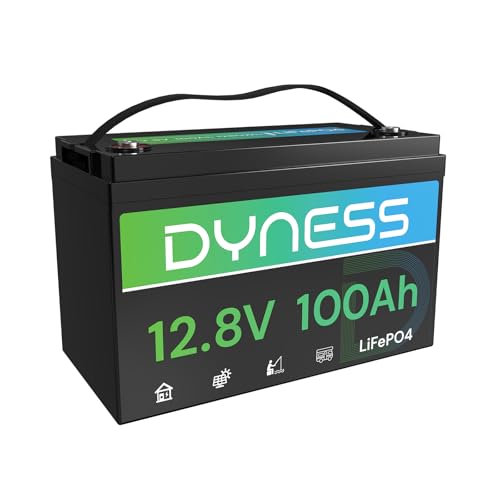
The Dyness set includes two BCI Group 31 12V 100Ah batteries at 13.0 x 6.77 x 8.43 in with a 100A BMS and low temperature charging protection. The cells are A+ grade with a 4000+ cycle rating. At $325.98 the pair stores about 2560Wh.

What works

  • Group 31 size drops into standard battery trays
  • Low temp charging protection guards winter solar
  • Two light batteries are easy to place and wire

Watch out for

  • 2560Wh total is modest for a big solar array
  • 100A BMS each caps inverter size
03
Best for: Single battery with inverter

Our take

It costs $139.61 more than the single Dyness 100Ah yet doubles the capacity and BMS.

Why it made the shortlist

The yeagulch 12V 200Ah has a 200A BMS, a 15000+ cycle claim and supports up to 4 in series for 48V and 4 in parallel. It weighs about 58.86 lb. At $316.59 it delivers about 2560Wh in one case.

Pick this if you want one battery with room for an inverter.

What works

  • 200A BMS supports a 2000W inverter
  • Series and parallel expansion is stated clearly
  • One case simplifies wiring compared with pairs

Watch out for

  • Heavy at about 58.86 lb for one person
  • Long case may not fit smaller bays
04
Best for: Starter solar setup

Our take

It costs $139.61 less than the yeagulch 200Ah and gives half the capacity and BMS headroom.

Why it made the shortlist

The Dyness 12V 100Ah is a Group 31 battery measuring 13.00 x 6.77 x 8.43 in with a 100A BMS and extreme cold charge protection. It is described for RV, solar and off grid use. At $176.98 it is the cheapest entry in this guide.

Pick this if you are starting a small solar setup with a single panel.

What works

  • Cold charge protection suits winter solar use
  • Group 31 size fits standard trays

Watch out for

  • 1280Wh is small for a real solar system
  • Single 100A BMS limits inverter loads

Methodology

How We Built This Shortlist

Each pick was assessed across 4 criteria weighted for real-world use.

01

Expansion rules

We checked stated series and parallel limits for building a larger solar bank.

02

BMS current

We compared continuous amp ratings to common RV inverter sizes.

03

Cold charging

We favored listings that state low temperature charge protection for winter solar.

04

Size and price

We compared listed dimensions, weight and cost per watt hour.

Decision guide

Match a Lithium RV Battery For RV Solar System to Your RV

By Solar Array Size

Your situationRecommended pickWhy
Single 200W panelDyness 100Ah1280Wh matches a small array
400W to 600W arrayDyness 100Ah Pair2560Wh across two batteries
800W or more with future growthdumfume 150Ah Pair3840Wh and 4S4P support
Array plus 2000W inverteryeagulch 200Ah200A BMS in one case

By Budget

BudgetRecommended pick
$170 to $320Dyness 100Ah or yeagulch 200Ah
$320 to $370Dyness 100Ah Pair or dumfume 150Ah Pair

One Big Battery vs a Matched Pair

One big battery

Fewer connections and one BMS, but heavier. yeagulch 200Ah is the example.

A matched pair

Easier to lift and more forgiving if one fails. dumfume 150Ah Pair and Dyness 100Ah Pair fit here.

Default to a pair if you must carry batteries by hand.

By System Voltage

Best pickRecommended pick
12V system onlyDyness 100Ah
Possible 24V upgradeyeagulch 200Ah
Possible 48V upgradedumfume 150Ah Pair
Compact Group 31 bayDyness 100Ah Pair

For Winter Solar Charging Specifically

Look for

A stated low temperature charge cutoff or protection for charging below freezing.

In this comparison

Dyness 100Ah Pair and dumfume 150Ah Pair both list low temperature protection, so solar charging pauses safely instead of damaging cells.

When to Spend More

Spend more if

Spend more on the dumfume 150Ah Pair if you may expand to 48V later.

Save if

Save with the single Dyness 100Ah at $176.98 if one small panel feeds lights and a fan.

FAQ

Before You Bring One Home

Can I wire these batteries in series for 24V or 48V?

The dumfume and yeagulch listings state series expansion, up to 4S for 48V. Always use matching units and follow the listing limits.

How big a solar array fits a 2560Wh bank?

A 400W to 600W array typically recharges 2560Wh in a sunny day. Actual output depends on sun hours and shade.

Is a 100A BMS enough for a solar system?

For lights and a fridge it is fine, but a 2000W inverter needs 200A. Choose the yeagulch 200Ah for larger inverters.

Do I need low temperature protection for solar?

If you camp in freezing weather, yes, because charging below 32F can damage cells.

Bottom line

The short version

Browse more lithium rv battery for rv solar system on Amazon →
Bowen Higgins, RV Editor at RV Gear Lab

About the author

Bowen Higgins

RV Editor at RV Gear Lab

Bowen covers RV power, water systems, towing and leveling, upkeep and interior comfort, with a focus on matching gear to the rig, the hookups and the way you actually travel.

More from Bowen →Editorial standards

Keep reading

Related guides