

We research everything we recommend. When you buy through our links, we may earn a commission. Learn more

Buying guide · 11 min read · Updated October 2, 2026

5 Best Portable Power Stations With a 30 Amp RV Outlet in 2026: A Practical RV Guide

Five portable power stations with a TT-30 RV outlet compared on 30A sizing, continuous watts, 3,000Wh-plus capacity and recharge options, $999 to $1,949.

Bowen HigginsBy Bowen HigginsRV Editor at RV Gear Lab5 products comparedSpec-sheet researched

At a glance

Our top picks

A TT-30 outlet on a portable power station is the plug that matches a travel trailer's 30 amp shore cord, so you can run the trailer from a battery instead of a campground pedestal. The number worth understanding is that 30 amps at 120 volts is 3,600 watts, which means the outlet label alone says nothing about whether the station behind it can deliver that load. Some stations are built to supply the full 3,600 watts, while others have a TT-30 but cap continuous output lower, so a rooftop air conditioner plus a microwave can trip them even though the plug fits.

We compared five stations that list a TT-30 or 30A RV port, all above 3,000Wh and priced from $999 to $1,949. Two are ABOK Ark3600 listings, two are BLUETTI Elite 300 bundles and one is a Pecron E3600LFP. The ranking weighs continuous watts against the 3,600W the plug can carry, price per watt-hour, recharge speed and what each bundle puts in the box, because two of the listings differ mainly in which accessory is included.

RV Gear Lab field notes

The Rig Fit Check

Start with the job
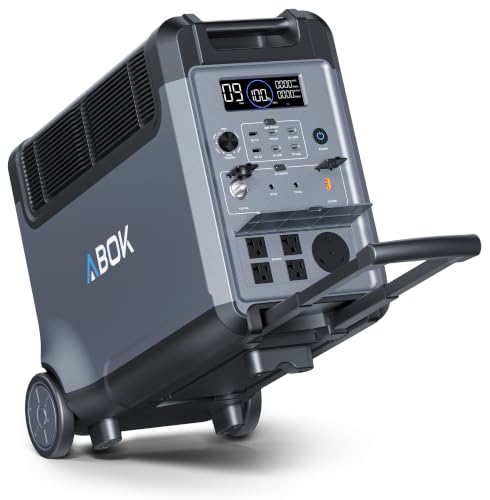
ABOK Ark3600 Portable Power Station, 3840Wh LiFePO4 Battery leads this shortlist for running a 30A trailer's biggest loads together. Use that fit as a reference point, then compare the alternatives against your own space and workload.
Specs that separate the picks
The first details to compare are 3,840Wh LiFePO4, 3,072Wh LiFePO4, 3,014.4Wh LiFePO4. Confirm the exact model and included components before ordering.
Trade-off to plan for
Costs $600 more than the Pecron for 25 percent more energy

Before you buy

What Matters Before You Choose a Portable Power Station With a 30 Amp RV Outlet

Key buying criteria so you get the right fit the first time.

  1. 01

    Continuous watts versus the plug

    A TT-30 plug is a 30 amp connection, and at 120 volts that is 3,600 watts, but the station behind it may only deliver 2,400 watts continuously. When a load exceeds the continuous rating the station shuts down or trips even though the plug fits, which on a hot day usually means the air conditioner. Divide the listed continuous watts by 120 to see the real amperage, and compare it with the loads you run together.

  2. 02

    TT-30 AC outlet versus 12V/30A DC port

    A TT-30 is a 120V AC outlet that connects to an RV shore cord, while a 12V/30A DC port is a low-voltage output that tops out around 360 watts and cannot feed the trailer's wall outlets. The Elite 300 lists both, and mixing them up is a common reading mistake on spec pages. Look for the phrase TT-30 or 120V 30A on the listing, not just 30A.

  3. 03

    Capacity and cost per watt-hour

    Nominal watt-hours show how much energy is stored, and dividing the price by that number shows what each unit costs to own. Here the Pecron works out near $0.33 per watt-hour and the ABOK Ark3600 near $0.42, so the extra $600 buys 768Wh and faster charging rather than a different outlet. Do the division yourself when a bundle adds a panel or charger.

  4. 04

    Recharge speed and source

    A station only helps if you can refill it between trips, and the makers list very different figures: 1.3 hours on 3,200W of AC for the Pecron, 2.3 hours on up to 3,500W combined for the ABOK, 3.2 hours from a vehicle for the BLUETTI Charger 2. These are best-case times at optimal input. Check which input each number assumes before comparing them.

  5. 05

    Liftability and packed size

    Stations in this class pack more than 3,000Wh of lithium into one case, and none of the listings publish weight. A unit you cannot lift into a storage bay alone is a poor match for a single traveler. Look for weight and dimensions in the spec table or manual, and decide beforehand whether you need wheels or a second person.

  6. 06

    Warranty and expansion

    The Pecron lists a 2 plus 3 year warranty, and the ABOK can expand to 11,520Wh with add-on batteries, which changes how long the station stays useful as your needs grow. A short warranty on a $1,500 purchase is a real cost risk. Read the registration steps, since extended terms often require them.

Our standards

Why You Can Trust RV Gear Lab

At RV Gear Lab, we compare products based on rig fit and power or hookup compatibility, verified specifications, usability, setup requirements, weight, durability, and real-world trade-offs. We do not rank products purely on marketing claims or commission rates.

We have not personally tested every product listed. Where hands-on testing is not available, recommendations are based on verified manufacturer specifications, product documentation, use-case fit, and comparative research.

How we review RV gear →

Detailed reviews

The 5 best portable power stations with a 30 amp rv outlet, explained

01
Best for: Running a 30A trailer's biggest loads together

Our take

Pick this if you want to run a 30 amp trailer's air conditioner and other loads together with the plug's full 3,600W available, and you value the extra battery size.

Why it made the shortlist

The ABOK Ark3600 pairs a 3,840Wh LiFePO4 battery with 3,600W of rated output and a 7,200W peak, and its 15 ports include one TT-30 RV outlet rated at 30A. The cells are listed as EVE LiFePO4, and the unit can be expanded to 11,520Wh with add-on batteries.

Against the Pecron E3600LFP it costs $600 more ($1,599 versus $999) and stores 768Wh more, which is 25 percent extra energy, so the Pecron is cheaper per watt-hour at about $0.33 versus $0.42. The ABOK lists faster combined charging, up to 3,500W of AC plus solar with 0 to 80 percent in about 1.1 hours under optimal conditions. Compared with the BLUETTI Elite 300 bundles it delivers 1,200W more continuous power than the Elite's 2,400W, for about $160 more than the Alternator Bundle ($1,599 versus $1,438.99).

What works

  • Rated output of 3,600W matches the full 30A plug
  • 3,840Wh stores 768Wh more than the Pecron
  • Listed 0 to 80 percent charge in about 1.1 hours
  • Expands to 11,520Wh with add-on batteries

Watch out for

  • Costs $600 more than the Pecron for 25 percent more energy
  • Listing text does not publish weight or dimensions
  • Fast charge times assume optimal AC plus solar input together
02
Best for: Full 30A capability on the lowest budget

Our take

Pick this if you want the plug's full 3,600W for the least money and expect to charge from a wall outlet or a generator.

Why it made the shortlist

The Pecron E3600LFP holds 3,072Wh in a LiFePO4 battery and lists pure sine wave output rated at 3,600W, with a TT30-R RV receptacle among its 16 outputs (four AC sockets, four USB-A, two 100W USB-C, an XT60 port, a cigarette lighter port and a DC5525 port). Like the ABOK, its rated output matches the 3,600W a 30A plug can carry. The box includes both a 15A and a 30A AC charging cable.

At $999 it is the cheapest pick, $600 below the ABOK Ark3600 and $439.99 below the BLUETTI Alternator Bundle, which works out to roughly $0.33 per watt-hour, the lowest in this guide. In exchange it stores 768Wh less than the ABOK. Its listed recharge is quick, a full charge in 1.3 hours from 3,200W of AC input or 2 hours from 1,800W, against the ABOK's 2.3-hour full-charge figure that relies on up to 3,500W of combined AC and solar.

The listing states a 2 plus 3 year warranty.

What works

  • Rated 3,600W output matches a full 30A plug
  • Listed full recharge in 1.3 hours on 3,200W AC
  • Ships with both 15A and 30A AC charging cables

Watch out for

  • Holds 768Wh less than the ABOK Ark3600
  • Listing text mentions no app or bundled solar panel
  • Weight and dimensions are not in the feature bullets
The catch
The caveat is a shorter feature list, with no app or bundled solar panel mentioned in the listing text, and weight and dimensions that you will need to confirm on the spec table.
03
Best for: Drivers with moderate loads who refill on the road

Our take

Pick this if your loads fit inside 2,400W, such as a fridge, lights, electronics and one appliance at a time, and you drive most days so the tow vehicle can refill it.

Why it made the shortlist

This bundle pairs the BLUETTI Elite 300 (3,014.4Wh LiFePO4, 2,400W continuous and 4,800W surge) with the 1,200W Charger 2 alternator charger, which the listing says ships separately. The Elite has a dedicated TT-30 RV outlet and a 12V/30A DC port, plus a UPS switchover under 10 milliseconds.

It costs $461 less than the same station with a 500W solar panel ($1,899.99 versus $1,438.99), and it recharges from a vehicle in 3.2 hours while driving.

What works

  • Recharges from a vehicle alternator in about 3.2 hours
  • Dedicated TT-30 outlet plus a 12V/30A DC port
  • Switches to battery in under 10 milliseconds as a UPS
  • About 59 percent smaller than traditional large stations, per BLUETTI

Watch out for

  • 2,400W continuous covers only about 20A of the plug
  • Alternator charger ships separately from the power station
  • Stores 826Wh less than the ABOK for $160 less
The catch
BLUETTI describes it as nearly 59 percent smaller than traditional large power stations, a claim it attributes to Frost & Sullivan.
04

Best Full-Power Solar Bundle · 4 of 5

ABOK Ark3600 Portable Power Station with 400W Solar Panel

Best for: Stationary camps wanting full power plus solar

Our take

Pick this if you camp stationary with open sky and want the full-power station plus a panel in one purchase.

Why it made the shortlist

This is the same Ark3600 as the top pick (3,840Wh, 3,600W rated, 7,200W peak, one TT-30 RV port among 15 outputs) sold with a 400W solar panel. The listing also describes a smart app that can schedule charging for off-peak electricity rates. The panel adds $350 over the $1,599 base unit ($1,949 versus $1,599).

A rough estimate with no losses is 3,840Wh divided by 400W, about 9.6 hours of ideal sun for one charge, where the BLUETTI's 3,014.4Wh from 500W is about 6 hours. Real recharge will be slower than both.

What works

  • Includes a 400W solar panel for off-grid recharging
  • Keeps the full 3,600W rated output and TT-30 port
  • 3,840Wh capacity is the largest in this guide
  • App can schedule charging during off-peak electricity hours

Watch out for

  • Costs $350 more than the same station without a panel
  • A 400W panel needs roughly 9.6 ideal hours for a full charge
The catch
Against the BLUETTI Solar Bundle it costs $49.01 more ($1,949 versus $1,899.99) and brings a larger battery (3,840Wh versus 3,014.4Wh) and the full 3,600W output, but a smaller panel, 400W versus 500W.
05
Best for: Sun-first campers with moderate electrical loads

Our take

Pick this if you plan to charge mainly from the sun and your loads stay under 2,400W.

Why it made the shortlist

The BLUETTI Solar Bundle combines the Elite 300 (3,014.4Wh LFP battery, 2,400W output, TT-30 outlet and 12V/30A DC port) with a 500W solar panel that the listing says ships separately.

It is $461 more than the Alternator Bundle ($1,899.99 versus $1,438.99), and that buys a 500W panel in place of a 1,200W alternator charger. It also costs $900.99 more than the Pecron E3600 ($1,899.99 versus $999), which stores more energy (3,072Wh) and supplies 3,600W.

What works

  • 500W panel is the largest solar input bundled here
  • Listed 0 to 100 percent solar charge in about 7 to 10 hours
  • TT-30 outlet and 12V/30A DC port both included
  • 3,014.4Wh capacity in a compact LiFePO4 design

Watch out for

  • 2,400W continuous limits it to about 20A of the plug
  • Listing says the 500W panel ships separately
  • Pecron stores more energy and costs $900.99 less
The catch
BLUETTI lists a 0 to 100 percent solar recharge in about 7 to 10 hours, and states the unit is nearly 59 percent smaller than traditional large power stations.

Methodology

How We Built This Shortlist

Each pick was assessed across 5 criteria weighted for real-world use.

01

TT-30 sizing

A 30A plug at 120V can carry 3,600W. We compared each listing's continuous rating against that number and marked stations that stop at 2,400W as limited.

02

Capacity per dollar

We divided each price by nominal watt-hours, giving about $0.33 for the Pecron and $0.42 for the ABOK, and noted that bundled panels and chargers change the math.

03

Recharge options

We recorded the AC, solar and vehicle charging figures each maker lists, and flagged where a quoted time depends on optimal conditions or combined inputs.

04

What the box includes

We separated stations that include a panel or alternator charger from those that ship them separately, since that changes the real total cost.

05

Disclosed gaps

Weight, dimensions, noise and cold-weather limits are missing from most listing text. We say so plainly rather than guess, and tell you where to check.

Decision guide

Match a Portable Power Station With a 30 Amp RV Outlet to Your RV

By Trailer Load

Start with the biggest thing you will run at the same time, since that decides whether 2,400W or 3,600W is enough.

Your situationRecommended pickWhy
Rooftop air conditioner plus microwave or other big loads togetherABOK Ark36003,600W rated output matches the full 30A plug
Cheapest way to get a full 3,600WPecron E36003,600W rated at $999
Fridge, lights, electronics and one appliance at a timeBluetti Alternator Bundle2,400W is enough, and it is $461 under the solar kit
Stationary camp with open skyABOK Solar Bundle400W panel included with the 3,840Wh battery
Short stays and daily driving between sitesBluetti Alternator Bundle1,200W alternator charger refills in about 3.2 hours

By Budget

BudgetRecommended pick
Under $1,000Pecron E3600
$1,400 to $1,600ABOK Ark3600 for full power, or Bluetti Alternator Bundle for less output
$1,900 to $1,950ABOK Solar Bundle or Bluetti Solar Bundle

The gap between $999 and $1,599 buys 768Wh more energy and the ABOK's faster combined charging.

Full 3,600W vs 2,400W Output

3,600W rated

The plug can carry 30A at 120V, which is 3,600W, and these stations deliver that. The ABOK Ark3600, the ABOK Solar Bundle and the Pecron E3600 qualify, so a rooftop air conditioner and a second large appliance can run together.

2,400W continuous

At 2,400W the station supports about 20A of the plug, so the TT-30 fits but heavy loads must be staged. Both Bluetti bundles work this way, and each adds a 12V/30A DC port the others do not list.

Most 30 amp trailers should default to a 3,600W station unless you are sure the air conditioner never runs with other big loads.

By Recharge Source

How you will refill itRecommended pick
Wall outlet or generator, fastestPecron E3600 (1.3 hours on 3,200W AC)
Wall plus solar togetherABOK Ark3600 (up to 3,500W combined)
Tow vehicle alternatorBluetti Alternator Bundle (about 3.2 hours)
Mostly solarABOK Solar Bundle or Bluetti Solar Bundle

For Travel Trailer Owners With a 30 Amp Shore Cord Specifically

Look for

A TT-30 receptacle that matches your shore cord, a continuous rating near 3,600W if you run air conditioning, and a stated 30A. A 12V/30A DC port is a different thing and cannot power the trailer's 120V outlets.

In this comparison

The ABOK Ark3600 and Pecron E3600 are the two that list 3,600W alongside the TT-30 plug. The Bluetti Alternator Bundle suits a trailer whose big loads rarely run together.

When to Spend More

Spend more if

You run air conditioning from the battery or camp several days without hookups; the ABOK Ark3600 adds 768Wh over the Pecron and the ABOK Solar Bundle includes a panel.

Save if

You camp with hookups most nights and want backup only; the Pecron E3600 at $999 gives the same 3,600W rating for $600 less than the ABOK Ark3600.

FAQ

Before You Bring One Home

Can a portable power station run a 30 amp RV air conditioner?

Often yes, if the station's continuous output covers the air conditioner's running watts and its startup surge. A 3,600W station like the ABOK Ark3600 or Pecron E3600 has headroom, while a 2,400W station can run a single air conditioner but leaves less room for a second large appliance. Check your unit's rated running amps on its nameplate.

Will a TT-30 outlet work on a 50 amp RV?

Only through a 30 amp to 50 amp adapter, and the whole rig then draws from one 30A supply, so you are limited to 3,600W total. Large loads on both legs of a 50 amp system can overload it. Turn off extra breakers before connecting.

Is the ABOK Ark3600 worth $600 more than the Pecron E3600?

Only if you need the extra 768Wh, the combined 3,500W AC and solar input or the expansion path to 11,520Wh. For wall-powered backup the Pecron gives the same 3,600W rating and a quicker listed full recharge. Spend the $600 if you often camp without hookups for more than a day.

How do I connect a power station to my trailer?

Switch the trailer's main breaker off, plug the shore cord into the station's TT-30 outlet, turn the station's AC output on, then switch the trailer breaker back on and start loads one at a time. Confirm the station's manual says the outlet can be used as shore power. Never back-feed a trailer from an unlisted adapter.

How long will a 3,840Wh station run my RV?

Divide watt-hours by your average load: 3,840Wh at 300W is roughly 12.8 hours, and at 1,500W it is about 2.6 hours, before inverter losses. An air conditioner running constantly drains it in a few hours. Treat all of these as estimates.

Does the neutral and ground setup matter?

Yes. Some trailers and surge protectors expect a bonded or floating neutral, and the listings do not describe the station's neutral behavior. Ask the maker before connecting an EMS or surge protector, and avoid daisy-chaining adapters.

Bottom line

The short version

Browse more portable power stations with a 30 amp rv outlet on Amazon →
Bowen Higgins, RV Editor at RV Gear Lab

About the author

Bowen Higgins

RV Editor at RV Gear Lab

Bowen covers RV power, water systems, towing and leveling, upkeep and interior comfort, with a focus on matching gear to the rig, the hookups and the way you actually travel.

More from Bowen →Editorial standards

Keep reading

Related guides