

We research everything we recommend. When you buy through our links, we may earn a commission. Learn more

Buying guide · 10 min read · Updated October 1, 2026

7 Best Portable RV Generators in 2026: A Practical RV Guide

Portable RV generators compared on running watts, weight, RV-ready outlets, dual fuel, and CO shutoff, with picks from 1,800 to 4,000 running watts for campers.

Bowen HigginsBy Bowen HigginsRV Editor at RV Gear Lab7 products comparedSpec-sheet researched

At a glance

Our top picks

A portable RV generator has to do two jobs that pull in opposite directions: make enough running watts to start a rooftop air conditioner, and stay light enough that one person can lift it out of a truck bed or pass-through bay. Most of this roundup sits in the 3,000 to 4,000 running watt class, where a single unit can handle a 13,500 BTU AC on a 30 amp trailer, plus a few smaller units for owners who value carrying weight over output.

We compared running watts (not starting watts), real carrying weight, whether the outlet is a direct TT-30R RV plug or a twist-lock that needs an adapter, dual fuel options, and CO shutoff systems. Prices run from under $300 to about $650, and the gap mostly buys weight savings, electric start, and propane flexibility.

RV Gear Lab field notes

The Rig Fit Check

Start with the job
Champion 4000-Watt RV Ready Portable Inverter Generator leads this shortlist for 30 amp trailer owners running one rooftop AC. Use that fit as a reference point, then compare the alternatives against your own space and workload.
Specs that separate the picks
The first details to compare are 3,000 running / 4,000 starting W, 4,000 rated W on gas or propane, 2,900 rated / 3,600 surge W. Confirm the exact model and included components before ordering.
Trade-off to plan for
Gasoline only, no propane option

Before you buy

What Matters Before You Choose a Portable RV Generator

Key buying criteria so you get the right fit the first time.

  1. 01

    Running Watts, Not Peak Watts

    Running (rated) watts is what a generator sustains, while peak or surge watts last only a few seconds for motor startup. A 13,500 BTU rooftop AC typically draws around 1,300 to 1,800 running watts but needs a much bigger burst to start. Check the rated watts in the listing and plan for about 3,000 running watts if you want AC plus a few other loads.

  2. 02

    Real Carrying Weight

    Portable means different things to different listings, and a generator over about 50 pounds is hard for one person to lift. Wheeled units roll well on pavement but not over campsite gravel. Find the exact weight in the listing and decide if you will lift or roll it.

  3. 03

    TT-30R vs L5-30R Outlet

    A TT-30R accepts your RV cord directly, while an L5-30R is a twist-lock that needs an L5-30P to TT-30R adapter. Both deliver 30 amps at 120 volts. Check the outlet list in the listing, and budget for an adapter if it says L5-30R.

  4. 04

    Inverter Clean Power

    Inverter generators produce power with low total harmonic distortion, usually under 3 percent, which protects RV control boards and electronics. They also throttle down at light loads to save fuel and noise. Look for THD under 3 percent or the word inverter in the listing.

  5. 05

    CO Shutoff and Safety Systems

    Carbon monoxide from generators is a real risk around RVs, especially with wind blowing exhaust toward a window. Systems like CO Shield or WEN Watchdog shut the engine down at dangerous levels. Look for a named CO shutoff system, and still place the generator downwind and away from the rig.

  6. 06

    Parallel Capability

    Parallel kits link two identical inverter generators for combined output, letting two light units do what one heavy unit does. This is a common route to 50 amp style power. Check that the listing says parallel ready and note that cables are often sold separately.

Our standards

Why You Can Trust RV Gear Lab

At RV Gear Lab, we compare products based on rig fit and power or hookup compatibility, verified specifications, usability, setup requirements, weight, durability, and real-world trade-offs. We do not rank products purely on marketing claims or commission rates.

We have not personally tested every product listed. Where hands-on testing is not available, recommendations are based on verified manufacturer specifications, product documentation, use-case fit, and comparative research.

How we review RV gear →

Detailed reviews

The 7 best portable rv generators, explained

01
Champion 4000-Watt RV Ready Portable Inverter Generator
  • 3,000 running / 4,000 starting W
  • Under 49 lbs, TT-30R outlet
  • CO Shield auto shutoff
Check price on Amazon for Champion 4000-Watt RV Ready Portable Inverter Generator (opens in a new tab)
Best for: 30 amp trailer owners running one rooftop AC

Our take

This suits 30 amp trailer owners who want to run one AC and lift the generator themselves.

Why it made the shortlist

Champion's 4000-watt inverter is our top portable pick because it pairs real AC-starting output with a weight one person can manage. It makes 3,000 running and 4,000 starting watts at under 49 pounds, runs up to 10 hours, measures 64 dBA from 23 feet, and has a direct 120V TT-30R RV outlet plus CO Shield automatic shutoff.

What works

  • Light enough for one person at 4,000 starting watts
  • Direct TT-30R plug, no adapter needed
  • CO Shield shuts it down if CO builds up
  • Parallel-ready with a second Champion 4000

Watch out for

  • Gasoline only, no propane option
  • Recoil start only
02
WEN 4800-Watt Dual Fuel RV-Ready Inverter Generator, Electric Start
  • 4,000 rated W on gas or propane
  • Electric start, CO shutdown
  • Wheels and telescoping handle
Check price on Amazon for WEN 4800-Watt Dual Fuel RV-Ready Inverter Generator, Electric Start (opens in a new tab)
Best for: Owners who want propane and electric start

Our take

Choose it if you roll the generator rather than lift it and like propane's clean storage.

Why it made the shortlist

WEN's 4800-watt dual fuel model is the pick for owners who want to run on the propane tank already on their trailer. Its 224cc engine makes 4,000 rated watts on both gasoline and propane, with 4,800 surge watts on gas, and it adds electric start, a CO shutdown sensor, wheels with a telescoping handle, and a tool-free LPG quick connector.

You gain about 1,000 extra running watts over the Champion, propane flexibility, and push-button start. Against the lighter WEN 3600 below, it doubles the outlet count with four 120V receptacles plus a TT-30R.

What works

  • Same 4,000 rated watts on propane as gasoline
  • Push-button electric start saves pulling a cord
  • Tool-free LPG connector makes propane hookup quick
  • Four 120V outlets plus TT-30R

Watch out for

  • Heavier, built to roll more than carry
03
WEN 56360i 3600-Watt RV-Ready Portable Inverter Generator
  • 2,900 rated / 3,600 surge W
  • 46 lbs, TT-30R outlet
  • Fuel shutoff, 3-year warranty
Check price on Amazon for WEN 56360i 3600-Watt RV-Ready Portable Inverter Generator (opens in a new tab)
Best for: Weight-conscious owners who still want to run AC

Our take

The strongest case for WEN 56360i 3600-Watt RV-Ready Portable Inverter Generator is 46 pounds with AC-class output.

Why it made the shortlist

The WEN 56360i balances AC-capable output and low weight. Its 149cc engine makes 2,900 rated and 3,600 surge watts in a 46 pound body, with a TT-30R RV outlet, two 120V receptacles, 12V and USB ports, a fuel shutoff that empties the carburetor, and a three-year warranty.

Against the A-iPower 2300 below, it adds enough output for most 13,500 BTU AC units and a direct RV outlet, where the A-iPower needs a twist-lock adapter.

What works

  • 46 pounds with AC-class output
  • Fuel shutoff cuts carburetor gumming in storage
  • Direct TT-30R outlet for RV cords

Watch out for

  • No CO shutoff mentioned
  • Gas only, recoil start
04
A-iPower 2300W Dual Fuel Inverter Generator, RV Ready
  • 1,800 running W gas, 1,600 propane
  • 40.3 lbs, parallel ready
  • L5-30R twist-lock outlet
Check price on Amazon for A-iPower 2300W Dual Fuel Inverter Generator, RV Ready (opens in a new tab)
Best for: Small trailers and vans without rooftop AC

Our take

This suits van and small trailer owners who mostly charge batteries and run a microwave.

Why it made the shortlist

The A-iPower 2300 is the lightest generator here at 40.3 pounds while still offering dual fuel. It makes 1,800 running watts on gas and 1,600 on propane, runs as low as 61 dB, has a CO sensor indicator, telescoping handle with flat-free wheels, and a 30 amp L5-30R twist-lock outlet.

It ranks below the WEN 3600 because 1,800 running watts will not start most rooftop air conditioners alone. What you get is the lowest weight and propane flexibility. Pairing two units in parallel is its route to AC power, which suits owners who would rather lift two small units than one heavy one.

What works

  • Lightest pick at 40.3 pounds
  • Dual fuel in a small package
  • Parallel ready for more output later

Watch out for

  • Too small for most rooftop AC units alone
  • Needs an adapter for a TT-30 RV cord
05
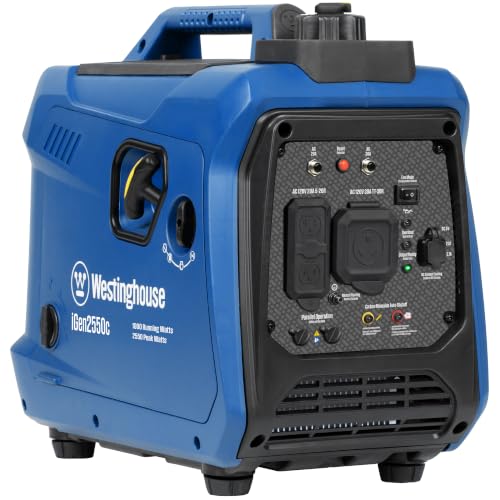
Westinghouse iGen2550c 2550 Peak Watt Inverter Generator, RV Ready
  • 1,900 running / 2,550 peak W
  • As quiet as 52 dBA, Eco Mode
  • TT-30R outlet, 11 hr runtime
Check price on Amazon for Westinghouse iGen2550c 2550 Peak Watt Inverter Generator, RV Ready (opens in a new tab)
Best for: Quiet campgrounds and battery charging

Our take

Choose Westinghouse iGen2550c 2550 Peak Watt Inverter Generator, RV Ready for as quiet as 52 dBA in Eco Mode.

Why it made the shortlist

The Westinghouse iGen2550c is the quiet, compact choice. It makes 1,900 running watts and 2,550 peak, runs up to 11 hours at 25 percent load, can be as quiet as 52 dBA in Eco Mode, and has a TT-30R outlet, a 5-20R duplex, two USB ports, and an LED data center showing fuel and output.

Against the Champion at the top, it trades more than a thousand watts for quieter campsite manners.

What works

  • As quiet as 52 dBA in Eco Mode
  • Up to 11 hours at a quarter load
  • LED data center shows fuel and output
  • Direct TT-30R outlet takes your RV cord

Watch out for

  • Cannot run a rooftop AC alone
  • Parallel cables cost extra
06
PowerSmart 4000 Watt Portable Inverter Generator
  • 3,200 rated / 4,000 peak W
  • 59 dBA from 23 ft
  • L5-30R outlet, parallel capable
Check price on Amazon for PowerSmart 4000 Watt Portable Inverter Generator (opens in a new tab)
Best for: Value buyers who want AC power and accept an adapter

Our take

Pick it if you want 4,000 peak watts at a mid price and can accept an adapter.

Why it made the shortlist

PowerSmart's 4000-watt inverter delivers Champion-class output for about $240 less. It makes 3,200 rated and 4,000 peak watts with under 3 percent THD, runs up to 8 hours at 25 percent load on a 1.3 gallon tank, and rates 59 dBA from 23 feet, with a 30A L5-30R outlet, 5-20R duplex, 12V, and USB.

On paper it beats the Champion at the top for running watts and quoted noise. It ranks lower because it carries a two-year warranty versus Champion's three, has no documented CO shutoff, and uses a twist-lock outlet that needs an adapter for RV cords. Against the Genkins below, it is quieter and fully enclosed.

What works

  • 3,200 running watts for about $400
  • Parallel capable with a second unit

Watch out for

  • Twist-lock outlet needs an RV adapter
  • Two-year warranty is shorter than rivals
  • Small 1.3 gallon tank
The catch
The caveat is the smaller 1.3 gallon tank, which limits runtime at higher loads.
07
Genkins 4500W Open Frame Inverter Generator, 30A Outlet
  • 3,700 rated / 4,500 peak W
  • 2.11 gal tank, 8 hr at half load
  • Open frame, 70 dB at 7 m
Check price on Amazon for Genkins 4500W Open Frame Inverter Generator, 30A Outlet (opens in a new tab)
Best for: Budget buyers who can park it far from camp

Our take

This suits budget buyers who park the generator away from the rig and need AC power.

Why it made the shortlist

The Genkins 4500W is the cheapest way to 3,700 rated watts in this roundup. Its 212cc OHV engine feeds pure sine output under 3 percent THD, a 2.11 gallon tank gives up to 8 hours at half load, and it adds low-oil shutdown and overload protection with an L5-30R outlet.

In exchange, you get the most running watts per dollar here and a bigger tank than the PowerSmart.

What works

  • Most running watts per dollar in this list
  • Larger 2.11 gallon tank than PowerSmart
  • Low-oil shutdown protects the engine

Watch out for

  • Loudest pick here due to open frame
  • Pull start and manual choke only
The catch
It ranks last because the open frame design is noticeably louder, rated at 70 dB at 7 meters versus the enclosed picks above, and it uses pull start with a manual choke.

Methodology

How We Built This Shortlist

Each pick was assessed across 5 criteria weighted for real-world use.

01

Running Watts vs Air Conditioner Needs

Compared rated (running) output against what a typical 13,500 or 15,000 BTU rooftop AC needs, ignoring headline peak figures.

02

Carrying Weight and Handling

Weighed listed weight, handles, and wheels, since a portable generator that is too heavy rarely leaves the truck.

03

RV Outlet Type

Checked for a direct TT-30R outlet versus an L5-30R twist-lock that needs an adapter for standard RV cords.

04

Fuel and Starting Options

Compared gas-only versus dual fuel, tank size, runtime claims, and electric versus recoil start.

05

Safety and Warranty

Credited CO shutoff systems, low-oil shutdown, and warranty length.

Decision guide

Match a Portable RV Generator to Your RV

By RV Size and AC Load

Your RVPick
30 amp trailer with one 13,500 BTU ACChampion 4000-Watt RV Ready
30 amp trailer, want propane and electric startWEN 4800-Watt Dual Fuel
Small trailer, AC needed, weight criticalWEN 56360i 3600-Watt
Van or teardrop without rooftop ACA-iPower 2300W Dual Fuel
Battery charging and small loads onlyWestinghouse iGen2550c

By Budget

BudgetPick
Under $300Genkins 4500W Open Frame
$400 to $500PowerSmart 4000 Watt, Westinghouse iGen2550c, WEN 56360i, or A-iPower 2300W
$600 to $650Champion 4000-Watt or WEN 4800-Watt Dual Fuel

Gas Only vs Dual Fuel

Gas only

Gasoline gives full rated output and simpler engines, but fuel goes stale and needs stabilizer for storage. In this comparison: Champion 4000, WEN 56360i, Westinghouse iGen2550c, PowerSmart 4000, and Genkins 4500W.

Dual fuel

Propane stores indefinitely and burns cleaner, often at slightly lower output, and you can tap the RV's own tank. In this comparison: WEN 4800-Watt Dual Fuel and A-iPower 2300W.

Default to gas for the lightest unit; choose dual fuel if you boondock and already carry propane.

By Outlet and Hookup

You wantPick
Plug RV cord straight in, no adapterChampion 4000-Watt RV Ready
Direct TT-30R plus many household outletsWEN 4800-Watt Dual Fuel
Accept a twist-lock adapter for savingsPowerSmart 4000 Watt
Parallel two small units laterA-iPower 2300W Dual Fuel

For Solo Lifting Into a Truck Bed Specifically

Look for

A listed weight under about 50 pounds, a single top handle, and enough running watts for your largest load.

In this comparison

The Champion 4000-Watt at under 49 pounds and the WEN 56360i at 46 pounds both clear the bar while still running a rooftop AC.

When to Spend More

Spend more if

You lift the generator often or want CO shutoff and a three-year warranty; the Champion 4000-Watt earns its price.

Save if

It stays in the truck and is parked away from camp; the Genkins 4500W gives the most running watts per dollar.

FAQ

Before You Bring One Home

Will a 2,000 watt generator run my RV air conditioner?

Usually not on its own. Most rooftop units need roughly 1,300 to 1,800 running watts plus a large startup surge, which overwhelms small generators. A soft start kit can help, but a 3,000 running watt unit like the Champion 4000 is the reliable choice.

What is the most common mistake when buying a portable RV generator?

Comparing peak watts instead of running watts. Peak figures look impressive but only last seconds. Always compare rated watts against your largest continuous load.

Is dual fuel worth it over gas only?

It is worth it if you boondock and carry propane already, because propane stores indefinitely and does not gum carburetors. If you mostly stay in campgrounds, a lighter gas-only unit like the WEN 56360i is simpler.

How do I connect a portable generator to my RV?

Plug your RV cord into the TT-30R outlet, or into an L5-30P to TT-30R adapter if the generator has a twist-lock outlet. Start the generator and let it warm up before connecting, and turn on large loads one at a time.

How should I store a generator between trips?

Run it dry with the fuel shutoff if it has one, or add stabilizer to the tank. Change oil per the manual, especially after the break-in period. Run it under load for a short time each month so seals and carburetors stay healthy.

Bottom line

The short version

Browse more portable rv generators on Amazon →
Bowen Higgins, RV Editor at RV Gear Lab

About the author

Bowen Higgins

RV Editor at RV Gear Lab

Bowen covers RV power, water systems, towing and leveling, upkeep and interior comfort, with a focus on matching gear to the rig, the hookups and the way you actually travel.

More from Bowen →Editorial standards

Keep reading

Related guides