

We research everything we recommend. When you buy through our links, we may earn a commission. Learn more

Buying guide · 10 min read · Updated October 1, 2026

7 Best Quiet RV Generators in 2026: A Practical RV Guide

The quietest RV generators compared on rated dBA, measuring distance, load level, and real output, from Honda and Yamaha to quiet budget picks for campgrounds.

Bowen HigginsBy Bowen HigginsRV Editor at RV Gear Lab7 products comparedSpec-sheet researched

At a glance

Our top picks

Noise is the reason most campground neighbors resent generators, and many national park campgrounds cap generator noise at around 60 decibels measured from about 50 feet. That makes quietness more than comfort: it decides where you are allowed to run at all. The catch is that listings quote decibels at different distances and loads, so a 52 dBA claim at quarter load and a 58 dBA claim at 22 feet are not directly comparable.

This roundup focuses on inverter generators with documented low noise ratings, then weighs how much power each delivers at that sound level. Honda and Yamaha set the benchmark, but several quieter budget units come close for far less money, and we explain where the difference shows up.

RV Gear Lab field notes

The Rig Fit Check

Start with the job
Honda EU2200i 2200 Watt Inverter Generator leads this shortlist for campers who want the quietest proven generator. Use that fit as a reference point, then compare the alternatives against your own space and workload.
Specs that separate the picks
The first details to compare are 2,200W, 48 to 57 dB(A), 2,200W, 79cc Yamaha engine, 3,200W, 54 to 58 dB(A). Confirm the exact model and included components before ordering.
Trade-off to plan for
Costs about three times budget rivals

Before you buy

What Matters Before You Choose a Quiet RV Generator

Key buying criteria so you get the right fit the first time.

  1. 01

    Decibels Need Distance and Load

    A decibel figure means little without how far away and at what load it was measured, and noise drops noticeably as distance doubles. A rating at 23 feet and quarter load will look much lower than one at 7 meters under full load. Check whether the listing states distance and load, as WEN does with 58 dBA at 22 feet and quarter load.

  2. 02

    Know the Campground Limit

    Many national park campgrounds limit generators to about 60 decibels measured at 50 feet, along with set generator hours. A generator rated near 60 dBA at closer distance will usually comply. Check rules for the parks you visit and choose a unit with headroom below the limit.

  3. 03

    Load Determines Real Noise

    Inverter generators throttle down at light loads, so they are quietest when charging batteries and loudest when starting an AC. A unit running near its limit will be far noisier than its rated figure. Choose enough capacity that your normal load is well below the maximum.

  4. 04

    Running Watts for Your AC

    A 13,500 BTU rooftop AC needs a generator in roughly the 3,000 running watt class for reliable starts, while 2,200 watt units usually need a soft start kit or a parallel partner. Check the listing for a stated AC rating like the Honda EU3200i or Pulsar claims.

  5. 05

    Eco Throttle and Runtime

    Eco or Smart Throttle modes match engine speed to load, reducing both noise and fuel use. A larger tank combined with throttle control means fewer refuels and less noisy restarts. Look for runtime at quarter or half load and tank size in gallons.

  6. 06

    CO Shutdown and CARB Status

    CO shutdown systems turn the engine off when carbon monoxide builds up, and CARB compliance is required to buy certain models in California. The Honda EU2200i in this list is not sold in California. Check both before ordering.

Our standards

Why You Can Trust RV Gear Lab

At RV Gear Lab, we compare products based on rig fit and power or hookup compatibility, verified specifications, usability, setup requirements, weight, durability, and real-world trade-offs. We do not rank products purely on marketing claims or commission rates.

We have not personally tested every product listed. Where hands-on testing is not available, recommendations are based on verified manufacturer specifications, product documentation, use-case fit, and comparative research.

How we review RV gear →

Detailed reviews

The 7 best quiet rv generators, explained

01
Honda EU2200i 2200 Watt Inverter Generator
  • 2,200W, 48 to 57 dB(A)
  • CO-MINDER auto shutdown
  • Bluetooth app, 3-year warranty
Check price on Amazon for Honda EU2200i 2200 Watt Inverter Generator (opens in a new tab)
Best for: Campers who want the quietest proven generator

Our take

Choose it if quiet hours and resale value matter most.

Why it made the shortlist

The Honda EU2200i remains the quiet-generator benchmark. It runs at 48 to 57 dB(A), which Honda describes as quieter than normal conversation, and adds the My Generator Bluetooth app for remote stop and service reminders, CO-MINDER automatic carbon monoxide shutdown, and a three-year residential warranty.

Against the Yamaha EF2200iS ranked just below, the two are close in output and noise. Honda wins on the app and CO-MINDER, while Yamaha builds in a standard RV outlet.

What works

  • 48 dB(A) at low load is benchmark quiet
  • CO-MINDER shuts down before CO gets dangerous
  • App allows remote stop and service reminders
  • Holds resale value well over the years

Watch out for

  • Costs about three times budget rivals
  • Not sold in California
  • Too small for most rooftop AC alone
02
Yamaha EF2200iS 2200 Watt Inverter Generator
  • 2,200W, 79cc Yamaha engine
  • Built-in RV outlet
  • Smart Throttle load sensing
Check price on Amazon for Yamaha EF2200iS 2200 Watt Inverter Generator (opens in a new tab)
Best for: Owners who want premium quiet with direct RV hookup

Our take

Pick it if you want brand-tier quiet with direct RV hookup.

Why it made the shortlist

Yamaha's EF2200iS is the closest rival to the Honda. Its 79cc engine uses Yamaha Quiet Technology with a dedicated muffler, Smart Throttle automatic load sensing, an illuminated multi-function LED display, a Smart Dial start knob, and a standard RV outlet.

Its advantage over the Honda is the built-in RV outlet, so you can plug a 30 amp cord straight in without an adapter.

What works

  • Standard RV outlet, no adapter needed
  • Illuminated display readable at night
  • Smart Throttle lowers noise at light loads

Watch out for

  • No CO shutdown documented
The catch
It ranks second because Yamaha does not publish a decibel range in this listing and lacks Honda's CO shutdown system.
03
Honda EU3200i 3200 Watt Inverter Generator
  • 3,200W, 54 to 58 dB(A)
  • Runs most 13,500 BTU RV AC
  • Under 60 lbs, CO-MINDER
Check price on Amazon for Honda EU3200i 3200 Watt Inverter Generator (opens in a new tab)
Best for: Quiet campgrounds where you still need AC

Our take

This suits owners who must run AC in quiet campgrounds and want a single unit.

Why it made the shortlist

The EU3200i is Honda's answer for owners who need quiet and a rooftop AC. It runs at 54 to 58 dB(A), handles most 13,500 BTU RV AC units according to Honda, weighs under 60 pounds, runs 3.3 to 8.6 hours on 1.2 gallons with Eco Throttle, and includes CO-MINDER and the Bluetooth app.

Compared with the EU2200i at the top, it adds the output to start an AC for a small rise in noise.

The caveats are the very high price and the small 1.2 gallon tank.

What works

  • Runs most 13,500 BTU RV ACs quietly
  • Under 60 pounds for a 3,200 watt unit
  • CO-MINDER and app control included

Watch out for

  • Most expensive generator in this list
  • Small 1.2 gallon tank limits runtime
04
Westinghouse 5000 Peak Watt Super Quiet Inverter Generator
  • 3,900 rated / 5,000 peak W
  • As low as 52 dBA, 18 hr runtime
  • Remote key fob start
Check price on Amazon for Westinghouse 5000 Peak Watt Super Quiet Inverter Generator (opens in a new tab)
Best for: All-night AC with minimal refueling

Our take

Pick it if you want to run AC overnight without refueling.

Why it made the shortlist

This Westinghouse makes 3,900 rated and 5,000 peak watts while running as low as 52 dBA, and its 3.4 gallon tank stretches to 18 hours with Economy Mode. It has remote start with a key fob, electric and recoil start, a TT-30R outlet, and an LED data center showing fuel, output, and remaining runtime.

It offers more running power than the Honda EU3200i for less than a third of the price, with a much longer runtime.

What works

  • Up to 18 hours on a 3.4 gallon tank
  • Remote start from inside the RV
  • Data center shows remaining runtime
  • Direct TT-30R outlet takes your RV cord

Watch out for

  • Heavier than the Honda units
  • No CO shutdown listed
The catch
It ranks below the Honda because it is heavier and lacks a CO shutdown system on this listing.
05
WEN DF451i 4500-Watt Dual Fuel Inverter Generator
  • 58 dBA at 1/4 load, 22 ft
  • 3,500 W gas / 3,150 W propane
  • Auto Fuel Selection, CARB compliant
Check price on Amazon for WEN DF451i 4500-Watt Dual Fuel Inverter Generator (opens in a new tab)
Best for: Propane users who need quiet operation

Our take

WEN DF451i 4500-Watt Dual Fuel Inverter Generator is the better fit when propane users who need quiet operation.

Why it made the shortlist

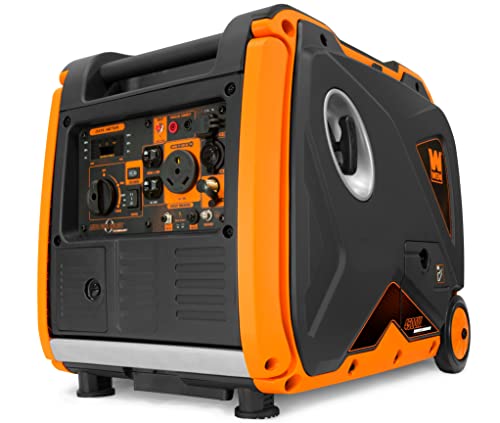
WEN's DF451i is the quiet pick for propane users. It rates 58 dBA at quarter load from 22 feet, makes 3,500 rated watts on gas and 3,150 on propane, and its Auto Fuel Selection switches from propane to gas automatically for longer runs. It is EPA III and CARB compliant with keyless electric start and a TT-30R outlet.

Against the Westinghouse above it, the WEN adds propane and automatic fuel switching while making a bit less power, and its noise figure is quoted at a specific distance, which is more transparent.

What works

  • Switches from propane to gas on its own
  • Noise quoted with distance and load
  • CARB compliant, sold in California

Watch out for

  • Noise rises well above 58 dBA under AC load
  • Heavier than gas-only rivals
The catch
Against the Pulsar below, it is pricier but adds CARB compliance and dual fuel.
06
Pulsar PGD40ISCO 4000W Quiet Inverter Generator
  • 3,200 rated / 4,000 peak W
  • 59 dB rated, parallel ready
  • 1 gal tank, 4 hr at half load
Check price on Amazon for Pulsar PGD40ISCO 4000W Quiet Inverter Generator (opens in a new tab)
Best for: Weekend AC use on a budget

Our take

Choose Pulsar PGD40ISCO 4000W Quiet Inverter Generator for parallel ready for more output.

Why it made the shortlist

The Pulsar PGD40ISCO is the cheapest quiet unit here that claims rooftop AC support. It provides 3,200 rated and 4,000 peak watts, is rated at 59 dB, is parallel ready, and Pulsar lists it for AC units up to 13,500 BTU.

It does match the Honda EU3200i's AC claim at a fraction of the price, which makes it compelling for occasional use.

What works

  • Parallel ready for more output
  • Lightweight design for 4,000 peak watts

Watch out for

  • Only about 4 hours at half load
  • Noise distance not stated
The catch
It ranks below the WEN DF451i because its 1 gallon tank only gives about 4 hours at half load, and Pulsar does not state the measuring distance for its 59 dB figure.
07
WEN 56235i 2350-Watt Super Quiet Inverter Generator
  • 1,900 rated / 2,350 surge W
  • 39 lbs, fuel shutoff
  • Two 120V outlets, no TT-30R
Check price on Amazon for WEN 56235i 2350-Watt Super Quiet Inverter Generator (opens in a new tab)
Best for: Vans and small trailers on a budget

Our take

This suits van owners and small trailers charging batteries.

Why it made the shortlist

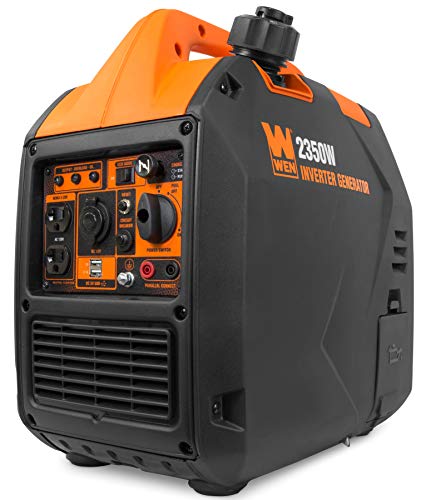
The WEN 56235i is the lightest and least expensive quiet generator here. It weighs 39 pounds, makes 1,900 rated and 2,350 surge watts of clean power, and WEN describes its noise as comparable to normal conversation. A fuel shutoff empties the carburetor before storage.

It is a budget alternative to the Honda EU2200i with similar running output at roughly a third of the price.

What works

  • Only 39 pounds to carry
  • Fuel shutoff reduces storage problems

Watch out for

  • No RV outlet, needs an adapter
  • Two-year warranty only

Methodology

How We Built This Shortlist

Each pick was assessed across 5 criteria weighted for real-world use.

01

Documented Noise Rating

Compared published dBA figures and noted the measuring distance and load level, since figures without them are not directly comparable.

02

Output at Low Noise

Weighed how many running watts each unit delivers relative to its noise rating, especially for rooftop AC.

03

Runtime and Throttle

Checked tank size, Eco or Smart Throttle modes, and runtime claims that keep noise down at light loads.

04

Safety and Compliance

Credited CO shutdown systems and CARB or EPA compliance for owners in strict areas.

05

Price and Warranty

Compared warranty length and long-term value against price differences.

Decision guide

Match a Quiet RV Generator to Your RV

By Quiet Hours and Power Need

Your situationPick
Strict campground, small loads onlyHonda EU2200i
Strict campground, direct RV plug wantedYamaha EF2200iS
Strict campground and rooftop ACHonda EU3200i
Overnight AC without refuelingWestinghouse 5000 Peak Watt
Weekend AC on a budgetPulsar PGD40ISCO

By Budget

BudgetPick
Under $500WEN 56235i or Pulsar PGD40ISCO
$800 to $900Westinghouse 5000 Peak Watt or WEN DF451i
$1,100 to $1,400Honda EU2200i or Yamaha EF2200iS
Over $2,500Honda EU3200i

Premium Brand vs Budget Quiet

Premium brand

Tight manufacturing, dealer networks, and strong resale justify higher prices, and noise figures tend to be conservative. In this comparison: Honda EU2200i, Yamaha EF2200iS, and Honda EU3200i.

Budget quiet

Similar output and claimed noise for a fraction of the price, but shorter warranties and less transparent ratings. In this comparison: Westinghouse 5000 Peak Watt, WEN DF451i, Pulsar PGD40ISCO, and WEN 56235i.

Most occasional campers do fine with a budget quiet unit; full-timers often recover a Honda's premium in reliability and resale.

By Fuel Preference

FuelPick
Gas, longest runtimeWestinghouse 5000 Peak Watt
Propane with auto switch to gasWEN DF451i
Gas, smallest and lightestWEN 56235i
Gas, best fuel efficiency at light loadHonda EU2200i

For National Park Campgrounds Specifically

Look for

A rated noise near or below 60 dBA at a stated distance, plus enough output that you are not running at full load, which is when generators get loudest.

In this comparison

The Honda EU2200i at 48 to 57 dB(A) and the Honda EU3200i at 54 to 58 dB(A) give the most headroom, while the WEN DF451i quotes 58 dBA at quarter load.

When to Spend More

Spend more if

You camp where quiet rules are enforced or full-time; the Honda EU2200i or EU3200i keeps you legal and holds resale value.

Save if

You camp occasionally at private parks; the Westinghouse 5000 Peak Watt offers more power and runtime for far less.

FAQ

Before You Bring One Home

Which quiet generator can run my RV air conditioner?

Look for roughly 3,000 running watts. In this list, the Honda EU3200i, Westinghouse 5000 Peak Watt, WEN DF451i, and Pulsar PGD40ISCO are the AC-capable options. Two 2,200 watt units in parallel also work.

What mistake do people make comparing generator noise?

Comparing decibel figures measured at different distances and loads. A unit rated at quarter load from 23 feet is not necessarily quieter than one rated at full load from 7 meters. Compare like for like when possible.

Is a Honda EU2200i worth it over the WEN 56235i?

For full-timers and strict campgrounds, yes, because of CO-MINDER, the app, proven reliability, and resale value. For occasional use, the WEN delivers similar running watts at about a third of the price.

How can I make my generator quieter at camp?

Point the exhaust away from your RV and neighbors, place it on soft ground rather than pavement, and move it further away with a heavy duty cord. Keep loads light when possible so the throttle stays low.

How do I maintain an inverter generator for long life?

Change oil after the break-in period and then per the manual, use fresh or stabilized fuel, and run it monthly under load. Clean the spark arrestor and air filter regularly, especially in dusty campsites.

Bottom line

The short version

Browse more quiet rv generators on Amazon →
Bowen Higgins, RV Editor at RV Gear Lab

About the author

Bowen Higgins

RV Editor at RV Gear Lab

Bowen covers RV power, water systems, towing and leveling, upkeep and interior comfort, with a focus on matching gear to the rig, the hookups and the way you actually travel.

More from Bowen →Editorial standards

Keep reading

Related guides