

We research everything we recommend. When you buy through our links, we may earn a commission. Learn more

Buying guide · 10 min read · Updated October 2, 2026

5 Best Portable RV Solar Panel Kit in 2026: A Practical RV Guide

Five portable RV solar panel kits compared by weight, folded size, controller type and power station input limits, with daily energy math for each.

Bowen HigginsBy Bowen HigginsRV Editor at RV Gear Lab5 products comparedSpec-sheet researched

At a glance

Our top picks

A portable solar kit lives or dies on two numbers most listings bury: how much it weighs when you carry it and how many watts your battery or power station will actually accept. A 300W panel plugged into a station capped at 200W input is still a 200W setup. These five kits range from an 8.5 lb 100W panel to a 28.46 lb 200W suitcase, and every one ships with a controller or is built for a power station. Match panel size to the input limit first.

RV Gear Lab field notes

The Rig Fit Check

Start with the job
Renogy 200W Portable Solar Panel Kit for Power Station leads this shortlist for power station users who want durability. Use that fit as a reference point, then compare the alternatives against your own space and workload.
Specs that separate the picks
The first details to compare are 200W N-type, 25% efficient, 300W, 15.2 lb folded, 100W, 8.5 lb. Confirm the exact model and included components before ordering.
Trade-off to plan for
28.46 lb is heavy for one hand carry

Before you buy

What Matters Before You Choose a Portable RV Solar Panel Kit

Key buying criteria so you get the right fit the first time.

  1. 01

    Daily energy, not nameplate

    A 100W panel does not make 100 watts all day. On five peak sun hours, expect roughly 350 to 400Wh after losses, not the 500Wh the label implies. Check the wattage and your region's sun hours, then size backward from your daily Wh use.

  2. 02

    Controller type and amps

    The controller regulates charging between the panel and battery. PWM controllers, like those on the DOKIO and Go Power kits, are simple but waste panel voltage, while MPPT converts more of it. Look for the controller amp rating, such as 20A or 30A, and match it to panel current.

  3. 03

    Power station input cap

    Many portable stations accept only 100 to 200W of solar, and DOKIO's listings say so directly. A 300W panel then simply runs below its rating. Find the maximum solar input in your station's spec sheet before buying watts you cannot use.

  4. 04

    Weight and folded size

    Portable only counts if you can lift it. The kits here range from 8.5 lb to 28.46 lb, and folded thickness of 1.1 inches decides whether it slides behind a seat. Check listed weight and folded dimensions together.

  5. 05

    Cable length and connectors

    A short cable forces the controller into the sun, where it runs hot. DOKIO lists 9.84 to 9.85 foot cables and Renogy supplies alligator clips. Confirm the connector type, such as Anderson, matches your battery or station.

Our standards

Why You Can Trust RV Gear Lab

At RV Gear Lab, we compare products based on rig fit and power or hookup compatibility, verified specifications, usability, setup requirements, weight, durability, and real-world trade-offs. We do not rank products purely on marketing claims or commission rates.

We have not personally tested every product listed. Where hands-on testing is not available, recommendations are based on verified manufacturer specifications, product documentation, use-case fit, and comparative research.

How we review RV gear →

Detailed reviews

The 5 best portable rv solar panel kit, explained

01
Best for: Power station users who want durability

Our take

At $269.99 it costs $90.22 more than the DOKIO 300W and weighs about 13 lb more, which is the price of the tougher glass build and named station compatibility.

Why it made the shortlist

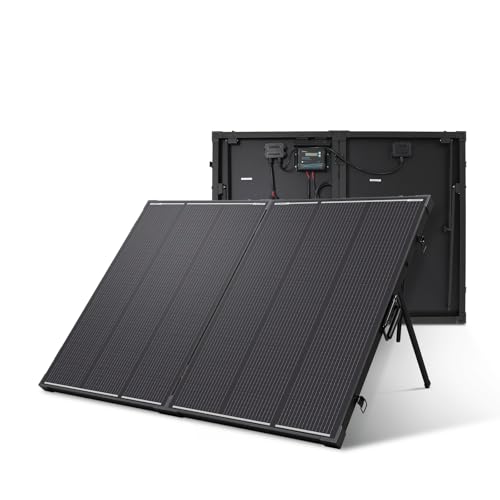
The Renogy 200W Portable kit uses N-type cells rated up to 25% efficient and folds into a suitcase-style case. It weighs 28.46 lb, with low-iron tempered glass, an aluminum frame and an IP65 junction box. The listing names compatibility with Jackery Explorer 1000 v2, EcoFlow DELTA 3 and Anker SOLIX S2000 power stations.

Pick this if you want the sturdiest panel that lives in a truck bed.

What works

  • Tempered glass and aluminum frame survive rough trailers
  • Listing names compatible Jackery, EcoFlow and Anker stations
  • Cells rated up to 25% efficient help in haze

Watch out for

  • 28.46 lb is heavy for one hand carry
  • Costs $90.22 more than the DOKIO 300W
02
Best for: Direct 12V battery charging

Our take

At $179.77 it is $90.22 under the Renogy 200W.

Why it made the shortlist

The DOKIO 300W folds to 19.3 x 37.4 x 1.1 inches and weighs 15.2 lb, a lot less than the Renogy 200W for 100W more nameplate power. It ships with a standalone PWM controller and a 9.85 foot cable. DOKIO warns that some power stations cap solar input at 100 to 200W.

Pick this if you charge a 12V battery directly and want maximum watts.

What works

  • 300W at 15.2 lb beats the Renogy on watts per pound
  • Separate PWM controller can be replaced later
  • 3 m cable lets the controller sit in shade

Watch out for

  • Many power stations cap input below 300W
  • PWM controller is less efficient than MPPT
The catch
The tradeoff is thinner build credentials, and the PWM controller wastes some panel voltage on larger battery banks.
03
Best for: Starting small and expanding

Our take

It sits $32.51 above the Renogy 100W.

Why it made the shortlist

The Go Power DuraLite 100W weighs 8.5 lb and includes a 30-amp PWM charge controller, so it plugs into an RV battery with the supplied accessories. You can add up to 2 more panels for 300W total. The listing positions it for lights, fans and DC loads.

Pick this if you want to start small and grow.

What works

  • Weighs 8.5 lb, easy to store under a bed
  • Add up to 2 panels for 300W
  • 30A controller leaves room for expansion

Watch out for

  • 100W is slow for a fridge
  • Costs $7.73 more than the 300W DOKIO
The catch
The caveat is that 100W adds only a few hundred Wh on a sunny day.
04

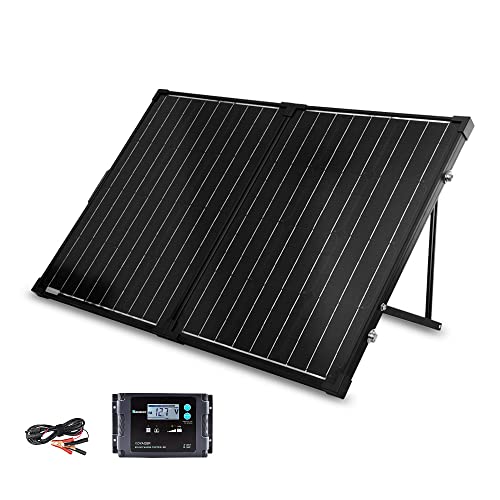
Best Plug and Play · 4 of 5

Renogy 100W Portable Solar Panel

Renogy 100W Portable Solar Panel
  • 100W N-type, 17.42 lb
  • 20A waterproof PWM controller
  • Alligator clip cables
Check price on Amazon for Renogy 100W Portable Solar Panel (opens in a new tab)
Best for: Simple battery top-ups

Our take

At $154.99 it is $115.00 under the Renogy 200W.

Why it made the shortlist

The Renogy 100W Portable kit has a pre-installed waterproof 20A PWM controller and alligator clip cables, so it works out of the box. It weighs 17.42 lb, uses N-type cells up to 25% efficient, and has bypass diodes in the junction box to limit hot-spot loss.

Pick this if you want a trusted brand and simple clips.

What works

  • Waterproof controller comes pre-installed, no wiring needed
  • Bypass diodes limit power loss when partly shaded
  • Costs $115.00 less than the Renogy 200W

Watch out for

  • 17.42 lb is heavy for 100W
  • 20A PWM controller limits future expansion
The catch
The caveat is that 17.42 lb is heavy for only 100W.
05
Best for: Lightweight budget setups

Our take

At $134.77 it is the cheapest pick, $45.00 under the DOKIO 300W and $20.22 under the Renogy 100W.

Why it made the shortlist

The DOKIO 200W weighs 9.7 lb and folds to 20 x 27 x 1.1 inches, with a standalone PWM controller and a 9.84 foot cable. The listing warns that some power stations cap input at 100 to 150W, so check yours before assuming 200W arrives.

It trades the DOKIO 300W's power for about 5.5 lb less weight. Pick this if you want the lightest 200W setup.

What works

  • 200W at 9.7 lb is light for one person
  • Folds to 1.1 inches thick for tight storage
  • Costs $45.00 less than the DOKIO 300W

Watch out for

  • PWM controller wastes some panel voltage

Methodology

How We Built This Shortlist

Each pick was assessed across 4 criteria weighted for real-world use.

01

Weight and fold size

We compared listed weight and folded dimensions for one person carry and cabinet storage.

02

Controller match

We checked controller type and amp rating against typical 12V battery and station use.

03

Power per dollar

We divided listed watts by price and weighed the build quality behind each figure.

04

Station input limits

We looked at whether listings warn about power station solar input caps.

Decision guide

Match a Portable RV Solar Panel Kit to Your RV

By Weight You Can Carry

Your situationRecommended pickWhy
Under 10 lb for one hand carryGo Power DuraLite8.5 lb for 100W
About 10 lb with more powerDOKIO 200W9.7 lb for 200W
Mid weight, maximum wattsDOKIO 300W15.2 lb for 300W
Heavy but built to lastRenogy 200W28.46 lb with glass and IP65 box

By Budget

BudgetRecommended pick
$130 to $160DOKIO 200W or Renogy 100W
$170 to $190DOKIO 300W or Go Power DuraLite
$260 to $270Renogy 200W

PWM Controller vs Power Station Input

PWM controller kit

DOKIO 300W, DOKIO 200W, Go Power DuraLite and Renogy 100W include PWM controllers for direct 12V battery charging, which wastes some voltage but is simple.

Power station feed

Renogy 200W lists named station compatibility, but the station caps input, often at 100 to 200W, so extra panel wattage is wasted.

Most RVers charging a battery should default to a PWM kit unless they own a named power station.

By Budget

Best fitRecommended pick
Under $140 for 200WDOKIO 200W
Around $155 for a trusted brandRenogy 100W
About $180 for 300WDOKIO 300W
Around $270 for a sturdy 200WRenogy 200W

For Charging a 12V RV Battery Specifically

Look for

A controller rated for your panel current, such as 20A or 30A, and a cable long enough to reach shade.

In this comparison

Go Power DuraLite includes a 30A controller and lets you add panels, while DOKIO 300W ships a 9.85 ft cable for placing the panel in sun and the controller in shade.

When to Spend More

Spend more if

Spend more if the panel lives outside: Renogy 200W costs $90.22 over the DOKIO 300W for tempered glass and an IP65 junction box.

Save if

Save if you camp in good weather: DOKIO 200W at $134.77 gives 200W without paying for ruggedness you may not need.

FAQ

Before You Bring One Home

How many watts of portable solar do I need?

Divide your daily Wh by about 350 per 100W on a five sun-hour day. A 200W panel then supplies around 700Wh.

Is PWM good enough for an RV?

For small 12V batteries, yes. MPPT recovers more energy on larger banks, but PWM kits cost less.

Will a 300W panel work on my power station?

Only up to the station's input cap, which DOKIO says is often 100 to 200W. Check the spec before buying.

Can I leave a portable panel out overnight?

Not recommended unless it is rated for weather. Renogy lists IP65 junction boxes and tempered glass, while others do not list a rating.

Can I expand the Go Power DuraLite?

Yes, the listing says you can add up to 2 more panels for 300W total.

Bottom line

The short version

Browse more portable rv solar panel kit on Amazon →
Bowen Higgins, RV Editor at RV Gear Lab

About the author

Bowen Higgins

RV Editor at RV Gear Lab

Bowen covers RV power, water systems, towing and leveling, upkeep and interior comfort, with a focus on matching gear to the rig, the hookups and the way you actually travel.

More from Bowen →Editorial standards

Keep reading

Related guides