

We research everything we recommend. When you buy through our links, we may earn a commission. Learn more

Buying guide · 11 min read · Updated October 1, 2026

6 Best Value Lithium RV Batteries in 2026: A Practical RV Guide

Large 280Ah to 460Ah lithium RV batteries compared on value: Bluetooth, 200A+ BMS, metal cases, and cost per Ah for owners replacing a whole battery bank.

Bowen HigginsBy Bowen HigginsRV Editor at RV Gear Lab6 products comparedSpec-sheet researched

At a glance

Our top picks

For a lot of RV owners, the best value is not the cheapest battery but the one that replaces an entire lead-acid bank in a single box. A 280Ah to 460Ah LiFePO4 battery can retire two or four golf cart batteries, eliminate the parallel cabling between them, and still cost less per Ah than buying several 100Ah units.

This guide focuses on that whole-bank tier. We compared Bluetooth monitoring, BMS current, case construction, cold-weather behavior, and cost per Ah across six large batteries, using specs and buyer feedback rather than marketing claims, to find which ones give boondockers the most capability for their money.

RV Gear Lab field notes

The Rig Fit Check

Start with the job
TechCella 12V 320Ah LiFePO4 Battery, 200A BMS, Bluetooth leads this shortlist for Boondockers replacing a lead-acid bank with one monitored battery. Use that fit as a reference point, then compare the alternatives against your own space and workload.
Specs that separate the picks
The first details to compare are 320Ah, about $1.25 per Ah, 280Ah, 3584Wh, 300Ah, 200A BMS. Confirm the exact model and included components before ordering.
Trade-off to plan for
58 lbs is a two-person lift

Before you buy

What Matters Before You Choose a Value Lithium RV Battery

Key buying criteria so you get the right fit the first time.

  1. 01

    Cost per Ah Against Several Small Batteries

    A big single battery should cost the same or less per Ah than buying several 100Ah batteries, or the convenience is costing you. Divide the price by capacity and compare it to a quality 100Ah drop-in. In this tier, figures between about $1.25 and $1.90 per Ah represent good value.

  2. 02

    BMS Current for Your Inverter

    Large batteries are usually paired with large inverters, and at 12V a 2000W load pulls well over 170A. A 200A BMS fits a 2000W inverter, while a 250A BMS gives room for larger units. Find the continuous BMS rating in the listing and match it to your inverter, not to the surge figure.

  3. 03

    Maximum Charge Current

    A 300Ah battery fed by a typical 30A to 55A converter takes many hours to refill. Batteries that accept 100A or more let a large solar array or inverter charger refill them quickly. Look for a stated charge current range and compare it with your charging sources.

  4. 04

    Weight and Installation

    Large LiFePO4 batteries weigh roughly 55 to 90 lbs, which is still lighter than the lead-acid bank they replace but too heavy for one person to lift into a compartment safely. Mounting feet and handles make a big difference. Check the listed weight and plan a two-person install.

  5. 05

    Case Construction

    Metal cases resist heat, impact, and vibration and often bolt directly to the floor, while plastic cases rely on a battery box and straps. For rigs that see washboard roads, vibration resistance can matter as much as capacity. Look for mounting feet, a metal enclosure, or internal cell brackets in the description.

  6. 06

    Recovery and Activation Behavior

    When a BMS trips on overload or deep discharge, some batteries recover automatically after a short delay, while others need a charger with 0V activation to wake up. Knowing this ahead of time avoids a stranded weekend. Check the listing for auto-recovery timing and activation notes.

Our standards

Why You Can Trust RV Gear Lab

At RV Gear Lab, we compare products based on rig fit and power or hookup compatibility, verified specifications, usability, setup requirements, weight, durability, and real-world trade-offs. We do not rank products purely on marketing claims or commission rates.

We have not personally tested every product listed. Where hands-on testing is not available, recommendations are based on verified manufacturer specifications, product documentation, use-case fit, and comparative research.

How we review RV gear →

Detailed reviews

The 6 best value lithium rv batteries, explained

01
Best for: Boondockers replacing a lead-acid bank with one monitored battery

Our take

TechCella 12V 320Ah LiFePO4 Battery, 200A BMS, Bluetooth makes the shortlist because accepts 20A to 160A charging current.

Why it made the shortlist

The TechCella 320Ah delivers the strongest overall value in the whole-bank tier: 320Ah with Bluetooth and a 200A BMS for about $400, or roughly $1.25 per Ah. Its case measures 13.58 x 7.48 x 9.64 inches at 58.43 lbs, and it accepts anywhere from 20A to 160A of charging current, so it pairs well with both a basic converter and a large solar array.

What works

  • Accepts 20A to 160A charging current
  • Recovers from overload in 30 seconds
  • Compact for 320Ah at 13.58 inches long

Watch out for

  • 58 lbs is a two-person lift
The catch
Against the VATRER and ECO-WORTHY picks below, it lacks a starting mode and a metal case, but it costs $130 to $360 less.
02
Best for: Owners who want 280Ah and Bluetooth under $400

Our take

Best for RVers with a firm budget who want app monitoring and a large single battery.

Why it made the shortlist

The GOKWH 280Ah is the cheapest way into this tier at about $380, storing 3584Wh behind a 200A BMS. Its Bluetooth app shows capacity, current, and temperature and adds fault alerts and diagnostic info, and the brand lists FCC and UN38.3 compliance with an 8000 plus cycle rating.

What works

  • App sends fault alerts and diagnostics
  • Lists FCC and UN38.3 compliance
  • Rated for 8000 plus cycles

Watch out for

  • Discharge cutoff listed, charge cutoff unclear
The catch
It ranks below the TechCella because it costs more per Ah, roughly $1.36 versus $1.25.
03
Best for: Motorhome owners who want house and start power in one

Our take

Best for motorhome or generator owners who want emergency starting power from the house bank.

Why it made the shortlist

The VATRER 300Ah adds something none of the other large batteries here offer: a dual-mode BMS. In normal mode it is a 300Ah deep-cycle house battery rated for over 5000 cycles; in start mode it can deliver 1500A for cranking an engine or generator. The app tracks voltage, current, SOC, and cycle count.

It ranks third because at about $540 it costs roughly $1.80 per Ah, notably more than the TechCella and GOKWH above. Compared with the ECO-WORTHY 280Ah below, it costs about the same, trading a metal case for the start mode and slightly more capacity.

What works

  • Start mode delivers 1500A for engine cranking
  • App tracks cycle count and SOC
  • Charges in about 4.5 hours on 850W solar
  • High and low temperature cutoffs listed

Watch out for

  • Hot surface warning on the case
04
Best for: Van and off-road rigs that see rough roads

Our take

Best for vans, truck campers, and off-road trailers where vibration and mounting matter more than squeezing every Ah per dollar.

Why it made the shortlist

The ECO-WORTHY EnergyRock 280Ah is built for rigs that take a beating. Its metal enclosure adds heat and fire resistance, four mounting feet let it bolt directly to the floor without a battery box, and reinforced internal cell holders resist road vibration. A one-touch safety switch disconnects output during installation or storage.

It ranks fourth on value because at about $530 it costs roughly $1.89 per Ah, more than every pick above it.

What works

  • Metal case adds heat and fire resistance
  • Mounting feet mean no battery box needed
  • Safety switch cuts output for maintenance
  • Reinforced cell holders resist road vibration

Watch out for

  • Costs about $1.89 per Ah
  • Heavier than plastic-case batteries
05
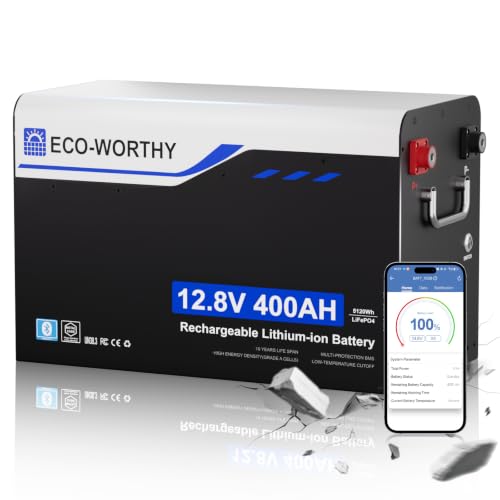
ECO-WORTHY 12V 400Ah Metal Case LiFePO4 Battery, 250A BMS
  • 400Ah, 250A BMS
  • Steel case with safety switch
  • Low-temp charge protection
Check price on Amazon for ECO-WORTHY 12V 400Ah Metal Case LiFePO4 Battery, 250A BMS (opens in a new tab)
Best for: Full-timers running a large inverter off-grid

Our take

Best for full-time and long-stay boondockers with a 2500W-class inverter.

Why it made the shortlist

The ECO-WORTHY 400Ah is the pick for full-timers who want to replace four 100Ah batteries with one box. It pairs Grade A cells with a 250A BMS, the highest current rating here, so it can support a larger inverter than the 200A picks above, and its steel case, mounting feet, and independent low-current safety switch carry over from the 280Ah model.

Compared with the LiTime 460Ah below, it offers a little less capacity for about $240 less.

What works

  • 400Ah replaces four 100Ah batteries
  • 250A BMS supports a larger inverter
  • Safety switch reduces spark risk at terminals
  • Bluetooth app shows system health

Watch out for

  • About $760 total
  • Very heavy single unit to install
The catch
Caveat: a single 400Ah battery is heavy and concentrates all your storage in one unit, so plan the install and lifting carefully.
06
Best for: Big motorhomes with a Group 8D bay

Our take

Best for large motorhome owners who want maximum capacity in an 8D slot from a well-known brand.

Why it made the shortlist

The LiTime 460Ah is the capacity ceiling for this guide, built into a standard Group 8D case for motorhomes and large fifth wheels that already have an 8D bay. It uses EV-grade cells with a 250A BMS, holds above 12.8V across its usable range, and is covered by product liability insurance.

What you pay for is a recognized brand and a standard size that drops into an existing 8D tray.

What works

  • Largest capacity in this roundup at 460Ah
  • Fits a standard Group 8D battery box
  • 250A BMS with EV-grade cells
  • Holds voltage above 12.8V to full depth

Watch out for

  • Highest cost per Ah here at about $2.17
  • No Bluetooth listed on this model

Methodology

How We Built This Shortlist

Each pick was assessed across 5 criteria weighted for real-world use.

01

Cost per Ah at Bank Scale

Ranked batteries of 280Ah and up on dollars per Ah, since that is the real comparison against buying several 100Ah batteries.

02

BMS Current for Large Inverters

Compared 200A and 250A BMS ratings against common 2000W to 3000W RV inverters, since big batteries are usually paired with big loads.

03

Case Build and Mounting

Gave credit for metal cases, mounting feet, and safety switches that simplify floor installs and reduce vibration risk.

04

Charge Acceptance and Recharge Time

Checked the listed maximum charging current, since a 300Ah battery fed by a 30A converter needs about ten hours to refill.

05

Monitoring Included

Noted Bluetooth apps, fault alerts, and cycle counters, since a large single battery needs accurate state of charge data.

Decision guide

Match a Value Lithium RV Battery to Your RV

By Bank Size You Are Replacing

Current lead-acid bankRecommended pickWhy
Two 6V golf cart batteriesGOKWH 280Ah280Ah lithium roughly doubles usable energy
Two 12V Group 27 batteriesTechCella 320Ah320Ah with Bluetooth in a 13.58 inch case
Bank that also starts a generatorVATRER 300Ah Dual-Mode1500A start mode from the house battery
Four 6V batteries in a large bayECO-WORTHY 400Ah Metal Case400Ah and a 250A BMS
Group 8D in a motorhomeLiTime 460Ah Group 8DDirect 8D fit at 460Ah

By Budget

BudgetRecommended pickApprox. $ per Ah
Under $400GOKWH 280Ah or TechCella 320Ah$1.36 or $1.25
$530 to $540ECO-WORTHY 280Ah Metal Case or VATRER 300Ah Dual-Mode$1.89 or $1.80
About $760ECO-WORTHY 400Ah Metal Case$1.90
About $1000LiTime 460Ah Group 8D$2.17

Metal Case vs Plastic Case

Metal case

A steel enclosure spreads heat, resists impact, and often includes mounting feet and a safety switch, so the battery can bolt to the floor without a separate box. It adds weight and cost. In this roundup: ECO-WORTHY 280Ah Metal Case and ECO-WORTHY 400Ah Metal Case.

Plastic case

ABS cases are lighter and cheaper and fit standard battery boxes and straps. They depend more on how securely you strap them down. In this roundup: TechCella 320Ah, GOKWH 280Ah, VATRER 300Ah Dual-Mode, and LiTime 460Ah Group 8D.

Choose plastic for the best value in a trailer with a proper battery box; choose metal for vans and off-road rigs that see constant vibration.

By Inverter Size

Inverter sizeRecommended pickBMS rating
Up to 2000W, budgetGOKWH 280Ah200A
Up to 2000W with fast chargingTechCella 320Ah200A, up to 160A charge
2000W plus engine start backupVATRER 300Ah Dual-Mode200A plus 1500A start mode
2500W to 3000WECO-WORTHY 400Ah Metal Case250A
2500W to 3000W, 8D bayLiTime 460Ah Group 8D250A

For Full-Time Boondocking Specifically

Look for

At least 300Ah, a BMS of 200A or more, charge acceptance high enough for your solar array, and an app with accurate state of charge so you can plan generator runs.

In this comparison

The TechCella 320Ah covers all four for about $400, accepting up to 160A of charge. Step up to the ECO-WORTHY 400Ah Metal Case if you run a 2500W-class inverter and want 400Ah.

When to Spend More

Spend more if

Your rig sees rough roads or you need very high current. The ECO-WORTHY 280Ah Metal Case and ECO-WORTHY 400Ah Metal Case add metal cases and mounting feet, and the ECO-WORTHY 400Ah Metal Case adds a 250A BMS.

Save if

Your trailer has a sturdy battery box and you run a 2000W inverter or smaller. The TechCella 320Ah or GOKWH 280Ah gives you a monitored 280Ah to 320Ah battery for under $400.

FAQ

Before You Bring One Home

Is one 300Ah battery better than three 100Ah batteries?

It is simpler, with one BMS and fewer cables, and often cheaper per Ah. Three smaller batteries are easier to lift and give you redundancy if one fails, so the right choice depends on your space and how you install.

Is the ECO-WORTHY 400Ah worth it over the TechCella 320Ah?

Only if you need the extra capacity or a 250A BMS for a large inverter. The TechCella costs much less per Ah and handles most 2000W setups comfortably.

Can my RV converter charge a 300Ah lithium battery?

Yes if it has a lithium profile, but a 30A to 55A converter will take many hours to fill a large battery. Many owners add solar or an inverter charger to shorten recharge time.

What is a common mistake when installing a big lithium battery?

Using cables and fuses sized for the old lead-acid bank. Higher current from a large inverter needs heavier cable and a properly rated fuse close to the battery positive terminal.

How do I store a large lithium battery between trips?

Charge it to around half, switch off output with the battery switch or a disconnect, and keep it from freezing if it will be charged. Top it up every few months.

Bottom line

The short version

Browse more value lithium rv batteries on Amazon →
Bowen Higgins, RV Editor at RV Gear Lab

About the author

Bowen Higgins

RV Editor at RV Gear Lab

Bowen covers RV power, water systems, towing and leveling, upkeep and interior comfort, with a focus on matching gear to the rig, the hookups and the way you actually travel.

More from Bowen →Editorial standards

Keep reading

Related guides