

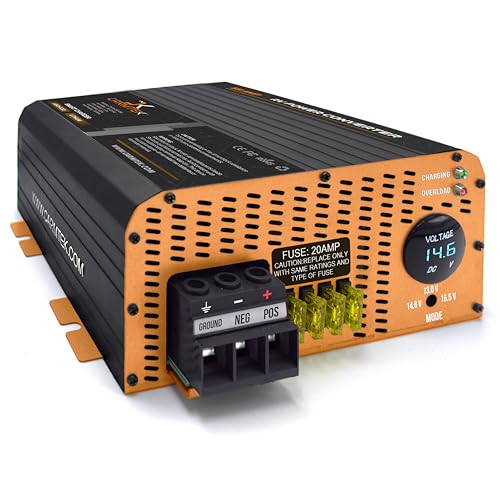
We research everything we recommend. When you buy through our links, we may earn a commission. Learn more

Buying guide · 11 min read · Updated October 2, 2026

6 Best RV Converter Chargers in 2026: A Practical RV Guide

Six 55 to 80 amp RV converter chargers compared by charge-current math, voltage modes and cooling, so you can size one to a big battery bank.

Bowen HigginsBy Bowen HigginsRV Editor at RV Gear Lab6 products comparedSpec-sheet researched

At a glance

Our top picks

Most converter roundups sort by amp rating, but the job you hire a converter charger for is the second half of its name: putting current into a battery bank while the rig's 12V loads also pull. A 200Ah lithium bank can accept a lot more than a 45 amp box can spare, and that gap, not the label, decides how long you wait. As a rule of thumb, an effective charge rate is the converter's amps minus the loads you leave running, and at 13.6 volts every 10 amps is about 136 watts of DC.

We compared six aftermarket chargers from 55 to 80 amps, priced from $72.81 to $169.90, with the charge angle in mind: voltage modes, stage descriptions, cooling and the battery sizes each listing actually claims. For name-brand OEM replacement parts see our factory-part guide, and for a specific size see the amp-specific pages. Here the question is which unit fits a bigger or lithium-heavy battery bank without wasting money.

RV Gear Lab field notes

The Rig Fit Check

Start with the job
WAVLINK 80A RV Power Converter 120V AC to 12V DC Battery Charger (GS1500RV-80) leads this shortlist for large banks over 200Ah. Use that fit as a reference point, then compare the alternatives against your own space and workload.
Specs that separate the picks
The first details to compare are 80A, 13.0V to 16.5V range, 55A, 13V to 16.5V adjustable, 55A, 13.0/14.6/16.5V modes. Confirm the exact model and included components before ordering.
Trade-off to plan for
Feature text names no lithium mode or charge stages

Before you buy

What Matters Before You Choose an RV Converter Charger

Key buying criteria so you get the right fit the first time.

  1. 01

    Charge current after loads

    A converter's amps are shared between the battery and the rig, so a 55 amp unit with 15 amps of loads leaves about 40 for the battery. A 200Ah bank half empty then needs roughly 2.5 hours at that rate, and longer as charge tapers. Add your running loads, subtract from the rating, and compare to the battery's maximum charge current.

  2. 02

    Battery's own charge limit

    Many batteries limit charge current to a fraction of their capacity, so a bigger charger does not charge faster. A 100Ah battery with a 50 amp limit gains nothing from an 80 amp box. Read the battery spec for the maximum charge current before choosing a size.

  3. 03

    Lithium voltage step

    Lithium wants a steady absorb voltage near 14.4 to 14.6 volts and does not need an equalization or desulfation stage. A unit without a 14.6 volt option may undercharge it. Look for a numbered step or a LiFePO4 mode and check it against the battery maker's spec.

  4. 04

    Stage naming

    A Desulfation or equalization stage can reach high voltages for lead-acid, and on lithium it is harmful. If a listing names stages, see which are skipped in lithium mode. A listing with no stage names, like the WAVLINK 80A, leaves you to check the manual.

  5. 05

    Heat and cooling

    An 80 amp unit at 13.6 volts moves around 1,088 watts, and heat shortens electronics life. A temperature-triggered fan with a metal housing helps. Check the listing for a fan description, and allow clearance around the unit.

  6. 06

    Seller and certification clarity

    Three picks here come from seller names rather than established converter brands, and only some list marks like CE, FCC or RoHS. None here lists a UL mark in the feature text. Check the return window and ask for documentation before hardwiring a high-current unit.

Our standards

Why You Can Trust RV Gear Lab

At RV Gear Lab, we compare products based on rig fit and power or hookup compatibility, verified specifications, usability, setup requirements, weight, durability, and real-world trade-offs. We do not rank products purely on marketing claims or commission rates.

We have not personally tested every product listed. Where hands-on testing is not available, recommendations are based on verified manufacturer specifications, product documentation, use-case fit, and comparative research.

How we review RV gear →

Detailed reviews

The 6 best rv converter chargers, explained

01
Best for: Large banks over 200Ah

Our take

Pick this for a 200Ah or larger bank, or a rig with a lot of 12V loads.

Why it made the shortlist

The WAVLINK 80A is an 80 amp deck-mount converter and charger sold as a replacement part for RV trailers and campers. The listing names a temperature-control fan system, an LED indicator for converter status, CE, FCC and RoHS certifications, and a wide voltage range from 13.0V to 16.5V that also suits boat and other 12V systems. It sells for $149.99.

It ranks first because 80 amps leaves the most headroom for a large bank after loads: at 13.6 volts that is about 1,088 watts of DC, 25 amps more than the 55 amp picks. It costs $20 less than the CARMTEK 55 and is $20.02 above the Hihitomorrow 65 amp.

What works

  • Gives 80 amps, about 1,088 watts of DC at 13.6V
  • Costs $20.02 less than the CARMTEK 55 amp
  • LED indicator shows converter status at a glance
  • Temperature-controlled fan limits noise at light load

Watch out for

  • Feature text names no lithium mode or charge stages
  • Cites CE, FCC and RoHS rather than a UL listing
02
Best for: Mid-size lithium banks

Our take

Choose it for a mid-size lithium bank where you want the clearest listing at 55 amps.

Why it made the shortlist

The CARMTEK RV Converter 55 Amp converts 120V shore power to 12V DC for loads and battery charging. The listing says it supports lead-acid and LiFePO4, uses smart multi-stage charging that adjusts current and voltage, and has a 13V to 16.5V adjustable range. It lists six protections: short circuit, overload, over-temperature, under-voltage, over-voltage and reverse polarity. It is priced at $169.90.

Against the KSGNY 55A at $129.99 it lists lithium and more protections for $39.91 more.

What works

  • Lists LiFePO4 and lead-acid with an adjustable range
  • Six protections include under-voltage and reverse polarity
  • Costs $39.91 more than the KSGNY 55A with more detail
  • Multi-stage charging adjusts current and voltage

Watch out for

  • Costs $89.91 more than the MWXNE 55 amp
  • Gives no wattage, dimensions or stage names
03
Best for: Mid-size banks on a budget

Our take

Pick it for a mid-size lithium or lead-acid bank on a budget where you want a clear three-stage cycle.

Why it made the shortlist

The MWXNE 55 Amp delivers up to 55 amps of DC and uses a switch to choose between lead-acid and LiFePO4 modes, plus a fixed voltage mode with steps of 13.0, 14.6 and 16.5 volts. Charging is a three-stage cycle of Boost, Normal and Trickle. The listing adds a metal housing, a temperature-controlled fan, thermal shutdown, and extra fuses for added safety. It costs $79.99.

It ranks third because it combines named voltage steps and stages at $79.99, which is $89.91 under the CARMTEK 55A with a similar capability.

What works

  • Switch selects lead-acid or LiFePO4 charging
  • Three named stages cover boost, normal and trickle
  • Extra fuses are included for added safety
  • Costs $89.91 less than the CARMTEK 55A

Watch out for

  • The 16.5 volt step could overcharge a battery bank
  • Gives 10 amps less than the cheaper VEVOR 65A
04
Best for: WF-9800 bays with 65 amp needs

Our take

Choose it for a 65 amp lead-acid or lithium bank in a trailer with a WF-9800 deck mount.

Why it made the shortlist

This 65 amp converter from Hihitomorrow lists a steady 65 amp output, three preset voltage modes of 13V, 14.6V and 16.5V, and four charging stages named Boost, Normal, Storage and Desulfation. It is described as a replacement for the WF-9800 series and built from steel, plastic, aluminum alloy, circuit boards and copper. It costs $129.99.

It ranks fourth because the Desulfation stage is aimed at lead-acid, so a lithium owner would use the 14.6 volt preset instead. It is the one pick that names a WF-9800 series fit, which helps for an older trailer.

What works

  • Names a WF-9800 series replacement fit
  • Four stages are listed including a storage mode
  • Steady 65 amp output, about 884 watts at 13.6V
  • Costs $20 less than the WAVLINK 80 amp

Watch out for

  • Costs $57.18 more than the VEVOR 65A for similar presets
  • Seller name is not an established converter brand
05
Best for: Budget buyers with a mid-size bank

Our take

Pick it as a low-cost charger for a mid-size bank where you can set the mode by hand.

Why it made the shortlist

The VEVOR 65 Amp is the cheapest unit here at $72.81. It lists dedicated lead-acid and LiFePO4 modes, a fixed voltage mode with choices of 13.0, 14.6 and 16.5 volts, a temperature-triggered fan, a metal housing, six protections and a 100 percent copper cable. The listing says it suits medium-capacity batteries rated 55Ah to 70Ah.

It ranks fifth because that 55Ah to 70Ah note conflicts with its main reason to exist, since a 65 amp charger is larger than a battery that size wants. It is $57.18 below the Hihitomorrow 65A and $7.18 below the MWXNE 55A, with 10 more amps than the MWXNE.

What works

  • Cheapest here at $72.81 with 65 amps
  • Six protections and a copper cable are included
  • Dedicated LiFePO4 mode plus numbered fixed voltages
  • Metal housing with a temperature-triggered fan

Watch out for

  • Listing pairs it with batteries of 55Ah to 70Ah
  • No UL-style listing is mentioned in the feature text
06
KSGNY 55A RV Power Converter 110V to 12V DC Charger (PM3-55)
  • 55A, 110V AC to 12V DC
  • -10 to 60 C operating range
  • Flush-mount compact body
Check price on Amazon for KSGNY 55A RV Power Converter 110V to 12V DC Charger (PM3-55) (opens in a new tab)
Best for: Plain lead-acid 55A flush-mount installs

Our take

KSGNY 55A RV Power Converter 110V to 12V DC Charger (PM3-55) makes the shortlist because compact body supports flush mounting without modifications.

Why it made the shortlist

The KSGNY 55A lists a 55 amp output from 110V AC to 12V DC, named as the PM3-55 in its own text. The feature bullets cover three protections (overvoltage, overcurrent and short-circuit), an operating range of -10 to 60 degrees Celsius with vibration resistance, and a compact body that supports flush mounting. It is used to charge RV batteries and power a refrigerator, lighting and navigation. It costs $129.99.

It costs $50 more than the MWXNE 55A, which adds lithium and named stages, and $39.91 less than the CARMTEK 55A, which adds six protections and an adjustable range.

What works

  • Compact body supports flush mounting without modifications
  • Overvoltage, overcurrent and short-circuit protection are listed
  • Vibration resistance is stated for bumpy roads

Watch out for

  • Listing never mentions lithium, stages or voltage options
  • Costs $50 more than the MWXNE 55A for less detail
The catch
Choose it only for a lead-acid bank where you want a compact, flush-mount 55 amp supply.

Methodology

How We Built This Shortlist

Each pick was assessed across 5 criteria weighted for real-world use.

01

Charge headroom

We converted each amp rating into approximate DC watts at 13.6 volts and compared how much room is left for the battery after house loads.

02

Voltage control

We checked for numbered voltage steps, an adjustable range or lithium mode instead of a bare compatibility claim.

03

Stage description

We looked at whether stages are named (Boost, Normal, Trickle, Storage) and whether a lead-acid desulfation stage might apply to lithium.

04

Stated battery size

Some listings tie a unit to a battery range, and we noted those because they can conflict with the unit's amp rating.

05

Price and certification

We weighed the $72.81 to $169.90 spread against listed marks such as CE, FCC, RoHS and protection lists.

Decision guide

Match an RV Converter Charger to Your RV

By Battery Bank Size

Match the charger to how much current the bank can accept after your loads.

Your situationRecommended pickWhy
200Ah or larger bank, many 12V loadsWAVLINK 80A80 amps leaves the most headroom
100Ah to 200Ah lithium bankCARMTEK 55ALithium claim with six protections
100Ah to 200Ah bank on a budgetMWXNE 55ANamed stages and lithium switch for $79.99
Lead-acid trailer with a WF-9800 bayHihitomorrow 65ANames a WF-9800 replacement fit
55Ah to 70Ah bank, lowest costVEVOR 65AListing is written for that bank size

By Budget

BudgetRecommended pick
Under $80VEVOR 65A or MWXNE 55A
$125 to $135Hihitomorrow 65A or KSGNY 55A
$145 to $175WAVLINK 80A or CARMTEK 55A

More Amps vs More Detail

More amps

The WAVLINK 80A and the VEVOR 65A give the most current per dollar. They suit larger banks, but the WAVLINK lists no stages and the VEVOR ties itself to small batteries.

More listing detail

The CARMTEK 55A and MWXNE 55A spell out lithium support, protections and stages at 55 amps. They charge a smaller bank well but have less headroom.

Most buyers with a 100Ah to 200Ah bank are better served by detailed 55 amp listings than by an 80 amp box with little explanation.

By Charge Voltage Control

Your needRecommended pickWhy
Numbered 14.6V lithium stepMWXNE 55AOffers 13.0, 14.6 and 16.5V modes
Wide adjustable rangeWAVLINK 80A13.0V to 16.5V range stated
Lithium and lead-acid listed with protectionsCARMTEK 55ASix protections, adjustable range
Four-stage lead-acid cycleHihitomorrow 65ABoost, Normal, Storage, Desulfation

For Boondocking Rigs With a Big Lithium Bank Specifically

Look for

Enough output to feed loads and the bank at once, a numbered lithium voltage and cooling that keeps the box from derating when it runs for hours.

In this comparison

The WAVLINK 80A has the most headroom at about 1,088 watts of DC, and the CARMTEK 55A has the clearest lithium listing. The MWXNE 55A is the cheaper way to get a 14.6 volt step.

When to Spend More

Spend more if

You have a large bank or want the most explicit lithium listing; the WAVLINK 80A offers headroom and the CARMTEK 55A offers detail.

Save if

Your bank is mid-size and you can set a mode by hand; the MWXNE 55A at $79.99 or VEVOR 65A at $72.81 do the job for about half the price.

FAQ

Before You Bring One Home

What is the difference between a converter and a converter charger?

A converter changes 120V AC to 12V DC to run loads. A converter charger also charges the battery in stages. Most RV converters today are both, so the name is mainly a search habit.

Will an 80 amp charger damage a small battery?

It can if the battery's charge current limit is lower than the output. Many small batteries accept only a fraction of capacity. Use a smaller unit or check for a current limit, and note the VEVOR 65A is pitched at 55Ah to 70Ah banks.

Is the CARMTEK worth $90 more than the MWXNE?

If you want the six listed protections and a clearer lithium statement, maybe. The MWXNE gives named voltage steps and stages for $79.99, so most buyers will pick it for value.

How do I set these chargers for lithium?

Use the lithium or LiFePO4 mode where it exists, or the 14.6 volt step, after checking your battery's absorb voltage. Do not leave a 16.5 volt step selected on a battery.

Can these replace a factory WFCO or Progressive unit?

Only if the cutout and connectors match. The Hihitomorrow 65A names a WF-9800 fit, and the rest are generic. See our factory-part guide for exact OEM matches.

How do I check that my charger is working correctly?

Measure battery voltage with a meter while plugged in. A lead-acid battery should sit near 13.2 to 14.4 volts in float or absorb, and a lithium bank should follow its maker's spec. A reading far below suggests a loose lug or failing unit.

Bottom line

The short version

Browse more rv converter chargers on Amazon →
Bowen Higgins, RV Editor at RV Gear Lab

About the author

Bowen Higgins

RV Editor at RV Gear Lab

Bowen covers RV power, water systems, towing and leveling, upkeep and interior comfort, with a focus on matching gear to the rig, the hookups and the way you actually travel.

More from Bowen →Editorial standards

Keep reading

Related guides