

We research everything we recommend. When you buy through our links, we may earn a commission. Learn more

Buying guide · 12 min read · Updated October 2, 2026

6 Best RV Generators in 2026: A Practical RV Guide

Six RV-ready generators from $370 to $798 compared on TT-30 output, rated watts, dual-fuel runtime, noise, weight and carbon monoxide shutdown.

Bowen HigginsBy Bowen HigginsRV Editor at RV Gear Lab6 products comparedSpec-sheet researched

At a glance

Our top picks

Most trailers are wired for 30 amp service, and 30 amps at 120 volts is 3,600 watts, so a generator bigger than about 4,000 watts cannot push more than 3,600 of it through a single TT-30 plug. That fact reshapes the shopping question: the useful number is not the biggest watt label but how many rated watts you get on the fuel you will actually burn, whether the output is clean enough for electronics, and whether the plug on the panel is the one your trailer cord expects. Starting watts, quoted in large type on most listings, only last a few seconds.

We compared six RV-ready generators from $369.99 to $798, all of which list a 30A outlet, with attention to rated watts per fuel, runtime figures, noise and weight where the listing states them. This is the hub page, so each pick below says who should buy it and who should skip it, and the narrower guides on this site cover specific wattage classes in more depth.

RV Gear Lab field notes

The Rig Fit Check

Start with the job
WEN 4800-Watt Dual Fuel RV-Ready Inverter Generator DF480iX leads this shortlist for one-air-conditioner trailers wanting equal output on either fuel. Use that fit as a reference point, then compare the alternatives against your own space and workload.
Specs that separate the picks
The first details to compare are 4,000 rated watts, both fuels, 3,000 running watts, 5,100 rated watts on gasoline. Confirm the exact model and included components before ordering.
Trade-off to plan for
Listing gives no decibel figure, only a conversation comparison

Before you buy

What Matters Before You Choose an RV Generator

Key buying criteria so you get the right fit the first time.

  1. 01

    Running watts versus starting watts

    Starting (or peak) watts is a brief surge that lasts a few seconds when a motor starts, while rated or running watts is what the generator can supply continuously. An air conditioner's compressor needs the surge once and the running watts afterward, so a generator advertised at 4,650 peak but only 3,600 rated can still struggle with heavy loads. Look for the 'rated' or 'running' line in the listing, not the large title number.

  2. 02

    The 30A plug shape

    RV shore cords use a TT-30P plug, and a generator with a TT-30R receptacle takes it directly. Many listings say 30A but supply an L5-30R twist-lock, which needs a small adapter, and a few do not state the shape at all. Look for 'TT-30R' in the outlet list, and plan for an adapter if you only see L5-30R.

  3. 03

    Inverter versus conventional output

    Inverter generators produce clean power, with distortion usually listed under 3 percent, which protects laptops, TVs and the electronics in newer converters. Conventional generators can output a rougher waveform. Check the listing for a total harmonic distortion number, since a model that does not mention inverter technology should be treated as conventional.

  4. 04

    Carbon monoxide shutdown

    A generator can kill a sleeper in a camper when exhaust drifts toward a window, and an automatic shutdown sensor shuts the engine off when CO levels climb. It is a backup, not a license to run the unit close to the RV. Look for the sensor named in the listing (WEN Watchdog, CO Shield) and keep the generator several feet from windows and vents.

  5. 05

    Fuel runtime at realistic load

    Runtime figures are quoted at a specific load, often 25 percent, and drop quickly under a running air conditioner. A 1.6-gallon tank giving 8 hours at 25 percent load is about 0.2 gallons per hour, but at half load or more it will be much shorter. Check the load the listing uses before comparing hours between models.

  6. 06

    Weight, noise and warranty

    Under 50 pounds is a one-person lift; open-frame models above that often need a ramp or a second person. Noise is quoted at 23 feet and runs from 60 to 64 dBA in the listings that state it. Warranty ranges from two to three years here, so read what is covered before registering.

Our standards

Why You Can Trust RV Gear Lab

At RV Gear Lab, we compare products based on rig fit and power or hookup compatibility, verified specifications, usability, setup requirements, weight, durability, and real-world trade-offs. We do not rank products purely on marketing claims or commission rates.

We have not personally tested every product listed. Where hands-on testing is not available, recommendations are based on verified manufacturer specifications, product documentation, use-case fit, and comparative research.

How we review RV gear →

Detailed reviews

The 6 best rv generators, explained

01
WEN 4800-Watt Dual Fuel RV-Ready Inverter Generator DF480iX
  • 4,000 rated watts, both fuels
  • TT-30R plus four 120V outlets
  • CO Watchdog shutdown
Check price on Amazon for WEN 4800-Watt Dual Fuel RV-Ready Inverter Generator DF480iX (opens in a new tab)
Best for: One-air-conditioner trailers wanting equal output on either fuel

Our take

Pick this if one rooftop air conditioner plus other trailer loads is your normal summer scenario and you want the same output whether you run gas or a propane tank.

Why it made the shortlist

The WEN DF480iX is a 224cc dual-fuel inverter generator rated at 4,000 watts on gasoline with a 4,800 watt surge, and on propane it still lists 4,000 rated watts with a 4,320 watt surge. That flat rating across both fuels is unusual in this price class. It has a TT-30R RV receptacle, four three-prong 120V receptacles, a 12V DC outlet, two USB ports, wheels and a telescoping handle, and the WEN Watchdog sensor shuts it down if carbon monoxide builds up.

It costs $647, which is $151 less than the WEN DF680iX and $7.01 more than the Champion 4000. Against the budget picks it is $248 more than the Westinghouse 4650 ($647 versus $399) and delivers 400 more rated watts on gasoline.

What works

  • Rated 4,000 watts on gasoline and on propane
  • CO Watchdog shuts the engine down automatically
  • TT-30R plug and four 120V outlets on the panel
  • Wheels and telescoping handle come built in

Watch out for

  • Listing gives no decibel figure, only a conversation comparison
  • Weight is not stated
  • Costs $248 more than the Westinghouse 4650
The catch
Against the Champion it adds 1,000 more rated watts (4,000 versus 3,000 running) and dual-fuel flexibility, but it does not list a decibel figure, only a comparison to normal conversation.
02

Best Lightweight Quiet Pick · 2 of 6

Champion 4000-Watt RV Ready Portable Inverter Generator

Best for: Solo campers who lift the generator themselves

Our take

Pick this if you carry the generator in and out of a truck bed yourself and expect to run a single rooftop air conditioner with modest other loads.

Why it made the shortlist

The Champion 4000 is a gasoline inverter generator with 4,000 starting watts and 3,000 running watts, weighing under 49 pounds, with a listed noise level of 64 dBA from 23 feet and up to 10 hours of runtime. Its panel has a 120V TT-30R outlet, a 120V 20A household outlet with less than 3 percent total harmonic distortion, a 12V automotive-style outlet and parallel outlets. CO Shield shuts the engine off when carbon monoxide builds up.

What works

  • Weighs under 49 pounds for one-person lifting
  • Published 64 dBA noise level at 23 feet
  • Under 3 percent distortion on the household outlet
  • Parallel kit available to double output later

Watch out for

  • Gasoline only, with no propane option
  • Parallel kit that doubles output is sold separately
  • Gives 1,000 fewer rated watts than the WEN DF480iX
03
Best for: Two-air-conditioner rigs and home backup duty

Our take

Choose WEN 6800-Watt Dual Fuel RV-Ready Inverter Generator DF680iX for offers an L14-30R receptacle for 120V or 240V.

Why it made the shortlist

The WEN DF680iX is a 224cc dual-fuel inverter generator with 6,800 surge watts and 5,100 rated watts on gasoline, and 6,000 surge and 4,500 rated on propane. It has a TT-30R RV receptacle, an L14-30R 120V/240V receptacle, two three-prong 120V receptacles and a 12V outlet. The listing describes a bonded-neutral 240V configuration that can also give low-power Level 2 charging to an electric vehicle, and it includes the CO Watchdog sensor.

It is the most expensive pick at $798, which is $151 above the WEN DF480iX and $158.01 above the Champion 4000. For that it delivers 1,100 more rated watts than the DF480iX on gasoline (5,100 versus 4,000), and unlike the others it offers a 240V receptacle.

What works

  • Offers an L14-30R receptacle for 120V or 240V
  • Bonded-neutral 240V can feed Level 2 vehicle charging

Watch out for

  • Costs $151 more than the WEN DF480iX
  • Weight is not published in the feature bullets
  • Only 3,600W can pass through the TT-30 plug
04
Best for: Budget buyers wanting dual fuel and a TT-30R

Our take

Pick this if you want the lowest entry price with both fuels and a true TT-30R plug on the panel.

Why it made the shortlist

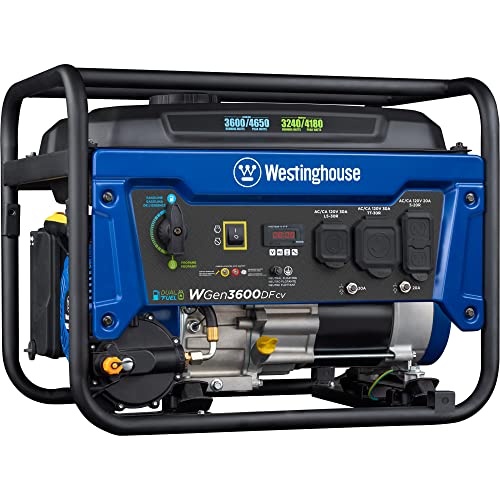
The Westinghouse 4650 is a 212cc dual-fuel generator rated at 4,650 peak watts, 3,600 rated watts on gasoline and 3,240 on propane. It has a TT-30R, an L5-30R, a 5-20R duplex outlet, a 4-gallon tank with a fuel gauge, and up to 14 hours of runtime per tank. The listing mentions automatic low oil and carbon monoxide shutdown, rubber outlet covers, and a 3-year limited warranty.

At $399 it is $248 below the WEN DF480iX and 400 rated watts under it on gasoline.

What works

  • Includes a true TT-30R plus an L5-30R outlet
  • Four-gallon tank runs up to 14 hours per tank
  • Automatic low oil and CO shutdown listed
  • Three-year limited warranty at under $400

Watch out for

  • Listing does not describe clean inverter power
  • Weight and noise level are not published
05
Best for: Lightweight weekend trips with moderate loads

Our take

Pick this if you need a light, quiet generator that one person can carry and you accept refueling every few hours.

Why it made the shortlist

The EFURDEN 4300 lists 4,300 starting watts and 3,300 running watts, with less than 2 percent total harmonic distortion, a weight of 45 pounds and a size of 18.5 by 11.5 by 20 inches. It produces 60 dBA at 23 feet according to the listing and has five outputs: one AC 120V 30A port, two 120V 20A ports, a USB port and a QC 3.0 Type-C port.

It costs $389.99, which is $9.01 below the Westinghouse 4650 and $250 below the Champion 4000. Against the Champion it lists 300 more running watts and a lower noise figure of 60 versus 64 dBA, and it is lighter at 45 versus under 49 pounds, with a 2-year warranty compared with the Champion's three.

What works

  • Weighs 45 pounds, light enough to carry alone
  • Quiet 60 dBA at 23 feet, per the listing
  • Clean power with under 2 percent distortion

Watch out for

  • Small 1.1-gallon tank gives about 5 hours at half load
  • Gasoline only with no propane connection
  • 30A port shape is not stated
06
Best for: Lowest-cost entry into dual-fuel inverter power

Our take

Pick this if you want dual-fuel flexibility, clean power and the lowest price and are willing to buy an adapter for the RV plug.

Why it made the shortlist

The PowerSmart 4400 is a dual-fuel inverter generator rated at 4,400 starting and 3,600 running watts on gasoline, and 4,000 starting and 3,300 running watts on LPG. The gas tank holds 1.6 gallons for an 8-hour run at 25 percent load, and a standard 20-pound propane tank gives up to 24 hours at 25 percent load. Its panel has one L5-30R 120V 30A twist-lock outlet, one 5-20R duplex outlet and a 12V 8A DC port, with Eco-Mode and less than 3 percent distortion.

At $369.99 it is the cheapest pick, $20 under the EFURDEN 4300 and $29.01 under the Westinghouse 4650.

What works

  • Cheapest here at $369.99 with dual-fuel capability
  • A 20-pound propane tank runs up to 24 hours at 25 percent load
  • Eco-Mode lowers engine speed under light loads

Watch out for

  • Has an L5-30R twist-lock, so a TT-30R adapter is likely needed
  • Weight, noise and CO shutdown are not stated
  • Two-year warranty is shorter than the Westinghouse's
The catch
It matches the Westinghouse's 3,600 gasoline rated watts and adds the inverter-grade power the Westinghouse listing does not claim, but it lacks a TT-30R receptacle, so an L5-30R to TT-30R adapter is likely needed to reach a trailer cord.

Methodology

How We Built This Shortlist

Each pick was assessed across 5 criteria weighted for real-world use.

01

Rated watts by fuel

We used the running or rated figure on each fuel, not the starting number, and noted how much output drops on propane.

02

RV plug match

We checked whether the panel lists a TT-30R, an L5-30R twist-lock, or just an unspecified 30A port, since only the first fits a trailer cord directly.

03

Power quality and safety

We recorded listed distortion figures, inverter claims and carbon monoxide shutdown language, and marked missing information as a gap rather than a pass.

04

Runtime, noise and weight

We compared stated tank size, hours at a given load, decibel levels at 23 feet and pounds, and flagged where listings leave one out.

05

Price and support

We compared the sticker price, bundled extras and warranty length, from two to three years, against output per dollar.

Decision guide

Match an RV Generator to Your RV

By RV Air Conditioning Setup

Match the generator to how many big loads run at once, not to the largest number on the box.

Your situationRecommended pickWhy
One rooftop air conditioner plus fridge and lightsWEN DF480iX4,000 rated watts on either fuel with a real TT-30R
Two air conditioners or a 50 amp rig through an adapterWEN DF680iX5,100 rated watts and a 240V outlet
One small air conditioner, lifted by one personChampion 4000Under 49 lb, 3,000 running watts
Weekend trip with light loadsEFURDEN 430045 lb, 3,300 running watts
Minimum budget, one air conditionerWestinghouse 46503,600 rated watts and a TT-30R at $399

By Budget

BudgetRecommended pick
$370 to $400PowerSmart 4400, EFURDEN 4300 or Westinghouse 4650
$640 to $650WEN DF480iX or Champion 4000
$800WEN DF680iX

Under $400 you are choosing between dual-fuel flexibility (PowerSmart, Westinghouse) and low weight (EFURDEN).

Dual Fuel vs Gasoline Only

Dual fuel

Propane keeps for years and runs cleaner, but rated output drops: the Westinghouse 4650 falls from 3,600 to 3,240 watts and the PowerSmart 4400 from 3,600 to 3,300. The WEN DF480iX holds 4,000 on both fuels, while the WEN DF680iX goes from 5,100 to 4,500.

Gasoline only

The Champion 4000 and EFURDEN 4300 skip the second fuel, so they are lighter and simpler, and they depend on fresh gas for storage. They suit short trips where you refill from the tow vehicle.

Most trailer owners should default to dual fuel, since a 20-pound propane tank can outlast a weekend, unless weight is the main concern.

By Noise and Weight

Your priorityRecommended pick
Lightest, one-hand carryEFURDEN 4300 (45 lb)
Published quiet figure with parallel optionChampion 4000 (64 dBA, under 49 lb)
Quietest stated numberEFURDEN 4300 (60 dBA at 23 feet)
Wheels and handle, weight unlistedWEN DF480iX or WEN DF680iX

For Campgrounds With Quiet Hours Specifically

Look for

A published decibel level at 23 feet, an inverter engine that slows under light load, and a location where exhaust points away from your neighbors. A listing with no noise figure leaves you guessing.

In this comparison

The EFURDEN 4300 lists 60 dBA and the Champion 4000 lists 64 dBA. WEN's DF480iX compares itself to normal conversation without a number, so ask for the spec sheet.

When to Spend More

Spend more if

You run two air conditioners, need a 240V outlet or want home backup; the WEN DF680iX at $798 adds 1,100 rated watts over the WEN DF480iX for $151.

Save if

You run one air conditioner with hookups most nights; the Westinghouse 4650 at $399 or PowerSmart 4400 at $369.99 each give 3,600 rated watts on gasoline for about $250 less than the WEN DF480iX.

FAQ

Before You Bring One Home

How big a generator do I need for a 30 amp RV?

A 30 amp service tops out at 3,600 watts, so a generator with about 3,600 to 4,000 rated watts covers it. Add up your running loads (an air conditioner, fridge and electronics) and leave 20 percent headroom. Anything above 4,000 rated watts is only useful for the other outlets, since the TT-30 plug cannot pass more than 3,600W.

Can I plug a 50 amp RV into one of these generators?

Only with a 30A to 50A adapter, and the whole rig then runs from a single 30A supply with a 3,600W ceiling. Both legs of a 50 amp panel will share that one leg. Turn off the second air conditioner and big appliances before starting.

Is the WEN DF680iX worth $151 more than the DF480iX?

Only if you need 5,100 rated watts, a 240V outlet or home backup. For a single-air-conditioner trailer the DF480iX already has 4,000 rated watts on both fuels, more than the 3,600W the TT-30 can carry.

How do I connect a generator to my trailer safely?

Place it outdoors on level ground at least several feet from windows and vents, with the trailer's main breaker off. Plug the shore cord into the TT-30R (or into an L5-30R adapter), start the engine, wait for it to settle, then switch the breaker on and start loads one at a time.

Why does propane lower the wattage?

Propane has less energy per volume than gasoline, so the same engine makes less power on it. The Westinghouse 4650 drops from 3,600 to 3,240 rated watts, the WEN DF680iX from 5,100 to 4,500, while the WEN DF480iX holds 4,000 on both.

How should I store a generator between trips?

Run it until the carburetor is empty or add fuel stabilizer, and keep propane tanks upright outdoors. Change the oil on the manual's schedule and run the engine briefly each month. WEN's fuel shutoff helps by burning off carburetor fuel before shutdown.

Bottom line

The short version

Browse more rv generators on Amazon →
Bowen Higgins, RV Editor at RV Gear Lab

About the author

Bowen Higgins

RV Editor at RV Gear Lab

Bowen covers RV power, water systems, towing and leveling, upkeep and interior comfort, with a focus on matching gear to the rig, the hookups and the way you actually travel.

More from Bowen →Editorial standards

Keep reading

Related guides