

We research everything we recommend. When you buy through our links, we may earn a commission. Learn more

Buying guide · 10 min read · Updated October 2, 2026

3 Best RV Inverter For Air Conditioner in 2026: A Practical RV Guide

Which RV inverter can start an air conditioner? AIMS 2000W inverter charger, EGSCATEE 2500W and Sunwheel 4000W compared on surge, DC amps and transfer.

Bowen HigginsBy Bowen HigginsRV Editor at RV Gear Lab3 products comparedSpec-sheet researched

At a glance

Our top picks

An RV air conditioner is the hardest load an inverter will see. A 13,500 BTU rooftop unit often runs near 1,400 to 1,800 watts and its compressor can briefly pull several times that at startup unless it has a soft start. On the DC side, 2,000 watts means 170 amps or more at 12V. We picked three pure sine inverters with different strengths, and explain which one pairs with a soft start AC and which would need a larger battery bank or a higher voltage system.

RV Gear Lab field notes

The Rig Fit Check

Start with the job
2500W Pure Sine Wave Inverter leads this shortlist for Hardwired AC with a soft start. Use that fit as a reference point, then compare the alternatives against your own space and workload.
Specs that separate the picks
The first details to compare are 2500W pure sine, 5000W peak, 2000W continuous, 6000W surge, 4000W continuous, 8000W peak. Confirm the exact model and included components before ordering.
Trade-off to plan for
Does not charge batteries, per the listing

Before you buy

What Matters Before You Choose an RV Inverter For Air Conditioner

Key buying criteria so you get the right fit the first time.

  1. 01

    AC running and startup watts

    The AC nameplate lists running amps, and multiplying by 120V gives running watts. A compressor can briefly draw 3 to 5 times that at startup unless soft started. Look at the nameplate, not the BTU number.

  2. 02

    DC amps at the battery

    At 12V, 2,000W needs roughly 170 to 185 amps and 2,500W over 210. Lower voltage battery sags and cables heat. Check that your battery BMS and cable gauge can carry it.

  3. 03

    Surge duration

    A surge rating is only useful for its duration: AIMS lists 6,000W for up to 20 seconds, while others list peak power without a time. Compressors need time to ramp. Look for a stated duration.

  4. 04

    Transfer switch and pass-through

    A transfer switch moves your loads between shore power and inverter automatically. EGSCATEE lists about 12 ms and AIMS includes one. Without it, you must switch manually.

  5. 05

    Hardwire versus plug-in

    AC loads run through breakers, and an AC wired to the panel needs a hardwired inverter. EGSCATEE has a terminal block. Check that the listing mentions terminals, not just outlets.

Our standards

Why You Can Trust RV Gear Lab

At RV Gear Lab, we compare products based on rig fit and power or hookup compatibility, verified specifications, usability, setup requirements, weight, durability, and real-world trade-offs. We do not rank products purely on marketing claims or commission rates.

We have not personally tested every product listed. Where hands-on testing is not available, recommendations are based on verified manufacturer specifications, product documentation, use-case fit, and comparative research.

How we review RV gear →

Detailed reviews

The 3 best rv inverter for air conditioner, explained

01

Best Overall · 1 of 3

2500W Pure Sine Wave Inverter

2500W Pure Sine Wave Inverter
  • 2500W pure sine, 5000W peak
  • Built-in ATS, about 12 ms
  • Hardwire terminals, remote
Check price on Amazon for 2500W Pure Sine Wave Inverter (opens in a new tab)
Best for: Hardwired AC with a soft start

Our take

At $219.99 it costs $722.01 less than the AIMS 2000W and adds 500W continuous.

Why it made the shortlist

The EGSCATEE 2500W is a pure sine wave inverter with 5,000W peak and a built-in automatic transfer switch that changes over in approximately 12 ms. It has a hardwired AC terminal block, a remote controller, dual cooling fans and about 3 AWG cables of 1.97 ft in the box.

Pick this if you want an AC capable inverter with a built-in transfer switch.

What works

  • Built-in transfer switch changes over in about 12 ms
  • 2,500W covers a soft start 13.5K BTU AC
  • Remote controller included in the box

Watch out for

  • Does not charge batteries, per the listing
  • 2,500W draws over 210 amps at 12V
The catch
Caveat: 3 AWG short cables suit shorter runs, and 2,500W at 12V draws over 210 amps.
02
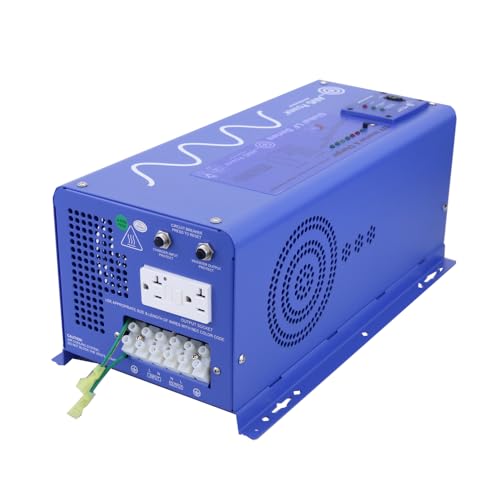
AIMS 2000W 12V Pure Sine Inverter Charger w/Transfer Switch 120V Backup
  • 2000W continuous, 6000W surge
  • Surge lasts 20 seconds
  • 70A charger, transfer switch
Check price on Amazon for AIMS 2000W 12V Pure Sine Inverter Charger w/Transfer Switch 120V Backup (opens in a new tab)
Best for: All in one charger, inverter and transfer switch

Our take

Pick this if you want charging and switching in one box.

Why it made the shortlist

The AIMS 2000W is a low frequency pure sine inverter charger with 6,000W surge for up to 20 seconds, a 70 amp charger with LiFePO4 profile and a transfer switch. Its heavy transformer design is built for inductive loads such as AC compressors.

What works

  • 6,000W surge for 20 seconds helps compressor starts
  • 70A charger supports LiFePO4 and AGM
  • Transformer design handles inductive loads well

Watch out for

  • Costs $722.01 more than EGSCATEE 2500W
  • 2,000W continuous is tight for larger AC units
03

Best Budget Headroom · 3 of 3

SUNWHEEL 4000W Pure Sine Wave Inverter

SUNWHEEL 4000W Pure Sine Wave Inverter
  • 4000W continuous, 8000W peak
  • Pure sine, over 90% efficient
  • Cables and 6 fuses included
Check price on Amazon for SUNWHEEL 4000W Pure Sine Wave Inverter (opens in a new tab)
Best for: Large banks and two AC units

Our take

Pick this if you run two AC units on a large bank.

Why it made the shortlist

The Sunwheel 4000W is a pure sine inverter with 4,000W continuous and 8,000W peak at startup, efficiency over 90% and protections for undervoltage, overvoltage, overheating and overload. It ships with 4 cables and 6 fuses.

What works

  • 8,000W peak covers a hard compressor start
  • $20.11 cheaper than EGSCATEE with more power
  • Cables and fuses included in the box

Watch out for

  • No transfer switch or charger in the listing
  • Full load pulls over 330 amps at 12V

Methodology

How We Built This Shortlist

Each pick was assessed across 4 criteria weighted for real-world use.

01

Compressor start

We compared peak or surge ratings and their duration against a typical AC compressor start.

02

Continuous headroom

We matched continuous watts against a 13,500 BTU unit's running draw.

03

DC side

We converted watts to battery amps at 12V to flag cable and bank needs.

04

Switching and charging

We noted whether each listing includes a transfer switch, charger and remote.

Decision guide

Match an RV Inverter For Air Conditioner to Your RV

By Air Conditioner Type

Your situationRecommended pickWhy
Soft start 13.5K BTU rooftopEGSCATEE 2500WContinuous watts fit, 5,000W peak
Standard 13.5K BTU without soft startSunwheel 4000W8,000W peak handles compressor kick
Small 9K to 10K BTU unitAIMS 2000W20 second surge, includes charger
Two AC units on a big bankSunwheel 4000W4,000W continuous

By Budget

BudgetRecommended pick
$190 to $200Sunwheel 4000W
$210 to $220EGSCATEE 2500W
$940 to $950AIMS 2000W

Inverter Only vs Inverter Charger

Inverter only

EGSCATEE 2500W and Sunwheel 4000W convert DC to AC and are cheaper, but need a separate converter or charger.

Inverter charger

AIMS 2000W adds a 70A charger and transfer switch, which simplifies install but costs far more per watt.

Most owners should default to a cheaper inverter plus their existing converter, unless wiring is being redone.

By Battery Voltage

Best pickRecommended pick
12V lithium bank, 400Ah or moreEGSCATEE 2500W
12V bank, 200AhAIMS 2000W
Upgrading to 24VSunwheel 4000W
Existing lead acid bankAIMS 2000W

For Soft Start Air Conditioners Specifically

Look for

A continuous rating about 1.5x the AC running watts, plus a stated surge time so the compressor start does not trip the inverter.

In this comparison

EGSCATEE 2500W fits a soft start unit running near 1,500W. AIMS 2000W states a 20 second surge, which suits a compressor start, but its continuous rating is the limit.

When to Spend More

Spend more if

Spend more on AIMS 2000W if you want charger, inverter and switching in one box with a 20 second surge.

Save if

Save with Sunwheel 4000W at $199.88 if your bank is large and you have a separate converter.

FAQ

Before You Bring One Home

Can a 2000W inverter start a 13.5K BTU AC?

Only if the unit has a soft start. Without one the startup draw can exceed 2,000W.

How long will a battery bank run an AC?

A 1,500W AC pulls roughly 125 amps from 12V, so a 400Ah lithium bank lasts about 3 hours.

Is 12V enough for an RV air conditioner?

It is possible but demanding. Many installers prefer 24V or 48V to reduce amps.

Does the EGSCATEE charge my batteries?

No. The listing states it is not a power source and cannot charge batteries.

Bottom line

The short version

Browse more rv inverter for air conditioner on Amazon →
Bowen Higgins, RV Editor at RV Gear Lab

About the author

Bowen Higgins

RV Editor at RV Gear Lab

Bowen covers RV power, water systems, towing and leveling, upkeep and interior comfort, with a focus on matching gear to the rig, the hookups and the way you actually travel.

More from Bowen →Editorial standards

Keep reading

Related guides