

We research everything we recommend. When you buy through our links, we may earn a commission. Learn more

Buying guide · 11 min read · Updated October 2, 2026

6 Best RV Solar Panel Mounts for Pole, Ground and Portable Use in 2026: A Practical RV Guide

Six pole, ground and portable RV solar panel mounts compared on panel size limits, tilt range, pole diameter and wind notes for panels that stay off the roof.

Bowen HigginsBy Bowen HigginsRV Editor at RV Gear Lab6 products comparedSpec-sheet researched

At a glance

Our top picks

Roof brackets get most of the attention, but a roof is a poor place for a solar panel half the time. It is shaded by trees at the campsite, flat to a sun that sits low in winter, and hot enough to cut output. A panel on a pole, a ground stand or a folding portable stand can be tilted, turned and moved into sun while the RV sits in shade. That is a different purchase from a roof bracket, with its own traps: pole diameters that do not match, panel width limits and wind.

We compared six mounts from $29.77 to $180.19 on what the listings state: the panel size or watt range each accepts, tilt range, pole diameter or ground use, materials, warranty and wind notes. Three are fixed pole or wall mounts, one is a folding ground and roof tilt rail set, and two are portable stands for foldable or flexible panels. The sections below show where each one fits and where it does not.

RV Gear Lab field notes

The Rig Fit Check

Start with the job
Newpowa Universal Solar Panel Double Arm with Support Pole and Wall Mount Bracket, 0-90 Degree Tilt, up to 400W leads this shortlist for pole or wall arrays for two large panels. Use that fit as a reference point, then compare the alternatives against your own space and workload.
Specs that separate the picks
The first details to compare are Up to 55.51 inch panel width, Two panels, 170W each, One panel, 50W to 150W. Confirm the exact model and included components before ordering.
Trade-off to plan for
Listing does not state the pole diameter clamps fit

Before you buy

What Matters Before You Choose an RV Solar Panel Mount for Pole, Ground and Portable Use

Key buying criteria so you get the right fit the first time.

  1. 01

    Panel width and thickness limits

    A mount arm or clamp is built for a range of panel widths and frame thicknesses, and a panel outside that range simply will not bolt on. The AIMS Dual Pole lists 26.5 inches per panel, the LINOVISION Pole lists 19.3 to 28 inches wide and 0.9 to 1.26 inches thick, and the Newpowa Double Arm accepts up to 55.51 inches. Measure your panel's width, length and frame thickness, and compare them with the listing before ordering.

  2. 02

    Pole diameter match

    Clamps only close around a pole of the right size. The AIMS Dual Pole lists poles up to 3.25 inches, while the LINOVISION Pole lists 4.33 to 4.72 inches, a range that excludes common 2 and 3 inch pipe. Measure the outside diameter of your pole with a tape wrapped around it and divide by 3.14, then check that number against the listing.

  3. 03

    Tilt range against your latitude

    A panel produces the most when it faces the sun squarely, and the sun sits lower in winter and farther north. A 20 to 45 degree range suits summer, while a 0 to 90 degree range handles winter at high latitudes. Check the listed tilt range, and match it to the steepest angle you will need, which in winter is often close to your latitude plus 15 degrees.

  4. 04

    Wind resistance and anchoring

    A tilted panel acts as a sail, and wind that lifts a stand can crack the panel and take the cable with it. Only the AeternaSol 45 states a wind load of 2400Pa, and the DOKIO listing tells you to use ropes or pegs. Look for a stated wind rating, and plan stakes, ballast or guy lines for ground mounts either way.

  5. 05

    Materials and corrosion

    A mount sits outdoors for years, and rust weakens clamps and bolts. The AIMS Dual Pole lists anodized aluminum with stainless hardware, the Nicesolar Stand lists 5mm 304 stainless, and the LINOVISION Pole lists galvanized steel. Look for the material and the hardware finish in the listing, and avoid mixing metals that cause galvanic corrosion.

  6. 06

    What is included and cost per supported watt

    A mount that carries more watts per dollar is usually cheaper, but only if you need the capacity. The Newpowa Double Arm works out near $0.40 per supported watt with two 200W panels, while the LINOVISION Pole is near $0.73 for one 150W panel. Divide price by the largest total watts you will mount, and check whether the pole, stakes or cable are included.

Our standards

Why You Can Trust RV Gear Lab

At RV Gear Lab, we compare products based on rig fit and power or hookup compatibility, verified specifications, usability, setup requirements, weight, durability, and real-world trade-offs. We do not rank products purely on marketing claims or commission rates.

We have not personally tested every product listed. Where hands-on testing is not available, recommendations are based on verified manufacturer specifications, product documentation, use-case fit, and comparative research.

How we review RV gear →

Detailed reviews

The 6 best rv solar panel mounts for pole, ground and portable use, explained

01
Best for: Pole or wall arrays for two large panels

Our take

Pick this if you are building a campsite pole or a fence-line array for two larger panels.

Why it made the shortlist

The listing says it takes panels up to 55.51 inches wide, holds one 160W to 250W panel or two 200W Newpowa panels, tilts from 0 to 90 degrees and includes screws, bolts, washers, nuts and steel clamps. It costs $159.99.

It carries more panel than any other fixed mount here: two 200W panels is 400W, compared with 340W for the AIMS Dual Pole and 150W for the LINOVISION Pole. That works out to about $0.40 per supported watt against about $0.53 for AIMS.

What works

  • Holds two 200W panels, 400W total, on one bracket
  • Tilts from 0 to 90 degrees for any season
  • Mounts on pole, wall, fence or any flat surface
  • Screws, bolts and steel clamps come in the box

Watch out for

  • Listing does not state the pole diameter clamps fit
  • Other-brand panels may need holes drilled for the bracket
The catch
The Newpowa Double Arm is a heavy-duty aluminum alloy bracket with a bottom support that mounts to a pole, wall, fence or any flat surface.
02
Best for: Long-term pole installs with a stated warranty

Our take

Choose it if you want stated pole sizes, stainless hardware and a 10-year warranty for a long-term campsite or park-model install.

Why it made the shortlist

The AIMS pole mount holds two panels of up to 170W each or 26.5 inches wide, tilts from 20 to 70 degrees, uses clamps for existing poles up to 3.25 inches in outer diameter and is built of anodized aluminum with stainless steel hardware. Predrilled holes speed assembly, and the listing states a 10-year warranty. It costs $180.19.

What works

  • 10-year warranty is stated in the listing
  • Anodized aluminum with stainless steel hardware resists rust
  • Pole size limit of 3.25 inches is published
  • Predrilled holes make assembly quick with basic hand tools

Watch out for

  • Costs $20.20 more than the Newpowa and holds less
  • 26.5 inch width limit excludes many 200W panels
The catch
At 26.5 inches wide it fits older 100W to 170W panels and will accept only one larger panel.
03
Best for: A single small panel on a large post

Our take

Pick this if your post is 4.3 to 4.7 inches in diameter and you want a single 100W to 150W panel.

Why it made the shortlist

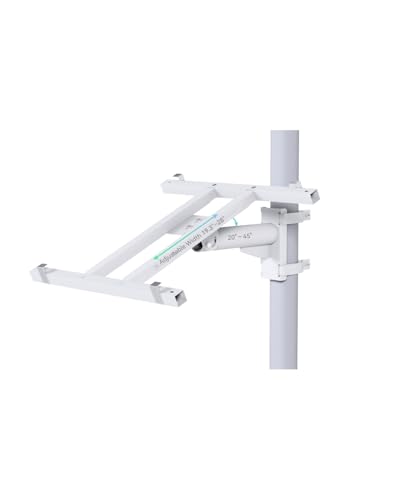
The LINOVISION Pole mount is made of galvanized steel and takes a single panel of 50W to 150W, with an adjustable width of 19.3 to 28 inches and a thickness of 0.9 to 1.26 inches. It clamps to poles 4.33 to 4.72 inches (110 to 120 mm) in diameter with half-round clamps and tilts between 20 and 45 degrees. It costs $109.99, and the listing says one person can install it with the included hardware.

Its pole range is a big gotcha: 4.33 to 4.72 inches is far larger than the 3.25 inch limit of the AIMS, so it suits utility poles and heavy posts rather than a standard 2 or 3 inch pipe.

What works

  • Galvanized steel gives strong wind resistance
  • Adjustable width covers panels 19.3 to 28 inches
  • One person can install it with included hardware
  • Cheapest fixed pole mount in this group

Watch out for

  • Only fits poles 4.33 to 4.72 inches in diameter
  • 20 to 45 degree tilt limits steep winter angles
04
Best for: Ground-level rigid panels where wind is a worry

Our take

Choose it if you want a ground-ready tilt mount for a rigid panel at a low price.

Why it made the shortlist

The AeternaSol 45 inch set is aluminum alloy with triangular bracing, designed for panels from 100W to 400W, with a 0 to 90 degree tilt, horizontal or vertical mounting and a listed 2400Pa wind load, 1.4 kN per square meter snow load and 120 kg load capacity. It ships with four fixed brackets, two tilt brackets, M6 and M8 hardware and six self-drilling screws, and works on roofs, balconies, boats, campers or the ground. It costs $39.99.

What works

  • Wind load of 2400Pa is stated, unlike most mounts
  • Works on ground, roof, balcony or boat
  • Horizontal or vertical panel mounting is possible
  • Costs $120 less than the Newpowa Double Arm

Watch out for

  • Ground use needs your own ballast or stakes
The catch
It is the cheapest fixed mount here and the only one that states a wind load, so it is the right pick when a panel will sit on the ground and a gust is a real risk.
05
Best for: Foldable or flexible panels carried to camp

Our take

Pick this if you carry a foldable or flexible panel and want a stable, packable stand.

Why it made the shortlist

The Nicesolar stand is made from 5mm 304 stainless steel, folds to 375 by 300 by 27 millimeters, weighs 2.58 pounds, has three angle settings and installs and removes without tools. The listing says it is meant for foldable and flexible panels, not for fixed rigid glass panels, and notes hand welding means angles vary slightly. It costs $59.99.

What works

  • Tool-free setup and takedown at the campsite
  • 5mm 304 stainless steel resists rust and bending
  • Folds to 27 millimeters thick for storage
  • Three set angles cover low and high sun

Watch out for

  • Not suitable for rigid glass panels
The catch
The caveat is that the listing does not state wind limits, so strap or ballast it on breezy days.
06
Best for: Cheap tilt for a foldable panel in calm weather

Our take

Choose it if you need a cheap way to tilt a foldable panel in calm weather.

Why it made the shortlist

The DOKIO stand is a stainless steel arc that props a foldable panel at an adjustable angle, folds flat for storage and works with panels of various sizes, using one or more stands depending on the panel. It costs $29.77.

You may need two stands for a wide panel, which brings the cost close to the Nicesolar.

What works

  • Adjusts the tilt angle to follow the sun
  • Folds flat and fits in a bin or storage bay
  • Works with foldable panels of various sizes

Watch out for

  • Needs ropes or pegs to hold in wind
  • Listing gives no weight, size or load limit
The catch
It is the cheapest option here and $30.22 below the Nicesolar Stand, but it gives you a continuous angle adjustment instead of fixed steps and no listed size, weight or material grade.

Methodology

How We Built This Shortlist

Each pick was assessed across 5 criteria weighted for real-world use.

01

Panel size and watt limits

We checked each mount's stated width or watt range against common 100W to 250W panels, since a mount that cannot fit your panel is useless.

02

Pole diameter match

We compared stated pole diameters, from 3.25 inches for AIMS to 4.33 to 4.72 inches for LINOVISION, because a mismatch is the most common failure of a pole mount.

03

Tilt range

We compared tilt ranges, 0 to 90, 20 to 70 and 20 to 45 degrees, since winter sun at higher latitudes needs a steep angle.

04

Wind and stability notes

We looked for stated wind loads and anchoring guidance, noting where listings tell you to add ropes, pegs or ballast.

05

Cost per supported watt

We divided price by the maximum panel watts each mount can carry, to separate efficient mounts from expensive ones for small panels.

Decision guide

Match an RV Solar Panel Mount for Pole, Ground and Portable Use to Your RV

By Where the Panel Sits

Decide where the panel will live, then pick the mount type.

Your situationRecommended pickWhy
Campsite or park-model pole array, two large panelsNewpowa Double ArmHolds two 200W panels on pole, wall or fence
Long-term pole with stated warranty and pipe sizeAIMS Dual Pole10-year warranty and 3.25 inch pole limit
Large post of about 4.3 to 4.7 inchesLINOVISION PoleClamps are sized for 110 to 120 mm poles
Rigid panel on the ground, wind a worryAeternaSol 45Lists a 2400Pa wind load and 0 to 90 tilt
Foldable or flexible panel carried to campNicesolar StandStainless steel, tool-free and folds to 27 mm
Cheap tilt for a foldable panelDOKIO StandLowest price at $29.77

By Budget

BudgetRecommended pick
Under $40DOKIO Stand or AeternaSol 45
$55 to $65Nicesolar Stand
$100 to $120LINOVISION Pole
$155 to $185Newpowa Double Arm or AIMS Dual Pole

Fixed Pole Mount vs Portable Stand

Fixed pole or ground mount

The Newpowa Double Arm, AIMS Dual Pole, LINOVISION Pole and AeternaSol 45 hold rigid panels in place for days or seasons. You set the angle once, bolt the panels, and run a cable to the RV, but the pole or ground anchoring is on you.

Portable stand

The Nicesolar Stand and DOKIO Stand prop foldable or flexible panels for a day, then pack away in a storage bay. They cost under $60 each but hold only light panels, and the DOKIO listing says to use ropes or pegs in wind.

Fixed mounts suit long stays and rigid panels, and portable stands suit travelers who move every few days.

By Tilt Range Needed

Your latitude and seasonRecommended pickWhy
Winter use, steep sun angle neededNewpowa Double Arm0 to 90 degree range covers steep angles
General seasonal adjustmentAIMS Dual Pole20 to 70 degrees covers most seasons
Mostly summer at lower anglesLINOVISION Pole20 to 45 degree range suffices
Changing angle during the dayNicesolar StandThree set angles, simple to switch

For Boondocking in Windy Sites Specifically

Look for

A stated wind load, a way to anchor the base with stakes or ballast, and strong materials such as stainless steel or galvanized steel.

In this comparison

The AeternaSol 45 lists 2400Pa wind and snow loads, and the LINOVISION Pole is galvanized steel. The DOKIO Stand tells you to add ropes or pegs, and the Nicesolar Stand gives no wind rating, so weigh them down.

When to Spend More

Spend more if

The mount stays installed for years. The AIMS Dual Pole at $180.19 gives a 10-year warranty and stainless hardware, and the Newpowa Double Arm at $159.99 carries 400W.

Save if

You move every few days or have one small panel. The DOKIO Stand at $29.77 and the AeternaSol 45 at $39.99 cost far less.

FAQ

Before You Bring One Home

Do these mounts work on an RV roof?

Some can, but they are designed for off-roof use. The AeternaSol 45 lists roofs among its uses, while the pole mounts are intended for posts and walls. For roof-mounted brackets, see the best RV solar panel mounting brackets guide.

What is the biggest mistake with pole mounts?

Buying before measuring the pole. The AIMS Dual Pole fits poles up to 3.25 inches and the LINOVISION Pole fits 4.33 to 4.72 inches, and neither works on the other's pole size. Measure the outside diameter first.

Is the AIMS Dual Pole worth $20 more than the Newpowa Double Arm?

If you need a 10-year warranty and stainless hardware, yes. If you want to carry larger panels or two 200W units, the Newpowa holds 400W against 340W and costs less.

How do I set the tilt angle?

A simple rule is to set the angle close to your latitude for year-round use, steeper in winter by about 15 degrees and flatter in summer by the same amount. Adjust it every few months if the mount allows, and aim the panel's face toward true south in the northern hemisphere.

How should I secure a portable stand in wind?

Use ropes, pegs or weight, as the DOKIO listing advises. Keep the panel low and facing into the wind when possible, and take it down in storms. A cable run to the RV should be secured so a gust cannot pull the panel over.

Bottom line

The short version

Browse more rv solar panel mounts for pole, ground and portable use on Amazon →
Bowen Higgins, RV Editor at RV Gear Lab

About the author

Bowen Higgins

RV Editor at RV Gear Lab

Bowen covers RV power, water systems, towing and leveling, upkeep and interior comfort, with a focus on matching gear to the rig, the hookups and the way you actually travel.

More from Bowen →Editorial standards

Keep reading

Related guides