


We research everything we recommend. When you buy through our links, we may earn a commission. Learn more

Buying guide · 11 min read · Updated October 2, 2026

6 Best 200 Watt RV Solar Panels in 2026: A Practical RV Guide

Six 200 watt RV solar panels and kits compared on real daily watt-hours, controller type, roof mounting and voltage fit, so you know what 200W delivers.

Bowen HigginsBy Bowen HigginsRV Editor at RV Gear Lab6 products comparedSpec-sheet researched

At a glance

Our top picks

A 200 watt label describes a panel rated under laboratory conditions, not what lands in your battery. The simple arithmetic is rated watts times peak sun hours: 200W over 3, 5 and 7 hours is 600, 1,000 and 1,400 watt-hours before any losses from heat, angle, shading and the controller. Treat those numbers as a ceiling, then expect less.

We compared six 200 watt options from $119.77 to $269.99 and split them by what you actually get in the box. Some are two 100 watt rigid panels with brackets and a controller, some are a single flexible panel, one is a foldable suitcase, and one has no controller at all. The picks below flag which ones reach 200W with what is included, what controller sits between the panel and the battery, and which mount to the roof without extra purchases.

RV Gear Lab field notes

The Rig Fit Check

Start with the job
Renogy 200W 12V N-Type RV Solar Panel Kit with Adventurer 30A Controller leads this shortlist for permanent roof arrays from a single brand. Use that fit as a reference point, then compare the alternatives against your own space and workload.
Specs that separate the picks
The first details to compare are 200W, 22% efficient N-type cells, Two 100W panels, 30A controller, 200W foldable, 28.46 lb. Confirm the exact model and included components before ordering.
Trade-off to plan for
Costs about $57 more than the ECO-WORTHY kit

Before you buy

What Matters Before You Choose a 200 Watt RV Solar Panel

Key buying criteria so you get the right fit the first time.

  1. 01

    What 200W is worth in a day

    A 200 watt panel produces its rating only in ideal sun, so daily energy is roughly 200 times your peak sun hours: 600Wh at 3 hours, 1,000Wh at 5 and 1,400Wh at 7, before real-world losses. Heat, tilt, dirt and controller efficiency all reduce that, so treat listing figures like 800Wh at 4 hours as a best case. Compare the estimate to your daily use, such as a fridge and lights, rather than to the nameplate.

  2. 02

    Is the full 200W in the box

    Some products sold as 200W are two 100W panels while others are one 200W panel, and the difference changes roof area, wiring and shading behavior. A kit may or may not include a controller, brackets and cable. Read the what-you-get line in the listing and count panels and parts before comparing prices.

  3. 03

    PWM versus MPPT controller

    A PWM controller pulls the panel voltage down to the battery's voltage, wasting some of the panel's potential, while an MPPT controller converts the excess voltage into extra charging current. The kits here with controllers list PWM models at 20A or 30A. Look for the controller type in the listing, and consider a separate MPPT unit if you have a long cable run or a cold climate.

  4. 04

    Roof area and mounting method

    Rigid panels need a flat area, space for brackets and clearance from vents and air conditioners, while flexible panels follow curves but sit directly on the roof. Z brackets, adhesive pads and no-drill folding panels each have different roof risks and sealant needs. Measure the free roof area and check the listing dimensions, then plan sealant for every screw.

  5. 05

    Voltage and current compatibility

    A panel's open-circuit voltage must fit your controller or power station input window, and two panels wired in series add voltage while parallel adds current. The BougeRV Arch listing warns its 36V open-circuit range may not suit some power stations. Check the input voltage and amperage limits of your equipment, then compare to the panel's voltage on the listing.

  6. 06

    Expansion ceiling and warranty

    A controller with a 30A limit can handle a bit over 400W on a 12V battery, so a 200W array leaves room to grow, while a 20A controller leaves less. Warranty length, from one year on the ECO-WORTHY to five on Renogy, signals how long the maker expects it to last. Check the controller's amp limit, plan the future panel count, and read the warranty line.

Our standards

Why You Can Trust RV Gear Lab

At RV Gear Lab, we compare products based on rig fit and power or hookup compatibility, verified specifications, usability, setup requirements, weight, durability, and real-world trade-offs. We do not rank products purely on marketing claims or commission rates.

We have not personally tested every product listed. Where hands-on testing is not available, recommendations are based on verified manufacturer specifications, product documentation, use-case fit, and comparative research.

How we review RV gear →

Detailed reviews

The 6 best 200 watt rv solar panels, explained

01
Best for: Permanent roof arrays from a single brand

Our take

Pick this if you want a permanent roof array and a simple one-box purchase from a brand with a long warranty.

Why it made the shortlist

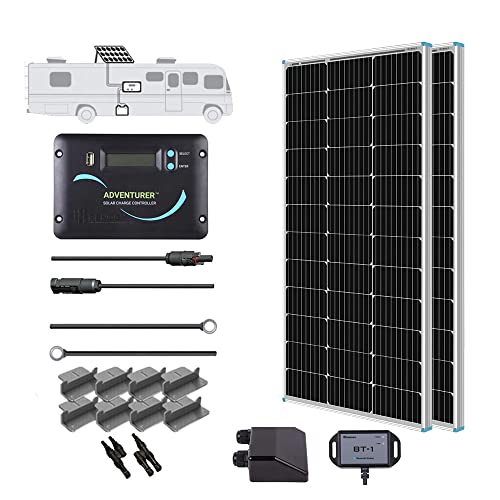
The Renogy 200W 12V Kit pairs N-type panels with the Adventurer-Li 30A PWM charge controller. The listing gives 22 percent cell efficiency, 2400 Pa wind and 5400 Pa snow load ratings, pre-drilled mounting holes with plug-and-play cables, and Y branch connectors for parallel wiring. It says 800Wh a day is based on 4 hours of sunlight, and it is priced at $243.09.

It ranks first because the controller is included and flush-mounts on a wall, the panel has published load ratings, and the listing says it supports lithium, lead-acid and gel batteries. Against the $185.99 ECO-WORTHY kit, you pay about $57 more and gain a named controller and a five-year warranty against one year.

What works

  • Controller included and made for flush wall mounting
  • Rated for 2400 Pa wind and 5400 Pa snow
  • Five-year warranty with 24/7 technical support
  • Y connectors ready for parallel wiring

Watch out for

  • Costs about $57 more than the ECO-WORTHY kit
  • PWM controller wastes some panel voltage on 12V banks
02
Best for: First DIY roof installs on a budget

Our take

Choose it if you want to mount two panels on a flat roof this weekend with a complete parts list and you are comfortable drilling and sealing Z brackets.

Why it made the shortlist

The ECO-WORTHY 200W kit includes two 100W monocrystalline panels, two sets of Z mounting brackets, a 30A solar controller, a pair of 16.4 ft 10 AWG solar cables and connectors. The listing cites 800Wh per day under 4 hours of full sun, 21.5 percent cell efficiency, a 2400 Pa wind rating and 5400 Pa snow load, and panels that wire in series for 24V or parallel for 12V. It costs $185.99.

The tradeoffs are a one-year warranty and the panel size of 35.2 by 23.1 by 1.37 inches each, meaning two panels need roughly 11 square feet side by side. Compared with the DOKIO, you get a controller and a second panel for $66 more.

What works

  • Brackets, cable and controller are all in the box
  • Wires in parallel for 12V or in series for 24V
  • Each panel is a modest 35.2 by 23.1 inches
  • Costs $57 less than the Renogy kit

Watch out for

  • Warranty is one year against five on Renogy
  • Two panels need about 11 square feet of roof
03
Best for: Shade-prone sites and no-drill setups

Our take

Pick this if you want to keep your roof unmodified, park in shade often, or need solar for a rented unit.

Why it made the shortlist

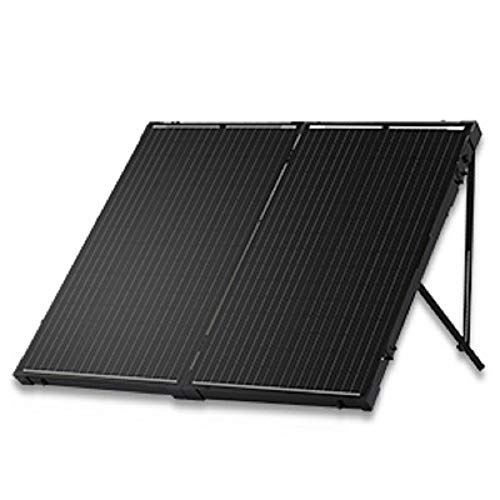
The Renogy 200W Suitcase is a foldable panel pair that closes into a carry case weighing 28.46 pounds. The listing gives up to 25 percent efficient N-type cells, an adjustable aluminum kickstand, an installed waterproof 20A PWM controller, alligator clip cables and a 5-year materials and workmanship warranty. It says up to 1000Wh per day, which matches 5 peak sun hours. Price is $229.99.

That tilt can recover output a flat roof panel loses, and you can move it out of shade.

What works

  • No roof drilling or sealant is needed at all
  • Tilt it toward the sun and out of shade
  • Waterproof controller arrives already wired to the panels
  • Five-year warranty matches the roof-mount Renogy kit

Watch out for

  • You must set up and stow it at each stop
  • 20A controller is smaller than the 30A on fixed kits
04
Best for: Curved roofs and weight-sensitive rigs

Our take

Choose BougeRV Arch Pro 200W Anti-Shading N-Type Fiberglass Flexible Solar Panel for weighs only 7.94 pounds for 200 watts.

Why it made the shortlist

The BougeRV Arch Pro is a single 200W fiberglass flexible panel that weighs 7.94 pounds and is 2.5mm thick. The listing claims 16BB N-type cells with up to 25 percent conversion, bypass diodes for partial shading, an ETFE surface, IP68 water and dust resistance, 270 degrees of bend and a 5-year support promise. It is priced at $269.99, the most in this guide.

It ranks fourth because it is the most expensive and the listing carries a plain warning that its 36V open-circuit voltage range (plus or minus 5 percent) may not be compatible with certain power stations.

What works

  • Weighs only 7.94 pounds for 200 watts
  • Bypass diodes keep output up under partial shade
  • Bends to fit curved roofs up to 270 degrees

Watch out for

  • Costs the most here at $269.99
  • 36V open-circuit voltage may not fit some power stations
05
Best for: Owners who already have a controller

Our take

Pick this if a rigid frame will not fit your roof curve or weight limit and you already own a controller.

Why it made the shortlist

The Renogy Flexible 200W bends to 240 degrees, uses half-cut PERC cells, and weighs about half of a rigid panel according to the listing. It cites an average 1000Wh per day at 5 hours of sunlight, an IP67 junction box, 5400 Pa snow and 2400 Pa wind ratings, pre-drilled mounting holes and 12 AWG connector cables 27.6 inches long. It costs $242.99.

It ranks fifth because it has no included controller, mounts, or long cable, so the real cost goes up once you add a controller.

What works

  • Half the weight of a rigid panel, per the listing
  • Pre-drilled holes and 12 AWG cables are included
  • Rated for 5400 Pa snow and 2400 Pa wind
  • Costs $27 less than the BougeRV flexible panel

Watch out for

  • No charge controller is included in the listing
  • Attached cables are only 27.6 inches long
06
Best for: Owners who bring their own controller

Our take

Choose it if you already own a controller or plan to buy an MPPT unit and want the lowest panel cost.

Why it made the shortlist

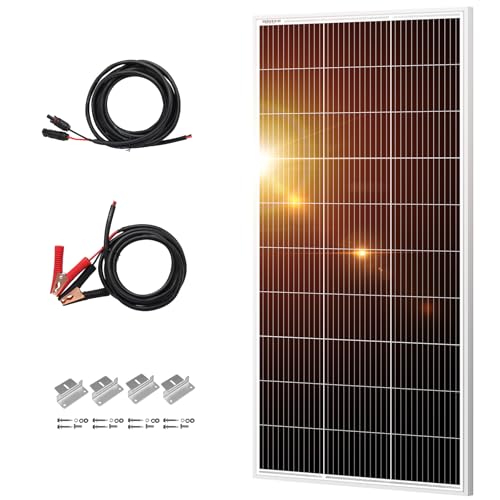
The DOKIO 200W is a single 200W, 18V panel with Z brackets, alligator clips and a 5 m MC4 cable, priced at $119.77.

It does cost $66 less than the ECO-WORTHY and $123 less than the Renogy kit, which is its entire advantage.

What works

  • 5 m MC4 cable lets you reach the controller
  • Half-cell layout with bypass diodes for shade
  • Rated for up to 25 years of output

Watch out for

  • You must buy and install your own controller
  • No warranty length or panel size in the listing
The catch
The caveat is that the listing gives no warranty length or panel dimensions in its feature text, so check both on the product page before ordering.

Methodology

How We Built This Shortlist

Each pick was assessed across 5 criteria weighted for real-world use.

01

Does the kit reach 200W

We counted what is in the box: one 200W panel versus two 100W panels, and whether the controller, brackets and cable are included or are extra purchases.

02

Realistic daily watt-hours

We used the simple 200W times 3, 5 and 7 peak sun hour estimate, and noted the listing figures of 800Wh at 4 hours and 1000Wh at 5 hours as best-case numbers.

03

Controller type and limits

We looked at whether a controller is included, whether it is PWM or MPPT, and its amp limit, because the controller decides how much of the panel's rating reaches the battery.

04

Roof area and weight

We compared panel format, rigid, flexible or folding, and the roof space or weight each demands, using dimensions or weights where the listing gave them.

05

Expansion and voltage fit

We checked whether panels wire in series or parallel for later expansion and whether open-circuit voltage could clash with a power station or controller.

Decision guide

Match a 200 Watt RV Solar Panel to Your RV

By Mounting Style

How the panel attaches decides cost, roof work and how much sun it collects.

Your situationRecommended pickWhy
Permanent flat roof, two panels, DIY bracketsECO-WORTHY KitZ brackets, cable and controller are included
Permanent roof, want a long warrantyRenogy KitController included and a five-year warranty
No roof drilling, frequent shadeRenogy SuitcaseUnfolds and tilts, with no installation
Curved roof or strict weight limitBougeRV Arch7.94 pounds and bends to 270 degrees
Curved roof, already own a controllerRenogy FlexibleBends to 240 degrees at half the rigid weight

By Budget

BudgetRecommended pick
Under $150DOKIO 200W, plus a controller you add
$185 to $190ECO-WORTHY Kit
$229 to $245Renogy Suitcase, Renogy Kit or Renogy Flexible
$270BougeRV Arch

Rigid Panels vs Flexible Panels

Rigid panels

The Renogy Kit, ECO-WORTHY Kit and DOKIO 200W use framed rigid panels with brackets, which leave an air gap under the panel for cooling. They need drilled or adhesive mounts and more roof area.

Flexible panels

The BougeRV Arch and Renogy Flexible bend to 270 and 240 degrees and weigh far less. They fit curved roofs, but sit flat on the roof surface, and each costs more per watt than the rigid kits here.

Most RV owners with a flat roof should default to rigid kits, and choose flexible only when weight, curvature or a no-bracket look specifically applies.

By Controller and Voltage Needs

Your setupRecommended pickWhy
Want controller included, 30ARenogy Kit or ECO-WORTHY KitBoth include a 30A PWM controller
Portable use, controller attachedRenogy Suitcase20A waterproof PWM is pre-wired
Plan to buy an MPPT controllerDOKIO 200WPanel only, so the controller choice is yours
Feeding a portable power stationRenogy SuitcaseCheck input voltage first; BougeRV Arch warns 36V may not fit

For Small Roofs Specifically

Look for

Panel dimensions that fit between vents and AC units, room for walkway, and a format that fits the roof shape, since two 100W panels, as in the ECO-WORTHY Kit, need roughly twice the width of one.

In this comparison

The ECO-WORTHY Kit lists 35.2 by 23.1 inches per panel, the BougeRV Arch is only 2.5mm thick, and the Renogy Suitcase folds to a 28.46 pound case that never touches the roof.

When to Spend More

Spend more if

You want a long warranty and a clean install; the Renogy Kit offers five years and a flush controller, while the BougeRV Arch adds shade tolerance for a curved roof.

Save if

You are handy and own a controller; the DOKIO 200W costs $119.77 and the ECO-WORTHY Kit includes brackets and cable for $185.99.

FAQ

Before You Bring One Home

Will a 200 watt panel run my RV fridge?

Often it can offset a compact 12V fridge, but it depends on your daily use and the sun. At 800Wh to 1000Wh in good conditions, you can cover lights, a fan and a 12V fridge, but not an air conditioner. Add up your daily watt-hours first and compare.

Do I need a controller with a 200W panel?

Yes, always. The DOKIO 200W says plainly that a PWM or MPPT controller is not included. The Renogy Kit, ECO-WORTHY Kit and Renogy Suitcase include one, so check the what-you-get line before buying a panel alone.

Is a flexible panel worth the higher price?

Only when the roof is curved, you cannot add weight, or you want a low profile. The BougeRV Arch and Renogy Flexible cost $243 to $270 against $186 for the two-panel ECO-WORTHY kit, so you pay a premium for shape and weight.

How do I connect two 100W panels?

Parallel wiring keeps 12V and adds current, while series adds voltage for a 24V system. The ECO-WORTHY listing supports either, and the Renogy Kit includes Y branch connectors for parallel. Match the wiring to your controller's voltage and amp limits.

Can I plug a flexible panel into a power station?

Only after checking voltage. The BougeRV Arch warns that its 36V open-circuit range may be incompatible with certain power stations. Compare that voltage to your station's input window before connecting.

How should I maintain roof panels?

Rinse off dust and bird droppings, check sealant around every screw each season and look for loose connectors. Shade from even a small object can cut output across a series string, so keep the panel clear.

Bottom line

The short version

Browse more 200 watt rv solar panels on Amazon →
Bowen Higgins, RV Editor at RV Gear Lab

About the author

Bowen Higgins

RV Editor at RV Gear Lab

Bowen covers RV power, water systems, towing and leveling, upkeep and interior comfort, with a focus on matching gear to the rig, the hookups and the way you actually travel.

More from Bowen →Editorial standards

Keep reading

Related guides