

We research everything we recommend. When you buy through our links, we may earn a commission. Learn more

Buying guide · 11 min read · Updated October 2, 2026

5 Best Budget Silicone RV Roof Sealants in 2026: A Practical RV Guide

Five silicone RV roof sealants, from roll-on gallons to lap sealant multi-packs, with what to know before you commit a joint to silicone for good.

Bowen HigginsBy Bowen HigginsRV Editor at RV Gear Lab5 products comparedSpec-sheet researched

At a glance

Our top picks

Silicone is the odd one out among roof sealants. It stays flexible for years, shrugs off UV and handles ponding water better than most acrylics, which is why it appeals to owners who are tired of recoating. The price of that durability is permanence: almost nothing bonds to a cured silicone surface afterward, so choosing it commits that joint or roof to silicone from then on. Think of it as a one-way door: the roof that goes through it does not come back to acrylic or rubber coatings without a lot of scraping.

That trade shapes how this guide is organized. Every pick here is a genuine silicone product by its own title, split between roll-on gallons that coat a whole roof and self-leveling lap sealant packs that fill seams and vent flanges. Which form you want depends on whether the roof is failing everywhere or only at a handful of joints, and the two forms are priced very differently. Mixing the two up is the most common way a buyer ends up with six tubes and a leaking roof, or a gallon and a single dribbling vent.

We evaluated five silicone products from the lowest-priced pack up to the most expensive gallon, reading each listing for surfaces named, application method and what the extra money adds. A budget buyer should leave knowing both which silicone to buy and whether silicone is the right chemistry for their roof at all, since a mistake here is hard to undo. Whatever the price tier, the permanence question comes first, so read the cons and the buying criteria before you pick a rung and carry the chosen can up the ladder.

RV Gear Lab field notes

The Rig Fit Check

Start with the job
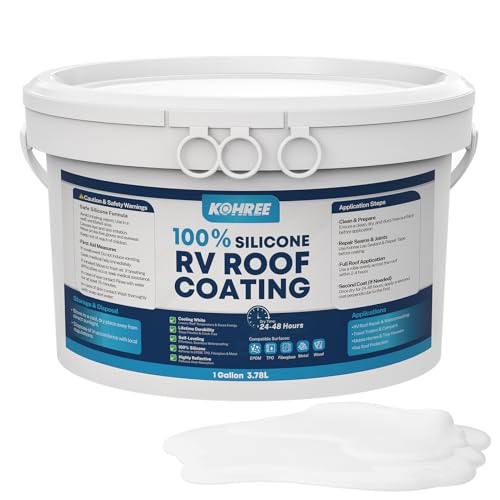
Kohree RV Roof Coating 1 Gallon, 100% Silicone RV Roof Sealant, White, No Primer Needed leads this shortlist for Owners recoating a full EPDM or TPO roof in one silicone product.. Use that fit as a reference point, then compare the alternatives against your own space and workload.
Specs that separate the picks
The first details to compare are 100% silicone white gallon, 100% silicone, self-leveling white, Six silicone lap sealant tubes. Confirm the exact model and included components before ordering.
Trade-off to plan for
Cured silicone blocks later recoating

Before you buy

What Matters Before You Choose a Budget Silicone RV Roof Sealant

Key buying criteria so you get the right fit the first time.

  1. 01

    Silicone permanence

    Once cured, silicone resists almost everything, including the new sealant or coating you might want to put over it later. A silicone repair commits that joint to silicone from then on, and a silicone coating commits the roof. That is fine for a roof you intend to leave alone for a decade and costly for one you may recoat. Decide before you open the can.

  2. 02

    Coating versus lap sealant

    A gallon of silicone coating is a roll-on film for the whole roof, while a lap sealant tube is a bead for seams, vent flanges and fasteners. Use a tube for a leak and a gallon for a roof that has failed everywhere. The Kohree and Gociean are gallons, and the Felizshop and MuzeFansi are tube packs.

  3. 03

    Named roof materials

    Roof membranes differ a lot, from EPDM and TPO to PVC, fiberglass and aluminum, and a product that bonds to one can misbehave on another. The Gociean names seven materials and the Felizshop names seven too. When a listing names none, as the MuzeFansi listing does for roofs, ask the seller before buying.

  4. 04

    Primer and surface prep

    The Kohree states no primer is needed once the roof is clean, which saves a product and a day. Other silicones leave primer unmentioned. Chalky rubber needs a cleaning pass, and slick metal gets a light sanding. Clean and dry the roof before any silicone goes down.

  5. 05

    Application and coverage

    One gallon covers about 50 square feet on the Kohree listing, applied by brush, roller or sprayer. Tubes are rated by ounces, such as 10.1 ounces per MuzeFansi bottle. Measure the roof or add up the seams first. Many owners find one gallon per 50 square feet is a useful rule for ordering.

  6. 06

    Temperature and weather range

    Silicone tolerates heat well, and the MuzeFansi lists minus 122 to 572 degrees Fahrenheit. Application temperature matters too, since cold or wet surfaces slow cure. Seek a stated range on the listing. A stated heat figure, like the Ziollo's claimed 15 degree cooling, is a plus.

Our standards

Why You Can Trust RV Gear Lab

At RV Gear Lab, we compare products based on rig fit and power or hookup compatibility, verified specifications, usability, setup requirements, weight, durability, and real-world trade-offs. We do not rank products purely on marketing claims or commission rates.

We have not personally tested every product listed. Where hands-on testing is not available, recommendations are based on verified manufacturer specifications, product documentation, use-case fit, and comparative research.

How we review RV gear →

Detailed reviews

The 5 best budget silicone rv roof sealants, explained

01
Best for: Owners recoating a full EPDM or TPO roof in one silicone product.

Our take

An aluminum inner bag keeps the coating fresh and the larger opening on the pail fits more sizes of brush, details that help on a long roof job.

Why it made the shortlist

The Kohree is a 100 percent silicone roof coating with a white, heat-reflective finish that creates a rubber surface and cuts heat absorption. Named roofs include EPDM, TPO, campers and trailers, and it says the formula has good elasticity and breathability, so it resists cracking when temperatures swing. The white, heat-reflective finish cuts heat absorption through the roof.

The instructions say no primer is needed after the roof is cleaned, and the coating goes on by brush, roller or quality sprayer, with one gallon covering 50 square feet. Kohree is the costliest of the five, a small step above the Gociean, and the money buys a primer-free route for the two most common membranes. Lined up with the Gociean, it trades the longer substrate list for a stated no-primer route on EPDM and TPO, which buys one less product and a quicker weekend.

A low-odor formula that is safe indoors and out makes it comfortable to work with around the camper. A buyer with an EPDM or TPO trailer who wants a one-and-done silicone roof for years fits best.

What works

  • Pure silicone film, no primer required
  • Names EPDM and TPO directly
  • Wide pail opening fits large brushes
  • Low odor, safe indoors and out

Watch out for

  • Cured silicone blocks later recoating
02
Best for: Roofs with seams, edges and small cracks that need a flowing white film.

Our take

A foil bag sits inside the bucket to keep the pail cleaner during use, an easy detail that reduces mess at the end of a roof day.

Why it made the shortlist

The Gociean is a 100 percent silicone coating described as solvent-free, water-free and asphalt-free, producing a rubber-like membrane that stays flexible. The self-leveling formula spreads over roof panels, seams and edges, and the listing says it applies by brush, roller or sprayer for repair and maintenance. The listing calls the formula solvent-free, water-free and asphalt-free, and says it forms a thick flexible barrier over seams, edges and small cracks.

Compatible roof materials include EPDM, TPO, PVC, fiberglass, aluminum, coated metal and wood, a broader list than most silicone gallons give. It sits just below the Kohree on price, which leaves a heat-reflective white coat at a modest saving. Against the Kohree, it trades the primer-free claim for a self-leveling flow and a seven-material list, which buys coverage for roofs with mixed surfaces.

Choose it for a mixed roof with several materials or a flat panel where the flow smooths over small cracks. The owner of a roof with coated metal trim, aluminum panels and wood blocking around vents fits best.

What works

  • Longest list of compatible roof types
  • Self-leveling flow smooths small cracks
  • Foil inner bag keeps the pail clean
  • Solvent-free and asphalt-free

Watch out for

  • Brand is new with little history
  • Primer guidance is not detailed
03
Best for: Rigs with many vents and edges that need a lot of lap sealant.

Our take

A non-toxic formula that complies with environmental standards works indoors or outdoors, so the same pack can reseal a window frame as well as a vent flange.

Why it made the shortlist

The Felizshop is a six-pack of self-leveling silicone lap sealant tubes, meant for the joints around roof edges and vents. The maker lists compatibility with EPDM rubber, TPO, aluminum, galvanized metal, fiberglass, vinyl and concrete, which covers nearly every roof an RV can carry. The maker states the sealant forms a tight bond at roof edges and vents and stays dependable through sun, rain, wind and freezing temperatures.

It describes a tight bond and resistance to sun, rain, wind and freezing temperatures, and says it can be applied on flat or sloped surfaces to form a uniform sealing layer. Price lands mid-pack, noticeably below either gallon, and six tubes spread across a big rig's many fixtures. Held up to the MuzeFansi pair, it trades a stated temperature range for a six-tube supply and a longer substrate list, which buys enough sealant for a whole rig.

Buy it for a motorhome or fifth wheel with a long list of roof penetrations. A motorhome or fifth wheel with many vents, edges and trim joints to reseal fits best.

What works

  • Six tubes handle a long list of fixtures
  • Names seven roof and substrate types
  • Works on flat or sloped surfaces
  • Non-toxic formula for indoor use

Watch out for

  • Six tubes is far more than one repair needs
  • Tube size is not clearly stated
04
Ziollo RV Roof Sealant, Leak Repair 100% Silicone Liquid Rubber Waterproof Coating
  • 100% silicone liquid rubber
  • Interior cooling up to 15°F claimed
  • Cleaner and seam tape available
Check price on Amazon for Ziollo RV Roof Sealant, Leak Repair 100% Silicone Liquid Rubber Waterproof Coating (opens in a new tab)
Best for: Pop-ups and travel trailers where interior heat is the main complaint.

Our take

The system approach suits a weekend owner who wants a cleaner, a seam reinforcement and a coating from one line.

Why it made the shortlist

The Ziollo is a 100 percent silicone liquid rubber coating with a self-leveling formula that flows across the roof. Its listing claims a highly reflective white surface that drops interior temperatures by up to 15 degrees Fahrenheit, which is a specific figure that few silicone listings print. The spec sheet states the coating moves with the camper through extremes from desert heat to Alaskan cold, flexing instead of cracking.

It is sold for campers, pop-ups, motorhomes and travel trailers, with an easy DIY application, and it belongs to a full Ziollo system that includes a roof cleaner and a paintable seam tape for trouble spots. It costs well under either gallon. Beside the Gociean, it trades the named substrate list for a stated cooling figure and a family of matching accessories, which buys a heat claim and a cleaner you can pair.

A pop-up camper with a canvas-heavy interior benefits most from that stated heat reduction. A pop-up or travel trailer owner whose main complaint is a stuffy cabin in summer fits best. The maker also names pop-ups and motorhomes, so small roofs and big ones are both covered.

What works

  • States up to 15°F interior cooling
  • Self-leveling flow spreads across the roof
  • Matching cleaner and seam tape offered
  • Aimed at campers and pop-ups

Watch out for

  • Listing does not name specific roof membranes
  • Container size needs checking on the page
05
MuzeFansi RV Roof Lap Sealant Self Leveling, 2 Pack RV Roof Silicone Sealant White
  • Two 10.1 oz silicone bottles
  • -122°F to 572°F tolerance
  • Self-leveling white lap sealant
Check price on Amazon for MuzeFansi RV Roof Lap Sealant Self Leveling, 2 Pack RV Roof Silicone Sealant White (opens in a new tab)
Best for: The leanest budget for resealing a few vents and window frames in silicone.

Our take

Listed uses include window frames, door edges, ceilings and vents, so a single pair repairs trouble spots both outside and inside.

Why it made the shortlist

The MuzeFansi is a two-pack of 10.1 ounce silicone lap sealant bottles, 20.2 ounces in total, made with silicone adhesive that maintains flexibility once cured. The product is described as self-leveling with strong adhesion, and the listing calls the pair more than enough for most repair jobs. Its label states the silicone adhesive stays flexible after curing, and a durable plastic nozzle comes with the bottles.

The temperature tolerance is stated as minus 122 to 572 degrees Fahrenheit, the widest range on this list, and the secure plastic nozzle keeps application simple. It reads as the cheapest silicone in this guide by a clear margin, which makes it the lowest-risk way to try the chemistry. Put alongside the Felizshop pack, it trades tube count for a stated range of minus 122 to 572 degrees Fahrenheit, which buys well-documented heat and cold tolerance at the lowest cost.

Buy it for a small trailer or a van where a few small joints need silicone and nothing more. A van or small trailer owner sealing a few vents, door edges and window frames in silicone fits best.

What works

  • Widest stated temperature range
  • Works on windows, doors, ceilings and vents
  • Simple plastic nozzle for easy use

Watch out for

  • Two bottles cover a small area only
  • Roof materials are not named

Methodology

How We Built This Shortlist

Each pick was assessed across 5 criteria weighted for real-world use.

01

Genuine silicone products

Every pick had to call itself silicone in its own title or bullets. The Kohree and Gociean list 100 percent silicone, and the Felizshop and MuzeFansi are silicone lap sealants. Ranking here is an editorial call built from the product specs.

02

Form and job match

A gallon coats a roof and a lap pack seals joints, so we matched each pick to the job it suits rather than ranking all five head to head. Whole-roof failure favors the gallons, and local leaks favor the packs.

03

Stated surfaces and primer

Each listing was checked for named roof materials and any primer instruction. The Kohree says no primer is needed, and the Gociean and Felizshop name several substrates. Listings with no material list scored lower.

04

Permanence trade-off

Almost nothing bonds to cured silicone, so we weighed how clearly each product is a long-term commitment. A hands-off roof benefits, while a roof you may recoat later does not. The point is raised in every relevant section.

05

Price position inside the shortlist

Ordered from a bargain two-pack up to the priciest gallon, each rung is tied to a concrete difference such as pack count or a primer-free route. Our wider approach sits on the How We Review page.

Decision guide

Match a Budget Silicone RV Roof Sealant to Your RV

By Repair Scope

How much of the roof is failing decides the form of silicone you need.

Your situationRecommended pickWhy
Whole EPDM or TPO roof failingKohreePrimer-free silicone gallon for both membranes
Mixed roof materials, small cracksGocieanSelf-leveling gallon naming seven materials
Many vents and edges on a big rigFelizshopSix lap sealant tubes
Hot pop-up needing coolingZiollo SiliconeClaims up to 15°F interior drop
A few vents on a small trailerMuzeFansiTwo bottles at the lowest cost

By Budget

Positions within this shortlist, with the mechanism each step buys.

Price bandRecommended pickWhat the money buys
Entry of this shortlistMuzeFansiTwo silicone lap bottles for small repairs
Low-mid of this shortlistZiollo SiliconeA self-leveling coating with a heat claim
Mid of this shortlistFelizshopSix tubes for a big rig
Upper of this shortlistGocieanA full gallon naming seven roof materials
Top of this shortlistKohreeA primer-free route on EPDM and TPO

Silicone vs an Acrylic or Rubber Coating

The chemistry decides what you can do to the roof later.

Silicone

The Kohree, Gociean and Ziollo Silicone hold film thickness and handle ponding, but nothing bonds to them afterward, so the roof stays silicone.

Acrylic or rubber alternatives

A lap-sealant approach like the Felizshop or the MuzeFansi treats seams and vents only, leaving the field of the roof open to any chemistry later, which keeps options open for an older roof.

Pick the Kohree if you want a decade of hands-off roof, or skip silicone if you plan to recoat later.

By Roof Material

Each membrane asks for a different listing claim.

Your roofRecommended pickWhy
EPDM or TPOKohreeNames both and needs no primer
Aluminum or coated metalGocieanLists aluminum and coated metal
Vinyl or galvanized trimFelizshopNames vinyl and galvanized metal
Unknown mixed surfacesGocieanSeven named materials in one gallon

For Hot-Weather Camping Specifically

Heat resistance is a natural strength of silicone.

Look for

A white reflective film and a stated heat or cooling figure, as the Ziollo Silicone and Kohree print.

In this comparison

The Ziollo Silicone claims up to 15 degrees Fahrenheit of interior cooling, and the MuzeFansi lists a 572 degree Fahrenheit upper limit.

When to Spend More

The top of the list pays off when silicone suits your roof.

Spend more if

You want the whole roof done once with a primer-free silicone, as with the Kohree, or a seven-material gallon like the Gociean.

Save if

The leaks are local, where the MuzeFansi or Felizshop packs seal a few joints for less.

FAQ

Before You Bring One Home

Can I recoat a roof that already has silicone on it?

Almost nothing bonds to cured silicone, so recoating is difficult. A silicone coat commits the roof to silicone, which is why you should choose it only when you want a long-term, hands-off finish.

Does silicone work on an EPDM rubber roof?

The Kohree and Felizshop name EPDM, and the Kohree states no primer is needed. Clean the roof thoroughly first, scrub off any chalky residue and let it dry. Remember that the choice is permanent, so be sure silicone suits the roof you plan to keep.

Is the Kohree worth more than the Gociean?

It sits a small step above on price. The step up buys a stated primer-free route on EPDM and TPO, while the Gociean names a wider list of roof types. Pick by the membranes on your roof.

Should I buy a gallon or a pack of tubes?

A gallon coats a whole roof at about 50 square feet per gallon, and tubes seal seams and vents. For a few leaks, the MuzeFansi or Felizshop packs cost noticeably less than a gallon.

How do I prep for silicone?

Clean off dirt and chalk, dry the roof fully and scuff smooth metal lightly. The Kohree needs no primer, but a clean surface still matters. Scrape off loose old sealant first.

Will silicone fix a roof that holds standing water?

Silicone tolerates ponding better than most acrylics, but it does not fix drainage. Seal the low spots and consider why the water sits there. A slight slope added with a shim or a drain path will do more for the roof's life than any extra coat.

Bottom line

The short version

Browse more budget silicone rv roof sealants on Amazon →
Bowen Higgins, RV Editor at RV Gear Lab

About the author

Bowen Higgins

RV Editor at RV Gear Lab

Bowen covers RV power, water systems, towing and leveling, upkeep and interior comfort, with a focus on matching gear to the rig, the hookups and the way you actually travel.

More from Bowen →Editorial standards

Keep reading

Related guides