

We research everything we recommend. When you buy through our links, we may earn a commission. Learn more

Buying guide · 10 min read · Updated October 2, 2026

5 Best RV Roof Coating For Leaks in 2026: A Practical RV Guide

Five RV roof coatings and sealants compared for leak repair by chemistry, primer needs, coverage and cure, for owners chasing a roof drip.

Bowen HigginsBy Bowen HigginsRV Editor at RV Gear Lab5 products comparedSpec-sheet researched

At a glance

Our top picks

A leak is almost never fixed by painting the whole roof. The water enters at a seam, vent or crack, so the best leak coatings flow into those spots and say what they bond to.

This list ranks five products by how specifically each states its leak-repair method, substrate list and coverage. None replaces repairing rotted decking, so test the area before you coat.

RV Gear Lab field notes

The Rig Fit Check

Start with the job
Saavysil RV Roof Coating & Leak Repair leads this shortlist for Cracks, vents and seams. Use that fit as a reference point, then compare the alternatives against your own space and workload.
Specs that separate the picks
The first details to compare are Pure silicone, self-leveling, 100% silicone liquid rubber, MS polymer sealant, 1 gallon. Confirm the exact model and included components before ordering.
Trade-off to plan for
Silicone is hard to coat over later

Before you buy

What Matters Before You Choose an RV Roof Coating For Leaks

Key buying criteria so you get the right fit the first time.

  1. 01

    Where leaks start

    Most RV roof leaks begin at seams, vents, skylights and fasteners, not in the open field. A coating only helps if it reaches those spots. Trace the water before you buy.

  2. 02

    Self-leveling behavior

    A self-leveling coating flows into hairline cracks and low spots on its own. That helps with sealing gaps but can run on a sloped roof. Look for the self-leveling note and your roof's slope.

  3. 03

    Coverage and film thickness

    A thin coat cracks sooner, and the film thickness is what keeps water out. E-SDS states 0.8 to 1 millimeter, and BEEST asks for 1 gallon per 50 square feet. Check the thickness or coverage rule on the listing.

  4. 04

    Silicone versus other chemistries

    Silicone resists ponding water but is hard to coat over with other chemistries later. Liquid rubber and MS polymer have different recoat rules. Check the recoat note before you choose.

  5. 05

    Primer and substrate

    Saavysil states bonding without primer to several roof types, and others are silent. A missing primer step on a wrong substrate fails in a season. Match your roof type to the listing.

  6. 06

    Structural limits

    Soft decking and failed seams keep leaking under any coating. Press on suspect areas and fix wet material first. Plan repairs before you coat.

Our standards

Why You Can Trust RV Gear Lab

At RV Gear Lab, we compare products based on rig fit and power or hookup compatibility, verified specifications, usability, setup requirements, weight, durability, and real-world trade-offs. We do not rank products purely on marketing claims or commission rates.

We have not personally tested every product listed. Where hands-on testing is not available, recommendations are based on verified manufacturer specifications, product documentation, use-case fit, and comparative research.

How we review RV gear →

Detailed reviews

The 5 best rv roof coating for leaks, explained

01
Saavysil RV Roof Coating & Leak Repair
  • Pure silicone, self-leveling
  • 100 sq ft per gallon, one coat
  • 1-hour rain ready
Check price on Amazon for Saavysil RV Roof Coating & Leak Repair (opens in a new tab)
Best for: Cracks, vents and seams

Our take

It is the best match for owners who want a one-coat silicone that flows into cracks, vents and seams.

Why it made the shortlist

Saavysil is a pure silicone self-leveling coating that the listing says covers up to 100 square feet per gallon in one coat. It states bonding to EPDM, TPO, fiberglass, aluminum, metal and concrete without primer, and a one hour rain ready time.

Against Ziollo Silicone, it states a coverage figure and a fast rain-ready window. Against BEEST 1 Gal, it needs one coat instead of two or three.

It earns its slot for cracks, vents and seams.

What works

  • Self-leveling flows into hairline cracks
  • One coat covers 100 sq ft per gallon
  • No primer stated on the listing
  • Rain ready in about one hour

Watch out for

  • Silicone is hard to coat over later
  • Single gallon covers a small roof
02

Best Silicone System · 2 of 5

Ziollo RV Roof Sealant

Ziollo RV Roof Sealant
  • 100% silicone liquid rubber
  • Self-leveling formula
  • Cleaner and seam tape system
Check price on Amazon for Ziollo RV Roof Sealant (opens in a new tab)
Best for: Silicone with prep products

Our take

It suits owners who want a silicone system with matched prep products.

Why it made the shortlist

Ziollo RV Roof Sealant is a 100 percent silicone liquid rubber with a self-leveling formula and a reflective white finish. The listing links it to Ziollo cleaner and seam tape, and says it can drop interior temperatures by up to 15 degrees F.

Against Saavysil, it is part of a branded system with cleaner and tape. Against BEEST 3.5 Gal, it is silicone rather than liquid rubber wording.

It is a natural fit for silicone with prep products.

What works

  • Pure silicone named
  • Self-leveling formula
  • Matched cleaner and seam tape
  • Reflective white finish

Watch out for

  • No coverage figure in the listing text
03
E-SDS Camper Roof Sealant Metal RV Roof Coating 1 Gallon
  • MS polymer sealant, 1 gallon
  • 40 sq ft per gallon
  • 0.8 to 1 mm after 2-3 coats
Check price on Amazon for E-SDS Camper Roof Sealant Metal RV Roof Coating 1 Gallon (opens in a new tab)
Best for: Polymer sealant fans

Our take

It fits owners who want a non-silicone sealant and a stated layer thickness.

Why it made the shortlist

E-SDS is a 1 gallon MS polymer roof sealant described as having a 10 plus year service life. It adheres to rubber, metal and concrete, covers 40 square feet per gallon, and 2 to 3 coats build a 0.8 to 1 millimeter layer.

Against Saavysil, it is a polymer instead of silicone, so it can be recoated more flexibly. Against BEEST 1 Gal, it states a film thickness.

Think of it as the pick for polymer sealant fans.

What works

  • States a 0.8 to 1 mm film
  • Adheres to rubber, metal and concrete
  • Non-toxic, zero-odor formula
  • Corrosion resistance stated

Watch out for

  • Lowest coverage at 40 sq ft per gallon
  • Service life is a listing claim
04

Best Large Roof Pail · 4 of 5

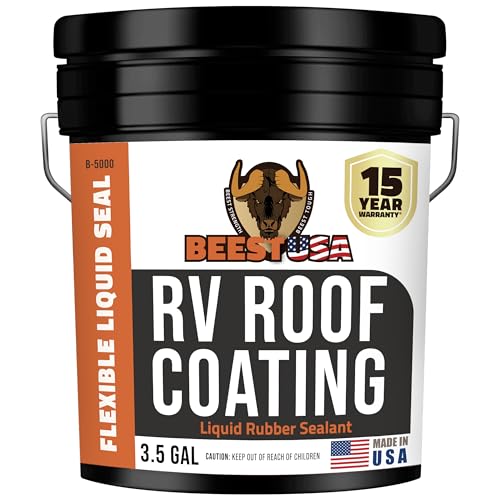
BEEST RV Roof Coating White

BEEST RV Roof Coating White
  • 3.5 gallon liquid rubber
  • Covers up to 175 sq ft
  • 2-3 heavy coats
Check price on Amazon for BEEST RV Roof Coating White (opens in a new tab)
Best for: Whole-roof recoats

Our take

It is a fit for a bigger roof where leaks are scattered and a whole-roof recoat makes sense.

Why it made the shortlist

BEEST 3.5 gallon covers up to 175 square feet in two coats, using solar reflective white liquid rubber. The listing says to apply 1 gallon per 50 square feet over 2 to 3 heavy coats.

Against BEEST 1 Gal, it holds 3.5 times the coating. Against Ziollo Silicone, it uses liquid rubber wording and lower coverage.

Buyers focused on whole-roof recoats will find it a sensible match.

What works

  • Covers 175 sq ft in two coats
  • Solvent-free, ultra-low VOC
  • Solar reflective white finish
  • Brush, roller or sprayer

Watch out for

  • Needs 2 to 3 heavy coats
  • Chemistry is only called liquid rubber
05

Best Budget Gallon · 5 of 5

BEEST RV Roof Coating White

BEEST RV Roof Coating White
  • 1 gallon liquid rubber
  • 50 sq ft per gallon
  • Wait 4 hours between coats
Check price on Amazon for BEEST RV Roof Coating White (opens in a new tab)
Best for: Single leak spots

Our take

It suits owners with one leaking spot and a small budget.

Why it made the shortlist

BEEST 1 gallon is the small pail of the same white liquid rubber coating, covering about 50 square feet in two coats. It is described as flexible, UV stable and solar reflective.

Against BEEST 3.5 Gal, it is the lower-cost entry for a spot repair. Against Saavysil, it asks for more coats and covers less area.

It earns its slot for single leak spots.

What works

  • Flexible and UV stable
  • Two coats to build thickness
  • Brush, roller or sprayer

Watch out for

  • No primer or cleaner included
  • Covers only a small area

Methodology

How We Built This Shortlist

Each pick was assessed across 5 criteria weighted for real-world use.

01

Leak method

We compared whether each listing describes flowing into cracks and seams or only coating a surface.

02

Substrates named

Roof types and any primer notes were compared.

03

Coverage and thickness

Square feet per gallon, coats and film thickness were compared.

04

Cure speed

Rain-ready and recoat times were compared.

05

Chemistry

Silicone, MS polymer and liquid rubber coatings were separated.

Decision guide

Match an RV Roof Coating For Leaks to Your RV

By Leak Location

Your situationRecommended pickWhy
Cracks, vents and seamsSaavysil SiliconeSelf-leveling, one coat.
Matched prep productsZiollo SiliconeCleaner and seam tape system.
Non-silicone sealantE-SDS MS PolymerMS polymer with film thickness.
Scattered leaks, large roofBEEST 3.5 GalCovers 175 sq ft.
One small spotBEEST 1 GalLow-cost gallon.

By Budget

BudgetRecommended pick
$40 to $70E-SDS MS Polymer or Saavysil Silicone
$70 to $190BEEST 1 Gal or BEEST 3.5 Gal
$250 to $260Ziollo Silicone

Silicone vs Liquid Rubber

Silicone

Saavysil Silicone and Ziollo Silicone are pure silicone, which flows into cracks and handles standing water.

Liquid rubber

BEEST 3.5 Gal and BEEST 1 Gal are liquid rubber, thicker coats that need two or three passes.

Most owners should choose Saavysil Silicone for a leak repair, and BEEST 3.5 Gal for a whole-roof recoat.

By Roof Size

SizeRecommended pick
Small spot repairBEEST 1 Gal
Mid roof, one coatSaavysil Silicone
Large roofBEEST 3.5 Gal
Branded systemZiollo Silicone

For Seam and Vent Leaks Specifically

Look for

A self-leveling coating that flows into cracks and names seams or vents, as on Saavysil Silicone.

In this comparison

Saavysil Silicone says it seals cracks, seams and penetrations. Use seam tape or sealant for failed seams and then coat over the area.

When to Spend More

Spend more if

Spend more on Saavysil Silicone or Ziollo Silicone if you want a silicone that flows into gaps.

Save if

Save with BEEST 1 Gal for a small job where one spot leaks.

FAQ

Before You Bring One Home

Can a roof coating stop an active leak?

It can seal small cracks, but failed seams and rotted decking need repair. Saavysil Silicone targets cracks and seams in its listing.

What is the common leak repair mistake?

Coating the whole roof without finding the source. Trace the water to the entry point first.

Is silicone worth more than liquid rubber for leaks?

Silicone like Saavysil Silicone flows into cracks and needs fewer coats. BEEST 1 Gal costs less for small jobs.

How do I apply a self-leveling coating?

Clean and dry the roof, then pour and spread it with a roller or brush. Follow the label for coat count.

When should I replace instead of coat?

When decking is soft or the membrane is torn through. A coating does not rebuild those parts.

Bottom line

The short version

Browse more rv roof coating for leaks on Amazon →
Bowen Higgins, RV Editor at RV Gear Lab

About the author

Bowen Higgins

RV Editor at RV Gear Lab

Bowen covers RV power, water systems, towing and leveling, upkeep and interior comfort, with a focus on matching gear to the rig, the hookups and the way you actually travel.

More from Bowen →Editorial standards

Keep reading

Related guides