
Practical Camping Guide · 12 min read
How to Choose a Camping Hammock
Choose a camping hammock by length, width, capacity, fabric and suspension, and learn how to hang it, keep bugs out and stay warm underneath.

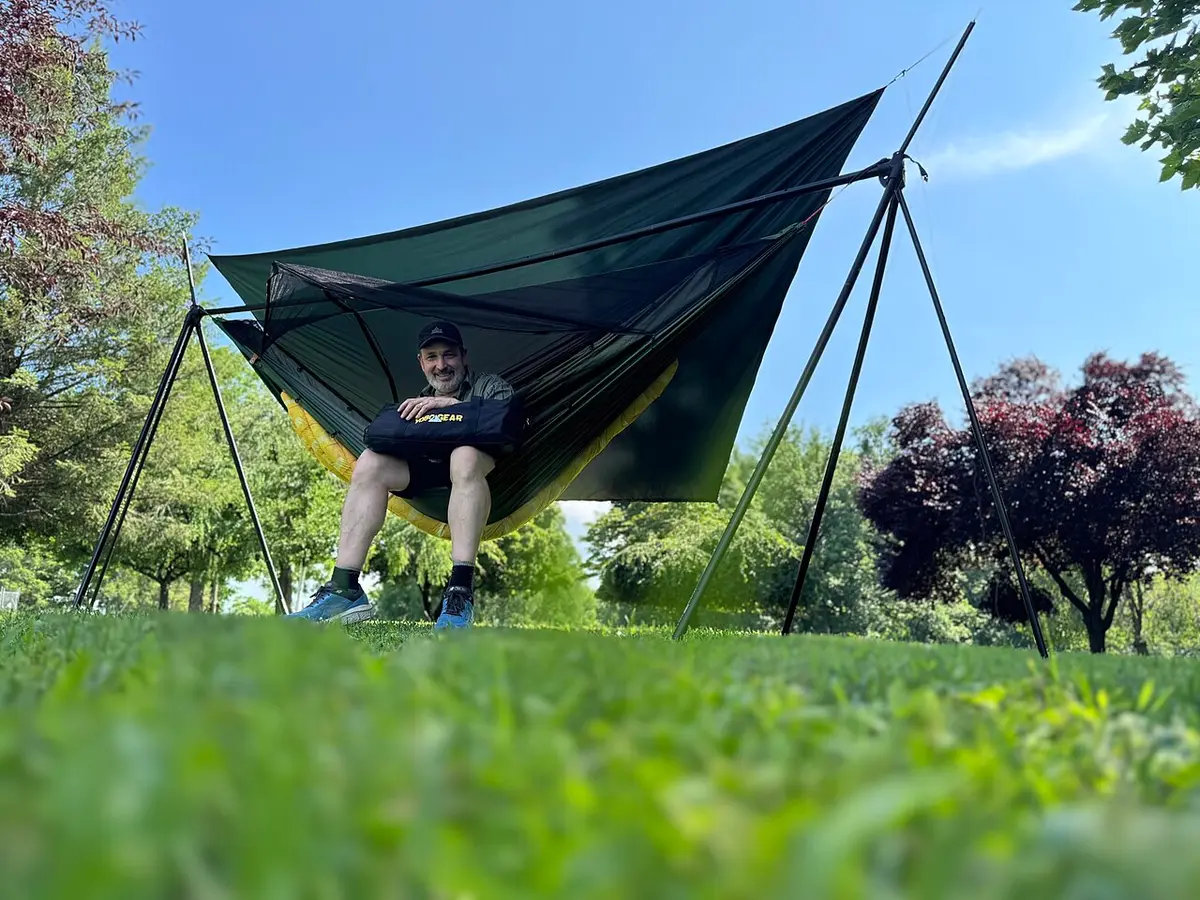
Choose a camping hammock by deciding how you will use it: a single hammock about 9 to 10 feet long and 4.5 feet wide suits one person and packs small, a double at 10 to 11 feet long and 5 to 6 feet wide is roomier and holds more weight, and a hammock with built-in bug netting and a tarp becomes a full shelter. Check the weight capacity, fabric strength, the quality of the straps and what you need underneath for warmth, since cold air under a hammock drains heat faster than the air above.
Hammocks reward a little planning. They weigh less than most tents, set up in minutes and sleep comfortably on uneven ground, but they need trees, a few extra pieces of gear and a different approach to staying warm and dry. This guide covers sizing, fabric, suspension, the correct hang, bug and rain protection, insulation, accessories, safety and care, and a short comparison of hammocks with tents and ground sleeping.
What a camping hammock is, and what you need with it
A camping hammock is a rectangle of fabric, usually ripstop nylon or polyester, that you hang between two trees or posts and sleep in. By itself it is a bed. To be a shelter it needs three more things: a suspension system (straps and hardware), overhead rain protection (a tarp) and often a bug net. In cold weather it also needs insulation underneath, because your weight compresses a sleeping bag and exposes your back to cold air.
Many hammocks sold for casual use are simple sacks with a pair of straps, suited to naps and warm nights. Others are camping systems with an integrated bug net, a ridgeline and attachment points for a tarp and underquilt. Decide first whether you want a lounge hammock or a sleeping system, because the price and complexity differ.
Size and capacity
Length and width determine comfort. A hammock should be at least 2 feet longer than your height, which gives it room to sag in the right shape. For most adults, 9 to 11 feet is appropriate. Width affects how flat you can lie: a narrow hammock forces you to lie in a banana curve, while a wider one lets you sleep at a diagonal, which flattens your back.
| Type | Length | Width | Typical weight capacity | Packed weight |
|---|---|---|---|---|
| Single | 9 to 10 ft | 4.5 to 5 ft | 300 to 400 lb | 10 to 20 oz |
| Double | 10 to 11 ft | 5 to 6 ft | 400 to 500 lb | 16 to 30 oz |
| Large or XL | 11 to 12 ft | 6 ft and up | 500 lb and up | 24 to 40 oz |
Weight capacity is usually stated for static load. Add the weight of your gear and the load from sitting or moving suddenly. If you are heavy or hang with a partner, choose a double or larger. Look at the stated capacity as an upper limit, and avoid dynamic loads such as jumping in. Our shop lists include the best camping hammocks under $30, under $50, under $75, under $100 and under $150 so you can see how capacity and features change with price.
Fabric and construction
Hammock fabric is nylon or polyester, often ripstop with a tight weave. Weights are given as denier or grams per square meter. Lighter fabrics at 20D to 40D save weight and feel soft, but are more delicate and may stretch. Heavier fabrics at 70D or more are tougher and a better choice for rough use. Look for stitched seams with a double or box-stitch pattern at the ends, where the load is highest. The ends should gather into a tight bundle or attach to a reinforced loop.
Nylon is soft and has some stretch, making it comfortable and forgiving. Polyester stretches less and handles UV better. Parachute nylon is common and offers a good balance. If you plan to leave the hammock hanging in the sun for days, choose a fabric with UV resistance. A reinforced border and bar-tacks at stress points add durability.
Suspension: straps, not rope
The suspension holds you off the ground and protects the trees. Use wide straps, at least 3/4 inch and preferably 1 inch or more, so they spread the load over the bark and do not cut into it. Many parks and trails require tree-friendly straps, and a thin rope can girdle and damage a tree. Straps usually come with a series of loops or a ladder, which lets you adjust the height and tension easily.
Hardware matters. Carabiners or metal rings connect the straps to the hammock. Look for hardware with a stated working load or break strength well above your weight, and check it for damage before each trip. Avoid cheap carabiners meant for decoration or key rings. Some systems use whoopie slings or continuous loops of cord, which are light and adjustable but require careful knots. For beginners, a strap-and-carabiner kit is simplest.
Hanging it correctly
Correct hanging makes the difference between a comfortable bed and a backache.
- Pick two healthy, living trees about 12 to 15 feet apart, at least 6 inches in diameter. Avoid dead trees and trees with dead limbs, which can fall.
- Attach the straps around 5 to 6 feet off the ground, so the hammock hangs with its low point about 18 inches above the ground when you are in it.
- Aim for a 30 degree angle between the strap and the horizontal. Too tight a hang creates a high tension on the trees and straps and a sensation like lying in a trampoline. Too slack makes you sag like a cup.
- Lie at a slight diagonal, with your head toward one side, to flatten your body.
- Check the ground below for rocks and roots in case you fall, and keep a clear space.
If trees are too far apart or too close, adjust the strap placement or use a ridgeline, a cord that sets the hammock's sag. Practice the hang at home to learn the right height and angle. A well-hung hammock should be about as flat as a couch.
Bug and rain protection
Insects are a challenge because they can bite through the fabric from below. Options include a built-in bug net that zips around the hammock, a separate net that covers it, or a mosquito-proof fabric on the floor. Check that the mesh is fine enough for no-see-ums if you camp near water.
Rain needs a tarp above the hammock. A tarp 10 to 12 feet long and 8 to 10 wide, hung as a ridgeline roof with the sides pitched low, keeps rain off and cuts wind. Use enough overlap to prevent wind-driven rain. For choosing and rigging a tarp, see our guide to how to choose and rig a camping tarp. Be sure to tie the tarp so the lower edges slope away from the hammock.
Staying warm: the underquilt problem
When you lie in a hammock, your weight compresses the sleeping bag beneath you, so its insulation does nothing, and cold air circulates under the hammock and steals your heat even on mild nights. That is why hammock campers use an underquilt, a quilt that hangs outside the hammock and insulates your back and sides, or a sleeping pad inside the hammock. For summer nights above 60 degrees, a thin pad or a foam sheet is enough. For cool nights, an underquilt rated for the temperature is the efficient solution.
A sleeping bag still works for the top, and a top quilt can be lighter. If you use a regular bag, a pad inside the hammock gives support and some insulation, though pads tend to slip. See what is R-value in a sleeping pad and sleeping bag vs quilt for background, and our guide on how to sleep comfortably while camping covers the broader system.
Accessories worth having
- A ridgeline, a cord between the ends that keeps the sag consistent.
- A pair of tree-friendly straps with adjustable loops.
- A bug net if your hammock does not include one.
- A tarp and guylines, with stakes.
- An underquilt or a pad for cool nights.
- A small pillow, since a hammock lacks a built-in headrest.
- A gear sling or organizer that hangs inside, so a headlamp and phone are near.
Weigh accessories before buying. A complete hammock system with tarp, net, straps and underquilt can weigh as much as a light tent and cost as much, so the advantages of a hammock are strongest when you need flexibility in terrain, not just weight savings.
The flat-lay and why the angle matters
A hammock sleeps well because of geometry, not magic. When you hang it with the right sag, the fabric stretches into a shallow curve and you lie diagonally across it, which spreads your weight and flattens your spine. The tension on the suspension depends on the angle: the lower the angle of the straps, the larger the force on each tree and strap. At a 30 degree strap angle, the tension on each strap is roughly equal to your weight, while at 15 degrees it is about double. That is why a taut hammock feels hard and risks overloading hardware, and why a slightly slack hang with a proper sag is both more comfortable and safer.
If you cannot find a good diagonal, try shifting your head to one side and your feet to the other, and rotating until your body is flat. If you feel pressure on your shoulders or knees, adjust the sag with the straps. Lengthening the distance between trees tightens the hang, and shortening it gives more sag. A ridgeline set to about 83 percent of the hammock's length is a common starting point, and it helps you get a repeatable hang.
Entering, exiting and sleeping position
Getting in and out of a hammock takes a little technique. Sit down in the middle, with the hammock behind you, then swing your legs in and lie back, moving toward a diagonal position. To get out, reverse the steps, sitting up and putting your feet down before standing, and never stand directly in the hammock. Use both hands to keep the fabric stable. Children and pets can climb in, though they need supervision around the straps.
For sleep, aim for a diagonal about 10 to 15 degrees off the centerline, with your head slightly elevated. Side sleepers can bend their knees and rest in a curved position, though a flat-lay is usually more comfortable. A small pillow supports your neck, and a rolled jacket or the hammock's own gathered end serves as a headrest. Over a few nights, you learn the angle that suits you, and many people sleep better in a hammock than on the ground.
Setting up in imperfect conditions
Sometimes the trees are not ideal. If the trees are too far apart, add a longer strap or a rope to span the gap, keeping the strap angle in mind. If they are too close, hang the hammock with a bit more sag or use a ridgeline to adjust. If the trees are very large, wrap the strap twice to keep it in place. On slopes, hang parallel to the contour lines so you do not roll to one side.
In windy conditions, lower the hang and use a tarp with extra guylines. In places without trees, some people use hammock stands, which are free-standing frames, but they are heavy and not for backpacking. Be ready to change plans if there are no suitable trees, and always carry a backup, such as a ground tarp and pad.
Hammock versus tent versus ground
A hammock shines on uneven, rocky, wet or sloped ground where a tent pitch is hard, and in forests with plenty of trees. It is comfortable for many sleepers, especially on their backs. It requires trees, and it is less suitable above the tree line, in deserts and at sites without anchors. A tent works anywhere and offers more privacy and space. Ground sleeping needs a flat spot and a pad, and it is simplest in open areas.
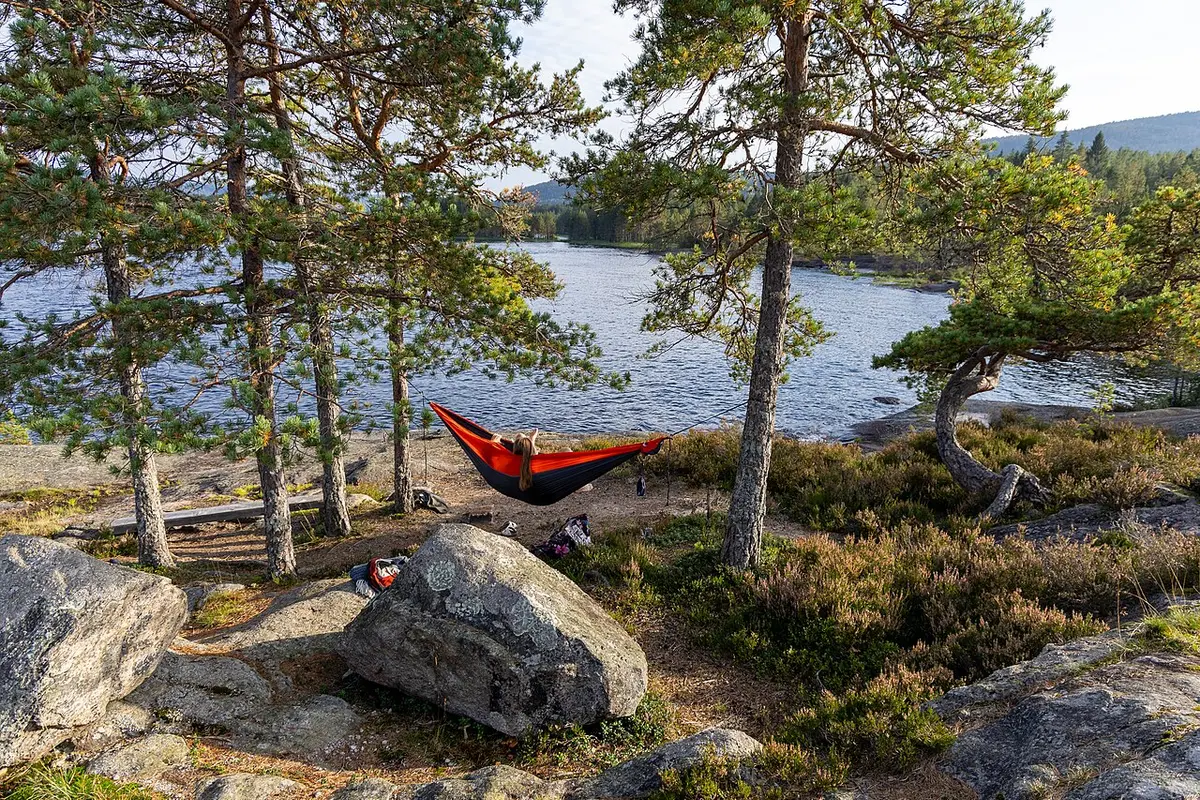
For camping with a partner, two hammocks side by side work, though a double hammock is more intimate and less comfortable for many. For families, a tent is usually easier. For solo and minimalist trips, a hammock is a fine choice.
Choosing by budget and trip type
Hammock prices span a wide range, and the best value depends on your trips. For occasional use at campgrounds and the beach, an inexpensive double hammock with tree straps does the job, and at low prices you are mostly paying for fabric and basic stitching. For regular overnight use, step up to a hammock with a stronger fabric, a better suspension and a bug net. For backpacking and bikepacking, look at weight and packed size, and plan a lightweight tarp and underquilt.
Think about what you already own. If you have a tent and a good pad, a simple hammock can serve as a lounge and a nap spot. If you want to replace the tent, price out the whole system, including tarp, net and insulation, and compare the total weight and cost with a lightweight tent. Many hikers find that a hammock system costs about the same as a mid-range tent and weighs about the same, with the advantages being comfort and flexible sites. Start simple, learn the hang and add pieces as you discover what you need.
Hammock etiquette and leave-no-trace habits
Hammock campers share the woods with others, so a few habits matter. Hang on durable sites that already show use, and avoid fragile vegetation and small saplings. Use wide straps that spread the load and do not scar bark, and remove them when you leave. Keep your hang away from trails and water, and do not tie to trees in areas that prohibit it. Pack out all trash, and never cut branches to clear a hang. Where local rules limit hammocks or require specific straps, follow them. These small courtesies keep trees healthy and keep more places open to hammock camping.
Safety, rules and care
- Hang low. A fall from 18 inches onto the ground is a nuisance, while a high hang can injure you.
- Check the trees and straps every trip, and inspect the hammock seams.
- Follow local rules: some campgrounds and parks restrict hammocks or require specific straps.
- Never tie a hammock to a vehicle or fence post that could move.
- Dry the hammock before storing, and keep it out of the sun.
- Wash it gently in cool water with mild soap, and line dry.
Related reading
A hammock changes the usual sleep-system rules, and a few related guides fill in the gaps. Sleeping pad vs air mattress compares the two insulating options you might put inside, and sleeping bag vs camping blanket helps you decide what to use on top.
Common mistakes to avoid
- Hanging the hammock too tight or too high.
- Ignoring the cold air under the hammock on cool nights.
- Using thin cord or rope that damages tree bark.
- Skipping a bug net or tarp until it matters.
- Trusting cheap carabiners without a rated load.
- Choosing trees that are too small or too dead.
- Forgetting to practice before the trip.
Frequently asked questions
How long should a camping hammock be?
At least 2 feet longer than your height, which usually means 9 to 11 feet. A longer hammock allows a flatter lie. Width of 4.5 to 6 feet also helps you sleep at a diagonal for comfort.
Can two people sleep in one hammock?
A double hammock holds two people, but sleeping together is usually uncomfortable and heavy. Many couples prefer two separate hammocks side by side. Check the weight capacity and use strong suspension.
Do I need a sleeping pad in a hammock?
On cool nights, yes or an underquilt. Your weight compresses the bag under you, so insulation is lost. A pad provides some insulation and shape, though an underquilt is more efficient and does not slip.
What kind of straps should I use?
Wide, tree-friendly straps at least 3/4 to 1 inch wide, rated well above your weight, with adjustable loops. Avoid thin ropes that can damage trees.
How high should I hang a hammock?
Hang the suspension points about 5 to 6 feet high, so the hammock's lowest point is around 18 inches off the ground with you in it. Aim for a 30 degree strap angle.
Are hammocks safe for the trees?
Yes, with wide straps and healthy trees. Avoid thin cord, dead trees and sensitive vegetation, and follow local rules. Wide straps spread the load and protect the bark.
Sources & further reading
Image credits
- "Dutch in a Quilted Chameleon Hammock" by Dutchware, CC BY-SA 4.0, via Wikimedia Commons.
- "Hammock in the wild" by Jarle Hammen Knudsen (dubidubno), CC BY 4.0, via Wikimedia Commons.


Ready to buy?
Compare the gear: Sleep Gear
5 Best Camping Hammocks Under 100 in 2026
Best camping hammocks under $100: five hammocks from a 3-in-1 hammock tent to a 16 oz single, compared on bug protection, weather cover and weight.
5 Best Camping Hammocks Under 150 in 2026
Best camping hammocks under $150: five hammocks including three freestanding stand hammocks and two tree hammocks, compared on capacity and portability.
6 Best Camping Hammocks Under 30 in 2026
Best camping hammocks under $30: six single and double hammocks with and without bug nets, compared on capacity, weight, size and included straps.
3 Best Camping Hammocks Under 50 in 2026
Best camping hammocks under $50: three options above $24 compared on capacity, size and packed weight, for campers who want a step up from a basic hammock.
5 Best Camping Hammocks Under 75 in 2026
Best camping hammocks under $75: complete hammock sets with net, rain fly and underquilt, plus lighter options, compared on what each kit includes.
Keep reading