We research everything we recommend. When you buy through our links, we may earn a commission. Learn more

Buying guide · 10 min read · Updated October 2, 2026

2 Best Suv Tents For 4runner in 2026: A Practical Camping Guide

Two SUV tents for Toyota 4Runner owners compared, a fitted hatch annex at $329.99 and a 9x9 dome at $161.99, with picks by group size and setup.

Danny WalkerBy Danny WalkerCamping Editor at RV Gear Lab2 products comparedSpec-sheet researched
Camper standing next to a tent at a campsite

At a glance

Our top picks

The Toyota 4Runner is a favorite tow vehicle and trail rig, and its tall rear hatch and flat cargo floor make it a natural base for a tent that attaches to the back of the vehicle. An SUV tent turns that cargo area into the doorway of a sleeping room: you sleep on a cot or air mattress in the cargo bay or on the ground under the tent skirt, with extra living space behind you. For RV owners it also has a second life, since a small tent annex beside a camper adds a bedroom for kids or a place to keep wet gear.

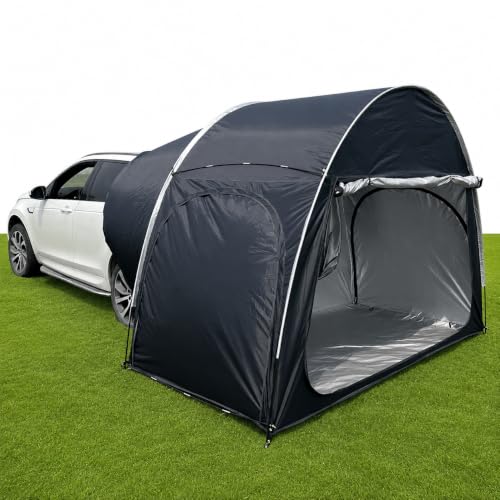
The first thing to understand is that SUV tents come in two broad styles. A fitted hatch tent is cut to a particular vehicle shape, and its sleeve wraps around the hatch opening so the connection is snug and rain resistant. A universal dome with an attachment sleeve fits many SUVs, minivans and crossovers with an adjustable collar, and it can also stand on its own when you drive off for the day. The fitted style costs more and seals better. The universal style costs less and sleeps more.

Fit matters more than most buyers expect. A sleeve that hangs a few inches off the hatch lets in wind, insects and rain, and a tent that blocks the rear camera, sensors or the hatch lift is a daily annoyance. The 4Runner also has model year changes, with a rear window design and roof rack options that vary across generations, so checking the listed years before ordering is part of the job. Also remember that tow hitch accessories, bike racks and cargo carriers can interfere with the sleeve.

Two tents are worth a 4Runner owner's attention: the MWKHZIL tent titled for the 4Runner at $329.99 and a 9 by 9 foot SUV dome tent at $161.99. We compared fit claims, capacity, height, weather features and price, and we matched each tent to a type of trip. The decision comes down to the tradeoff between a fitted annex and a roomy universal dome.

Practical details separate a good SUV tent night from a frustrating one. Park on level ground, because a slope tilts both the vehicle and the sleeping area, and leave the hatch open only as far as the sleeve allows. Bring a small broom for sand, a headlamp for the cargo bay and a few extra stakes, since campground soil varies from soft sand to hard clay. Most owners also learn to keep keys, phones and a light where they can reach them from a sleeping bag.

Safety deserves a sentence of its own. A vehicle attached to a sleeping space should never be run with the engine on while people sleep, because exhaust can collect near the rear. Turn the engine off, keep a window cracked for airflow and leave the sleeve clear of the exhaust pipe and any hot parts. Those habits cost nothing and remove the largest risk of vehicle based camping.

RV Gear Lab field notes

The Campsite Fit Check

Start with the job
MWKHZIL SUV Tent for Camping for Toyota 4Runner 1984 leads this shortlist for 4Runner owners wanting a fitted annex. Use that fit as a reference point, then compare the alternatives against your own space and workload.
Specs that separate the picks
The first details to compare are Titled for 4Runner 1984 to present, 9x9 ft, sleeps up to 5. Confirm the exact model and included components before ordering.
Trade-off to plan for
Costs about twice the Trekway

Before you buy

What Matters Before You Choose a Suv Tent For 4runner

Key buying criteria so you get the right fit the first time.

  1. 01

    Vehicle fit and sleeve design

    The sleeve is the fabric collar that wraps around the vehicle opening and holds the tent in place. A sleeve that matches the hatch shape keeps out rain, wind and insects, while a loose one lets them in. Check that the listing names your model and years, as the MWKHZIL does for the 4Runner, and look at how the sleeve straps down. A wrong sleeve fit also lets mosquitoes in, which makes the sleeve the most important detail for summer camping.

  2. 02

    Floor size and sleeping capacity

    Capacity ratings assume sleepers lying side by side without gear, so real comfort needs more room. A 9 by 9 foot floor sleeps several people, while a compact annex serves two. Compare the floor dimensions to your sleeping setup, including cots, mattresses and bags. Gear takes space too, so a 9 by 9 foot floor with five sleepers feels very different than the same tent with three.

  3. 03

    Standing height

    Height decides whether you can stand to dress or move around. Nearly 7 feet, as on the dome, allows most adults to stand, while lower tents force you to crouch. Look for the peak height in the specs and check where it sits in the tent, since it may only exist in the center. Check as well where the tent lets you stand, because a high center with sloped sides leaves much less usable room.

  4. 04

    Waterproofing and fabric

    Fabric and coatings decide how a tent handles rain and sun. Oxford fabric with a waterproof coating, taped seams and a rainfly each add protection. Look for named materials rather than generic waterproof claims, and note that the MWKHZIL lists no waterproof rating number, so ask about seam taping. Ask the seller about seam taping if the listing is silent, and treat seams with sealer before a wet trip.

  5. 05

    Free standing ability

    A free standing tent holds its shape without the vehicle, so you can leave camp set up and drive away. A tent that depends on the vehicle must be taken down to use the car. The dome works either way, and the hatch annex is designed to be attached. A free standing tent also lets you leave camp set up while you drive to trailheads or town.

  6. 06

    Packed size and setup time

    Larger tents take longer to pitch and more room to pack. A folded size that fits your cargo area matters when you are also carrying gear. Read setup notes and folded dimensions in the listing, and practice at home before the first trip. Folded dimensions matter as much as weight when the cargo bay is already full of coolers and bags.

Our standards

Why You Can Trust RV Gear Lab

At RV Gear Lab, we compare products based on campsite fit, verified specifications, usability, setup requirements, weight, durability, and real-world trade-offs. We do not rank products purely on marketing claims or commission rates.

We have not personally tested every product listed. Where hands-on testing is not available, recommendations are based on verified manufacturer specifications, product documentation, use-case fit, and comparative research.

How we review camping gear →

Detailed reviews

The 2 best suv tents for 4runner, explained

01
MWKHZIL SUV Tent for Camping for Toyota 4Runner 1984
  • Titled for 4Runner 1984 to present
  • Oxford with waterproof coating
  • Rear hatch attachment
Check price on Amazon for MWKHZIL SUV Tent for Camping for Toyota 4Runner 1984 (opens in a new tab)
Best for: 4Runner owners wanting a fitted annex

Our take

The custom-fit hatch tent for a 4Runner's rear opening.

Why it made the shortlist

The MWKHZIL tent is titled for the Toyota 4Runner from 1984 to the present and attaches to the rear hatch so the cargo area opens directly into the tent. It uses Oxford fabric with a waterproof coating and folds compact for travel, at $329.99.

The direct hatch connection is its defining feature, since it seals around the opening of a particular vehicle shape and gives a smoother walk through from the cargo bay than a generic sleeve. Compared with the 9 by 9 foot dome at $161.99, it trades some floor area for a cleaner vehicle connection, with large openings that help airflow on warm nights.

Owners who want a purpose built annex for a 4Runner and are happy to pay for a fitted connection will find it the more tailored of the two.

What works

  • Names the 4Runner and its model years
  • Connects directly to the cargo area
  • Large openings for airflow
  • Folds compact for travel

Watch out for

  • Costs about twice the Trekway
The catch
Capacity and size are not stated, so check dimensions.
02

Best for Big Groups · 2 of 2

SUV Dome Tent

SUV Dome Tent
  • 9x9 ft, sleeps up to 5
  • Nearly 7 ft stand-up height
  • 6x4 ft awning, free rainfly
Check price on Amazon for SUV Dome Tent (opens in a new tab)
Best for: 4Runner families

Our take

The big-group dome that connects to a 4Runner or stands alone.

Why it made the shortlist

The SUV Dome Tent is a 9 by 9 foot shelter that sleeps up to five, with nearly 7 feet of standing height, a 6 by 4 foot awning and a free rainfly, at $161.99. It attaches to an SUV with a sleeve and also works as a free standing tent.

The awning adds a covered outdoor spot, and the free rainfly adds weather protection without an extra purchase.

Families and groups who want space for several sleepers, plenty of headroom and a flexible tent that works with or without the vehicle will find it the better value.

What works

  • Sleeps five adults plus two in the SUV
  • Stand-up height inside
  • Awning and rainfly included
  • Works with or without a vehicle

Watch out for

  • Generic fit across many SUVs
  • Larger setup takes more time
The catch
It is a generic sleeve, so check how it seals around your hatch.

Methodology

How We Built This Shortlist

Each pick was assessed across 5 criteria weighted for real-world use.

01

Vehicle fit

The fitted MWKHZIL names the 4Runner and its years, while the 9 by 9 foot dome fits many SUVs. We compared how each listing describes the connection to the hatch and what that means for sealing and daily use. We also noted how each listing treats roof racks and hitch accessories, since those change how a sleeve sits.

02

Interior space and headroom

Group size decides the footprint. We compared the 9 by 9 foot floor and nearly 7 foot standing height of the dome with the more compact fitted annex, looking at how many sleepers each really fits. Standing height was weighed against how much of the floor actually has that clearance.

03

Weather protection

Waterproof coatings, rainflies, awnings and large openings each protect or ventilate in different ways. We compared the Oxford fabric on the MWKHZIL and the included rainfly and awning on the dome. Sealing at the hatch edge and ventilation through the large openings were considered together, since a tight tent also needs airflow.

04

Setup and packing

A larger tent takes more time to pitch and more room to pack. We weighed the folded size of the MWKHZIL and the setup effort of the larger dome for typical weekend trips. We also considered how the tent behaves in wind, since larger domes need more stakes and guy lines.

05

Price and flexibility

At $329.99 and $161.99, the cost gap is large. We weighed the price against fit, space and whether a tent can be used away from the vehicle. Price was weighed against how often a typical owner would use each tent in a season.

Decision guide

Match a Suv Tent For 4runner to Your Camp Setup

By Group Size

The number of people sleeping in and around the tent decides the footprint more than any other factor. Count sleepers and add room for bags, since an annex also holds gear.

GroupRecommended pickWhy
Two adults with a cot or mattress in the 4RunnerMWKHZIL SUV Tent for Camping for Toyota 4RunnerA fitted annex that opens straight into the cargo area.
Family of four or fiveSUV Dome TentA 9 by 9 foot floor that sleeps up to five.
Couple who wants gear spaceSUV Dome TentNearly 7 feet of height and a 6 by 4 foot awning add usable room.
Solo traveler who wants a fast setupMWKHZIL tentA compact fitted tent that folds small.

Add a few feet of margin to your sleeping area if you carry large bags or cots, since tent floors feel smaller when full.

By Budget

The two tents sit on opposite sides of a large price gap, so budget often decides the choice.

BudgetRecommended pick
Around $160SUV Dome Tent at $161.99 for a roomy dome with an awning and a free rainfly.
Around $330MWKHZIL at $329.99 for a fitted 4Runner annex with a direct hatch connection.

Fitted Annex vs Universal Dome

These designs solve the same problem in different ways, and the tradeoff is fit versus space.

Fitted hatch annex

The MWKHZIL is titled for the 4Runner from 1984 to the present, connects directly to the cargo area and uses a waterproof coated Oxford fabric. It folds compact and gives a tidier seal at the hatch, at roughly twice the price.

Universal dome

The 9 by 9 foot SUV Dome Tent sleeps up to five, offers nearly 7 feet of height and includes a 6 by 4 foot awning and rainfly. It works with many vehicles and stands without one, though the generic sleeve fits less tightly.

Choose the fitted annex if you camp as a couple and value a clean seal, and the dome if you need space or use more than one vehicle.

By Camping Style

How you camp changes what the tent must do. A basecamp stay differs from a drive off day trip.

StyleRecommended pick
Basecamp that stays pitched for days, with day trips by vehicleSUV Dome Tent, which stands without the vehicle.
Overlanding with a nightly moveMWKHZIL, which folds compact and attaches quickly to the hatch.
Family weekend near the RVSUV Dome Tent, with space for several sleepers.
Trailhead overnight in the 4RunnerMWKHZIL, for a direct walk through from the cargo area.

For 4Runner Owners Specifically

The 4Runner's hatch, rack options and rear sensors affect how a tent connects. A few checks save frustration.

Look for

A listing that names your model years, a sleeve that works with your hatch shape and clearance for any roof rack, hitch carrier or camera. Confirm that you can still open the hatch and reach the cargo area.

In this comparison

MWKHZIL names the 4Runner from 1984 to the present, which gives the clearest fit statement, and the 9 by 9 foot SUV Dome Tent uses an adjustable sleeve that suits many vehicles including the 4Runner.

When to Spend More

A difference of about $168 is a lot for a tent, so it helps to know what it buys.

Spend more if

Choose the MWKHZIL at $329.99 if you camp often from a 4Runner, want a snug seal around the hatch and prefer a compact tent that packs easily. The fitted design pays off with repeated use.

Save if

Choose the SUV Dome Tent at $161.99 if you camp occasionally, need room for a family or use more than one vehicle. You gain floor area and headroom for about half the price.

FAQ

Before You Bring One Home

Will an SUV tent fit my 4Runner?

A fitted tent like the MWKHZIL names the 4Runner and its model years, so fit should be close for those vehicles. Universal tents use adjustable sleeves for many SUVs. Measure your hatch opening, note any roof rack or hitch accessories and check the sleeve instructions before ordering. Rack and carrier clearance is the most common surprise, so test the fit in the driveway first.

Can I drive away with the tent attached?

No. SUV tents attach to the vehicle and must be unfastened before you move. A free standing dome can stay pitched while you drive off, but you need to detach the sleeve first. Never drive with the sleeve connected. Disconnect the sleeve completely and secure all straps before moving the vehicle.

Is the MWKHZIL worth twice the price of the dome?

If you camp often as a couple and want a tight hatch seal and a compact fold, yes. If you need room for several people, the 9 by 9 foot dome at $161.99 gives much more floor space and standing height. Think about group size first and budget second. A fitted tent also holds resale value better if you sell the vehicle and want to reuse the tent.

How do I keep rain out at the hatch connection?

Pull the sleeve snug, use every strap and tuck any loose fabric under the hatch seal. Park slightly uphill so water runs away from the opening. A strip of weather seal tape on the hatch edge helps in heavy rain. Condensation can look like a leak, so ventilate the tent to rule it out.

Can I sleep inside the 4Runner and use the tent as a porch?

Yes, many owners do. The fitted tent connects to the cargo area, so you can sleep in the vehicle and use the tent for changing and storage. Add a mattress that fits the cargo floor and vent a window for airflow. Keep a small fan on a USB battery for warm nights, since a closed cargo area gets stuffy. Check that your mattress fits between the wheel wells before buying, since the cargo floor is narrower than it looks.

How do I dry and store an SUV tent?

Open it in a garage or on a dry day until every panel is fully dry, then fold it loosely. Brush off sand and dirt before packing, and store it in a cool, dry place. A damp tent left in a bag can develop mildew in days. Lay the tent flat in the sun for an hour, since UV helps kill mildew spores.

Bottom line

The short version

For 4Runner owners who camp often as a pair, the MWKHZIL at $329.99 is the better choice, with a fitted hatch connection, compact fold and wide openings. It is the more tailored tent of the two.

The 9 by 9 foot SUV Dome Tent at $161.99 is the better choice for families and groups, with space for up to five, nearly 7 feet of height and a free rainfly and awning. It is also the better value if you use more than one vehicle.

Check your model years, accessories and hatch clearance before buying, and practice the setup once at home. A tent that fits well and goes up smoothly makes each trip more enjoyable.

Think of the tent as one part of a sleep system. A cot or a full width mattress in the cargo area, a warm bag and a pad for the tent floor matter as much as the shell overhead. With those in place, either tent turns a 4Runner into a comfortable basecamp, and an RV owner can reuse the dome as an overflow bedroom beside the camper.

Carry a few extra stakes, a small mallet and a roll of tape for quick repairs. Those small items fix the problems that most often interrupt a trip, from a bent stake to a torn mesh corner.

Browse more suv tents for 4runner on Amazon →
Danny Walker, Camping Editor at RV Gear Lab

About the author

Danny Walker

Camping Editor at RV Gear Lab

Danny covers camping gear, campsite setup, outdoor power, sleep systems and practical camping advice, with a focus on helping campers make better gear decisions.

More from Danny →Editorial standards

Keep reading

Related guides