

We research everything we recommend. When you buy through our links, we may earn a commission. Learn more

Buying guide · 10 min read · Updated October 2, 2026

4 Best Tipi Hot Tents in 2026: A Practical Camping Guide

Best tipi hot tents with stove jacks compared on floor size, headroom, venting and setup, for cold-weather campers who want a center-pole shelter.

Danny WalkerBy Danny WalkerCamping Editor at RV Gear Lab4 products comparedSpec-sheet researched
Camper standing next to a tent at a campsite

At a glance

Our top picks

A tipi hot tent tapers to a single peak, which gives standing room in the middle and a natural place for the stovepipe to exit. That shape is why tipis are the classic stove shelter, and it also means every listing is really a question of diameter, venting and how the stove jack sits.

Four tipis made this list, ranging from a two-person floorless model to a 4-8 person family shelter. Each was compared on listed floor size, door and vent layout, fabric ratings and whether an inner tent comes in the box.

RV Gear Lab field notes

The Campsite Fit Check

Start with the job
Night Cat Tipi Hot Tent: 4 Season Family Camping Tent with Stove Jack leads this shortlist for Families wanting bedroom and gear room. Use that fit as a reference point, then compare the alternatives against your own space and workload.
Specs that separate the picks
The first details to compare are Sleeps three, plus front room, Holds 4 to 8 people, 10.8 ft square floor. Confirm the exact model and included components before ordering.
Trade-off to plan for
Sleeps only three in the inner room

Before you buy

What Matters Before You Choose a Tipi Hot Tent

Key buying criteria so you get the right fit the first time.

  1. 01

    Stove jack and approved stoves

    A stove jack is a heat-resistant opening for the stovepipe, positioned on the tipi wall or roof. It matters because a tipi's slanting walls bring fabric close to any chimney, and the wrong stove can scorch a wall. Use only a stove approved for the tent as general safety guidance, and look for the stove-jack wording in the listing.

  2. 02

    Ventilation for a stove

    Vents are the openings that let fresh air in while the stove exhausts out. A sealed tipi with a burning stove can build up smoke and carbon monoxide, which is a real danger while you sleep. Count the top and bottom vents on the listing and keep one open at all times.

  3. 03

    Carbon monoxide alarm

    Carbon monoxide is an odorless gas from any combustion heat source, and fabric tents do not remove it. A battery CO alarm hung in the tent is the only way to notice it. Treat the alarm as a required item, since no listing can promise the air stays safe.

  4. 04

    Floor design and ground cold

    Floorless tipis breathe well but admit cold air and bugs, while sewn-in floors keep drafts out and trap moisture. This choice shapes stove traffic, sleeping layout and how you pack. Check whether the listing names a floor or says floorless.

  5. 05

    Pole and peg system

    A center pole or telescopic pole decides how fast the tipi goes up and how it handles wind. Aluminum poles save weight and resist rust. Check the listing's pole material and peg count before choosing a windy site.

  6. 06

    Inner tent versus open floor

    An inner mesh tent adds a bug barrier and some warmth, but it takes floor space from the stove and gear. Open floors give flexible room for cots and stoves. Look for the sleeping capacity with and without the inner.

Our standards

Why You Can Trust RV Gear Lab

At RV Gear Lab, we compare products based on campsite fit, verified specifications, usability, setup requirements, weight, durability, and real-world trade-offs. We do not rank products purely on marketing claims or commission rates.

We have not personally tested every product listed. Where hands-on testing is not available, recommendations are based on verified manufacturer specifications, product documentation, use-case fit, and comparative research.

How we review camping gear →

Detailed reviews

The 4 best tipi hot tents, explained

01
Best for: Families wanting bedroom and gear room

Our take

Choose it for a small family that wants a closed bedroom and a front room for boots and firewood.

Why it made the shortlist

The Night Cat Tipi pairs a separate outer fly with an enclosed inner sleeping room for up to three people, plus a front room for boots, furniture and firewood. It has a built-in stove jack, a full-mesh inner tent, dual doors and side mesh windows.

Where the FireHiking and Naturehike share one open floor, this one splits sleeping from living space, which keeps wet gear and stove traffic away from beds. Setup is a staked outline, a raised center pole and tightened guylines, with no pole sleeves to fight.

It suits a small family that wants a bedroom and a gear room under one roof.

What works

  • Separate bedroom keeps beds clean
  • Center-pole setup with no pole sleeves
  • Dual doors and side mesh windows
  • Outer fly adds a second rain layer

Watch out for

  • Sleeps only three in the inner room
The catch
The inner room tops out at three sleepers, so larger groups need the FireHiking.
02
Best for: Hunting parties and shared hot-tent camps

Our take

A roomy tipi for a crew that wants to cook and warm up together.

Why it made the shortlist

The FireHiking tipi lists 4 to 5 people with its semi inner tent and 4 to 8 people without it, built from 70D polyester with a 3000mm rain rating. Two opposite doors and a vent set (two mesh-covered at the top, two larger ones at the bottom) handle airflow.

It is the largest tent in this comparison, which separates it from the 2-4 person Naturehike and the 2-person Longeek. The opposing doors give a cross path for fresh air along the floor.

It suits bushcraft groups and hunting parties that cook and heat in one big shared room. The tipi shape gives the most standing space in the middle.

What works

  • Biggest capacity in this list
  • Top and bottom mesh vents
  • Cross-flow doors on opposite sides
  • Semi inner tent is optional

Watch out for

  • Larger tent needs a bigger stove plan
  • Polyester is bulkier than nylon
The catch
Bigger volume takes longer to heat, so plan fuel and stove size around the tent.
03

Best Value Double-Wall · 3 of 4

Naturehike Ranch Fire Teepee Tent

Naturehike Ranch Fire Teepee Tent
  • 10.8 ft square floor
  • Flame retardant 210T polyester
  • About 10.6 lb
Check price on Amazon for Naturehike Ranch Fire Teepee Tent (opens in a new tab)
Best for: Three-person cold-weather trips

Our take

A compact double-wall tipi with a snow skirt for two to four people.

Why it made the shortlist

Its floor runs 10.8 ft each way under a 6.9 ft peak, and the 210T flame retardant polyester shell weighs about 10.6 lb with a fire-rated stove jack.

Next to the FireHiking it trims the volume and gains a snow skirt plus a stated flame-retardant fabric. Compared with the Longeek, it brings a full inner tent and two doors for a similar spend.

It suits three or four people who want a cold-weather tipi that still packs to 23.6 by 7.5 by 35 inches. Two top vent windows add airflow for warm trips.

What works

  • Snow skirt blocks wind and drifts
  • Flame retardant fabric on the walls
  • Includes mesh inner tent
  • Packs to a modest size

Watch out for

  • About 10.6 lb is not ultralight
  • Smaller than the FireHiking
The catch
At roughly 10.6 lb it is more of a car-camp tipi than a pack-in one.
04
Best for: Solo campers and pairs on a budget

Our take

The entry-level pick for two people who want a stove-ready tipi without spending much.

Why it made the shortlist

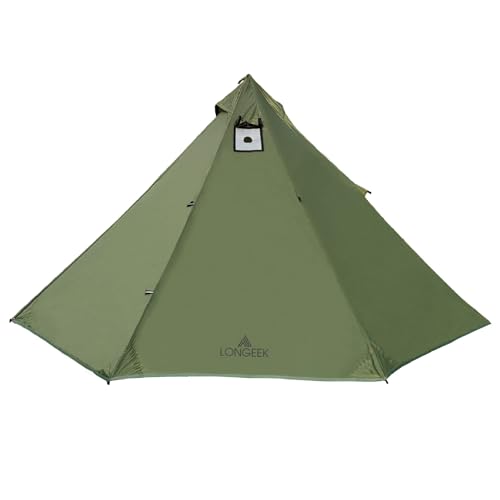
The Longeek is an octagonal tipi with a 3.2 m maximum floor diameter and 1.6 m height, built from ripstop fabric with PU3000mm waterproofing. One window doubles as a stove jack, with two screened vents and two opposite zipper doors.

It also includes aviation aluminum poles and 16 pegs, where others focus on fabric ratings.

It suits a solo camper or pair who wants a stove tipi at the lowest cost. It can also be pitched under a tree without the pole for extra headroom.

What works

  • Floorless layout improves airflow
  • Aluminum poles included
  • Two zipper doors and two screened vents

Watch out for

  • Stovepipe not included
  • Floorless design offers no ground barrier
The catch
The stovepipe is sold separately and the floorless build lets in cold ground drafts.

Methodology

How We Built This Shortlist

Each pick was assessed across 5 criteria weighted for real-world use.

01

Floor size and capacity

Listed diameters, square footage and the sleeper ratings each seller gives.

02

Stove jack placement

How each listing describes its stove jack and the fabric around it.

03

Ventilation layout

Door count, top and bottom vents and mesh panels.

04

Packed size and weight

Listed packed dimensions and weight where available.

05

Inner tent and floor

Whether a mesh inner is included and whether the floor is open or sewn.

Decision guide

Match a Tipi Hot Tent to Your Camp Setup

By Group Size

Your situationRecommended pickWhy
Solo or two on a budgetLongeek 2 PersonSmallest, cheapest, floorless octagon.
Three or four campersNaturehike Ranch Fire10.8 ft footprint with a mesh inner.
Families of three with gearNight Cat TipiBedroom and front room split.
Crew of five to eightFireHiking 4-8 PersonLargest tipi here.

By Budget

BudgetRecommended pick
$100 to $130Longeek 2 Person or Naturehike Ranch Fire
$170 to $200FireHiking 4-8 Person or Night Cat Tipi

Floorless vs Inner Tent

Floorless open tipi

Longeek 2 Person and the no-inner FireHiking 4-8 Person layout trade a floor for airflow and stove flexibility. Ground cold and bugs come in, so plan a groundsheet.

Inner tent plus fly

Night Cat Tipi and Naturehike Ranch Fire add a mesh inner for bugs and a drier sleeping zone. They give up some floor space to the inner.

Most cold-weather campers should pick the Naturehike Ranch Fire for a good balance of inner tent and cost.

By Camp Style

PriorityRecommended pick
Packed tight on a budgetLongeek 2 Person
Winter with a snow skirtNaturehike Ranch Fire
Separate bedroom and gear roomNight Cat Tipi
Big shared cooking tentFireHiking 4-8 Person

Safe Stove Setup Specifically

Look for

A stove jack, vent count and a maker-approved stove, plus clearance rules

In this comparison

Naturehike Ranch Fire pairs its jack with flame retardant cloth, while Longeek 2 Person lists a fireproof stove jack and a stovepipe-free package. Pair either with an approved stove and a CO alarm.

When to Spend More

Spend more if

Spend more on Night Cat Tipi if you want a closed bedroom, or on FireHiking 4-8 Person if a crew needs space for cooking and heat together.

Save if

Save with Longeek 2 Person or Naturehike Ranch Fire, which cover one to four sleepers at a lower price.

FAQ

Before You Bring One Home

Can I use a wood stove in any tipi?

Only use a stove the tent maker approves, and always keep fabric clear of the stove and pipe. A stove jack is only an opening, so clearance and a spark arrestor are your job.

What is the biggest mistake with tipi hot tents?

Sleeping with a stove burning and every vent closed. Carbon monoxide can build up in an enclosed tent, so use a battery alarm and keep vents open.

Is a bigger tipi worth it over a two-person model?

Only if you carry more than three people or cots. A larger tent takes more fuel and time to heat, and the Longeek 2 Person is easier to warm for a pair.

How do I set up a tipi hot tent?

Stake the base outline, raise the center pole and tension the guylines. Then fit the stovepipe through the jack once the stove is cold and check clearance.

How should I clean up after stove use?

Let the stove and pipe cool fully, then brush soot from the jack and wipe the fabric. Dry the tent before packing so mildew does not form.

Bottom line

The short version

Browse more tipi hot tents on Amazon →
Danny Walker, Camping Editor at RV Gear Lab

About the author

Danny Walker

Camping Editor at RV Gear Lab

Danny covers camping gear, campsite setup, outdoor power, sleep systems and practical camping advice, with a focus on helping campers make better gear decisions.

More from Danny →Editorial standards

Keep reading

Related guides