
Practical Camping Guide · 13 min read
Tent Waterproof Ratings (Hydrostatic Head) Explained
What hydrostatic head in millimeters means for a tent fly and floor, why seams matter, and which ratings suit your camping weather.

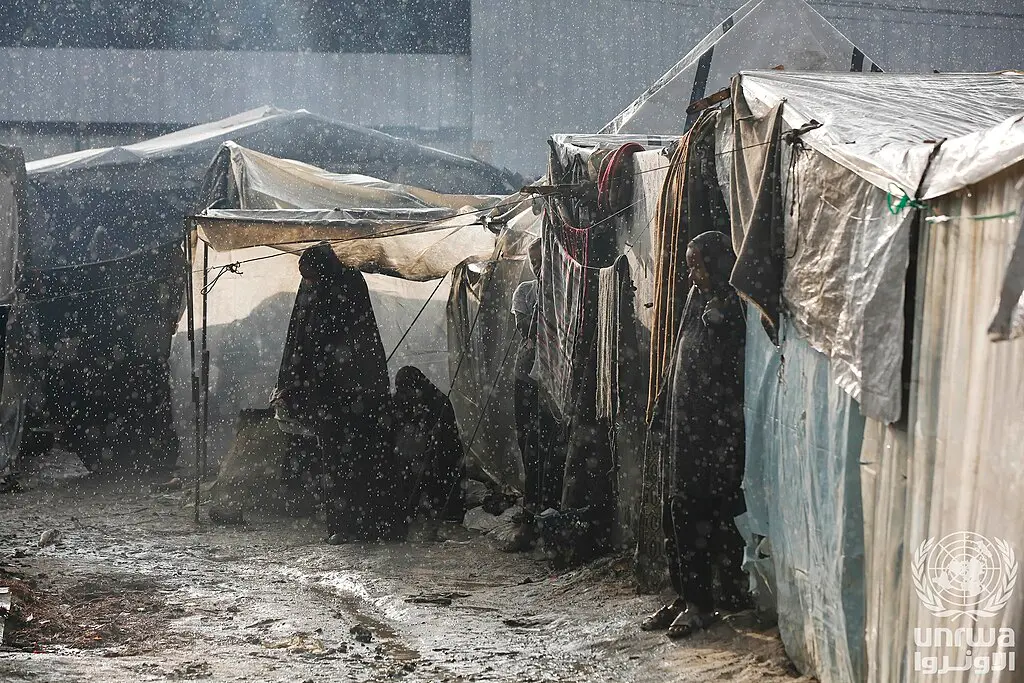
A tent's waterproof rating is a number in millimeters, such as 1,500 mm or 3,000 mm, and it describes how tall a column of water the fabric can hold back before water starts to push through. Higher means the fabric resists more pressure, but the number only covers the fabric under lab conditions. Seams, zippers, floor design, setup and fabric age decide whether you stay dry through a real night of rain.
That gap between the printed number and the wet-sleeping-bag reality is why so many shoppers get burned. A tent can be advertised as "3,000 mm waterproof" and still leak at the stitching, or a modest 1,500 mm fly can keep a camper dry all weekend because the seams are taped and the pitch is tight. This guide explains what hydrostatic head actually measures, which numbers make sense for a fly and for a floor, and how to read a spec sheet before you buy.
What hydrostatic head actually measures
Hydrostatic head (HH) is a lab test. A sample of fabric is clamped over a cylinder, and water is pushed against it with steadily rising pressure until water begins to come through, usually defined as a few drops appearing on the far side. The height of the water column at that moment, in millimeters, is the rating. A fabric rated at 2,000 mm held back the pressure of a water column two meters tall before leaking.
Rainfall does not behave like a two-meter water column. A raindrop hitting a taut fly produces a brief, small pressure. The pressures that approach the higher end of the scale happen when something presses water into the fabric: a camper's knee on a tent floor, a heavy pack sitting in a puddle, a fly that has sagged and is lying against the inner tent, or wind-driven rain slamming into a flat wall. That is why floors are expected to carry a much higher rating than flies even though they never see falling rain directly.
The test method matters too. Many reputable manufacturers cite a recognized method such as ISO 811 or an equivalent standard for textile water resistance, while some budget listings print a number with no method behind it. When a spec sheet gives a round number and nothing else, treat it as a rough indication rather than a verified specification.
The numbers: what each range means in practice
Retail guides and outdoor educators broadly agree on bands for what each range handles, even though the exact cutoffs vary from source to source. Use the table below as a practical framework rather than a guarantee.
| Rating (mm) | Typical use | Realistic expectation |
|---|---|---|
| Under 800 | Sun shelters, beach canopies | Light mist only; not a rain shelter |
| 800 to 1,500 | Fair-weather budget tents (fly) | Handles light rain if seams are sealed and the pitch is tight |
| 1,500 to 2,500 | Mainstream 3-season fly | Handles steady rain; borderline in sustained storms |
| 3,000 to 5,000 | Quality 3-season fly, many floors | Comfortable margin for multi-day rain |
| 5,000 to 10,000+ | Floors, 4-season flies, expedition tents | Margin for pooled water and heavy pack pressure |
For a rain fly, 1,500 to 2,000 mm is a sensible minimum for a tent you plan to use in real weather, and 3,000 mm is comfortable. For a floor, 3,000 mm is a common baseline and 5,000 mm or more is better, because the floor sits in contact with wet ground and bears your weight. If a listing gives a single number for the whole tent, find out whether it applies to the fly, the floor or both before comparing.
Why a higher number is not automatically better
The first trap is that coatings are a trade-off. To reach very high ratings, makers apply thicker polyurethane (PU) or silicone layers. Thick coatings can be heavier, stiffer, and less breathable, and a coated fabric that does not breathe worsens condensation inside the tent. Interior dampness in a sealed, heavily coated tent can soak a sleeping bag as thoroughly as a leak would.
The second trap is that the rating describes new fabric. Abrasion from packing, folding, UV exposure and washing wear the coating over the seasons. Fabric that tested at 3,000 mm in the factory may behave more like 1,500 mm after several years of use. This is why store-bought budget tents that leak in their second summer are so common: the original margin was thin and ageing consumed it.
The third trap is that fabric is only one piece of the system. An unsealed seam is a row of needle holes, and water will pass through each of them regardless of what the surrounding fabric rating says. A well-taped 1,500 mm fly can outperform an untaped 5,000 mm one in practice.
Seams, zippers and the parts the number ignores
Look for the phrase "factory taped seams" or "fully taped" in the specification. Tape is a thin waterproof strip heat-bonded over the stitching line. A listing that says "seam-sealed" may mean only the fly or only the floor corners, so read the details. Some tents ship with untaped seams and ask you to apply sealer yourself, which is workable but easy to skip; see our guide on how to waterproof a tent if you need to do this.
Zippers are the other weak point. Water-resistant coated zippers with storm flaps (a fabric flap that covers the zipper track) keep rain from running down the teeth. A door with an unprotected zipper on the windward side will drip even if the fabric is excellent.
Then there is the floor design. A "bathtub" floor wraps several inches up the walls so the seam between floor and wall sits above ground-level water. A flat-cut floor with seams at ground height lets splashback and pooled water find the stitching. When comparing budget models, this construction detail often matters more than whether a floor is 3,000 or 4,000 mm.
Rainfly versus floor versus inner tent
A double-wall tent separates the waterproof layer from the breathable layer. The fly is waterproof and the inner tent is mostly mesh or breathable fabric, which lets vapor from your breath escape through the inner and condense on the cool fly instead of on you. Because the inner is not meant to shed water, it has no rating that matters, and a rainfly that is pitched too close to the inner will transfer drips right through the mesh.
Single-wall tents do the opposite. One layer must both keep rain out and let vapor out, so these tents use waterproof-breathable fabrics and typically list a rating and a breathability figure. They are lighter but rely on venting and are less forgiving in warm humid weather.
Where the number appears on a spec sheet gives you a clue about quality. A listing that gives separate numbers for fly and floor, for example 2,000 mm and 5,000 mm, usually belongs to a maker that thought about the two jobs. A listing that says "waterproof 3,000 mm" with no further detail is less informative.
How to read a tent spec sheet in five minutes
When you are comparing a handful of budget tents, check these points in order. They take far less time than reading reviews and they screen out most problem listings.
- Find the fly rating and the floor rating, and confirm they are listed separately.
- Look for "taped seams" or "sealed seams" and note whether it covers fly, floor or both.
- Check the floor style: bathtub with walls raised several inches is preferable to a flat floor.
- Check the fabric: polyester and nylon with PU coating are standard; a ripstop weave resists tear growth.
- Look at the pole material, because a leaking tent is often a collapsing tent first. Fiberglass poles are cheap and heavy, aluminum is stronger.
- Confirm the fly reaches nearly to the ground; a short fly lets wind-driven rain enter at the bottom.
Compare against what you plan to do. If you camp only in dry summer weather, a 1,500 mm fly on a budget dome is fine, and the shortlist in our guide to the best dome tents under $50 fits that pattern. If you camp in regions with afternoon thunderstorms, step up to 2,000 mm or more with taped seams, such as the picks in the best camping tents under $100.
Matching the rating to where and when you camp
Climate and season should drive the choice more than a generic ranking. Camping in the desert Southwest in spring, rain is rare but when it comes it is sudden and heavy; a fly with a 1,500 mm rating and taped seams is usually fine, provided you can stake it taut. In the Pacific Northwest or Appalachians in shoulder season, you may face multiple days of continuous drizzle, which stresses a floor constantly and wears down a marginal coating. There, a 3,000 mm fly and 5,000 mm floor is worth the weight.
Elevation and exposure are factors as well. At altitude, wind-driven rain and graupel hit hard and the fly pressure goes up dramatically in gusts. A tent with a very low rating can fail there quickly, even when the same tent would be fine on a sheltered campground loop.
For families, size multiplies risk. A big cabin tent has a huge floor area that will carry the weight of cots and gear, and a large sloped roof panel that can pool water. Compare mid-range options in the best camping tents under $200 with attention to seam taping on the roof panels.
Setup matters as much as the rating
A perfectly rated fly will leak if it touches the inner wall or hangs slack. Pull the fly taut so water sheds quickly; pooled water on a sagging panel is the likeliest place for pressure to climb. Stake out guylines so the fly stands off the inner tent by at least a couple of inches at every point. Pitch with the door facing away from the prevailing wind, and avoid camping in a depression where water will collect under the floor.
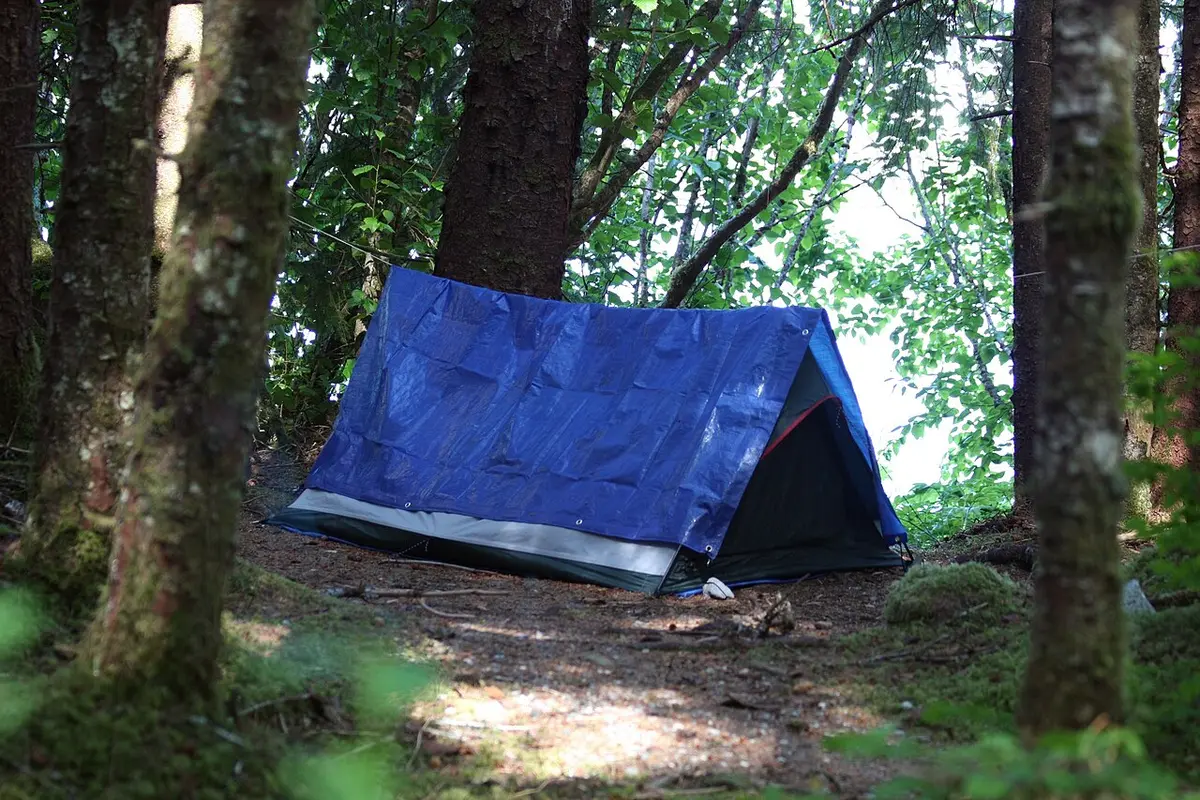
A footprint, which is a ground sheet cut to the tent floor, protects the floor from abrasion and punctures that cause leaks at the weakest point. Trim it a bit smaller than the floor so rain does not run onto it and pool between footprint and tent. If you want the step-by-step, see how to set up a tent.
Pitch location is part of waterproofing. Camp on slightly raised, well-drained ground, not at the bottom of a slope or in a dry creek bed. Dig no trenches (many parks forbid it), but do look at which way water would flow if it started pouring.
Caring for the coating over time
Waterproof coatings fail from the inside out. PU coating on the underside of a fly can hydrolyze, meaning it breaks down chemically in humid storage and turns sticky or flaky. A tent stored wet is the most common cause: mildew and coating breakdown start within days. Always dry the tent completely before packing it, and store it loose in a breathable bag in a cool, dry place. For more detail see how to store a tent the right way.
Clean gently. Harsh detergents, hot water, washing machines and dryers strip coatings. A soft sponge with lukewarm water and a mild non-detergent soap is the standard approach, and our guide on how to clean a tent without damaging it covers it in detail. Limit sun exposure when the tent is not in use, because UV weakens both the fabric and the coating.
When a coating does fail, a worn tent can be revived with a seam sealer on the seams and a wash-on or spray-on waterproofing product on the fabric, but treat it as a stopgap; once the coating is flaking, a replacement tent is usually the better value.
A worked example: choosing between two tents
Imagine two 4-person tents. Tent A is advertised as "waterproof to 3,000 mm" with no further detail, no mention of seams, and a flat floor. Tent B lists a 1,800 mm fly and a 4,000 mm floor, factory-taped seams, a bathtub floor with 6-inch walls and a fly that reaches within 3 inches of the ground. On paper Tent A looks better because of the larger number. In practice, Tent B is probably the safer choice, because it provides specifics where they count: seams sealed, floor protected, fly coverage low.
This is the main habit to build. Ask what the number applies to, what else is described, and whether the construction details back it up. A single big number with no supporting detail is a marketing figure; a set of modest numbers with real construction details is an engineering description.
Rating guidance by tent size and price tier
Budget tiers tend to follow predictable patterns, and knowing them helps you decide where a spec sheet is plausible and where it is stretching. At the very low end of the market, a dome tent in the thirty to seventy dollar range will usually pair a modest fly rating, often somewhere around 1,000 to 1,500 mm, with a thin floor. That is perfectly adequate for a dry weekend and a poor bet for a monsoon, so match it to the forecast. Moving up toward the three hundred dollar mark, as in the best dome tents under $300, you should expect seam taping everywhere, a bathtub floor, better poles and more honest numbers.
Two-person tents are the easiest place to get real waterproofing for little money, because there is less fabric to coat and seal. A compact shelter has fewer seams, shorter pole spans and less roof area to pool water. If your trips involve one or two campers, compare the shortlist in the best camping tents for 2 people before paying for volume you will not use. Bigger tents need more attention: a 10 by 10 foot roof has far more area to sag, and a sag that holds a few liters of water will exceed any fabric's comfortable rating at the lowest point.
A simple field test helps with any tent you already own. Set it up in the yard, spray the fly with a hose for ten minutes from above and then from the side, and wait with a flashlight inside. Dry fabric that beads water is healthy. Fabric that darkens and wets out has lost its durable water repellent finish, which is a separate layer from the waterproof coating and can be restored with a spray. Drips at stitching mean the seams need sealer. Drips at the middle of a panel suggest the coating is failing, which is the point at which replacement becomes more sensible than repair.
Common mistakes to avoid
- Treating the highest number as the best tent without checking seams, coating type and floor design.
- Comparing a fly rating from one listing with a floor rating from another.
- Assuming a tent that was dry last year is still dry; coatings age even when stored well.
- Pitching with a loose fly that touches the inner tent, which transmits water through the contact points.
- Packing a tent wet and leaving it in a hot trunk, which hydrolyzes PU coatings.
- Skipping a footprint on rough or rocky ground, which leads to pinhole leaks.
- Using fabric sprays on the outside while the real leak is at the seam tape.
Frequently asked questions
Is 1,500 mm waterproof enough for a camping tent?
For a rain fly with taped seams in typical three-season weather, yes. It handles steady rain when the pitch is tight. For the floor it is on the low side, since the floor takes body weight and ground moisture, so look for 3,000 mm or more there. If you camp somewhere with long wet spells or strong wind, aim higher for both.
Do I need a different rating for the floor and the fly?
They do different jobs. The fly sheds falling rain from a sloped surface, so a moderate rating is workable. The floor contacts wet ground and bears pressure from you and your gear, so it should rate higher. Good listings give both numbers; if only one appears, ask which part it applies to.
Can I increase a tent's waterproofing at home?
You can improve it. Seam sealer on the stitching and a spray-on or wash-in treatment on the fabric restore water beading and close needle holes. Treatment cannot rebuild a coating that has peeled off in sheets, and a heavily worn tent is usually better replaced. See our guide to waterproofing a tent for the sequence.
Does a higher rating mean the tent is more breathable or less?
A heavier coating often reduces breathability, which means more condensation inside. Double-wall tents avoid the problem by pairing a waterproof fly with a breathable inner, so vapor passes through the inner and condenses on the fly. For single-wall designs a separate breathability figure is worth looking for.
Why does my tent leak at the seams even though it is new?
Many budget tents ship with seams that are only partly taped, or taped on the fly but not at the floor corners. Check the stitching with a flashlight from inside during a hose test. Apply seam sealer along any line where light or water comes through, and let it cure fully before packing.
Is a ground tarp or footprint worth it for waterproofing?
It protects the floor coating from abrasion and punctures, which are the main cause of floor leaks. It does not make the tent waterproof, and a tarp that sticks out past the tent edge can channel water under the floor. Cut it slightly smaller than the tent footprint.
Sources & further reading
- Section Hiker: Hydrostatic Head Explained, Measuring Waterproofness
- Scandinavian Outdoor: What on Earth Is Hydrostatic Head
Image credits
- "Flooded tents of displaced Palestinians due to heavy rain in Deir el-Balah, Gaza Strip" by Ashraf Amra, CC BY-SA 3.0 igo, via Wikimedia Commons.
- "A small tent with a blue tarp draped over it sits in a clearing between trees. (46645bde-1a56-4bca-bdcf-5d48330ee411)" by National Park Service, Public domain, via Wikimedia Commons.


Ready to buy?
Compare the gear: Tents & Shelter
4 Best Dome Tents Under 300 in 2026
Best dome tents under $300: an instant 10-person dome, a mesh-top backpacking dome, an SUV-attached dome and a rain-first dome compared for car campers.
6 Best Dome Tents Under 50 in 2026
Best dome tents under $50: six two- and three-person domes compared on floor size, rain protection and pole type for budget campers.
5 Best Dome Tents Under 75 in 2026
Best dome tents under $75 compared on pitch time, rain protection, floor size and pole type, for campers who want a reliable two-person dome.
5 Best Camping Tent Under 100 in 2026
Best camping tents under $100: five budget tents from a 4-person instant cabin to a 2.2 lb one-person bivy, with notes on what $100 buys.
5 Best Camping Tent Under 200 in 2026
Best camping tents under $200: five picks from a 2.76 lb ultralight to an 8 person screen-porch tunnel, with what the stated numbers say.
5 Best Camping Tents For 2 People in 2026
Best camping tents for 2 people: five two-person tents from a 4.8 lb dome to a Coleman Sundome, with room, setup and weather notes for pairs.
6 Best Camping Tents For Families in 2026
Best camping tents for families: six 4 to 10 person cabin and dome tents, from 1 minute instant setups to 18 foot-wide group shelters.
5 Best Camping Tents in 2026
Best camping tents compared across pop-up, dome and backpacking styles, with floor size, weight, rain rating and setup notes for first-time buyers.
Keep reading