

We research everything we recommend. When you buy through our links, we may earn a commission. Learn more

Buying guide · 11 min read · Updated October 2, 2026

5 Best Budget 8 Sensor RV TPMS Kits in 2026: A Practical RV Guide

Five 8-sensor RV tire pressure monitors compared on spare-tire room, display size and pairing, for tow rigs with more than four wheels to watch.

Bowen HigginsBy Bowen HigginsRV Editor at RV Gear Lab5 products comparedSpec-sheet researched

At a glance

Our top picks

Eight sensors is a specific number, and it fits a specific rig. A truck has four tires and a tandem-axle trailer has four more, which makes eight before anyone thinks about a spare. Add one spare and a kit sold as eight sensors is already a wheel short, so the maximum the display can pair matters as much as the count in the box. This guide starts with that arithmetic: list every wheel you want watched, spares included, then see which kit has room for the total.

What the display does with eight readings decides whether the kit is pleasant or irritating on a long drive. A small screen has to cycle through positions, so a slow leak on the fourth tire waits its turn. A bigger panel shows every position at once, and a unit with a four-wheel mode lets you leave the trailer out when you drive the truck alone. Alarm behavior, thresholds you can adjust and how each sensor pairs all sit behind that one screen.

Budget eight-sensor kits cluster tightly, with the whole shortlist sitting in one narrow price band. Money here buys screen size, a rechargeable display and solar top-up rather than a different class of sensor. All five use external screw-on sensors, so none will read tire temperature the way an internal sensor does. We read every listing and product specs, and ranked each kit by how well it handles a rig that needs all eight positions.

RV Gear Lab field notes

The Rig Fit Check

Start with the job
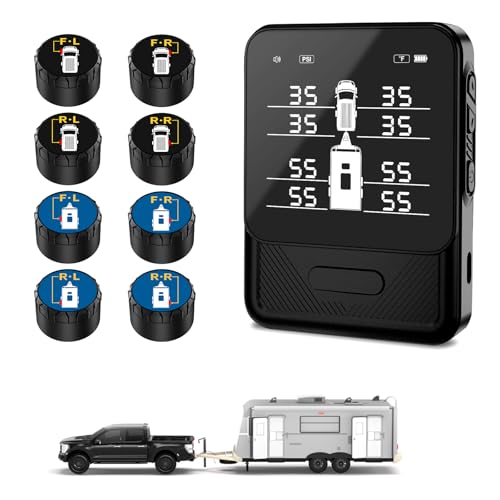
FIRE BULL Wireless RV TPMS with 8 Sensors (Max. 10), 2.46 inch HD Color Display leads this shortlist for Truck-and-trailer rigs that want room to grow past eight tires.. Use that fit as a reference point, then compare the alternatives against your own space and workload.
Specs that separate the picks
The first details to compare are 8 external sensors, up to 10, 8 sensors, 0-108 psi, 8 sensors, up to 10 positions. Confirm the exact model and included components before ordering.
Trade-off to plan for
Reads to 108 psi, below high-pressure tires

Before you buy

What Matters Before You Choose a Budget 8 Sensor RV TPMS Kit

Key buying criteria so you get the right fit the first time.

  1. 01

    Sensor count including spares

    Count every tire you want watched, then add the spare on the trailer and any on the truck. A kit sold with eight sensors covers eight wheels exactly, and a ninth means buying extras or a second system. Read the maximum the display can pair, not only the number in the box, because a ten-position display lets you add sensors later for a few extra dollars of hardware. Confirm the exact pairing maximum in the title or bullets, not a phrase like expandable.

  2. 02

    Pressure ceiling versus tire rating

    A TPMS has an upper limit on what it can read, and that limit has to sit above the tire's maximum cold inflation. Most kits here top out at 108 psi, which suits many trailer tires, while one lists a far higher range for heavy-duty rubber. A system that cannot reach the tire rating will either read wrong or never raise a high-pressure alarm. Find the number on the tire sidewall and compare it with the range printed in the listing.

  3. 03

    Display size and layout

    Eight readings are a lot for a small screen, which then has to cycle through tires and delay a warning from the position you are not looking at. A 7 inch panel shows everything at once, while the 2 to 3 inch displays rely on a vehicle diagram to keep readings organized. Think about where the display will sit and how bright the sun gets, then pick the size that lets you read all eight without taking your eyes off the road for long.

  4. 04

    Four-wheel mode and trailer separation

    A rig that tows on weekends spends the rest of the week as a lone truck. Sensors on a parked trailer stop transmitting, and a display that expects eight tires will keep raising signal-lost alarms. A four-wheel mode silences the missing positions. If your truck runs alone for most of the year, ask whether the kit offers this mode, and note that a few listings say nothing about it either way.

  5. 05

    Pairing procedure and sensor batteries

    Eight sensors have to be matched to eight positions, and a careless sequence can produce garbled data. Some kits arrive paired from the factory, while others require pairing one sensor at a time right after it is screwed on. External sensors use replaceable coin cells that last a year or so, so plan on swapping them and keep spares. Read the pairing note in the listing before you start so one mistake does not cost an afternoon.

  6. 06

    Signal reach and repeaters

    A trailer's rear axle can sit thirty feet or more behind the dash, and the signal has to cross a metal frame and a truck cab. A booster or repeater closes that gap and costs little in a kit that already includes one. Confirm a stated range in feet and a mention of a booster, and mount the display where it has a clear line toward the trailer rather than behind the center console.

Our standards

Why You Can Trust RV Gear Lab

At RV Gear Lab, we compare products based on rig fit and power or hookup compatibility, verified specifications, usability, setup requirements, weight, durability, and real-world trade-offs. We do not rank products purely on marketing claims or commission rates.

We have not personally tested every product listed. Where hands-on testing is not available, recommendations are based on verified manufacturer specifications, product documentation, use-case fit, and comparative research.

How we review RV gear →

Detailed reviews

The 5 best budget 8 sensor rv tpms kits, explained

01
Best for: Truck-and-trailer rigs that want room to grow past eight tires.

Our take

IP67 screw-on sensors shrug off car washes and rain, and the display runs from dual power sources.

Why it made the shortlist

The FIRE BULL ships with eight external sensors and a display that can pair up to ten, so two spare positions or a future axle already have a home. That headroom is the practical answer to the arithmetic of a truck plus a tandem trailer, and it keeps a spare monitored without buying a second kit.

Its 2.46 inch color screen draws a vehicle layout so each reading sits where the tire actually is, which makes a glance at the dash fast. Six alarm modes cover high pressure, low pressure, overheating, rapid leaks, slow leaks and low sensor battery, and the magnetic quick-detach bracket mounts without tape or wiring.

Sitting at the upper end of this shortlist on price, it is the one to pick when you want the expandable count and a clear picture of the whole rig.

What works

  • Pairs up to ten sensors for spares
  • Vehicle layout shows each tire position
  • Six alarm modes including slow leak
  • Magnetic mount, no tape or wiring

Watch out for

  • Reads to 108 psi, below high-pressure tires
  • Screen is modest next to the 7 inch units
02
Best for: Owners who want eight sensors and a color display without extra features.

Our take

Sensors are described as long-lasting with extended battery life, which suits a rig that sits parked for weeks between trips.

Why it made the shortlist

Here is the straightforward version of the eight-sensor idea: eight sensors, a color screen and a reading range up to 108 psi. Its label covers tool-free setup and universal fit across RVs, trailers, campers and motorhomes, so it works as a swap-in for most rigs without any special hardware.

Against the FIRE BULL 8-Sensor it keeps the same price band and the same range while spending its effort on simplicity. Real-time pressure and temperature appear on a vivid color display, and the alerts cover pressure swings and temperature changes as they happen.

A good fit for an owner who knows the count they need and wants a no-nonsense kit that tells them when a tire moves out of range.

What works

  • Eight sensors and color display in the box
  • Tool-free setup with universal fit
  • Pressure and temperature alerts
  • Extended-battery sensors for parked rigs

Watch out for

  • Listing gives little detail on alarm types
  • No stated option to add more sensors
03
B-Qtech RV Tire Pressure Monitoring System TPMS with 8 Sensors (0-108 PSI)
  • 8 sensors, up to 10 positions
  • 3.15 inch screen, USB-C rechargeable
  • 4-wheel and 8-wheel modes
Check price on Amazon for B-Qtech RV Tire Pressure Monitoring System TPMS with 8 Sensors (0-108 PSI) (opens in a new tab)
Best for: Rigs that tow, carry spares and sometimes drive the truck alone.

Our take

The 3.15 inch screen is clear for the price, and the display runs from a rechargeable 1000mAh battery that charges over USB-C.

Why it made the shortlist

The B-Qtech spells out the sensor budget better than any kit here: four for the tow vehicle, four for the trailer and two more for spare tires, ten positions in total. That is exactly the layout most tow rigs end up needing, and the box already holds eight sensors toward it.

A switch between four-wheel and eight-wheel mode is the standout feature. Drive the truck alone in four-wheel mode to cut false alerts from sensors that are parked at home, then flip to eight-wheel mode when the trailer is hitched. Thresholds for pressure and temperature can be adjusted to match your tires.

Magnetic mounting takes seconds. Rigs that change configuration between trips are where the display earns its keep.

What works

  • Four-wheel mode for solo truck driving
  • Room for two spare tires
  • Adjustable pressure and temperature limits
  • USB-C rechargeable display

Watch out for

  • Display battery needs periodic charging
  • Reads to 108 psi only
04
Best for: Heavy rigs with high-pressure tires that need a seven inch screen.

Our take

Power comes from both a solar panel and USB, so the display stays topped up on a sunny dash.

Why it made the shortlist

A 7 inch color panel is the headline, and it lets eight tire positions sit on one screen without cycling. For a long trailer where the driver wants to see all corners at a glance, the larger readout does what small units can never do.

The listing states a range up to 188 psi, which is wide enough to cover heavy-duty tires that run well above the 108 psi ceiling of the other kits here. All-copper sensors, six alarm modes and a sleep-wake function that saves power round out the specification.

It sits a small step below the top of this shortlist on price and rewards owners whose tires demand a high-pressure reading.

What works

  • Seven inch screen shows every tire
  • Range reaches 188 psi
  • Solar and USB charging
  • All-copper sensors, six alarm modes

Watch out for

  • Large display takes dash space
  • Brand is new to the category
05
SYNJAUPO RV Trailer TPMS with 7 inch LCD Screen, 8 Sensors, Signal Booster
  • 8 copper-core sensors, 0.1 psi
  • 7 inch color LCD, signal booster
  • 6 alarm modes, solar and USB
Check price on Amazon for SYNJAUPO RV Trailer TPMS with 7 inch LCD Screen, 8 Sensors, Signal Booster (opens in a new tab)
Best for: Budget buyers who want eight sensors, a big screen and a booster.

Our take

The listing gives a clear setup rule: pair each sensor individually right after installing it, one at a time, to avoid garbled data.

Why it made the shortlist

Here is the entry pick of the shortlist and still ships with a 7 inch color LCD, eight external copper-core sensors and a signal booster. Each sensor reports its own three-digit reading to a resolution of 0.1 psi, so small changes show up early.

Next to the Avutrel 7-Inch it costs a little less, and it adds the booster that helps a long trailer reach the dash. Six alarm modes and dual solar and USB charging keep the display ready on the road and parked.

Follow that and you get the lowest-cost route to eight monitored tires with a screen big enough to read from the driver seat.

What works

  • Signal booster for long trailers
  • 0.1 psi resolution per tire
  • Large 7 inch screen

Watch out for

  • Sensors must be paired one at a time
  • Pressure ceiling is not stated clearly

Methodology

How We Built This Shortlist

Each pick was assessed across 5 criteria weighted for real-world use.

01

Sensor count against the rig

Each listing was read for how many sensors ship in the box and how many the display can pair. A kit with a maximum of ten ranks above one that stops at eight, because a spare is the first thing a buyer wants to add. This is an assessment of listed specs, not bench measurement.

02

What the display does with eight readings

We compared screen size, whether all positions show at once and whether a four-wheel mode exists. Seven inch panels and layouts that mimic the vehicle scored well for glanceability. Cycling screens scored lower because a slow leak has to wait its turn.

03

Pressure range against real tires

The reading ceiling in each listing was set beside the pressures heavy RV tires run. Kits that reach 108 psi suit most trailer tires, and the one that states a far higher range earns credit for high-pressure rigs. A ceiling below the tire rating disqualifies a system outright.

04

Power and pairing

Solar or USB top-up for the display, rechargeable batteries and the way each sensor pairs were weighed together. A kit that pairs cleanly the first time saves an evening of troubleshooting at the campsite, and a display that stays charged on the dash saves a trip to the outlet.

05

Price position within the shortlist

All five sit in a narrow band, so price was judged as position and as what each step buys, such as a larger screen, a booster or expandability. No figure is quoted, because listing prices change and a typed number goes stale within days.

Decision guide

Match a Budget 8 Sensor RV TPMS Kit to Your RV

By Number of Tires to Monitor

Count the wheels first, spares included, and let that number choose the kit.

Tires to watchRecommended pickWhy
Eight, no sparesAUTOSIRS 8-SensorEight sensors and a color display, kept simple
Eight plus one or two sparesB-Qtech 8-SensorPairs up to ten positions and plans for spares
Ten with room to growFIRE BULL 8-SensorDisplay pairs up to ten sensors
Eight on a heavy rigAvutrel 7-InchListed range reaches 188 psi
Eight on a long trailerSYNJAUPO 7-InchIncludes a signal booster for the rear axle

By Budget

The whole shortlist sits in one narrow band, so the steps are small and each one buys a feature.

Price bandRecommended pickWhat the step buys
Entry of this shortlistSYNJAUPO 7-InchSeven inch screen, booster and 0.1 psi readings
A small step above entryAvutrel 7-InchWider listed pressure range for heavy tires
Top of this shortlistFIRE BULL 8-SensorExpandable to ten sensors with a vehicle layout
Top of this shortlistB-Qtech 8-SensorFour-wheel mode and USB-C rechargeable display
Top of this shortlistAUTOSIRS 8-SensorSimple tool-free eight-sensor setup

Big Screen vs Compact Display

Eight tires on one panel is a real design choice, and the two approaches suit different drivers.

Seven inch panel

Every position stays on screen at once, so a slow leak on any corner is visible without waiting for a cycle. Avutrel 7-Inch and SYNJAUPO 7-Inch fall in this group, and both add solar and USB charging.

Compact display with a layout

A 2 to 3 inch screen with a vehicle diagram takes less dash space and still shows position clearly. FIRE BULL 8-Sensor and B-Qtech 8-Sensor take this route, and the B-Qtech adds four-wheel mode for solo truck days.

Pick the large panel for long trailers and the compact display when dash space is tight.

By Tow Setup

How often the trailer travels with the truck decides whether mode switching and spare room matter.

SetupRecommended pickWhy
Truck alone most weeksB-Qtech 8-SensorFour-wheel mode ignores the parked trailer
Always hitched, tandem axleAUTOSIRS 8-SensorEight fixed positions with no extras to configure
Long trailer, rear axle far awaySYNJAUPO 7-InchBooster helps the signal reach the dash
Spare carried on the trailerFIRE BULL 8-SensorTen-position display keeps the spare watched

For Heavy Tandem Trailers Specifically

A loaded tandem trailer runs hotter and at higher pressure than a light camper.

Look for

A pressure range above the sidewall maximum, a display large enough to read all positions, and a signal path that reaches the rear axle. Adjustable alarm thresholds help set limits to the tire rating.

In this comparison

Avutrel 7-Inch lists the widest range, SYNJAUPO 7-Inch adds a booster, and B-Qtech 8-Sensor lets you set thresholds to match your tires. Those three fit heavy tandem setups best.

When to Spend More

In a band this tight, the extra money is small, so the question is which feature is worth it.

Spend more if

You carry spares, switch between truck-only and towing, or want room to add a third axle. FIRE BULL 8-Sensor and B-Qtech 8-Sensor justify their position with expandability and four-wheel mode.

Save if

Your rig has a fixed eight-tire layout and a spare you will not monitor. SYNJAUPO 7-Inch gives the large screen and booster at the entry of this shortlist, and AUTOSIRS 8-Sensor keeps setup simple.

FAQ

Before You Bring One Home

Why would I need eight sensors instead of four?

A truck has four tires and a tandem-axle trailer adds four more, so one set of four leaves the trailer unwatched. Trailer tires are the ones that fail most quietly, because nobody feels a soft tire from the driver seat. Eight sensors on one display give a single place to look at every wheel.

Does an eight-sensor kit cover my spare tire?

Not by default, because eight sensors fill eight positions. Kits that pair up to ten, such as the FIRE BULL 8-Sensor and B-Qtech 8-Sensor, leave room for one or two spare sensors. If your spare is mounted on the trailer, buy the extras from the same brand so the frequency matches.

Why do I get signal-lost alarms when I drive the truck alone?

The display is still listening for the trailer sensors, which go quiet when parked. A four-wheel mode, as on the B-Qtech 8-Sensor, tells the display to ignore those positions. Without it you can mute the alarm or unpair the sensors, then re-pair them before the next tow.

Is 108 psi enough for a heavy trailer?

It covers many trailer tires, but heavy-duty tires can be rated higher, so read the maximum cold inflation on the sidewall. The Avutrel 7-Inch lists a range up to 188 psi for that situation. A system that cannot read to the tire rating will never alarm correctly.

How should I pair eight sensors without errors?

Pair each sensor one at a time, immediately after screwing it on, as the SYNJAUPO 7-Inch listing instructs. Installing everything first and pairing in a batch can produce garbled data. Label positions as you go, and write the order down so tire rotation does not scramble the layout later.

Can external sensors tell me the true tire temperature?

They read cooler than internal sensors, because the cap sits on the valve stem rather than inside the wheel. That means an alarm threshold set for an internal system will be wrong here. Use the temperature as a trend, such as one tire running warmer than its neighbors, rather than an absolute number.

Bottom line

The short version

Browse more budget 8 sensor rv tpms kits on Amazon →
Bowen Higgins, RV Editor at RV Gear Lab

About the author

Bowen Higgins

RV Editor at RV Gear Lab

Bowen covers RV power, water systems, towing and leveling, upkeep and interior comfort, with a focus on matching gear to the rig, the hookups and the way you actually travel.

More from Bowen →Editorial standards

Keep reading

Related guides