

We research everything we recommend. When you buy through our links, we may earn a commission. Learn more

Buying guide · 11 min read · Updated October 2, 2026

6 Best Budget TPMS for Fifth Wheel RVs in 2026: A Practical RV Guide

Six budget tire pressure monitors compared on signal reach to the rear axle and pressure range, for fifth wheel owners running high-pressure tires.

Bowen HigginsBy Bowen HigginsRV Editor at RV Gear Lab6 products comparedSpec-sheet researched

At a glance

Our top picks

At a glance · 6 picks

A fifth wheel puts the tires a long way from the driver. The hitch sits over the truck bed, and the trailer's axles can be twenty-five or thirty feet behind the dash, with a truck cab and a metal frame in between. A tire monitor that works perfectly on a car can drop its signal on exactly the wheels that matter most here. Reach is therefore the first question for this guide, ahead of screen size or brand.

Fifth wheel tires also run hard. Heavy pin weight and a tall body mean tires rated for pressures well above what a passenger car sees, and a monitor has to read that high to be useful. A system that tops out near 87 psi cannot track a tire rated to 110, so it either misreads or never alarms. The pressure ceiling listed in each product description therefore sorts this shortlist before anything else does.

Prices run from cheap sets of four or six sensors up to a larger system that handles a dozen tires. Spending more mostly buys signal repeaters, flow-through sensors and a wider display rather than a better sensor. We read every listing and product specs for range, repeater support and pressure ceiling, and ranked the six by how well they suit a fifth wheel rather than a small camper.

RV Gear Lab field notes

The Rig Fit Check

Start with the job
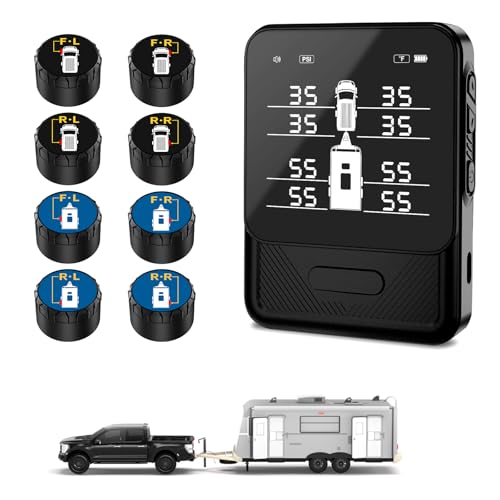
B-Qtech RV Tire Pressure Monitoring System TPMS with 8 Sensors (0-108 PSI) leads this shortlist for Dually-truck and tandem-axle fifth wheel combinations needing eight positions.. Use that fit as a reference point, then compare the alternatives against your own space and workload.
Specs that separate the picks
The first details to compare are 8 sensors, 0-108 psi, 6 flow-through sensors, up to 12 tires, 0-145 psi, 120 ft with booster. Confirm the exact model and included components before ordering.
Trade-off to plan for
No repeater mentioned for long trailers

Before you buy

What Matters Before You Choose a Budget TPM for Fifth Wheel RVs

Key buying criteria so you get the right fit the first time.

  1. 01

    Signal distance and repeaters

    The signal has to travel from the trailer's rear axle, past a long box and a truck cab, to a display on the dash. On a fifth wheel that can run past thirty feet, which is more than a basic 50 ft rating handles with margin. A repeater or booster sits partway down the trailer and rebroadcasts the sensors, and a kit that names one in the listing is a safer bet. Confirm a distance stated in feet and an actual repeater model, not a vague claim of strong signal.

  2. 02

    Pressure ceiling versus tire rating

    TPMS sensors measure up to a fixed maximum, and the maximum has to be above your tire's rated pressure with room to spare. Heavy fifth wheel tires are commonly rated far above passenger-car pressures, and a system reading only to 87 psi cannot monitor a tire rated to 110. It will clip the reading or miss the alarm. Read the sidewall maximum, then find the range in the listing and ignore kits that fall short.

  3. 03

    Sensors for the trailer, the truck and the spare

    Decide whether the system watches only the trailer or the truck too. A tandem trailer needs four sensors, a three-axle needs six, and a dually truck adds two more rear positions. Kits that pair up to ten or twelve tires let you start small and extend later. Count positions, add one for the spare, and compare against the maximum in the specification rather than the number of sensors in the box.

  4. 04

    External sensor trade-offs

    Screw-on external sensors are easy to move to another trailer, and their coin-cell batteries can be replaced for a few dollars about once a year. They sit on the valve stem rather than inside the wheel, so they read tire temperature cooler than an internal sensor would. An alarm threshold set for one type will be wrong for the other. Treat temperature as a trend, such as one tire running hotter than its neighbor.

  5. 05

    Flow-through sensors for inflating

    Standard sensors have to come off to add air, and on a tall fifth wheel that means fighting a cramped valve stem each time. Flow-through sensors let you attach a chuck to the sensor itself, and they save the wear of repeated threading. The listing should name the feature clearly, because ordinary sensors are often sold under similar wording. Anyone who tops off tires often will notice this feature every trip.

  6. 06

    Display power and readability

    A display that dies on a long haul is worse than none. Solar charging keeps it topped on a sunny dash, and a USB-C port covers the cloudy days or the winter. Screen brightness matters in direct sun, so look for backlight levels or auto brightness. A larger panel such as 3.6 inches cuts the time spent squinting at six or eight readings while driving.

Our standards

Why You Can Trust RV Gear Lab

At RV Gear Lab, we compare products based on rig fit and power or hookup compatibility, verified specifications, usability, setup requirements, weight, durability, and real-world trade-offs. We do not rank products purely on marketing claims or commission rates.

We have not personally tested every product listed. Where hands-on testing is not available, recommendations are based on verified manufacturer specifications, product documentation, use-case fit, and comparative research.

How we review RV gear →

Detailed reviews

The 6 best budget tpms for fifth wheel rvs, explained

01
B-Qtech RV Tire Pressure Monitoring System TPMS with 8 Sensors (0-108 PSI)
  • 8 sensors, 0-108 psi
  • 3.15 inch screen, USB-C rechargeable
  • 4-wheel and 8-wheel modes
Check price on Amazon for B-Qtech RV Tire Pressure Monitoring System TPMS with 8 Sensors (0-108 PSI) (opens in a new tab)
Best for: Dually-truck and tandem-axle fifth wheel combinations needing eight positions.

Our take

Here is the top of the shortlist on price, and the step up buys a full eight-tire set plus a four-wheel mode for driving the truck alone.

Why it made the shortlist

Eight sensors in the box matches the usual fifth wheel layout of a four-tire tandem trailer plus the four tires of the truck pulling it. The display can monitor up to ten positions, which includes a spare on each end of the rig.

A 3.15 inch color screen shows pressure and temperature in real time, and the magnetic mount keeps the dash tidy. Thresholds can be adjusted to your tires, which matters on a rig where the manufacturer's inflation chart is specific, and the display charges over USB-C from a rechargeable 1000mAh battery.

It stands as the straightforward pick for an owner who wants every tire on the rig on a single display.

What works

  • Eight sensors cover truck plus trailer
  • Thresholds adjust to your tire chart
  • Four-wheel mode for solo truck days
  • Room for two spare positions

Watch out for

  • No repeater mentioned for long trailers
  • Display needs periodic charging
02
Tymate TM12 RV Tire Pressure Monitoring System, 6 Flow-Thru Sensors TPMS
  • 6 flow-through sensors, up to 12 tires
  • 50 ft range, 100+ ft with repeater
  • Solar and USB-C power
Check price on Amazon for Tymate TM12 RV Tire Pressure Monitoring System, 6 Flow-Thru Sensors TPMS (opens in a new tab)
Best for: Long fifth wheels where a repeater extends signal toward the rear axle.

Our take

Solar and USB-C power keep the display alive on the road.

Why it made the shortlist

Signal reach is the reason the TM12 leads this angle. The listing states a stable 50 ft range that extends past 100 ft with the Tymate Repeater, which is the kind of reach a long fifth wheel needs to hold a link from the dash to the trailer's rear tires.

Flow-through sensors let you add air without unscrewing them, so topping off a tire takes a hose and a few seconds. The display supports up to twelve tires across four zones and shows six at once, with six alarm modes and a 433Hz color receiver.

It sits upper-mid on price in this guide, and the money buys flow-through sensors and the repeater route. A long trailer is the situation it was built around.

What works

  • Repeater extends range past 100 ft
  • Flow-through sensors for easy inflating
  • Shows up to twelve tires in zones
  • Six alarm modes, IP67 sensors

Watch out for

  • Repeater is a separate purchase
  • Six sensors leave out two trailer positions
03
Masoll RV Tire Pressure Monitoring System, TPMS Sensors Set of 4, 0-145psi, 120ft
  • 0-145 psi, 120 ft with booster
  • Factory-paired sensors, kits 2/4/6/8
  • Color LCD, four brightness levels
Check price on Amazon for Masoll RV Tire Pressure Monitoring System, TPMS Sensors Set of 4, 0-145psi, 120ft (opens in a new tab)
Best for: Fifth wheel owners with tires inflated above 110 psi.

Our take

Alarms cover high and low pressure, high temperature, fast leaks, lost sensors and low battery, shown on a color LCD with four brightness levels.

Why it made the shortlist

The Masoll reads up to 145 psi, which clears the ceiling that rules out cheaper kits for heavy fifth wheel tires. A trailer tire rated to 110 sits comfortably inside that range, and the kit is described as made for travel trailers, fifth wheels and campers.

A signal booster is included to push readings toward the display, and the listing claims a transmission distance up to 120 ft, which should cover the full length of most fifth wheels. Sensors arrive paired from the factory, so setup is to connect power and screw them on.

On price it is mid-pack on price, and the kit is also sold in 2, 6 and 8 sensor counts, so you can match your tires.

What works

  • Reads to 145 psi for heavy tires
  • Signal booster included in the kit
  • Factory-paired, easy first setup
  • Sold in 2, 4, 6 and 8 sensor kits

Watch out for

  • Set of four covers only two axles
  • Larger kits cost noticeably more
04
LETOURWM Tire Pressure Monitoring System for RV Truck Trailer, 6 Sensors TPMS, 217 PSI
  • 6 sensors, 3.6 inch LCD with clock
  • 100 ft range, 4-second refresh
  • Type-C and solar charging
Check price on Amazon for LETOURWM Tire Pressure Monitoring System for RV Truck Trailer, 6 Sensors TPMS, 217 PSI (opens in a new tab)
Best for: Heavy fifth wheels needing a wide range and a large readable screen.

Our take

The listing quotes a 100 ft range suited to long trailers, fifth wheels and motorhomes.

Why it made the shortlist

A 3.6 inch screen with a built-in clock makes this the easiest display to read at a glance in the shortlist, with three brightness levels for day and night. Six sensors cover a tandem trailer and a pair of dually positions, or a three-axle fifth wheel on its own.

The title cites a 0-217 psi range while the feature text describes up to 144 psi, so the wide ceiling is spelled out in a title that sits above anything the heavy tires here will demand. Readings refresh every four seconds, and voice plus visual warnings cover pressure, leaks, temperature, sensor faults and battery.

On price it sits at the lower-mid of this shortlist on price and gives a lot of screen and signal reach for the money.

What works

  • Large clear screen with clock
  • 100 ft range for long trailers
  • Voice and visual warnings
  • IP67 alloy sensors

Watch out for

  • Range figures differ within the listing
  • Six sensors cannot cover a truck and trailer
05
Best for: Smaller fifth wheels with four trailer tires and a modest budget.

Our take

In this guide it sits near the entry on price, and it leaves room to grow where the entry-level kits above it do not.

Why it made the shortlist

Four external sensors, up to ten tires on the display and a stated reading range of 0 to 144 psi make the TM2 a flexible small kit. Start with the four trailer tires today and add sensors for the truck or a spare when you want them.

Six alarm modes handle fast leaks and high or low pressure, and solar plus USB charging keep the display topped up. Sensors are described as low-power, running for up to six months between charges, and the color LCD adjusts its backlight automatically.

A four-tire tandem trailer with ordinary tire pressures is the use case where this kit fits best.

What works

  • Expandable to ten tires later
  • Auto-adjusting backlight
  • Solar charging keeps display ready
  • Low-power sensors last months

Watch out for

  • Another listing line says 87 psi range
  • Four sensors cover only the trailer
06
Best for: Budget buyers who need six tires watched, such as a three-axle fifth wheel.

Our take

Solar plus USB-C charging keeps the display powered on the road.

Why it made the shortlist

What you get is the entry pick, and it still brings six external sensors and a color display with all six positions shown at once. High and low pressure, high temperature, rapid leaks, low sensor battery and signal loss all trigger audible and visual alarms.

Pressure and temperature limits can be set from 0 to 144 psi, so you can match the numbers to the tire chart for your trailer load. Sensors send updates promptly when something is off and ease off when readings are normal, which helps battery life.

The listing mentions fit for dually trucks, so it can also watch a six-wheel tow vehicle. A sensible low-cost choice for a three-axle fifth wheel on its own, or for a truck that has dual rear wheels.

What works

  • Six positions on one screen
  • Adjustable pressure and temperature limits
  • Signal-loss alarm included

Watch out for

  • No repeater or booster mentioned
  • Range is not stated for long trailers

Methodology

How We Built This Shortlist

Each pick was assessed across 5 criteria weighted for real-world use.

01

Signal path to the rear axle

A fifth wheel's rear tires sit far from the dash, so we read each listing for stated range, any included booster and repeater support. A range quoted in feet and a named repeater scored above generic claims of strong signal. This is an assessment of listed specs, not a field measurement.

02

Pressure ceiling against tire ratings

Each kit's stated reading range was set beside the pressures heavy trailer tires run. A ceiling around 87 psi was treated as a disqualifier for a tire rated to 110, and ranges at 144 psi or above scored well. Conflicting range statements within one listing were noted.

03

Sensor count and layout

We matched sensor counts to typical fifth wheel layouts, such as a tandem trailer, a three-axle trailer or a truck plus trailer. Expandability counted for something, since many owners start with the trailer and add the truck later.

04

Serviceability of external sensors

External screw-on sensors move between rigs easily and use replaceable coin cells, but they read tire temperature cooler than internal sensors. Flow-through designs earned credit for letting you add air without removing them.

05

Price position inside the shortlist

Prices spread widely here, so each pick is placed as entry, mid or top of this shortlist, with the step up tied to what it adds, such as a repeater, flow-through sensors or more positions. We quote no figures since listing prices change.

Decision guide

Match a Budget TPM for Fifth Wheel RVs to Your RV

By Trailer Length and Signal Needs

The longer the trailer, the more the signal path matters, so start there.

Trailer lengthRecommended pickWhy
Long, 38 ft and upTymate TM12Repeater extends reach past 100 ft
Mid-length, repeater not neededMasoll 145psiBooster included, 120 ft stated range
Mid-length, want big screenLETOURWM 217psi100 ft range and a 3.6 inch display
Shorter fifth wheelTymate TM2Four-tire kit that can grow to ten
Truck plus trailer togetherB-Qtech 8-SensorEight sensors on one display

By Budget

Prices spread widely, so each band shows what the step up adds.

Price bandRecommended pickWhat the step buys
Entry of this shortlistFlydew 6-SensorSix sensors and adjustable limits
Just above entryTymate TM2Four sensors, expandable to ten tires
Lower mid of this shortlistLETOURWM 217psiBigger screen and a 100 ft stated range
Mid of this shortlistMasoll 145psi145 psi range and an included booster
Upper band of this shortlistTymate TM12Flow-through sensors and repeater support
Top of this shortlistB-Qtech 8-SensorFull eight-tire coverage with a four-wheel mode

Flow-Through Sensors vs Standard Screw-On

How you add air at the valve changes how often you will thank or curse the sensor.

Flow-through

Air goes in through the sensor, so the cap stays on and the threads stay clean. Tymate TM12 is the one pick that offers this, and it pairs it with a repeater for long trailers.

Standard screw-on

The sensor comes off for every fill, which is fine if you inflate rarely. Masoll 145psi, LETOURWM 217psi, Tymate TM2, Flydew 6-Sensor and B-Qtech 8-Sensor all work this way, and the lock nuts on some kits deter theft.

Pick flow-through if you top off tires often, and standard if you set pressure once a season.

By Tire Pressure

The pressure on your sidewall decides whether a kit is even eligible.

Tire pressureRecommended pickWhy
Rated above 110 psiMasoll 145psiReads to 145 psi with margin
Rated up to about 110 psiB-Qtech 8-SensorReads to 108 psi, suits most trailer tires
Wide-range reading wantedLETOURWM 217psiTitle cites a 217 psi ceiling
Custom alarm set pointsFlydew 6-SensorLimits set across 0-144 psi

For Tall, Heavy Fifth Wheels Specifically

A tall coach with heavy pin weight pushes both pressure and signal distance.

Look for

A reading range above the sidewall rating, a stated distance of 100 ft or more, a booster or repeater, and adjustable limits. A screen large enough to read all six or eight positions helps.

In this comparison

Masoll 145psi and LETOURWM 217psi combine range and reach, Tymate TM12 adds a repeater, and B-Qtech 8-Sensor adds a full eight-tire layout. Those four suit heavy fifth wheels best.

When to Spend More

The spread in this shortlist is wide, so the extra spend should buy something concrete.

Spend more if

Your trailer is long, your tires are high-pressure, or you want truck and trailer on one screen. Tymate TM12, Masoll 145psi and B-Qtech 8-Sensor each earn their position with reach, range or sensor count.

Save if

Your fifth wheel is shorter with standard tires and you only need the trailer watched. Flydew 6-Sensor and Tymate TM2 sit at the entry of this shortlist and cover the basics.

FAQ

Before You Bring One Home

Why does signal reach matter more on a fifth wheel?

The rear axle can sit thirty feet or more behind the dash, with a truck cab and a steel frame between. A basic 50 ft rating leaves little margin, and a dropped signal tends to hit the rear tires first. A repeater, such as the one that works with the Tymate TM12, relays the sensors forward.

Can a TPMS that reads to 87 psi monitor my trailer tires?

Not if the tires are rated to 110 or above, because the sensor cannot read that high and will clip the value or miss the alarm. Read the maximum cold inflation on the sidewall and pick a kit whose range clears it, such as the Masoll 145psi. Some listings give conflicting ranges, so compare the specification lines.

Do I need sensors on the truck too?

Not necessarily. Many fifth wheel owners monitor only the trailer, since the truck often has its own built-in system. If you want everything on one screen, an eight-sensor kit like the B-Qtech 8-Sensor covers four trailer tires and four truck tires, and a four-wheel mode lets you ignore the trailer when it is parked.

Are 4-sensor kits enough for a tandem fifth wheel?

Four sensors cover the four trailer tires, which is the tandem layout. A three-axle fifth wheel needs six. Kits that can pair more than they ship with, like the Tymate TM2, let you add sensors later, so you can start with the trailer and grow.

Should I pick flow-through sensors?

If you inflate often, yes, because you add air without removing the sensor. The Tymate TM12 is the flow-through option here. If you set pressure once a season and leave it, standard screw-on sensors do the job and save a little on cost.

How long do the sensor batteries last?

External sensors use replaceable coin cells that typically last a year or two, and the Tymate TM2 listing mentions up to six months between charges for its low-power sensors. Replace them in pairs or as a set so alarms do not start failing one at a time, and keep a few spare cells in the truck.

Bottom line

The short version

Browse more budget tpms for fifth wheel rvs on Amazon →
Bowen Higgins, RV Editor at RV Gear Lab

About the author

Bowen Higgins

RV Editor at RV Gear Lab

Bowen covers RV power, water systems, towing and leveling, upkeep and interior comfort, with a focus on matching gear to the rig, the hookups and the way you actually travel.

More from Bowen →Editorial standards

Keep reading

Related guides