

We research everything we recommend. When you buy through our links, we may earn a commission. Learn more

Buying guide · 11 min read · Updated October 2, 2026

6 Best Budget RV TPMS for Long Trailers in 2026: A Practical RV Guide

Six budget tire monitors chosen for long trailers and fifth wheels, ranked by stated signal range, booster support and pressure window.

Bowen HigginsBy Bowen HigginsRV Editor at RV Gear Lab6 products comparedSpec-sheet researched

At a glance

Our top picks

Length is the enemy of a wireless tire monitor. A 38 foot fifth wheel puts the last axle a long way from the dash, with a steel body and a slide room in between, and the weakest sensor on the rig is nearly always the one at the back. A kit that works on a 22 foot camper can drop its rear tires on a trailer this size.

That is the filter used here. We looked at each kit's stated reach, whether a booster ships inside the box or must be bought separately, and how many sensors it can manage as the rig grows. Pressure windows matter too, since long trailers often run heavier tires.

Prices climb with reach and capacity. The entry pick leans on a bundled repeater, the middle of the field adds booster kits with 120 foot claims, and the top kit gives a large display with a wide pressure window. Place the repeater with a clear path to the rear axle, whichever kit you take.

RV Gear Lab field notes

The Rig Fit Check

Start with the job
GUTA GT20 Trailer Tire Pressure Monitoring System, TPMS with 6 Sensors leads this shortlist for Fifth wheels and long trailers on heavy-duty tires.. Use that fit as a reference point, then compare the alternatives against your own space and workload.
Specs that separate the picks
The first details to compare are Six sensors, 0 to 188 PSI, Four pre-paired sensors, Set of 4, 2 to 8 available. Confirm the exact model and included components before ordering.
Trade-off to plan for
Most expensive pick in this guide

Before you buy

What Matters Before You Choose a Budget RV TPM for Long Trailers

Key buying criteria so you get the right fit the first time.

  1. 01

    Stated Transmission Distance

    Range figures range from 50 feet up to 120 feet in these listings. A trailer of 40 feet puts the rear axle at that distance plus the cab-to-hitch gap, so you want real margin. Compare the claimed number with your total rig length and add a buffer for steel walls.

  2. 02

    Bundled Booster or Repeater

    A booster in the box saves a second purchase and an install visit. When a repeater is separate, it can add meaningful cost on top of the kit price. Look at the listing's what-is-included list.

  3. 03

    Repeater Placement

    A repeater placed behind metal loses much of its benefit. The rear sensor should have a clear path to it, and the repeater should be powered reliably. If a rear tire stays weak, moving or adding a repeater usually fixes it.

  4. 04

    Sensor Count and Growth

    A long fifth wheel often has tandem axles plus a spare, so six sensors is a minimum. Scaling to ten or twelve avoids rebuying. Look for a stated maximum tire count.

  5. 05

    Pressure Window

    Heavy trailers run higher tire pressures than light campers. A window to 188 PSI gives margin, while 87 PSI may not cover heavy tires. Compare against your sidewall maximum.

  6. 06

    Display Visibility

    A readable screen reduces glances at the road. Rotating or adjustable brightness helps in glare. Check that the listing mentions brightness control.

Our standards

Why You Can Trust RV Gear Lab

At RV Gear Lab, we compare products based on rig fit and power or hookup compatibility, verified specifications, usability, setup requirements, weight, durability, and real-world trade-offs. We do not rank products purely on marketing claims or commission rates.

We have not personally tested every product listed. Where hands-on testing is not available, recommendations are based on verified manufacturer specifications, product documentation, use-case fit, and comparative research.

How we review RV gear →

Detailed reviews

The 6 best budget rv tpms for long trailers, explained

01
Best for: Fifth wheels and long trailers on heavy-duty tires.

Our take

Pressure units and temperature units switch, and a manual plus guide videos support pairing and replacement.

Why it made the shortlist

The GUTA GT20 pairs six sensors with a large color display and a 0 to 188 PSI window. Temperature reads from -40 to 221 degrees Fahrenheit, which covers desert and winter hauls.

As the most expensive pick here, its step up over the GUTA GT90 buys two more sensors and a display that can be rotated to suit the mounting position. Six real-time alert modes include rapid air loss.

A long fifth wheel owner who wants a polished screen has the best fit here.

What works

  • Six sensors with wide pressure window
  • Display orientation adjusts
  • Reads extreme temperatures
  • Guide videos for pairing

Watch out for

  • Most expensive pick in this guide
  • No booster named in the title
02
Best for: Single-axle long trailers that may add sensors later.

Our take

Setup is simple: power on the display and fit each sensor.

Why it made the shortlist

GUTA GT90 starts with four pre-paired sensors and a color LCD with three brightness levels. The 188 PSI range covers the heaviest trailer tires.

Sitting mid-pack on price, it undercuts the GUTA GT20 and still tracks up to ten tires, so adding two sensors later is possible. Alerts cover pressure, temperature, fast leakage, sensor loss and sensor battery.

A buyer who wants quality hardware now and growth later will like it.

What works

  • Pre-paired sensors, fast setup
  • 188 PSI window
  • Three brightness levels
  • Room for up to ten tires

Watch out for

  • Four sensors in the box
  • No booster in the kit
03
Best for: Long single trailers wanting a booster with the first purchase.

Our take

Alarms cover high and low pressure, temperature, fast leak, lost sensor and low sensor voltage.

Why it made the shortlist

Masoll includes a high-powered booster that pushes the stated transmission distance to 120 feet. That extends reach comfortably past a 40 foot rig.

A notch below the GUTA GT90 on price, it offers sensor sets of 2, 4, 6 or 8 and a 0 to 145 PSI window. Sensors are paired at the factory and the display has four brightness levels.

A long trailer owner gets range handled in the box.

What works

  • Booster included, 120 foot reach
  • Choose two to eight sensors
  • Factory paired sensors
  • Four brightness levels

Watch out for

  • Four sensors suit one trailer
  • Pressure ceiling is moderate
04
Best for: Owners who want to extend range with a separate repeater later.

Our take

USB-C or solar charging supplies the display.

Why it made the shortlist

Tymate TM12 shows six tires at once and handles up to twelve across four zones. Sensors come pre-programmed to their positions and carry IP67 sealing.

It costs a clear step below the Masoll 4-Sensor Booster and states a 50 foot range that the Tymate Repeater extends past 100 feet. That makes it a staged purchase for a long trailer.

A buyer who prefers to test the signal first, then add reach, will appreciate that.

What works

  • Repeater extends range past 100 feet
  • Sensors pre-set to positions
  • Twelve-tire capacity
  • IP67 sealed sensors

Watch out for

  • Repeater sold separately
  • Stated range is 50 feet alone
05
Best for: Owners who only need to watch the rear axle or a single pair.

Our take

The kit is designed so owners pick 2, 4, 6 or 8 sensors to match their tires.

Why it made the shortlist

This Masoll kit ships two sensors with the same booster and 120 foot reach as the four-sensor set. A rear tandem pair can be watched while the front stays unmonitored.

It costs less than the Tymate TM12 4-Sensor, which makes it the cheapest booster-equipped setup in this guide apart from the entry pick. The color display has four brightness levels.

What works

  • Booster included at a low outlay
  • Pay only for sensors you need
  • Factory paired
  • Four brightness levels

Watch out for

  • Two sensors leave wheels blind
  • Needs more sensors for full coverage
06
Best for: Budget buyers who still want six sensors and a repeater.

Our take

Setup needs no wiring or drilling.

Why it made the shortlist

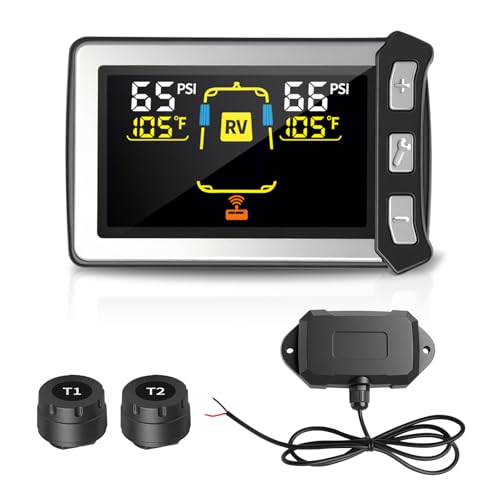
RVMATE is the entry pick and ships six pre-paired sensors with a repeater for long-range transmission. Six tires show simultaneously on the display.

Costing a fraction of the GUTA GT20, it keeps six alarm modes, 433.92 MHz transmission and solar plus USB charging. The detection range is 0 to 87 PSI.

A budget-minded owner with a mid-length trailer gets a repeater and six wheels for the least.

What works

  • Cheapest kit, repeater included
  • Six tires on one screen
  • No wiring or drilling
  • Solar plus USB charging

Watch out for

  • 87 PSI ceiling is low
  • Little brand history

Methodology

How We Built This Shortlist

Each pick was assessed across 5 criteria weighted for real-world use.

01

Reach claims

We evaluated each kit's stated transmission distance with and without a booster or repeater, treating them as manufacturer claims. Product specs shaped the comparison. Where a repeater ships in the box, we counted that in the kit's favour.

02

Booster availability

A booster that must be bought later raises the real price of a long-trailer setup. We separated bundled boosters, optional repeaters and kits with neither.

03

Sensor scaling

A long trailer may later grow from four to six or more sensors. We compared maximum tire counts and sensor-set options. Based on specs, kits with flexible sets scored higher.

04

Pressure window

Long trailers often ride on heavier tires. We compared windows from 87 PSI to 188 PSI against that need.

05

Display readability

A cab with glare needs a bright screen. We compared brightness levels, rotation and screen design.

Decision guide

Match a Budget RV TPM for Long Trailers to Your RV

By Trailer Length

Match the reach to the length of your rig.

LengthWhat you needPick
30 to 35 feetEntry repeater kitRVMATE 6-Sensor Repeater
35 to 38 feetOptional repeater laterTymate TM12 4-Sensor
38 to 42 feet120 foot booster kitMasoll 4-Sensor Booster
Rear axle only neededTwo sensors with boosterMasoll 2-Sensor Booster
Heavy fifth wheel188 PSI and six sensorsGUTA GT20

By Budget

Price bands track reach and capacity.

BandWhat it addsPick
Entry of this shortlistSix sensors with repeaterRVMATE 6-Sensor Repeater
LowBooster with two sensorsMasoll 2-Sensor Booster
Low-midExpandable displayTymate TM12 4-Sensor
Mid120 foot booster with four sensorsMasoll 4-Sensor Booster
TopSix sensors, 188 PSIGUTA GT20

Bundled Booster vs Add-On Repeater

Where the signal help comes from changes the total cost and the install plan.

Bundled booster

Everything arrives together. The Masoll 4-Sensor Booster, Masoll 2-Sensor Booster and RVMATE 6-Sensor Repeater take this approach.

Add-on repeater

Start with the monitor and extend later. The Tymate TM12 4-Sensor lists a repeater that stretches range past 100 feet.

Buy the bundle if your trailer is already long, the add-on route if you are unsure.

By Tire Pressure

A second axis independent of length.

TireWindow neededPick
Light ST tiresUp to 87 PSIRVMATE 6-Sensor Repeater
Standard trailer tiresUp to 145 PSIMasoll 4-Sensor Booster
Heavy-duty tiresUp to 188 PSIGUTA GT90
Fifth wheel with spareUp to 188 PSI, six sensorsGUTA GT20

For Fifth Wheels Specifically

Fifth wheels combine length, weight and many tires.

Look for

Six or more sensors, a 188 PSI window and range that clears the steel body.

In this comparison

The GUTA GT20 covers pressure and sensors, and the Masoll 4-Sensor Booster adds range.

When to Spend More

Spend more when the rig is heavy or the signal is fragile.

Spend more if

Your fifth wheel is heavy and long. The GUTA GT20 and GUTA GT90 bring 188 PSI windows.

Save if

Your trailer is mid-length on light tires. The RVMATE 6-Sensor Repeater or Masoll 2-Sensor Booster is enough.

FAQ

Before You Bring One Home

How long a trailer needs a booster?

Retail guidance suggests trailers around 35 feet and longer benefit from a repeater. A shorter rig often works with the stated sensor range alone.

Where should I put the repeater on a long trailer?

Near the rear axle with a clear path to the sensors and a reliable power source. If a sensor still reads weak, move the repeater or add a second.

Can I add a repeater after buying?

Some kits such as the Tymate TM12 4-Sensor list a repeater that extends reach beyond 100 feet. Others ship it in the box.

Do I need six sensors on a long trailer?

A tandem trailer has four wheels, so four sensors cover it, plus two for a spare or tow vehicle. The Masoll 2-Sensor Booster suits rear-axle-only watchers.

Why do rear tires drop out first?

They are furthest from the display and surrounded by metal. A booster pulls the weak signal forward.

Is 87 PSI enough for a long trailer?

Only for lighter tires. Heavier trailers often need a wider window, such as the 188 PSI of the GUTA GT20.

Bottom line

The short version

Browse more budget rv tpms for long trailers on Amazon →
Bowen Higgins, RV Editor at RV Gear Lab

About the author

Bowen Higgins

RV Editor at RV Gear Lab

Bowen covers RV power, water systems, towing and leveling, upkeep and interior comfort, with a focus on matching gear to the rig, the hookups and the way you actually travel.

More from Bowen →Editorial standards

Keep reading

Related guides