

We research everything we recommend. When you buy through our links, we may earn a commission. Learn more

Buying guide · 11 min read · Updated October 2, 2026

6 Best Budget RV TPMS With a Repeater in 2026: A Practical RV Guide

Six RV tire pressure systems that ship with a signal repeater for long trailers and fifth wheels, with notes on placement and range.

Bowen HigginsBy Bowen HigginsRV Editor at RV Gear Lab6 products comparedSpec-sheet researched

At a glance

Our top picks

At a glance · 6 picks

The usual failure on a long rig is not a bad sensor, it is a quiet one. Steel trailer walls and a body 35 feet or more behind the cab block the weak radio signal from rear wheels, and the display reports a lost sensor right when you are on the highway. A repeater fixes that by catching the signal near the rear axle and relaying it forward.

Every system in this guide comes with a repeater or booster in the box, so you are not paying twice. We compared them by how the repeater is designed, how many sensors sit behind it and what else the bundle adds, such as flow-through valves or a large screen.

Placement matters as much as the hardware. A repeater needs a clear path to the rear sensors and power from the trailer, and a weak reading may mean moving it or adding a second. The best picks here give you room to experiment with positioning.

RV Gear Lab field notes

The Rig Fit Check

Start with the job
NLNE Trailer Tire Pressure Monitoring System, 4.5" RV TPMS with 18 Sensors leads this shortlist for Multi-trailer or semi-style rigs with a huge number of wheels.. Use that fit as a reference point, then compare the alternatives against your own space and workload.
Specs that separate the picks
The first details to compare are Eighteen flow-through sensors, Eight flow-through sensors, Eight cap sensors, 0 to 188 PSI. Confirm the exact model and included components before ordering.
Trade-off to plan for
Most expensive pick in this guide

Before you buy

What Matters Before You Choose a Budget RV TPM With a Repeater

Key buying criteria so you get the right fit the first time.

  1. 01

    Repeater Placement Flexibility

    A repeater works by catching weak sensor signals near the rear axle and relaying them forward. If it sits behind metal or far from the sensors, the gain shrinks. An external antenna, like the one on the Tenpmas Repeater, lets you place the box where it has a clear path. Look for a listing that describes how and where the repeater mounts.

  2. 02

    Stated Range

    Range claims differ by seller and are measured in ideal conditions. A figure near 66 feet suits a mid-size trailer, while the longest fifth wheels want more headroom. Treat the number as an upper bound and add margin for steel walls.

  3. 03

    Sensors Served

    A repeater should cover every wheel that is far from the display. Count the sensors in the kit and the maximum tire capacity, since a 4-sensor kit leaves a spare or tow vehicle uncovered. Kits such as the NLNE 18-Sensor carry many positions behind one repeater.

  4. 04

    Flow-Through or Cap Design

    Flow-through sensors save a step at every top-up but need metal stems and clearance. Cap sensors are simpler and fit any stem. Match the design to your valve type and how often you add air.

  5. 05

    Power for the Repeater

    Some repeaters run on internal batteries, others take trailer power. A dead repeater looks exactly like a failed sensor. Check the listing for the power source and how it is wired.

  6. 06

    Alert Coverage

    A lost-signal alert is the key warning when a repeater drops out, alongside fast-leak and high-temperature alarms. Confirm all six are named in the listing. Without a lost-signal alert you may not notice a silent sensor.

Our standards

Why You Can Trust RV Gear Lab

At RV Gear Lab, we compare products based on rig fit and power or hookup compatibility, verified specifications, usability, setup requirements, weight, durability, and real-world trade-offs. We do not rank products purely on marketing claims or commission rates.

We have not personally tested every product listed. Where hands-on testing is not available, recommendations are based on verified manufacturer specifications, product documentation, use-case fit, and comparative research.

How we review RV gear →

Detailed reviews

The 6 best budget rv tpms with a repeater, explained

01
Best for: Multi-trailer or semi-style rigs with a huge number of wheels.

Our take

An auto sleep mode saves power after five minutes of inactivity, and the system works across a wide temperature span.

Why it made the shortlist

The NLNE kit is the largest in this guide and the most expensive pick here. Eighteen flow-through sensors, a 4.5 inch color display and a signal booster repeater cover up to 22 tires.

The pressure range reaches 188 PSI with 1 PSI resolution, so heavy-duty tires are handled. Sensors carry anti-theft locking nuts to protect them in campgrounds.

Pick this when the rig is more than a single trailer.

What works

  • Handles up to 22 tires
  • Flow-through inflation without removal
  • Anti-theft locking nuts
  • Three minute tool-free setup

Watch out for

  • Most expensive pick in this guide
  • Far more sensors than most need
02
Best for: Fifth wheel owners with metal stems who top up tires regularly.

Our take

Visual and audible alerts cover pressure, temperature, fast leaks, sensor battery and lost signal.

Why it made the shortlist

This GUTA GT30 kit gives eight flow-through sensors for metal valve stems and a repeater that receives and retransmits sensor data to the display. Sensors and monitor arrive pre-paired.

It is noticeably cheaper than the NLNE 18-Sensor while keeping a large full-color screen with adaptive backlighting for up to ten tires on a page. The display can track up to 46 tires across several trailers.

Fifth wheels this long get stable data to the dash with no extra purchase.

What works

  • Repeater included in the kit
  • Pre-paired sensors and monitor
  • Adaptive backlight screen
  • Six alert types

Watch out for

  • Metal stems required
03
GUTA GT30 Trailer Tire Pressure Monitoring System, RV TPMS with 8 Sensors
  • Eight cap sensors, 0 to 188 PSI
  • Signal booster included
  • Wireless sensor programming
Check price on Amazon for GUTA GT30 Trailer Tire Pressure Monitoring System, RV TPMS with 8 Sensors (opens in a new tab)
Best for: Owners with rubber stems or deep wheels who want standard caps.

Our take

A rechargeable lithium battery lasts about two weeks on a four-hour charge, and the monitor sleeps when the vehicle is still.

Why it made the shortlist

The same GT30 monitor appears here with eight standard cap sensors and a signal booster. Wireless programming removes the in-tire pairing step, so setup stays quick.

A small step down from the flow-through GUTA kit, it drops the pass-through valve feature and keeps the 0 to 188 PSI range. The display flips between front trailer and rear trailer views automatically.

What works

  • Booster in the box
  • Works with any valve stem
  • Auto switches trailer views
  • Long battery between charges

Watch out for

  • Sensors come off to add air
  • Display needs periodic charging
04
Best for: Tandem-axle trailers wanting flow-through sensors and a repeater.

Our take

Pressure range runs to about 199 PSI.

Why it made the shortlist

B-Qtech pairs six flow-through transmitters with a signal repeater and a 3.2 inch HD screen. The repeater is built to stabilise the signal once the distance between sensor and display grows.

Sitting mid-pack, it undercuts the GUTA 8 Flow-Thru and keeps solar and USB charging plus seven alert modes. A 4 or 6 tire switch lets the unit suit different vehicles.

Tandem trailers get a complete kit with repeater, flow-through valves and a flexible display.

What works

  • Repeater and flow-through together
  • Seven alert modes
  • Four or six tire switch
  • Solar and USB charging

Watch out for

  • Small 3.2 inch display
  • Needs metal valve stems
05
Best for: Travel trailer owners wanting solar charging plus a booster.

Our take

After ten minutes without motion or charging the display enters power-saving mode.

Why it made the shortlist

In the Tymate TM2 Booster Kit you get six sensors, a signal booster and a monitor with solar lithium charging. Up to ten tires can be tracked, so a tandem trailer plus spare fits.

Priced well below the B-Qtech Flow-Thru, it brings an auto-dimming color screen, five alarm modes and low-power sensors with extended battery life. Alarm thresholds are easy to edit.

It is an easy recommendation for a mid-length trailer that needs reliable reach.

What works

  • Booster and six sensors in one box
  • Solar charging built in
  • Auto-dimming color display
  • Low-power sensors last longer

Watch out for

  • Sensors need removing to inflate
  • 144 PSI ceiling
06
Best for: Budget buyers who want a repeater with an external antenna.

Our take

Five alarm modes support high and low pressure, fast leak, high temperature and sensor loss.

Why it made the shortlist

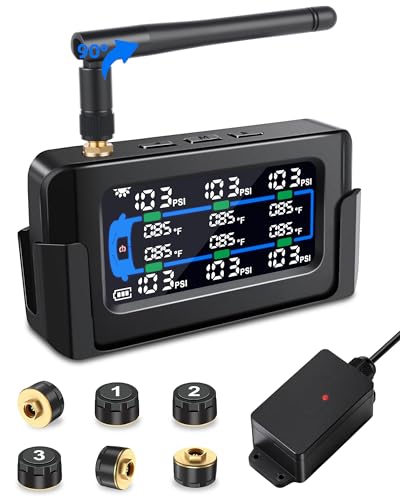
The Tenpmas kit is the cheapest on this list and still brings a repeater with an external enhanced antenna, rated to a 66 foot range. Six all-metal sensors use an integrated pure copper build.

At a fraction of the Tymate TM2 Booster's cost, the unusual selling point is 24-hour real-time updates, so you see current pressure instead of the value from before sleep. Each sensor weighs 15.5 grams.

A mid-sized trailer owner gets reach on a shoestring.

What works

  • Cheapest repeater kit here
  • External antenna on repeater
  • All-metal copper sensors
  • Live updates around the clock

Watch out for

  • Shorter stated range than others
  • Little brand history

Methodology

How We Built This Shortlist

Each pick was assessed across 5 criteria weighted for real-world use.

01

Repeater design

We evaluated how each repeater works, whether it is a separate relay, a built-in booster or one with an external antenna. Product specs and listing descriptions guided the comparison. Kits with an antenna got extra credit for placement flexibility.

02

Stated range

We compared the stated reach with and without the repeater, treating those figures as claims rather than guarantees. A longer range matters more as the trailer grows. Where a seller gave no range, we noted it as unknown.

03

Sensor count behind the repeater

A repeater is only useful for the sensors it serves. We counted sensor totals and maximum tire capacity so a long rig is covered. Kits that scale to many wheels were ranked higher for large rigs.

04

Valve compatibility

Flow-through sensors need metal stems, while standard cap sensors suit any stem. We weighed this against how often owners top up tires. Anti-theft features were noted for campground use.

05

Power and display

Because the repeater needs power too, we looked at how each kit is powered and how the display behaves when idle. Solar, USB and rechargeable options were compared. Based on specs, kits with solar and USB gave the least maintenance.

Decision guide

Match a Budget RV TPM With a Repeater to Your RV

By Trailer Length

The longer the rig, the more the repeater matters.

Rig lengthWhat helpsPick
Under 30 feetBasic booster, any stemTymate TM2 Booster
30 to 35 feetRepeater with flexible mountingTenpmas Repeater
35 to 40 feet, metal stemsFlow-through with repeaterB-Qtech Flow-Thru
Long fifth wheelBig sensor count and repeaterGUTA 8 Flow-Thru
Multi-trailer rigsCapacity for 22 tiresNLNE 18-Sensor

By Budget

Bands show what each step adds to the repeater bundle.

BandWhat the step addsPick
Entry of this shortlistRepeater with external antennaTenpmas Repeater
Lower midSolar monitor and boosterTymate TM2 Booster
MidFlow-through sensorsB-Qtech Flow-Thru
UpperEight sensors, 188 PSIGUTA GT30 8-Sensor
TopEighteen sensors, 22 tire capacityNLNE 18-Sensor

Flow-Through vs Standard Cap Sensors

Both styles work with a repeater, and each suits a different habit.

Flow-through

Inflate with the sensor in place, saving time on every top-up. The GUTA 8 Flow-Thru, B-Qtech Flow-Thru and NLNE 18-Sensor use this approach and need metal stems.

Standard cap

Simple, works with any stem and keeps profile low. The GUTA GT30 8-Sensor, Tymate TM2 Booster and Tenpmas Repeater follow this path.

Go flow-through if you air up often with metal stems, standard caps otherwise.

By Wheel Count

A repeater only helps wheels it can see, so count the positions.

Wheels to coverWhat fitsPick
Four to sixSingle trailer plus spareTymate TM2 Booster
Six with flow-throughTandem axle trailerB-Qtech Flow-Thru
Eight or moreTruck plus fifth wheelGUTA GT30 8-Sensor
Over a dozenMulti-trailer setupsNLNE 18-Sensor

For Fifth Wheels Specifically

A fifth wheel has a long steel body and high-pressure tires.

Look for

A repeater with strong gain, a 188 PSI range and enough sensors for two axles plus a spare.

In this comparison

The GUTA 8 Flow-Thru and GUTA GT30 8-Sensor both bring 188 PSI ranges and an included booster.

When to Spend More

Moving up buys sensor capacity and range headroom.

Spend more if

You tow a long fifth wheel or multiple trailers. The GUTA 8 Flow-Thru and NLNE 18-Sensor give the headroom to keep every wheel reporting.

Save if

Your trailer is mid-length. The Tenpmas Repeater or Tymate TM2 Booster delivers a repeater for far less.

FAQ

Before You Bring One Home

Where should I mount the repeater?

Place it near the trailer's rear axle with a clear path to the rear sensors and away from large metal panels. If a rear sensor still shows a weak signal, move the repeater or add another. Kits with an external antenna, such as the Tenpmas Repeater, make this easier.

Does a repeater really fix dropouts on a 40 foot trailer?

Owners of long fifth wheels commonly report that a booster ended intermittent signal loss, and placement and wiring matter as much as the hardware. Check the connection before blaming the unit.

Do I need a repeater on a short trailer?

Usually not. A short trailer sits within the stated range of most displays, so a basic kit is enough. A repeater earns its keep once the rig passes roughly 35 feet.

Are flow-through sensors safe on any valve stem?

They belong on metal stems only. The added length can also clash with dinghy or deep-dish wheels. Standard cap kits like the Tymate TM2 Booster avoid this issue.

Will the repeater need its own power?

Designs vary, so read the listing for the power source. A repeater that is not powered looks like a lost signal on the display. If the system suddenly drops, check the repeater first.

Can I add a second repeater later?

Technical advice for long rigs suggests an extra repeater may help when a rear sensor stays weak. Buying a kit with a repeater leaves you free to try this if the first position does not work.

Bottom line

The short version

Browse more budget rv tpms with a repeater on Amazon →
Bowen Higgins, RV Editor at RV Gear Lab

About the author

Bowen Higgins

RV Editor at RV Gear Lab

Bowen covers RV power, water systems, towing and leveling, upkeep and interior comfort, with a focus on matching gear to the rig, the hookups and the way you actually travel.

More from Bowen →Editorial standards

Keep reading

Related guides