

We research everything we recommend. When you buy through our links, we may earn a commission. Learn more

Buying guide · 11 min read · Updated October 2, 2026

6 Best Budget RV TPMS Systems in 2026: A Practical RV Guide

Six complete RV tire pressure monitoring systems with display, sensors and boosters, ranked by what each bundle includes for the money.

Bowen HigginsBy Bowen HigginsRV Editor at RV Gear Lab6 products comparedSpec-sheet researched

At a glance

Our top picks

At a glance · 6 picks

Shopping for a whole system is different from shopping for sensors. You are buying a bundle: a display, a set of sensors, a power arrangement and often a signal booster, and the budget end of the market packs these in very different ratios. One kit gives you a big seven inch screen and a dozen sensors, while another spends its money on a booster that reaches the back of a long trailer.

The six systems below were compared as bundles. We looked at what sits in the box, how the display is powered, how many wheel positions it can track and whether a booster is included or has to be bought later. All of them use external sensors that screw onto the valve stem, so setup is a driveway job.

Price steps in this guide mostly reflect bundle size. The entry system gives you a bright screen and six sensors with the bare minimum of extras, while the top pick adds a large display, extra sensor capacity and a signal booster. Decide how many wheels you need and how long your rig is, then pick the bundle that covers both.

RV Gear Lab field notes

The Rig Fit Check

Start with the job
RV Trailer Tire Pressure Monitoring System, Solar TPMS with 12 Sensors (Liwogi) leads this shortlist for Large rigs with many wheels that want everything in one kit.. Use that fit as a reference point, then compare the alternatives against your own space and workload.
Specs that separate the picks
The first details to compare are Twelve copper sensors, Eight sensors, 0 to 108 PSI, Six flow-through sensors. Confirm the exact model and included components before ordering.
Trade-off to plan for
Most expensive pick in this guide

Before you buy

What Matters Before You Choose a Budget RV TPMS System

Key buying criteria so you get the right fit the first time.

  1. 01

    Bundle Contents

    A system listing may or may not include a signal booster, spare sensor slots or a mounting accessory. Missing pieces mean second purchases, so a seemingly cheap kit can end up costing more than a fuller bundle. Read the in-the-box list in the listing and compare what each tier adds.

  2. 02

    Display Size and Mounting

    A seven inch screen can show twelve tires, but it needs dash space and a clear view. A compact magnetic-mount display stays out of the way and is easier to move between vehicles. Think about where the screen will sit before choosing, since a screen you cannot see is a screen you will not use.

  3. 03

    Wheel Mode Flexibility

    Some systems lock you into a fixed number of tire positions, while others switch between 4, 6, 8, 10 or 12 modes. Switching matters if you drive the tow vehicle alone some days and tow other days. Choose a unit with modes that match every configuration you plan to run.

  4. 04

    Sensor Build

    Copper-core and sealed sensors resist moisture better than bare plastic ones, and flow-through sensors save a step at every top-up. Metal valve stems are the right partner for flow-through designs. Look for IP67 or similar sealing language in the listing.

  5. 05

    Power Options

    Solar helps on long drives, USB-C gives a reliable backup and a rechargeable battery works for removable displays. A system with two power paths survives a cloudy week. Confirm the listing names the display battery capacity or runtime.

  6. 06

    Range and Booster

    A booster pulls the stated range out toward 100 feet or more, which suits long fifth wheels and motorhomes with a toad. Without one, rear sensors can drop out. Compare the stated range to your rig length and see if a booster is bundled.

Our standards

Why You Can Trust RV Gear Lab

At RV Gear Lab, we compare products based on rig fit and power or hookup compatibility, verified specifications, usability, setup requirements, weight, durability, and real-world trade-offs. We do not rank products purely on marketing claims or commission rates.

We have not personally tested every product listed. Where hands-on testing is not available, recommendations are based on verified manufacturer specifications, product documentation, use-case fit, and comparative research.

How we review RV gear →

Detailed reviews

The 6 best budget rv tpms systems, explained

01
Best for: Large rigs with many wheels that want everything in one kit.

Our take

A fifth wheel owner or a motorhome driver towing a car gets a screen big enough to read at a glance.

Why it made the shortlist

The Liwogi system is the largest bundle in this guide and the most expensive pick here. Twelve pure copper sensors, a seven inch color display and a dedicated signal booster arrive together, covering a tow vehicle, a tandem trailer and a spare in one purchase.

Readings go to 0.1 PSI, and the monitor can be set to 4, 6, 8, 10 or 12 wheel modes so it matches the rig you actually have. The copper sensor core resists corrosion, which suits sensors that live on a wet valve stem.

Buying the full bundle once saves piecing together extras later.

What works

  • Twelve sensors cover big rigs
  • Seven inch screen reads easily
  • Switchable 4 to 12 wheel modes
  • Booster included in the box

Watch out for

  • Most expensive pick in this guide
  • Overkill for a single-axle camper
02
Best for: Truck-and-trailer combinations that need eight wheels on one screen.

Our take

Solo trips can use the four-wheel mode to cut false alerts, and towing days switch to eight-wheel mode.

Why it made the shortlist

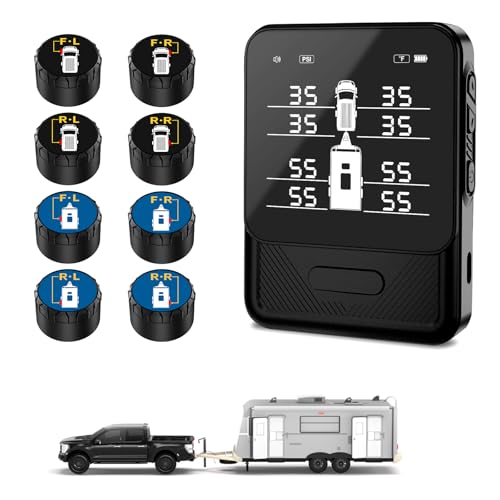
The B-Qtech bundle splits its eight sensors across a tow vehicle and a trailer, with room for two spare tires on top, ten sensors in all. A compact 3.15 inch display mounts magnetically so the dash stays clean.

Priced a bit below the Liwogi 12-Sensor, it trades the large screen for a pocket-sized one that stays out of the sightline. A 1000mAh rechargeable battery charges over USB-C.

That flexibility makes it a smart bundle for owners who swap between rigs.

What works

  • Magnetic mount, no sticky pad
  • Four or eight wheel modes
  • Adjustable alert thresholds
  • Quick USB-C charging

Watch out for

  • Small 3.15 inch screen
  • No solar panel on display
03
Best for: Owners who top up tires often and hate removing sensors.

Our take

USB-C or solar charging keeps the display running, and sensors come pre-programmed to their positions.

Why it made the shortlist

Six flow-through sensors let you add air without unscrewing anything, which saves minutes at every fuel stop. The display handles up to twelve tires across four zones, so the system grows with the rig.

Mid-pack on price, it undercuts the Liwogi 12-Sensor while keeping IP67 waterproof sensors and a 433Hz color receiver. The stated range is 50 feet, and a Tymate repeater extends that beyond 100 feet.

Anyone airing tires before every trip will feel the benefit within the first week.

What works

  • Add air without removing sensors
  • Pre-programmed tire positions
  • IP67 waterproof sensors
  • Repeater available to extend range

Watch out for

  • Needs metal valve stems
  • Repeater sold separately
04
Masoll RV Tire Pressure Monitoring System, TPMS Sensors Set of 4
  • Set of 4, 2 to 8 available
  • Booster for 120 foot range
  • Four brightness levels
Check price on Amazon for Masoll RV Tire Pressure Monitoring System, TPMS Sensors Set of 4 (opens in a new tab)
Best for: Fifth wheels and long trailers needing a signal boost from day one.

Our take

A four-level brightness control adjusts for day or night.

Why it made the shortlist

A booster ships in the box, pushing the stated transmission distance out to 120 feet. That reach matters for a long fifth wheel where the rear tires sit far from the dash.

The Masoll kit is a step below the Tymate TM12 on price, and buyers choose a set of 2, 4, 6 or 8 sensors to match their tire count.

It is a solid pick for a single-trailer buyer who wants range handled out of the gate.

What works

  • Booster included for long rigs
  • Choose two to eight sensors
  • Factory paired, easy setup
  • Full set of alerts

Watch out for

  • Four sensors suit one trailer only
  • Pressure ceiling is moderate
05
Best for: Anyone who wants a working system in minutes with no tools.

Our take

A small trailer or camper van owner gets an uncomplicated system here.

Why it made the shortlist

This XBNVGP kit installs in about two minutes with a five-step routine and no tire removal. Along with six alarm modes, four external sensors and solar plus USB-C charging come packed in.

The listing states support for vehicles up to 50 feet long, which positions it as a flexible bundle at a price well under the Masoll Booster Kit. Alert thresholds can be customized to match the tire.

The color display handles daily use, and smart power management keeps the monitor ready.

What works

  • Two minute tool-free setup
  • Customizable alert thresholds
  • Solar plus USB-C power
  • Suits trucks, SUVs and RVs

Watch out for

  • 88 PSI ceiling is low
  • Four sensors only
06
Best for: Budget buyers who want six sensors and voice alerts for the least outlay.

Our take

The sensor set is built for dust, water, wind and snow.

Why it made the shortlist

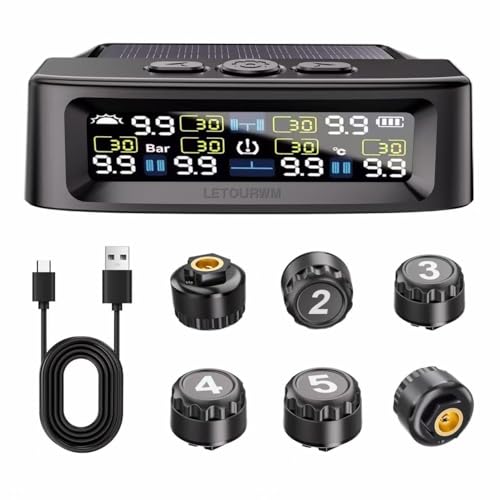
The LETOURWM system is the cheapest bundle in this guide and still brings six sensors, a large HD color screen and voice alerts. Auto brightness adjusts the display to the light around it.

Roughly a quarter of the cost of the Liwogi 12-Sensor, it keeps the essentials: 0 to 144 PSI range, six alarm modes and dual solar plus USB charging. The sensors screw onto valves in about two minutes.

Tandem trailer owners get full coverage for the lowest outlay in the lineup.

What works

  • Cheapest system here
  • Six sensors, tandem coverage
  • Voice alerts warn you early
  • Weather-resistant sensors

Watch out for

  • Brand has little track record
  • No booster included

Methodology

How We Built This Shortlist

Each pick was assessed across 5 criteria weighted for real-world use.

01

What is in the box

We evaluated each system as a bundle, listing display size, sensor count, power options and any booster. Product specs drove the comparison, since a larger bundle can be better value than a cheaper partial kit. Missing pieces were counted as extra purchases.

02

Display quality

Screen size and readability matter for a gauge you glance at while driving. We compared sizes from 3.15 to 7 inches and noted brightness controls and auto-dimming. Based on listing details, larger screens help big rigs, compact ones suit dash-limited vehicles.

03

Sensor design

We separated standard cap sensors from flow-through types and noted materials like copper cores and IP67 sealing. Flow-through designs save time at the air hose but need metal stems. Corrosion resistance was weighed as a long-term cost factor.

04

Signal strategy

Systems either include a booster, offer one as an add-on or rely on the stated sensor range. We compared those approaches against rig lengths and noted which kits include one in the bundle. Our analysis uses stated ranges and common buyer concerns.

05

Growth room

A system that tracks only four wheels forces a second purchase when the rig changes. We counted maximum tire capacity and wheel modes to see which kits scale. Systems with flexible modes scored higher.

Decision guide

Match a Budget RV TPMS System to Your RV

By Rig Size

Match the system's wheel capacity to the rig you drive most often.

RigWhat it needsPick
Fifth wheel plus dually truckTen to twelve sensors, big screenLiwogi 12-Sensor
Truck and trailer, occasional solo tripsSwitchable wheel modesB-Qtech 8-Sensor
Tandem travel trailerSix sensors, easy airing upTymate TM12 Flow-Thru
Long single trailerBooster for rear axle signalMasoll Booster Kit
Small camper or cargo trailerFour sensors, fast setupXBNVGP 4-Sensor

By Budget

Each step up in price adds bundle contents, not only quality.

BandWhat the bundle includesPick
Entry of this shortlistSix sensors, voice alertsLETOURWM 6-Sensor
LowFour sensors, two minute setupXBNVGP 4-Sensor
MidBooster in box, choice of sensor countMasoll Booster Kit
Upper midFlow-through sensors, 12-tire screenTymate TM12 Flow-Thru
TopTwelve sensors, seven inch screen, boosterLiwogi 12-Sensor

Flow-Through vs Standard Sensors

The sensor style decides how annoying routine inflation will be.

Flow-through

Air goes in through the sensor, so nothing comes off. The Tymate TM12 Flow-Thru uses this design, and it depends on metal valve stems and enough clearance at the wheel.

Standard cap

Sensors unscrew for every top-up, but they sit lower and suit any wheel depth. The Liwogi 12-Sensor, B-Qtech 8-Sensor and LETOURWM 6-Sensor follow this pattern.

Pick flow-through if you top up often, standard caps if your wheels are deep or stems are rubber.

By Included Booster

Signal strategy separates bundles that work on a long rig from those that need extras.

SituationWhat helpsPick
Rear tires 35 feet or more from the dashBooster in the bundleLiwogi 12-Sensor
Long fifth wheel on a tight outlay120 foot stated range with boosterMasoll Booster Kit
Mid-length trailer, upgrade laterOptional repeater availableTymate TM12 Flow-Thru
Short trailerNo booster requiredXBNVGP 4-Sensor

For Dash-Limited Vehicles Specifically

A cluttered windshield or a rented tow truck calls for a different display.

Look for

A compact display that mounts without suction cups and charges over USB-C so it moves easily between vehicles.

In this comparison

The B-Qtech 8-Sensor has a magnetic mount, and the LETOURWM 6-Sensor adds auto brightness for a clear dash view.

When to Spend More

Spending more buys capacity and signal reach in a single bundle.

Spend more if

Your rig has many wheels, a long body or a toad. The Liwogi 12-Sensor and Tymate TM12 Flow-Thru both scale beyond six wheels.

Save if

You tow one short trailer and want basic alerts. The LETOURWM 6-Sensor or XBNVGP 4-Sensor cover that for the least.

FAQ

Before You Bring One Home

What should a complete budget TPMS bundle include?

At minimum a display, one sensor per wheel and a power path such as solar or USB. A booster helps on long rigs, and a spare sensor slot saves a second purchase. Compare the in-the-box list across tiers.

Can one system monitor my truck and trailer together?

Yes, if it supports enough wheel positions. The B-Qtech 8-Sensor lists four for the vehicle, four for the trailer and two spare slots, and the Liwogi 12-Sensor goes higher.

Is a big seven inch display worth it?

For a large rig, yes, because twelve tires fit with readable text. For a camper with four wheels a smaller screen is perfectly fine and easier to mount.

Do I need a booster if my trailer is under 30 feet?

Often not, since stated ranges of 50 feet cover short rigs. Longer trailers and fifth wheels benefit from a booster such as the one in the Masoll Booster Kit.

Are copper sensors better?

Copper cores resist corrosion, which helps on sensors exposed to road spray. They are a durability bonus in the Liwogi 12-Sensor rather than a performance leap, so judge them alongside sealing and range.

How do I pair sensors after installation?

Most kits arrive paired, so you screw each sensor to its wheel position. Some bundles ask you to pair one at a time right after fitting, so follow the listing's order to avoid mix-ups.

Bottom line

The short version

Browse more budget rv tpms systems on Amazon →
Bowen Higgins, RV Editor at RV Gear Lab

About the author

Bowen Higgins

RV Editor at RV Gear Lab

Bowen covers RV power, water systems, towing and leveling, upkeep and interior comfort, with a focus on matching gear to the rig, the hookups and the way you actually travel.

More from Bowen →Editorial standards

Keep reading

Related guides