

We research everything we recommend. When you buy through our links, we may earn a commission. Learn more

Buying guide · 11 min read · Updated October 2, 2026

6 Best Budget TPMS for Class C RVs in 2026: A Practical RV Guide

Six affordable tire pressure monitors suited to six-wheel Class C motorhomes, with notes on dual rear wheels, range and display size.

Bowen HigginsBy Bowen HigginsRV Editor at RV Gear Lab6 products comparedSpec-sheet researched

At a glance

Our top picks

At a glance · 6 picks

A Class C motorhome has a layout that most tire pressure kits were not designed around. Two steer tires up front, then dual wheels on the rear axle, add up to six positions in a body that is usually 25 to 32 feet long. A kit sold for four-wheel cars leaves two tires unwatched, and the inner dual is the one that fails unseen.

That shapes the shortlist. Each pick here either ships with six sensors or scales to more, and the sensors are all external screw-on types that sit on the valve stems you can reach. Range is less of a worry than on a trailer, because the display sits in the same vehicle as the tires.

The price ladder is short. Entry picks cover six wheels with solar and USB charging, while the top pick adds ten sensors, a big seven inch display and a booster. Decide whether you tow a toad behind the coach before you choose, since that changes how many sensors you need.

RV Gear Lab field notes

The Rig Fit Check

Start with the job
RV Trailer Tire Pressure Monitoring System with 7" LCD Screen (SYNJAUPO) leads this shortlist for Class C owners who also tow a car and want every wheel on one screen.. Use that fit as a reference point, then compare the alternatives against your own space and workload.
Specs that separate the picks
The first details to compare are Ten all-copper sensors, Six pre-programmed sensors, Six external sensors. Confirm the exact model and included components before ordering.
Trade-off to plan for
Most expensive pick in this guide

Before you buy

What Matters Before You Choose a Budget TPM for Class C RVs

Key buying criteria so you get the right fit the first time.

  1. 01

    Six-Position Coverage

    Six wheels is the Class C layout, so a four-sensor kit leaves two tires blind. The rear dual pair share a hot environment and can hide a slow leak in the inner tire. Count sensors in the title and confirm the display shows all six at once.

  2. 02

    Reaching Inner Dual Stems

    Dual rear wheels put the inner valve stem behind the outer wheel, and many external sensors need a straight reach. Without a stem extension, the sensor may not thread on. Check how your stems exit the wheel before ordering.

  3. 03

    Pressure Rating Window

    Coach tires often run at higher pressure than car tires, and a sensor that tops out at 87 PSI may not suit them. Compare the printed sidewall maximum with the kit range. Wider windows, up to 217 PSI, offer headroom.

  4. 04

    Toad Compatibility

    If you tow a car, you need four more sensors and a display that can show ten tires. Buying twice costs more than buying once. A kit with ten sensors, such as the SYNJAUPO 10-Sensor, avoids that.

  5. 05

    Cab Display Fit

    A large screen reads well but competes for dash space, while a small one is easier to place. Think about sun glare and viewing angle. Auto brightness helps in both cases.

  6. 06

    Power Without Wiring

    Solar charging with USB backup keeps wiring out of a coach dash. A display that needs the 12V socket occupies it permanently. Look for dual charging in the listing.

Our standards

Why You Can Trust RV Gear Lab

At RV Gear Lab, we compare products based on rig fit and power or hookup compatibility, verified specifications, usability, setup requirements, weight, durability, and real-world trade-offs. We do not rank products purely on marketing claims or commission rates.

We have not personally tested every product listed. Where hands-on testing is not available, recommendations are based on verified manufacturer specifications, product documentation, use-case fit, and comparative research.

How we review RV gear →

Detailed reviews

The 6 best budget tpms for class c rvs, explained

01
Best for: Class C owners who also tow a car and want every wheel on one screen.

Our take

Dual solar and USB charging keeps the display powered.

Why it made the shortlist

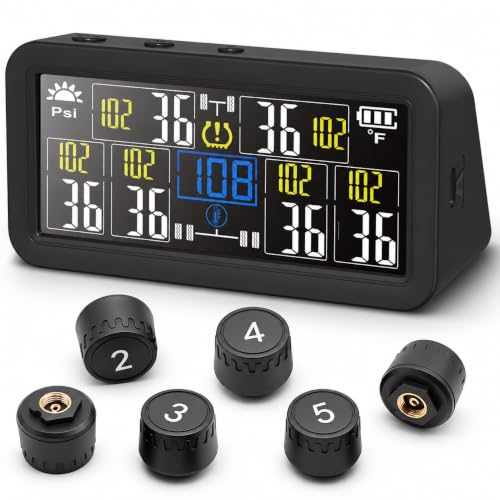
The SYNJAUPO kit ships with ten external sensors, which covers a six-wheel Class C and a four-wheel toad with no extra buying. A seven inch color display shows the whole combination at once.

Topping the list on price, the step up here buys all-copper sensors, 0.1 PSI readings and a signal booster. Over the Tymate TM12, it adds four sensors and a larger screen.

A coach owner with a towed vehicle gets one display for the whole rig.

What works

  • Ten sensors cover coach plus toad
  • Seven inch screen is easy to read
  • Readings to 0.1 PSI
  • Booster included in the kit

Watch out for

  • Most expensive pick in this guide
  • Each sensor must be paired as fitted
02
Best for: Standard Class C coaches with six wheel positions.

Our take

USB-C connects to any 12V source and the solar panel handles the rest.

Why it made the shortlist

The TM12 shows six tires at once and can grow to twelve across four zones. Sensors come pre-programmed to their positions, so the dual rear wheels are labeled right out of the box.

It sits mid-pack on price, a step down from the SYNJAUPO 10-Sensor, yet keeps IP67 sealed sensors and a stated 50 foot range that a repeater can push beyond 100 feet.

For a coach that rarely tows, this is the cleanest six-wheel answer.

What works

  • Sensors pre-set to tire positions
  • Room to add more sensors
  • IP67 waterproof sensors
  • USB-C and solar power

Watch out for

  • Repeater is a separate buy
  • Pressure ceiling is moderate
03
Best for: Drivers who want a purpose-built six-position layout with a bigger screen.

Our take

Smart energy saving comes with solar and USB-C charging.

Why it made the shortlist

Flydew built this kit around six-wheel RVs and heavy-duty trucks. A four inch LCD lays out the six tire positions clearly day or night, and the response is quick at 0.3 seconds.

It lands a little under the Tymate TM12 on price and swaps the twelve-tire growth path for a focused six-position layout. Five alert modes cover high and low pressure, temperature, leaks and sensor trouble.

A Class C owner who wants a no-nonsense six-tire display will find this one quick to live with.

What works

  • Built around six-wheel layouts
  • Four inch screen reads clearly
  • Fast 0.3 second response
  • Solar plus USB-C charging

Watch out for

  • Six tires is the ceiling
  • No booster in the box
04
Best for: Coaches on heavy-duty tires wanting a very wide pressure window.

Our take

Range is stated at 100 feet, plenty for a motorhome.

Why it made the shortlist

LETOURWM lists a range of 0 to 15 bar, 217 PSI, which handles every tire a Class C could carry. Six IP67 sealed alloy sensors report on a 3.6 inch screen with a built-in clock.

It costs the same as the Flydew 6-Wheel and adds voice and visual warnings across seven alerts. A 3-in-1 master chip refreshes every four seconds.

Type-C and solar power keep the display ready between trips.

What works

  • Seven alerts with voice warnings
  • Wide 217 PSI pressure window
  • Built-in clock on screen
  • IP67 sealed sensors

Watch out for

  • Little brand history
  • Refresh is every four seconds
05
Best for: Compact Class C and camper vans with four tire positions.

Our take

The display adjusts its brightness to the light.

Why it made the shortlist

VAOYAO ships four sensors with a solar display that leaves the 12V socket free. Six alerts cover leaks, pressure, temperature and sensor faults.

Next to the LETOURWM 217 PSI, the price is noticeably lower. The listing sets the limits clearly, with vehicles under 88 PSI and 32 feet in length, which fits small Class C coaches.

A van-based camper gets a clean install without clutter.

What works

  • Solar leaves the 12V socket free
  • Six alerts included
  • Auto brightness display
  • Weatherproof sensors

Watch out for

  • Four sensors leave duals unwatched
  • Low pressure ceiling
06
Best for: Budget buyers wanting six-wheel coverage for the smallest outlay.

Our take

A 433.92 MHz link carries the signal, and solar plus USB charging power the monitor.

Why it made the shortlist

Flydew's kit is the entry pick here and still delivers six external sensors with customizable alerts. Set high, low and temperature limits to match your tire load and driving.

At a fraction of the SYNJAUPO 10-Sensor's cost, it keeps a 0 to 144 PSI range. Sensors send fresh data at once when something is abnormal, then ease off to extend battery life.

A first-time TPMS buyer with a six-wheel coach gets full coverage here.

What works

  • Cheapest six-sensor kit here
  • Custom alert limits
  • Smart updates save battery
  • Solar and USB charging

Watch out for

  • Signal link is one-way
  • Short on extras

Methodology

How We Built This Shortlist

Each pick was assessed across 5 criteria weighted for real-world use.

01

Wheel layout

We evaluated each kit against the six-position layout of a Class C, with two steer tires and dual rear wheels. Sensor counts and wheel modes were compared. Kits with fewer than six sensors were flagged as partial answers.

02

Inner dual access

Inner dual tires are the hardest to reach. We compared external sensor designs and noted that cap sensors need a reachable stem, while internal sensors avoid that issue. Based on general buying guidance, a stem extension can help.

03

Display and cab fit

A coach cab has limited dash space. We compared screen sizes from 3.6 to 7 inches and noted mounting and charging methods. Larger screens read easier, while compact units fit tighter dashes.

04

Pressure window

Class C tires run higher than car tires. We compared stated pressure ranges and noted which kits cover heavy-duty needs. Ranges from under 88 PSI up to 217 PSI were weighed against typical coach tires.

05

Range and toad support

A motorhome rarely needs a booster, but a towed car does. We checked stated range and the number of extra sensors on offer. Kits with ten or more sensors scored higher for coach-and-toad use.

Decision guide

Match a Budget TPM for Class C RVs to Your RV

By Wheel Count

Start with how many tires your coach actually carries on the road.

SetupSensors neededPick
Compact Class C, four wheelsFourVAOYAO 4-Sensor
Standard Class C, dual rearSixTymate TM12
Six-wheel coach, tight budgetSixFlydew Solar 6
Heavy-duty tires on six wheelsSix with wide rangeLETOURWM 217 PSI
Coach plus towed carTenSYNJAUPO 10-Sensor

By Budget

Each price band adds sensors or display size.

BandWhat you getPick
Entry of this shortlistSix sensors, solar displayFlydew Solar 6
LowFour sensors, clean installVAOYAO 4-Sensor
MidPurpose-built six-wheel layoutFlydew 6-Wheel
Upper midTwelve-tire growth pathTymate TM12
TopTen sensors and seven inch screenSYNJAUPO 10-Sensor

Six Sensors vs Ten Sensors

The real question is whether the kit must cover a towed vehicle.

Six sensors

Covers the coach alone with a simple display. The Tymate TM12, Flydew 6-Wheel and Flydew Solar 6 sit here, and the TM12 can still add sensors later.

Ten sensors

Adds four toad wheels to the same screen. The SYNJAUPO 10-Sensor ships ready for that setup.

Choose six if you never tow, ten if a car follows the coach.

By Pressure Needs

A second filter that has nothing to do with wheel count.

Tire pressureWhy it mattersPick
Under 88 PSIPassenger-class tiresVAOYAO 4-Sensor
Up to 144 PSITypical coach tiresFlydew Solar 6
Heavy-duty up to 217 PSIMaximum headroomLETOURWM 217 PSI
Mixed coach and toadWide range, many sensorsSYNJAUPO 10-Sensor

For Dual Rear Wheels Specifically

Duals make inner tires the quiet failure point.

Look for

Six sensors, labeled positions and a way to reach inner stems, such as a valve extension or braided stem.

In this comparison

The Tymate TM12 arrives with pre-set positions, and the Flydew 6-Wheel lays out all six on one screen.

When to Spend More

Spend where the extra buys real coverage.

Spend more if

You tow a car or want a big readable screen. The SYNJAUPO 10-Sensor and Tymate TM12 both scale past six tires.

Save if

A solo coach needs only six wheels watched. The Flydew Solar 6 covers that for the least.

FAQ

Before You Bring One Home

How many sensors does a Class C need?

Six for the coach itself, because dual rear wheels double the rear axle count. Add four more if you tow a car. A four-sensor kit such as the VAOYAO 4-Sensor suits compact vans only.

Can external sensors reach inner dual stems?

Often they need a valve extension or braided stem to reach. Without one, the sensor may not thread on straight. Look at your wheel before buying.

Do I need a booster on a 30 foot coach?

Usually not, since the display and tires sit in the same vehicle and stated ranges of 50 to 100 feet are ample. A toad further back is the case that may need help.

Is a 217 PSI range useful?

It leaves headroom, but most coach tires run well below it. The LETOURWM 217 PSI offers it for buyers who want wide margin, whereas 144 PSI covers typical needs.

Solar or plug-in power in a cab?

Solar keeps the socket free and works well on sunny drives. USB backup covers cloudy days. Kits like the Flydew Solar 6 offer both.

Are copper sensors worth it?

Copper resists corrosion, which helps on sensors exposed to road spray. SYNJAUPO's 10-Sensor kit uses a copper core. It adds durability rather than accuracy, so weigh it against sealing and range.

Bottom line

The short version

Browse more budget tpms for class c rvs on Amazon →
Bowen Higgins, RV Editor at RV Gear Lab

About the author

Bowen Higgins

RV Editor at RV Gear Lab

Bowen covers RV power, water systems, towing and leveling, upkeep and interior comfort, with a focus on matching gear to the rig, the hookups and the way you actually travel.

More from Bowen →Editorial standards

Keep reading

Related guides