

We research everything we recommend. When you buy through our links, we may earn a commission. Learn more

Buying guide · 11 min read · Updated October 2, 2026

6 Best Budget TPMS for Tow Vehicle and Trailer: A Practical RV Guide

Six affordable tire monitors that track a tow vehicle and trailer on one screen, with tips on wheel modes, range and sensor swaps.

Bowen HigginsBy Bowen HigginsRV Editor at RV Gear Lab6 products comparedSpec-sheet researched

At a glance

Our top picks

At a glance · 6 picks

Towing means two sets of tires with different jobs. The truck carries tongue weight and spends hours at highway speed, while the trailer rides on a single axle or tandem pair. A good setup watches all of them on one display, so a slow leak on the truck is as visible as one on the trailer.

This list is built around that tow-and-trailer pairing. We compared how each kit labels positions, how it handles a truck that sometimes drives alone and whether the display can be told to ignore trailer tires when the camper is parked. Pressure range, sensor count and power sources round out the comparison.

Price tracks capacity. Entry picks cover four tires or six, while the top kit watches a dozen sensors across multiple trailers. Pick by how many tires you tow with, then check the range against your overall length.

RV Gear Lab field notes

The Rig Fit Check

Start with the job
FUZIDDN 12 Sensors RV Trailer Tire Pressure Monitoring System Solar TPMS leads this shortlist for Heavy tow rigs with many tires and a long trailer.. Use that fit as a reference point, then compare the alternatives against your own space and workload.
Specs that separate the picks
The first details to compare are Twelve flow-through sensors, Six cap sensors, Four pre-paired sensors. Confirm the exact model and included components before ordering.
Trade-off to plan for
Most expensive pick in this guide

Before you buy

What Matters Before You Choose a Budget TPM for Tow Vehicle and Trailer

Key buying criteria so you get the right fit the first time.

  1. 01

    Wheel Mode Switching

    A truck that sometimes drives alone should not flag trailer tires as missing. Some systems switch between four-wheel and eight-wheel modes to prevent false lost-signal alarms. Look for this option in the listing, since a constant false alarm trains you to ignore the warning.

  2. 02

    Total Tire Capacity

    A dually truck and a tandem trailer reach ten wheels fast, and a fifth wheel adds more. A display limited to six tires leaves some blind. Choose a monitor rated for more tires than you run today.

  3. 03

    Signal Booster Position

    The weakest link on a combination is the distance from the trailer rear to the truck dash. A booster on the tongue or outer frame retransmits the signal forward. Without one, rear tires may drop out at highway speed.

  4. 04

    Pressure Range Overlap

    Trailer tires often run higher pressure than the truck. A range that tops out at 87 PSI may not cover them. Compare the maximum pressures printed on both sets of tires with the kit range.

  5. 05

    Flow-Through Convenience

    Adding air to eight or more tires is slow when each sensor must come off. Flow-through designs save the step but need metal stems. Check your stems before choosing.

  6. 06

    Alert Clarity

    A truck cab is loud, so audible alerts must be distinct and the screen must show which tire is at fault. Confirm that the listing names fast-leak and lost-signal alarms. Without those two, a failing sensor can pass unnoticed.

Our standards

Why You Can Trust RV Gear Lab

At RV Gear Lab, we compare products based on rig fit and power or hookup compatibility, verified specifications, usability, setup requirements, weight, durability, and real-world trade-offs. We do not rank products purely on marketing claims or commission rates.

We have not personally tested every product listed. Where hands-on testing is not available, recommendations are based on verified manufacturer specifications, product documentation, use-case fit, and comparative research.

How we review RV gear →

Detailed reviews

The 6 best budget tpms for tow vehicle and trailer, explained

01
Best for: Heavy tow rigs with many tires and a long trailer.

Our take

Adaptive backlighting keeps the full-color display legible in any light.

Why it made the shortlist

FUZIDDN ships twelve flow-through sensors and a monitor rated for up to 46 tires, so a dually truck, a fifth wheel and a spare all fit. The 0 to 188 PSI range handles heavy-duty tires.

That makes it the most expensive pick here. Extra spend gets you flow-through inflation, six alert modes and a signal booster that sits on the trailer tongue or outer frame to cut electromagnetic interference.

Anyone towing a big fifth wheel behind a dually gets one system that covers it.

What works

  • Handles up to 46 tires
  • Flow-through inflation
  • Booster fights signal interference
  • Six alert modes

Watch out for

  • Most expensive pick in this guide
  • Needs metal valve stems
02
Best for: Half-ton trucks pulling a tandem-axle travel trailer.

Our take

A power-saving mode extends battery life.

Why it made the shortlist

GUTA GT40 brings six pre-configured cap sensors and a display for up to ten tires. A 0 to 188 PSI range covers truck and trailer tires with the same unit.

Priced a notch under the FUZIDDN 12-Sensor, it keeps solar and USB charging and an HD LCD with auto backlight. Fast-leak alerts are among six alarm modes.

It is a sound middle step for a single-trailer owner who wants room for a spare.

What works

  • Pre-configured sensors, simple setup
  • Six alarm modes
  • Auto backlight and power saving
  • Wide 188 PSI range

Watch out for

  • Cap sensors come off to add air
  • Stated sensor range is modest
03
Best for: One tow vehicle with a single-axle trailer or a camper van.

Our take

Setup is power on the display and install each sensor.

Why it made the shortlist

The GT90 gives four pre-paired sensors with the same 188 PSI range as the larger GUTA kits. Three brightness levels make the color screen easy to read at any hour.

Landing a clear step below the GUTA GT40 on price, it drops two sensors, yet it still monitors up to ten tires once more are added. Alerts cover pressure, temperature, leaks, signal and sensor battery.

A truck owner with a small trailer will enjoy a fast, honest system.

What works

  • Pre-paired, quick setup
  • Wide 188 PSI range
  • Three brightness levels
  • Can add sensors later

Watch out for

  • Four sensors only out of the box
  • Display needs charging
04
Best for: Trucks and small trailers where screen size matters most.

Our take

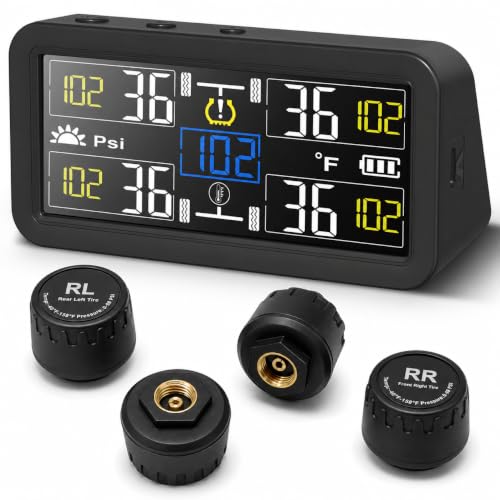
4-Wheel Tire Pressure Monitoring System - TPMS - with 4 Inches LCD Display (Flydew) makes the shortlist because large four inch screen.

Why it made the shortlist

Flydew pairs four external sensors with a big four inch LCD, and the display is clear enough to scan in a glance. Anti-theft lock nuts come in the box.

Priced well under the GUTA GT90, it settles for a narrower 2 PSI accuracy while keeping five warning functions and solar plus USB-C charging.

Installation needs no special tools. A weekend camper with a small trailer will find it a friendly, big-screen entry.

What works

  • Large four inch screen
  • Anti-theft lock nuts included
  • Five warning functions
  • No special tools needed

Watch out for

  • Four wheels only
  • Accuracy within 2 PSI
05
Best for: Owners who want the monitor to learn standard pressures by itself.

Our take

That simplicity suits a first-time tow vehicle owner.

Why it made the shortlist

Masoll M13 calibrates itself, so you set the tires to standard pressure and the sensors adopt that as the baseline. A high-efficiency solar panel charges the monitor with overheat and overcharge protection.

It sits at the entry tier alongside the Marcala V2.0 and covers 0 to 87 PSI with 1.5 PSI accuracy from a built-in pressure chip. A high-definition color LCD adjusts brightness for day and night.

The unit handles four tires for a short trailer without fuss.

What works

  • Sets its own baseline pressure
  • Solar charging with protection
  • Auto-adjusting brightness
  • Accurate to 1.5 PSI

Watch out for

  • Low 87 PSI ceiling
  • Four sensors only
06
Best for: Budget buyers who want six wheels covered with flexible sensor use.

Our take

Marcala also sells a range extender that boosts the signal up to 80 feet.

Why it made the shortlist

Marcala V2.0 is the entry pick and brings six sensors for a truck and trailer or a tandem axle. It can be set up to watch anywhere from one to six wheels.

It costs the same as the Masoll M13 yet delivers two more sensors and a 0 to 144 PSI window. Sensors update every second while driving, so alerts arrive in real time.

Overall it is the lowest-cost path to six-wheel monitoring on the list.

What works

  • Live updates every second driving
  • Configurable one to six wheels
  • Optional range extender

Watch out for

  • 26 foot stated range
  • Extender sold separately

Methodology

How We Built This Shortlist

Each pick was assessed across 5 criteria weighted for real-world use.

01

Truck and trailer coverage

We evaluated each kit against a typical towing combination: two axles on the truck, one or two on the trailer. Sensor totals and wheel modes were compared. Kits that can watch the trailer only on towing days earned extra credit.

02

Combined range

A truck pulling a 30 foot trailer stretches the signal path. We compared stated ranges and booster options. Based on specs, kits with a tongue-mounted booster or extender offered the best insurance.

03

Pressure window

Trucks and trailers can sit at very different pressures. We compared stated windows from 87 PSI to 188 PSI. Wider windows give one display room to track both.

04

Display and glare

Cab screens fight sun glare. We compared screen sizes, brightness levels and auto-dimming. Larger screens help on wide dashes.

05

Sensor swap and growth

A kit that grows with the rig saves a second purchase. We compared maximum tire counts and wheel configurations. Our analysis relies on listing specs and common towing needs.

Decision guide

Match a Budget TPM for Tow Vehicle and Trailer to Your RV

By Tire Count

Count the tires you tow with, then pick the display that covers them.

CombinationTiresPick
Truck plus single-axle trailerSixMarcala V2.0
Truck plus tandem trailerEight to tenGUTA GT40
Camper van or small trailerFourFlydew 4-Wheel
Dually plus fifth wheelTwelve or moreFUZIDDN 12-Sensor
Simple four-tire trailerFourMasoll M13

By Budget

Bands reveal what each step adds to the combination.

BandWhat the step buysPick
Entry of this shortlistSix sensors, flexible wheel useMarcala V2.0
LowFour sensors, auto-calibrationMasoll M13
Low-midLarge four inch screenFlydew 4-Wheel
Mid188 PSI range, expandableGUTA GT90
TopTwelve flow-through sensors, boosterFUZIDDN 12-Sensor

Fixed Layout vs Flexible Wheels

Some tow rigs change from trip to trip, and the kit should follow.

Fixed layout

Always the same truck and trailer, so a set number of sensors is fine. The GUTA GT40 and Masoll M13 suit that routine.

Flexible wheels

Sometimes solo, sometimes towing. The Marcala V2.0 can be set to monitor one to six wheels, and the GUTA GT90 can add sensors later.

Go flexible if the truck leaves the trailer behind often.

By Signal Path

A second decision axis that depends on how long the combination runs.

Overall lengthWhat helpsPick
Under 30 feet totalStated range is enoughMasoll M13
Around 35 feetOptional extenderMarcala V2.0
Over 40 feetTongue-mounted boosterFUZIDDN 12-Sensor
Mid-length tandemPre-configured sensorsGUTA GT40

For Dually Trucks Specifically

Dually trucks add rear wheels and higher pressures.

Look for

A wide pressure window, many sensors and a display that can show them all together.

In this comparison

The FUZIDDN 12-Sensor and GUTA GT40 both reach 188 PSI and scale to many tires.

When to Spend More

Pay more when the rig demands capacity.

Spend more if

You pull a fifth wheel or a long trailer. The FUZIDDN 12-Sensor and GUTA GT40 deliver headroom and booster support.

Save if

A small trailer sits behind a half-ton. The Marcala V2.0 or Masoll M13 covers the basics for much less.

FAQ

Before You Bring One Home

Can one monitor track both my truck and trailer?

Yes, if it supports enough tires. The GUTA GT40 handles up to ten tires, and the FUZIDDN 12-Sensor is rated far higher. Choose a unit rated for more tires than you use now.

What if I drive the truck without the trailer?

Pick a kit with wheel mode switching or configurable wheel counts, such as the Marcala V2.0. Otherwise the display will flag the missing trailer sensors every time.

Do I need flow-through sensors on a combination?

They save time when topping up many tires, but need metal stems. For a short trailer, cap sensors like those on the GUTA GT90 are simpler.

How far will the signal reach?

Listings vary. One GUTA kit gives a modest stated sensor range, while a booster extends reach for long combinations. Read the stated range against your overall length.

Is auto-calibration useful?

The Masoll M13 sets the baseline from your standard pressures, which suits beginners. Experienced owners may prefer manual thresholds.

Where should the booster go?

On a trailer tongue or outer frame, so it can catch signals and relay them forward. Clear metal obstructions out of the path.

Bottom line

The short version

Browse more budget tpms for tow vehicle and trailer on Amazon →
Bowen Higgins, RV Editor at RV Gear Lab

About the author

Bowen Higgins

RV Editor at RV Gear Lab

Bowen covers RV power, water systems, towing and leveling, upkeep and interior comfort, with a focus on matching gear to the rig, the hookups and the way you actually travel.

More from Bowen →Editorial standards

Keep reading

Related guides