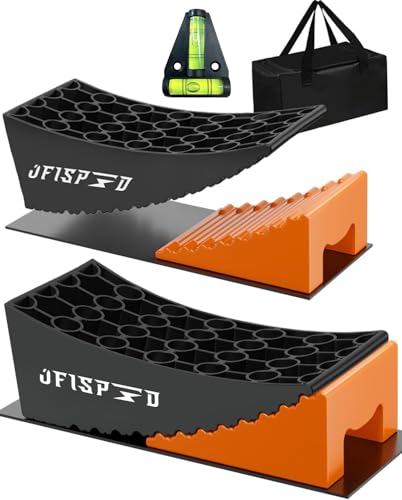
Few campsite chores are as satisfying as rolling onto a pad, driving up a pair of ramps and watching the bubble settle in the middle. Drive-on levelers do exactly that: you place a ramp or stack of blocks in front of the low tire, pull forward until the camper is level, set the chocks and you are done. There is no jack to crank, no motor to fail and no power to connect, which is why this style of leveler is the most common choice for travel trailers and small campers.
Drive-on levelers differ in ways that matter on real sites. Some are continuous curved ramps that give any height up to a limit, others are stepped ramps with fixed heights, and a few are gear-mesh blocks that interlock for adjustable lift. Lift range, load rating, how the leveler fits between dual axles and whether chocks and mats are included all change how easy the kit is to use. A leveler that is too short will not fix a steep site, and a leveler that is too long may not fit between closely spaced tires.
This guide compares five drive-on levelers. We evaluated them on lift range, load rating, dual-axle fit, grip design, what comes in the box and price, weighing documented specifications against owner feedback. They include a premium curved kit with chocks, mats and a bag, a lightweight stepped ramp pair, a dual-axle-friendly block kit, an eight-piece high-capacity kit and a single resin tri-leveler. Prices run from $29.90 to $119.47.
The load ratings are worth reading closely, because they are not directly comparable. The MaxxHaul lists 3,250 lbs per ramp and 6,500 lbs per pair, the Camco lists 3,500 lbs, and the RVMATE lists 35,000 lbs for the vehicle. Some of these are per-ramp figures and others are gross vehicle ratings, so compare them against your trailer's loaded weight and the weight on a single axle, not against each other.
Finally, consider how and where you camp. A flat, gravel-lined pad calls for a short lift, and a rough forest campsite may need more. A weekend owner who levels once a trip can live with a basic ramp, while a full-timer who levels every few days will appreciate a kit with mats, a bag and handles. The sections below match each leveler to a specific habit, axle layout and budget, and each recommendation names a product from the list above.
One practical tip applies to every kit here: approach the ramp straight on, slowly and with a spotter. Turning the wheel while climbing can push a ramp sideways, and rushing the last inch means overshooting level. Mark the final position of your tires with a piece of tape on the ground or note a landmark so you can repeat the result at your favorite sites.
Our standards
Why You Can Trust RV Gear Lab
At RV Gear Lab, we compare products based on rig fit and power or hookup compatibility, verified specifications, usability, setup requirements, weight, durability, and real-world trade-offs. We do not rank products purely on marketing claims or commission rates.
We have not personally tested every product listed. Where hands-on testing is not available, recommendations are based on verified manufacturer specifications, product documentation, use-case fit, and comparative research.
How we review RV gear →