

We research everything we recommend. When you buy through our links, we may earn a commission. Learn more

Buying guide · 11 min read · Updated October 2, 2026

6 Best Budget 3-Stage RV Water Filters in 2026: A Practical RV Guide

Six three-stage RV water filter systems and refill sets compared on stage order, micron ratings, brass hardware and flow so you know what each canister does.

Bowen HigginsBy Bowen HigginsRV Editor at RV Gear Lab6 products comparedSpec-sheet researched

At a glance

Our top picks

At a glance · 6 picks

A three-stage RV filter is three canisters in a row, and the whole value of the design is in what each canister is asked to do. Water meets a coarse sediment stage first, a carbon stage second and a fine finishing stage third. Each stage protects the next, so the carbon lasts longer than it would alone and the final cartridge sees water that has already been cleaned up. Think of it as a relay rather than three copies of the same filter, with each runner handing off cleaner water to the next in line.

That makes stage order and micron rating more important than the brand on the box. A sediment cartridge that is too fine will clog in weeks, one that is too coarse lets grit foul the carbon, and a tight third stage can choke pressure on a small RV pump. Budget kits make different choices here: some finish with a 0.2 micron cartridge, some with a 0.01 micron ultrafiltration membrane, some with extra granular carbon. Hardware differs too in practice, from brass hose fittings and steel brackets to light polycarbonate frames.

Read the stage lists in the picks below as a recipe. Compare what each stage is made of, then match the recipe to your water source and your pump. A kit that fits a chlorinated city hookup is not always the right one for a dusty well, and a fine finishing stage is a bad match for a weak pump. None of these listings promises protection from pathogens, so they are taste and particulate filters for the most part, and that is how they are judged here, in plain terms.

RV Gear Lab field notes

The Rig Fit Check

Start with the job
3-Stage RV Water Filtration System, 3-Cartridge Water Filter for RV Camper Van Boat leads this shortlist for Owners wanting a complete, ready-to-mount kit with a stated flow figure.. Use that fit as a reference point, then compare the alternatives against your own space and workload.
Specs that separate the picks
The first details to compare are 5 micron, 5 micron, 0.2 micron stages, 1 micron sediment, 5 micron carbon, GAC, Sediment plus dual CTO carbon. Confirm the exact model and included components before ordering.
Trade-off to plan for
Plastic canisters need protection from freezing

Before you buy

What Matters Before You Choose a Budget 3-Stage RV Water Filter

Key buying criteria so you get the right fit the first time.

  1. 01

    What each of the three stages does

    Stage one is usually a sediment cartridge that stops sand, silt and rust, stage two is a carbon block or granular carbon that handles chlorine, odor and volatile organic compounds, and stage three is a finishing cartridge. Sediment is a physical barrier, while carbon works by adsorption, so they do different jobs and neither replaces the other. Read the listing for the material in each canister, and be suspicious when a kit calls itself three-stage but lists only two media types. A real three-stage kit names three different things.

  2. 02

    Stage order and clogging

    Water should go coarse to fine, because a fine cartridge in front of a coarse one clogs quickly and wastes the media behind it. A 5 micron first stage lasts longer on dirty water than a 1 micron stage, while a 1 micron stage holds back more silt. Match the first stage to your source, and expect to change the sediment cartridge more often than the carbon. Cheap sediment cartridges exist for exactly this reason.

  3. 03

    Third-stage choice

    A third stage can be granular carbon for extra taste control, a 0.2 micron precision cartridge or a 0.01 micron ultrafiltration membrane. Rated at 0.2 micron, a stage screens bacteria-sized particles, though a listing that makes no pathogen claim should not be relied on as a purifier, and ultrafiltration offers the finest screening but restricts flow most. Pick the finishing stage for the job it actually does for you. Ask whether you want taste, particulates or both.

  4. 04

    Flow rate against your pump

    An RV water pump typically delivers a few gallons per minute, and every filter stage adds restriction. A stated figure such as 2.9 gallons per minute gives you something to compare with your pump rating, while a kit with no stated flow leaves you guessing. If your showers already feel weak, choose coarser stages or a higher stated flow, and install pressure gauges before and after the canisters. A drop of a few psi across the set is normal, but a large drop means a clogged cartridge.

  5. 05

    Fittings, housings and mounting

    Solid brass 3/4 inch fittings tolerate repeated connections and avoid the cracked plastic threads that cause leaks, and a steel or metal bracket resists vibration on the road. Polycarbonate frames are lighter but less rugged. Look for a mounting bracket, a filter wrench and spare O-rings in the box, since a leak at a bad O-ring is a common first-week failure. Hand-tighten, then check for drips under pressure.

  6. 06

    Cartridge cost and compatibility

    A three-stage system has three cartridges to replace, so ongoing cost matters more than the sticker price. Standard 2.5 by 10 inch cartridges can be sourced from many suppliers, while proprietary shapes lock you in. A refill set that fits an existing system, such as the VitaFlow Refill, can undercut a whole new kit. Check that replacements are widely available before you buy.

Our standards

Why You Can Trust RV Gear Lab

At RV Gear Lab, we compare products based on rig fit and power or hookup compatibility, verified specifications, usability, setup requirements, weight, durability, and real-world trade-offs. We do not rank products purely on marketing claims or commission rates.

We have not personally tested every product listed. Where hands-on testing is not available, recommendations are based on verified manufacturer specifications, product documentation, use-case fit, and comparative research.

How we review RV gear →

Detailed reviews

The 6 best budget 3-stage rv water filters, explained

01
3-Stage RV Water Filtration System, 3-Cartridge Water Filter for RV Camper Van Boat
  • 5 micron, 5 micron, 0.2 micron stages
  • 2.9 GPM stated flow
  • Steel bracket and filter wrench
Check price on Amazon for 3-Stage RV Water Filtration System, 3-Cartridge Water Filter for RV Camper Van Boat (opens in a new tab)
Best for: Owners wanting a complete, ready-to-mount kit with a stated flow figure.

Our take

Choose it when you want a single purchase that covers the hardware and the first set of cartridges, with enough accessories that installation can start the same afternoon.

Why it made the shortlist

The Krimwold gives the most balanced recipe in the guide. Water passes a 5 micron polypropylene sediment cartridge, then a 5 micron CTO carbon block, then a 0.2 micron precision cartridge, and the listing states a flow of 2.9 gallons per minute with a service life up to 7,500 gallons for the whole set of three cartridges.

A stated flow figure is useful because it lets you compare against your pump, and 2.9 gallons per minute sits close to what many RV pumps can deliver. It lands mid-pack on price, noticeably above the Filterelated 3-Stage and well below the iSpring CW31, and the step up buys a finer third stage, a steel bracket and a graduated recipe that protects each cartridge in turn.

What works

  • Complete kit with wrench and spare O-rings
  • States a 2.9 GPM flow figure
  • Balanced 5, 5, 0.2 micron stage recipe
  • Steel mounting bracket resists road vibration

Watch out for

  • Plastic canisters need protection from freezing
  • Listing names no NSF certification
02
Filterelated 3-Stage RV Water Filter System, 1μm Sediment + Carbon Block + GAC Filtration
  • 1 micron sediment, 5 micron carbon, GAC
  • 3/4 inch brass fittings
  • Three filter elements included
Check price on Amazon for Filterelated 3-Stage RV Water Filter System, 1μm Sediment + Carbon Block + GAC Filtration (opens in a new tab)
Best for: Budget buyers who want brass fittings and a proper three-canister build.

Our take

Brass 3/4 inch fittings are the sort you would expect on a costlier kit, and the system suits RV, boat and whole-house use.

Why it made the shortlist

This kit proves that three canisters do not need a high price. A 1 micron polypropylene sediment cartridge starts the line, a 5 micron compressed carbon block follows, and a granular activated carbon cartridge finishes, with the listing aiming it at chlorine, volatile organic compounds, tannins, odor and trihalomethanes, which are the usual complaints with city water.

Because the first stage is a fine 1 micron cartridge, it holds back more silt than the 5 micron sediment stage in the Krimwold, and the two carbon stages give extra contact time for taste. It sits near the low end of the shortlist on price, a clear step above the refill set and below the Krimwold.

Buy it if you want the cheapest complete three-canister recipe and plan to run city water or a mild well, with the extra carbon stage giving a taste edge at the tap.

What works

  • Two carbon stages boost taste improvement
  • Fine 1 micron first stage holds silt
  • Brass fittings usually cost extra
  • Lowest-cost complete kit

Watch out for

  • No stated flow figure in the listing
  • 1 micron stage may clog quickly in dirty water
03
iSpring CW31 RV Water Filter System, 3-Stage RV Water Filtration System for Campers
  • Sediment plus dual CTO carbon
  • 3/4 inch lead-free brass quick connectors
  • NSF-certified filters stated
Check price on Amazon for iSpring CW31 RV Water Filter System, 3-Stage RV Water Filtration System for Campers (opens in a new tab)
Best for: Full-timers wanting a known name, brass hose fittings and NSF-certified filters.

Our take

A system designed to avoid pressure drop and leaks suits a rig that is parked for weeks and used daily, where a slow drip or a pressure loss becomes a daily annoyance.

Why it made the shortlist

iSpring is a recognized water-treatment brand, and the CW31 comes with 3/4 inch lead-free brass hose quick connectors designed for a leak-free link to your hookup. The listing describes dual CTO carbon filtration alongside a sediment stage, aimed at rust, chlorine, odor and volatile organic compounds, so the water passes two carbon blocks on its way to the tap.

The listing states the filters are NSF-certified and describes the build as BPA-free and lead-free, a more specific claim than most budget kits make, which gives the kit a stronger paper trail than a no-name set. It is the most expensive pick in this guide, a large step above the Krimwold, and the extra buys the established name and the certification language.

Reach for it when you plan to live in the RV and want hardware that comes from a company with a known support channel and replacement-cartridge supply.

What works

  • Brass quick connectors give a tight seal
  • Listing states NSF-certified filters
  • Established brand with cartridge supply
  • Lead-free, BPA-free materials stated

Watch out for

  • Most expensive pick in this guide
  • Listing does not name the NSF standard
04
Best for: Owners in hard-water regions who want scale control and a fine third stage.

Our take

It lands in the upper-middle of the shortlist on price, a step above the Krimwold, and the step buys the ultrafiltration stage and the scale inhibitor.

Why it made the shortlist

The third stage is the headline. After a 1 micron sediment cartridge with polyphosphate and a carbon block, the water passes a 0.01 micron ultrafiltration membrane that the listing describes as a final barrier against particles far finer than a standard cartridge stops, which is the main reason to pick this kit and the reason it ranks as the most thorough particle screen on the list.

Polyphosphate in the first stage slowly releases food-grade scale-inhibiting compounds, which coat plumbing and help limit hardness buildup in a water heater. The reinforced metal bracket supports floor or wall mounting with anti-slip pads, and the listing describes high flow with minimal pressure drop through solid brass inline ports, which helps the installation stay neat and leak-free for the long haul.

Go with this one when your water is hard and you want protection for the heater, and you are comfortable with a finer final stage on your pump, since the kit lets you keep the same canister layout for years of use.

What works

  • Polyphosphate helps limit scale buildup
  • 0.01 micron third stage screens fine particles
  • Metal bracket mounts to floor or wall
  • Five-minute tool-free installation

Watch out for

  • Fine third stage can cut flow on weak pumps
  • Listing makes no pathogen claim for the UF stage
05
Best for: Van and camper owners wanting a light, vibration-resistant frame.

Our take

Quick connects click into place without tools, so setup and breakdown between campsites is fast, which matters for travelers who move often and unhook every few days.

Why it made the shortlist

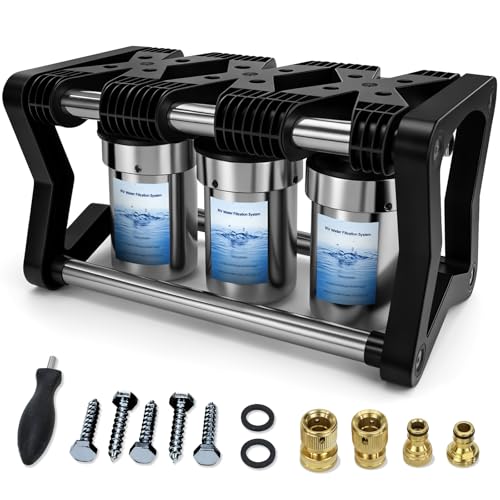
The frame is the distinguishing feature, and it shows how the kit was designed for life on the road. Product copy describes a polycarbonate carbon fiber mounting frame that is lightweight and built to resist bumps and vibration, which suits vans and trailers that spend a lot of time on rough roads and washboard campground approaches.

Filtration starts with a sediment stage that protects the following cartridges, and the finish is a 0.2 micron high-flow filter aimed at improving taste and reducing particulates, a fine stage that keeps flow brisk. The kit comes with brass garden hose quick connects, and the listing states up to 120 days of cleaner source water per cartridge set, a clear interval to plan around.

It sits in the upper end of the shortlist on price, below the iSpring CW31, and the step up from the entry kits buys the 0.2 micron finish and the lighter frame.

What works

  • Lightweight frame resists road vibration
  • 0.2 micron final stage
  • Tool-free quick connects
  • Stated 120-day cartridge interval

Watch out for

  • Polycarbonate frame is less sturdy than steel
  • Listing names no certification
06
3-Stage RV Water Filter Fit for Clearsource Ultra Three Canister System
  • 5 micron, 0.5 micron carbon, 0.01 micron UF
  • Fits Clearsource Ultra canisters
  • Up to 2,000 gallons stated
Check price on Amazon for 3-Stage RV Water Filter Fit for Clearsource Ultra Three Canister System (opens in a new tab)
Best for: Clearsource Ultra owners who need replacement cartridges rather than a new system.

Our take

The 5 micron, 0.5 micron, 0.01 micron sequence gives a graduated recipe with a very fine finishing stage, which is useful for taste and fine particles, and it keeps the existing brackets and fittings in use.

Why it made the shortlist

This is a cartridge set, not a housing, and it earns its place as the cheapest way to refresh a Clearsource Ultra three-canister system. It carries a 5 micron sediment cartridge, a 0.5 micron coconut carbon block and a 0.01 micron hollow fiber ultrafiltration membrane, sized to fit that system, so the three canisters you already own go back into service.

The seller states the set filters up to 2,000 gallons while maintaining water pressure, and it uses the same standard dimensions as other 10 inch cartridges, so the swap takes minutes. On the price ladder, this is the entry pick of the shortlist by a wide margin, and the saving is simply that the housings and hardware are already on your rig.

Pick this one if you already own a compatible three-canister setup and want a full refresh without replacing the system.

What works

  • Cheapest way to refresh three canisters
  • Graduated 5, 0.5, 0.01 micron recipe
  • Standard cartridge dimensions
  • Stated 2,000 gallon life

Watch out for

  • Cartridges only, with no housings or fittings
  • Useless without a compatible existing system

Methodology

How We Built This Shortlist

Each pick was assessed across 5 criteria weighted for real-world use.

01

Stage recipe

We evaluated each pick by what its three stages are made of and in what order. A graduated recipe, coarse to fine, earns credit because each stage protects the next. Front-loading a very fine cartridge was scored for clogging risk.

02

Stated ratings

Micron figures, flow rates and gallon capacities were read from each listing and compared across kits. Based on product specs, a printed number beat an adjective. Certification claims were credited only when the listing named them.

03

Hardware and install

Brass versus plastic fittings, bracket construction, included tools and mounting options shaped the score. We compared how much extra you would need to buy to finish an install. A complete kit scored higher than a bare set of canisters.

04

Flow versus pump

Finer stages restrict flow, so we weighed each kit's final stage against typical RV pump output. Kits that state a flow figure were easier to match to a pump. Ultrafiltration finishes were flagged for pressure sensitivity.

05

Honest scope

A three-stage sediment and carbon kit improves taste, chlorine and particulates, and none of these listings claims a pathogen reduction. We scored them on that basis and noted where a listing stretched. A fine micron figure is a particle claim, not a safety claim.

Decision guide

Match a Budget 3-Stage RV Water Filter to Your RV

By Water Source

The first stage should match what is actually in your water. Silt, rust and hardness each point to a different kit.

Water sourceMain concernRecommended pick
City water, chlorinatedTaste and odorFilterelated 3-Stage, with two carbon stages
Mixed campground tapsVariable sedimentKrimwold 3-Stage, with a coarse first stage
Hard water regionsScale in the water heaterFilterelated UF, with polyphosphate
Full-time living, city hookupLong-term reliabilityiSpring CW31, with certified filters

By Budget

Bands below are relative positions inside this shortlist rather than quoted prices. One pick is a refill set rather than a system.

Price bandWhat it buysRecommended pick
Entry of this shortlistReplacement cartridges for an existing rigVitaFlow Refill
Low of this shortlistA complete three-canister kit with brass fittingsFilterelated 3-Stage
Mid of this shortlistA complete kit with a stated flow figureKrimwold 3-Stage
Upper-mid of this shortlistA scale inhibitor and ultrafiltration stageFilterelated UF
Upper of this shortlistA light vibration-resistant frameFeeligivin 3-Stage
Top of this shortlistBrand-name hardware and certified filtersiSpring CW31

Sediment-Carbon-Carbon vs Sediment-Carbon-Ultrafiltration

The third stage is where these kits diverge most. One camp finishes with more carbon, the other with a fine membrane.

Carbon-focused finish

Extra carbon improves taste, chlorine and odor and keeps flow high. Filterelated 3-Stage, iSpring CW31 and Krimwold 3-Stage lean this way for everyday city water.

Fine-particle finish

A 0.2 or 0.01 micron stage screens fine particles but restricts flow. Filterelated UF, Feeligivin 3-Stage and VitaFlow Refill use this approach.

Choose a carbon finish for flow and taste, and a fine membrane only if your pump can spare the pressure.

By Rig Type

A van and a fifth wheel ask different things of a filter frame and a pump.

Rig typePriorityRecommended pick
Camper vanLight weight and vibration resistanceFeeligivin 3-Stage
Travel trailerBalanced kit with a stated flowKrimwold 3-Stage
Fifth wheel or motorhome, full-timeBrand support and certified filtersiSpring CW31
Existing Clearsource Ultra ownerReplacement cartridgesVitaFlow Refill

For Hard Water Specifically

Hardness shows up as scale in the heater and spots on fixtures. A sediment and carbon kit does not fix it, so plan accordingly.

Look for

A scale-inhibiting stage such as polyphosphate, which limits buildup without removing the minerals, as in the Filterelated UF kit. A water softener is the real fix for very hard water.

In this comparison

Filterelated UF is the only pick with polyphosphate, while Krimwold 3-Stage and iSpring CW31 do not claim hardness control.

When to Spend More

Spending more should buy hardware, certification or a stage you will actually use.

Spend more if

You live in the rig full time or have hard water. iSpring CW31 and Filterelated UF justify the step with certified filters and scale control.

Save if

You use city water and travel part-time. Filterelated 3-Stage covers taste and sediment for less, and VitaFlow Refill keeps an existing system running.

FAQ

Before You Bring One Home

Why three stages instead of one?

Each stage does a different job and protects the next. A sediment cartridge stops grit so the carbon does not clog, the carbon handles chlorine and taste, and a finishing stage polishes the water. A single cartridge asked to do all three clogs faster and does each job less well.

Is a 0.01 micron third stage a purifier?

Not by itself. A 0.01 micron membrane is a particle claim, and none of these listings makes a specific pathogen or virus claim. Treat it as a very fine particulate screen, and use a separate purifier or boiling if you drink questionable water.

Will a three-stage system hurt my water pressure?

It can. Every stage adds restriction, and a fine ultrafiltration finish adds the most, so a weak pump may feel it at the shower. Choose a kit with a stated flow figure, such as the Krimwold at 2.9 gallons per minute, and install a pressure gauge to see the real drop.

How often do the cartridges need replacing?

Listings range from about 120 days for the Feeligivin to 2,000 gallons for the VitaFlow set, and your real interval depends on water quality. Change the sediment cartridge first when flow drops, and replace the carbon when taste returns. Keep a spare set on board.

Can I mix cartridges from different brands?

Usually yes, if they are standard 2.5 by 10 inch cartridges. Stay with the same micron order, coarse to fine, and fit the sediment cartridge in the first canister. A refill set built for a particular system, like the VitaFlow Refill, is designed to match that sequence.

Do I need a bracket and pressure gauges?

A bracket keeps canisters from shifting on the road, and gauges before and after the system let you see when a cartridge is clogging. Kits like the Krimwold and Filterelated UF include a mounting bracket. Gauges are optional, but they are the best early warning you can add.

Bottom line

The short version

Browse more budget 3-stage rv water filters on Amazon →
Bowen Higgins, RV Editor at RV Gear Lab

About the author

Bowen Higgins

RV Editor at RV Gear Lab

Bowen covers RV power, water systems, towing and leveling, upkeep and interior comfort, with a focus on matching gear to the rig, the hookups and the way you actually travel.

More from Bowen →Editorial standards

Keep reading

Related guides