

We research everything we recommend. When you buy through our links, we may earn a commission. Learn more

Buying guide · 11 min read · Updated October 2, 2026

5 Best Budget Portable Water Filters for RV in 2026: A Practical RV Guide

Five free-standing, carry-anywhere RV water treatment units, from carbon systems to a softener and RO machines, compared on what each one actually fixes.

Bowen HigginsBy Bowen HigginsRV Editor at RV Gear Lab5 products comparedSpec-sheet researched

At a glance

Our top picks

A portable RV water filter is one you carry from site to site rather than bolt to a wall. It sits on the ground at the hookup, takes in water from the campground spigot, and sends cleaner water into your fresh-water hose. That freedom is convenient, and it is why this category mixes very different machines under one name. Some run on line pressure alone with no power at all, and some need a battery or an outlet, a drain hose and a little patience at the tap while it works.

Three kinds of product show up here. A carbon and sediment system improves taste and chlorine and protects your plumbing from grit. A resin softener tackles hard water scale, which is a different problem altogether. A reverse osmosis machine reduces dissolved solids and needs power and a drain hose. All three are portable, none replaces another, and each is aimed at a different complaint, so a buyer who matches the wrong machine to the wrong problem ends up disappointed. A softener will not fix chlorine taste, and a carbon block will not fix scale or a salty tap.

That makes the first question not which is best but what is wrong with your water. Pick the recipe for the problem, then compare the details. Look at the listing for stated flow, hose sizes, power sources and the exact numbers behind each claim, and be wary of any unit that promises to fix everything at once, whether it runs on pressure, a battery or a wall outlet. Portable gear is easiest to live with over many trips and many campgrounds when it does one job well and does not ask much of the campsite.

RV Gear Lab field notes

The Rig Fit Check

Start with the job
RV Water Filter Store Essential Portable RV System | 0.5 Micron Coconut Shell Carbon leads this shortlist for Most RVers wanting a portable carbon system with spare sediment filters.. Use that fit as a reference point, then compare the alternatives against your own space and workload.
Specs that separate the picks
The first details to compare are 0.5 micron coconut shell carbon block, 2 kg GAC and 1 kg KDF media, PP, carbon and RO membrane stages. Confirm the exact model and included components before ordering.
Trade-off to plan for
Listing says NSF approved without naming a standard

Before you buy

What Matters Before You Choose a Budget Portable Water Filter for RV

Key buying criteria so you get the right fit the first time.

  1. 01

    What problem you are solving

    Bad taste and chlorine call for carbon, scale and spotting call for a softener, and salty or mineral-heavy water calls for reverse osmosis. A buyer who picks the wrong category spends money and still has the original complaint. Taste the water first, look at the water heater for crust, and consider a cheap TDS meter. Then choose the media that matches the symptom. A tap with no taste and a crusty heater needs a softener, not more carbon.

  2. 02

    Power and water waste

    Carbon and softener units run on water pressure alone, while RO machines need a pump and electricity from a battery, AC outlet or vehicle. RO also sends part of the incoming water to a drain outlet, which matters where water is scarce. Check the listing for the power sources it supports and whether a drain hose is required. A drain-free system suits dry campgrounds better. Also check how long a battery runs per fill.

  3. 03

    Hose threads and hookup

    Standard garden hose threads are 3/4 inch, and a portable unit should connect to the spigot and your fresh-water hose with solid connectors rather than thin plastic threads. Brass or metal fittings tolerate repeated hookups better and leak less over time. Seek out a stated hose size, an included hose and any mention of a pressure rating. A leaking connector wastes water and soaks the campsite. Look for sealing washers in the box.

  4. 04

    Media bed size

    Contact time matters in carbon systems. A bed holding 2 kilograms of granular carbon and 1 kilogram of KDF gives the water a longer path than a thin cartridge, while a 0.5 micron carbon block gives a finer and slower path. Neither is universally better. A large bed suits strong chlorine, and a fine block suits steady everyday taste control. Compare the media weights printed in the listing.

  5. 05

    Reading TDS and the numbers

    TDS stands for total dissolved solids, measured in parts per million, and a before-and-after display on an RO unit shows how much the membrane removes. A stated reduction of around 98 percent is a seller claim based on a specific test water, so your results will vary. TDS does not measure bacteria or chemicals. Use it as a sign that the membrane is working, not as proof of safety.

  6. 06

    Storage and winter care

    Water trapped inside a housing, a resin tank or an RO membrane can freeze and crack parts. Drain the unit after each trip, let it dry and store it indoors in cold months. RO membranes also need to stay moist, so follow the maker's storage guidance. A cracked housing may not show a leak until the next hookup. That surprise is easy to avoid.

Our standards

Why You Can Trust RV Gear Lab

At RV Gear Lab, we compare products based on rig fit and power or hookup compatibility, verified specifications, usability, setup requirements, weight, durability, and real-world trade-offs. We do not rank products purely on marketing claims or commission rates.

We have not personally tested every product listed. Where hands-on testing is not available, recommendations are based on verified manufacturer specifications, product documentation, use-case fit, and comparative research.

How we review RV gear →

Detailed reviews

The 5 best budget portable water filters for rv, explained

01
Best for: Most RVers wanting a portable carbon system with spare sediment filters.

Our take

Coconut shell carbon is a respected media for chlorine, taste and odor, and the included spare sediment cartridge means the first swap needs no shopping.

Why it made the shortlist

What you get is the plain, useful answer for most campsites. The system pairs two 1 micron sediment filters in the box, one as a spare, with a 0.5 micron coconut shell carbon block, which is the standard two-stage recipe for improving taste while keeping grit out of the plumbing, the pump strainer and the faucet aerators.

This listing states flow of 3 to 4 gallons per minute at 60 PSI, a number that is easy to compare against an RV pump or campground pressure, and it describes the filters as NSF approved. A limited lifetime warranty covers defects and replacement parts. It sits at the lower middle of this shortlist on price, above the softener and below the H&G.

Put it on your list if you want a dependable portable system for everyday hookups and prefer a fine carbon block to a loose granular bed, with the warranty giving some comfort on a unit that will be moved often.

What works

  • Spare sediment filter included in the kit
  • Stated 3 to 4 GPM flow at 60 PSI
  • Limited lifetime warranty in the listing
  • Fine carbon block for taste and chlorine

Watch out for

  • Listing says NSF approved without naming a standard
  • Carbon is not a pathogen barrier
02
Best for: RVers who fill from varied taps and want a big carbon and KDF bed.

Our take

KDF media is commonly used to reduce chlorine and to limit microbial growth inside the filter itself, which keeps the bed fresher between trips.

Why it made the shortlist

Bed size is the story with this unit. The housing holds about 2 kilograms of granular activated carbon and 1 kilogram of KDF media, which gives the water a longer path through the media than a thin cartridge offers and suits taps with strong chlorine or odor, such as older municipal systems, small-town supplies and some campground wells.

A solid 3/4 inch garden hose thread connects at both ends, the listing describes lead-free, BPA-free components, and a portable handle lets you carry it between sites. On the price ladder it occupies the upper middle of this shortlist on price, a step above the RVWF Essential, and the step buys a much larger media bed and a carrying handle for lifting it in and out of the storage bay.

Favor it when you move between many different campgrounds and want one big, easily carried canister that handles unpredictable tap water, without worrying about changing small cartridges every few weeks or hauling spares.

What works

  • Large carbon and KDF bed for contact time
  • Solid brass-style 3/4 inch hose threads
  • Carry handle makes it easy to move
  • Lead-free, BPA-free components stated

Watch out for

  • Single-stage, with no separate sediment cartridge
03
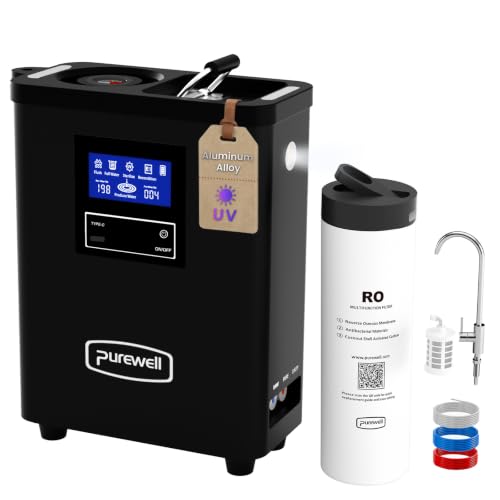
Purewell Portable Electric RO Water Filter System for Camping and RV Travel
  • PP, carbon and RO membrane stages
  • Dual TDS display, 5200 mAh battery
  • Aluminum housing, carry bag, light
Check price on Amazon for Purewell Portable Electric RO Water Filter System for Camping and RV Travel (opens in a new tab)
Best for: RVers with high-mineral water who want a rechargeable RO drinking-water unit.

Our take

An aluminum alloy housing, a carry bag and a built-in light make it practical for campsite use, and replaceable filter elements keep the unit serviceable.

Why it made the shortlist

This pick changes the job from filtering to reverse osmosis. Water passes a polypropylene pre-filter first, activated carbon and an RO membrane, and a dual TDS display shows the incoming reading beside the filtered reading, so you can see what the membrane is doing in real time at the campsite, instead of relying on faith.

A built-in 5200 mAh battery with USB-C charging runs the pump away from outlets, and separate outlets send filtered water and drain water to different containers.

Worth buying when your campground or well water is high in dissolved solids and you want clean drinking water from a battery-powered unit, with a light to help at dusk and a bag to protect it in the bay.

What works

  • Dual TDS display shows the real reduction
  • Battery runs it away from outlets
  • Separate drain and filtered outlets
  • Replaceable filter elements

Watch out for

  • Wastes water through the drain outlet
  • Slow for filling a whole fresh-water tank
04
CAMPLUX Nano 3 Pure Portable Water Filter Survival for Travel, Camping & RV | Reverse Osmosis
  • 0.0001 micron RO membrane
  • AC, 24V power bank or 12-24V vehicle
  • Real-time TDS and filter-life readout
Check price on Amazon for CAMPLUX Nano 3 Pure Portable Water Filter Survival for Travel, Camping & RV | Reverse Osmosis (opens in a new tab)
Best for: RVers wanting one RO unit that runs from AC, a power bank or a vehicle outlet.

Our take

Cost-wise, this is the most expensive pick in this guide by a wide margin, several times the RVWF Essential, and the money buys the membrane performance and the power options.

Why it made the shortlist

Power flexibility is the standout. The unit runs from household AC, a 24 volt power bank of over 20,000 mAh or a vehicle's 12 to 24 volt outlet, with the cables included, so it works in a driveway, at a boondock site or on the road, wherever a source of power happens to be, with no special wiring.

Its own listing describes a 0.0001 micron reverse osmosis membrane that it says could replace thousands of bottles, and reports about 98.6 percent TDS reduction, plus roughly 99 percent sulfate and 97.6 percent chloride reduction in its own testing, with real-time TDS readouts and on-screen filter-life reminders across a five-stage design that uses replaceable RO and carbon filters.

It can draw from streams, lakes, containers or any faucet. Say yes to it when drinking-water quality matters more than budget, and when you want one machine that can follow you from the driveway to a remote site.

What works

  • Runs from AC, power bank or vehicle
  • Stated 98.6 percent TDS reduction
  • Real-time raw and purified TDS readouts
  • Accepts stream and lake water

Watch out for

  • Most expensive pick in this guide
  • Listing makes no pathogen claim for stream water
05
VEVOR RV Water Softener, 16,000 Grain Portable Water Softener
  • 16,000 grain food-grade resin bed
  • 3/4 inch brass connectors, 42 inch hose
  • No electricity required
Check price on Amazon for VEVOR RV Water Softener, 16,000 Grain Portable Water Softener (opens in a new tab)
Best for: RVers fighting scale and spotting who have hard campground water.

Our take

Large 3/4 inch connections keep pressure drop modest, and the unit is built to be carried between sites, then drained and stored.

Why it made the shortlist

Here is a softener, and it solves a different problem from every other pick. A 16,000 grain resin bed targets the calcium and magnesium that leave scale in the water heater, white crust on fixtures and spots on windows, and it uses food-grade resin that the listing says can serve for about five years without filter changes.

Inlet and outlet ports use 3/4 inch brass connectors, a 42 inch hose comes in the box, and no electricity or tools are needed, which suits a campsite hookup where setup should take minutes. Lowest in cost, this is the entry pick of this shortlist, the least expensive way to address hardness, and the saving reflects that it is a single, simple resin tank.

Trust it when scale, not taste, is your main complaint, and pair it with a carbon filter if you also want chlorine and odor handled, since the resin and carbon do different work.

What works

  • Targets hardness scale in the heater
  • Large 3/4 inch connections protect pressure
  • No electricity or tools needed
  • Cheapest unit in the shortlist

Watch out for

  • Does not improve taste or chlorine
  • Listing skips the resin regeneration routine

Methodology

How We Built This Shortlist

Each pick was assessed across 5 criteria weighted for real-world use.

01

Problem matched to media

Every pick got judged by the problem its media can actually solve: taste and chlorine for carbon, scale for resin, dissolved solids for reverse osmosis. A pick was credited for being clear about its job. Overlapping marketing claims were set aside. The listing was read for what each unit says it does.

02

Portability in practice

Using product specs, we weighed carry handles, hose thread sizes, included hoses and whether the unit needs power. A carry-anywhere unit that needs a wall outlet scored lower for remote sites. Weight and bulk counted for the two RO machines.

03

Stated numbers

Micron ratings, flow figures, TDS reductions and grain capacities were taken from each listing. We favored printed numbers over adjectives, and we noted which numbers came from the seller's own testing. Certification wording was credited only when it named a standard.

04

Ongoing cost and waste

Cartridges, resin and membranes all wear out and RO units waste water to a drain. Our comparison covered how each pick handles replacement parts and whether it can run without a drain hose. A simple carbon cartridge is cheap to renew. Consumables decide the real cost.

05

Honest scope

Carbon improves taste, a softener targets hardness and RO lowers dissolved solids, and none of these listings makes a pathogen claim we would rely on. We scored each for its real job and flagged language that suggested more. Reduction claims stayed with the seller.

Decision guide

Match a Budget Portable Water Filter for RV to Your RV

By Water Problem

Match the media to the complaint. A mismatch is the most common way to waste money in this category.

Water problemWhat fixes itRecommended pick
Chlorine taste and odorCarbon block with sediment stageRVWF Essential
Strong chlorine from varied tapsLarge carbon and KDF bedH&G Portable
Scale and white crustResin softenerVEVOR Softener
High dissolved solids, salty waterReverse osmosis membranePurewell RO

By Budget

Every band is a relative position inside this shortlist rather than a quoted price. The spread is wide because the machines do different jobs.

Price bandWhat it buysRecommended pick
Entry of this shortlistA simple resin softenerVEVOR Softener
Lower-mid of this shortlistA carbon block system with sparesRVWF Essential
Mid of this shortlistA big carbon and KDF bedH&G Portable
Upper of this shortlistA battery-powered RO unitPurewell RO
Top of this shortlistA multi-power RO unit with TDS readoutsCAMPLUX Nano 3

Carbon System vs Reverse Osmosis

These two do different work and cost very different amounts. The right one depends on what you want out of the glass.

Carbon system

Improves taste and chlorine, runs on line pressure and wastes no water. RVWF Essential and H&G Portable are the picks, and they suit most campground taps.

Reverse osmosis

Lowers dissolved solids and shows the numbers, but needs power, a drain outlet and patience. Purewell RO and CAMPLUX Nano 3 are the picks, and they suit very mineral-heavy water.

Choose carbon for everyday taste and RO only if dissolved solids are a real problem.

By Power Source

Whether you have shore power, a battery bank or neither changes which portable unit makes sense.

Power situationWhat you needRecommended pick
No power, just line pressureA passive systemRVWF Essential
Hookups with line pressure onlyA large passive bedH&G Portable
Small battery, USB-C chargingA rechargeable RO unitPurewell RO
Vehicle, AC or a power bankA multi-input RO unitCAMPLUX Nano 3

For Drinking Water Specifically

Drinking water is the one place where you notice every mistake. Decide how much improvement you want at the glass.

Look for

A fine carbon block or an RO membrane, a stated flow and a before-and-after reading if possible, such as the RVWF Essential flow figure. Do not rely on any of these as a pathogen barrier for stream water.

In this comparison

RVWF Essential uses a 0.5 micron carbon block, Purewell RO and CAMPLUX Nano 3 show TDS readings, and H&G Portable gives the longest contact time.

When to Spend More

Going higher should buy a different capability, not just a nicer box.

Spend more if

Your water has high dissolved solids or you drink from questionable taps. Purewell RO and CAMPLUX Nano 3 justify the step with membrane reduction and TDS readouts.

Save if

Your water is municipal and you want better taste. RVWF Essential covers that, and VEVOR Softener handles scale if hardness is the complaint.

FAQ

Before You Bring One Home

Is a portable filter as good as a mounted one?

For taste and sediment, yes. A portable unit does the same job as a mounted canister system, and it moves with you. The trade-off is that you must hook it up and drain it at every stop. A mounted system suits full-timers, and a portable one suits travelers.

Does reverse osmosis remove bacteria and viruses?

A tight RO membrane is a strong physical barrier in principle, but neither RO listing here makes a pathogen claim, so treat TDS reduction as the claim you can trust. For stream or lake water, add boiling or a certified purifier. The numbers on a TDS display measure dissolved solids, not germs.

Why does an RO unit send water to a drain?

An RO membrane works by pushing water past a surface, and the dissolved solids that do not pass need to be flushed away with a stream of concentrate. That is why the Purewell RO has separate filtered and drain outlets. The ratio of waste to clean water varies, so conserve water where supply is limited.

Can a softener make water safe to drink?

Not at all. A resin softener swaps hardness minerals for others and protects the heater and fixtures from scale, but it does not remove bacteria or improve chlorine taste. Pair the VEVOR Softener with a carbon filter if you want both benefits, and keep sediment out of the resin.

How do I know when to replace the filter?

Taste and flow tell you. If chlorine odor returns or the fill slows, replace the carbon block or sediment filter. The CAMPLUX Nano 3 and Purewell RO show filter-life readouts, and the RVWF Essential gives you a spare sediment filter to swap in before you reorder.

Should I drain the unit between trips?

Yes. Water left in a housing can grow slime or freeze and crack the case. Drain it, let it dry and store it indoors. For an RO membrane, follow the manufacturer's storage guidance, since membranes need to stay moist to work well.

Bottom line

The short version

Browse more budget portable water filters for rv on Amazon →
Bowen Higgins, RV Editor at RV Gear Lab

About the author

Bowen Higgins

RV Editor at RV Gear Lab

Bowen covers RV power, water systems, towing and leveling, upkeep and interior comfort, with a focus on matching gear to the rig, the hookups and the way you actually travel.

More from Bowen →Editorial standards

Keep reading

Related guides