

We research everything we recommend. When you buy through our links, we may earn a commission. Learn more

Buying guide · 11 min read · Updated October 2, 2026

6 Best Budget Heated Water Hoses for RVs in 2026: A Practical RV Guide

Six low-cost heated drinking water hoses for RV winter hookups, compared on self-regulating versus thermostat control, drinking-water safety and ends.

Bowen HigginsBy Bowen HigginsRV Editor at RV Gear Lab6 products comparedSpec-sheet researched

At a glance

Our top picks

At a glance · 6 picks

Heated hose is the cheapest insurance against a frozen hookup, but the budget end of the category is crowded with look-alikes. Two details separate a hose worth owning from one that quietly fails: how the heating cable decides when to run, and whether the water-carrying liner is actually rated for drinking. Everything else is length and brand.

The control scheme comes in two flavors. A self-regulating cable varies its output along the whole length as the ambient temperature changes, so it draws less over a cold night. A thermostat-controlled cable switches the whole length on and off at a setpoint. Both keep water moving, but they behave differently on a power bill and in a hard freeze.

The potable rating is the line you do not cross. A heated garden hose and a heated drinking water hose are different products. Six picks, judged on listings and product specs, are ordered by how much each step up buys beyond the bare minimum of a heated, drinking-safe hose.

RV Gear Lab field notes

The Rig Fit Check

Start with the job
GLAUBIO 15FT Heated Water Hose for RV, -50F Anti-Freeze Drinking Hose, 7-Layer Food Grade leads this shortlist for Short winter hookups where low power draw and a layered liner matter most.. Use that fit as a reference point, then compare the alternatives against your own space and workload.
Specs that separate the picks
The first details to compare are 15 ft, 5/8 in inner diameter, 25 ft, -40F freeze rating, 25 ft, 1/2 in inner diameter. Confirm the exact model and included components before ordering.
Trade-off to plan for
Only 15 feet of reach

Before you buy

What Matters Before You Choose a Budget Heated Water Hose for RVs

Key buying criteria so you get the right fit the first time.

  1. 01

    Self-regulating versus thermostat control

    A self-regulating cable changes its output along its length as the ambient temperature changes, so it draws less during a mild night. A thermostat-controlled cable switches the whole length at a setpoint, which is simpler but cycles on and off. Over a winter the self-regulating design tends to cost less to run. Find the control type in the listing title or bullets, because several budget listings only say smart or intelligent.

  2. 02

    Potable-water rating

    The liner carries your drinking, cooking and shower water, so it must be rated for it. The benchmark is NSF/ANSI 61 or an explicit lead-free, BPA-free and phthalate-free statement. A garden-hose version can look identical and use an unrated liner. Seek out the potable wording by name, not a phrase like safe for all uses.

  3. 03

    Listed freeze rating

    Advertised freeze ratings range from roughly -40F to -50F, and they are the seller's own figures. A lower number gives more margin in a deep cold snap. The rating does not account for wind, an uninsulated spigot or wet ground. Compare the figures directly and pick a margin that matches your coldest stay.

  4. 04

    Ends and connectors

    The connectors and the cable entry are where a heated hose fails after coiling and uncoiling. Two washers at each end, a protected cord entry and a strain relief all extend life. Brass or copper nickel plated fittings resist cross-threading better than aluminum. Look at the connector material and the washer count in the listing.

  5. 05

    Length versus power draw

    Every foot of cable draws power, so a 75 foot hose pulls much more than a 15 foot one. On a pedestal already running a heater, a long cable is a real load. Buy the shortest hose that reaches the spigot with a little slack. Excess length wastes both money and amps.

  6. 06

    Safety features on the plug

    A GFCI plug, overheat protection and a status LED turn a heated cable from a guess into something you can trust. A plug that shows power status tells you at a glance whether the cable is running. Not every budget listing includes these, so look for them by name. Skipping GFCI protection on a wet connection is a poor trade.

Our standards

Why You Can Trust RV Gear Lab

At RV Gear Lab, we compare products based on rig fit and power or hookup compatibility, verified specifications, usability, setup requirements, weight, durability, and real-world trade-offs. We do not rank products purely on marketing claims or commission rates.

We have not personally tested every product listed. Where hands-on testing is not available, recommendations are based on verified manufacturer specifications, product documentation, use-case fit, and comparative research.

How we review RV gear →

Detailed reviews

The 6 best budget heated water hoses for rvs, explained

01
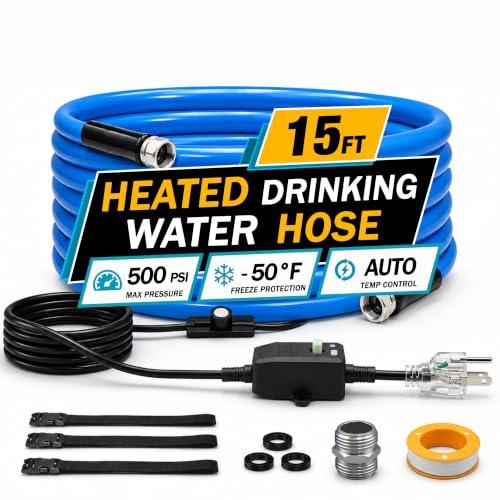
GLAUBIO 15FT Heated Water Hose for RV, -50F Anti-Freeze Drinking Hose, 7-Layer Food Grade
  • 15 ft, 5/8 in inner diameter
  • -50F rating, 15W at -40F
  • UL certified, GFCI and overheat protection
Check price on Amazon for GLAUBIO 15FT Heated Water Hose for RV, -50F Anti-Freeze Drinking Hose, 7-Layer Food Grade (opens in a new tab)
Best for: Short winter hookups where low power draw and a layered liner matter most.

Our take

Entry-end pricing, helped by the short length.

Why it made the shortlist

The GLAUBIO is the most detailed listing in this guide. At 15 feet with a 5/8 inch inner diameter, it is rated for automatic freeze protection down to -50F. Its seven-layer co-extruded build includes a silicone heat-transfer layer, and the listing states UL certification along with food-grade, lead-free, BPA-free and phthalate-free materials.

The power story is the standout. The listing contrasts common PTC heating hoses at 45W with its own silicone series-circuit band at 15W at -40F, a claimed 66.7 percent cut. Temperature, GFCI leak and overheat protection plus a plug LED are listed as safety features.

Owners whose hookup is a few feet from the spigot and who want the leanest draw should start here.

What works

  • Very low claimed power draw
  • UL certification and food-grade liner
  • Plug LED shows power status

Watch out for

  • Only 15 feet of reach
  • Draw figures are the seller's claims
02
Best for: Winter campers who want a built-in thermostat and a choice of lengths up to 100 feet.

Our take

Priced low-mid, a small step above the GLAUBIO, it appeals to buyers who prefer a thermostat approach and want a lineup of lengths in one brand.

Why it made the shortlist

The Treeligo uses an integrated thermostat to control heating according to temperature conditions, rated for freeze resistance down to -40F. Built for travel trailers, fifth wheels and motorhomes, it comes in 25, 50, 75 and 100 foot lengths so the hose can match the real hookup distance.

That length range is useful. It lets you buy the 25 foot version now and move up to a longer one for a farther spigot, within the same product family. The thermostat switches the whole cable at its setpoint, a simple scheme that is easy to understand.

What works

  • Thermostat control is easy to understand
  • Four length options in one line
  • Made for trailers and motorhomes

Watch out for

  • Listing gives few material details
  • Thermostat cycles the whole length
03
Wufoty 25FT Heated Water Hose for RV, Drinking Water Safe, -47F, 1/2 Inch Inner Diameter
  • 25 ft, 1/2 in inner diameter
  • -47F rating, 120VAC
  • Drinking water safe liner, adapter included
Check price on Amazon for Wufoty 25FT Heated Water Hose for RV, Drinking Water Safe, -47F, 1/2 Inch Inner Diameter (opens in a new tab)
Best for: Owners who want a certified drinking-water liner and a double-ended male adapter.

Our take

On price it sits mid-pack, a small step above the Treeligo for a similar length.

Why it made the shortlist

The Wufoty is a 25 foot heated hose with a 1/2 inch inner diameter, rated to prevent freezing down to -47F. The liner is described as certified drinking water safe hose, and the product operates at 120VAC under a thick wear-resistant PVC jacket.

That helps connect to either a spigot or a regulator, depending on the setup. A 30 day money back guarantee and a 3 year service commitment are also stated.

The extra buys a lower freeze rating and an explicit drinking-water-safe statement on the liner.

What works

  • Liner described as drinking water safe
  • Male adapter included in the box
  • 30 day money back guarantee

Watch out for

  • Control type is not stated
  • Narrower 1/2 inch bore
04
Bipeoo 30FT Heated Water Hose for RV, Antifreeze to -45F, Lead and BPA Free
  • 30 ft, -45F freeze rating
  • Lead-free and BPA-free hose
  • Offered in six lengths to 100 ft
Check price on Amazon for Bipeoo 30FT Heated Water Hose for RV, Antifreeze to -45F, Lead and BPA Free (opens in a new tab)
Best for: Rigs whose spigot sits 20 to 30 feet away and who want lead and BPA free materials.

Our take

Price steps up from the 25 foot picks, reflecting the extra five feet.

Why it made the shortlist

The Bipeoo is a 30 foot heated hose rated to prevent freezing down to -45F. Intelligent temperature adjustment is described aimed at saving power, and it states food-grade, lead-free and BPA-free hose materials with no odor.

It integrates heating and temperature sensing in one design, with a durable outer jacket protecting the cable from damage. The line is offered in six lengths from 15 to 100 feet, so the same hose family covers a short pedestal hookup or a long run.

Buyers who need a little more reach than a 25 foot hose provides and want a clear materials statement are the target.

What works

  • Reach beyond a 25 foot hose
  • Lead-free and BPA-free statement
  • Six length choices
  • Durable outer jacket

Watch out for

  • Control scheme is described loosely
05
REHOSEUP 50FT Heated Water Hose for RV, -45F Anti-Freezing, Self-Regulating
  • 50 ft, self-regulating cable
  • -45F freeze rating
  • Washer pair at each end, 3 year warranty
Check price on Amazon for REHOSEUP 50FT Heated Water Hose for RV, -45F Anti-Freezing, Self-Regulating (opens in a new tab)
Best for: Long winter hookups where a self-regulating cable keeps power use down.

Our take

A distant spigot is what it is built for.

Why it made the shortlist

The REHOSEUP 50 foot hose uses a self-regulating design rated to keep water from freezing down to -45F.

A washer pair at each end is the main leak-prevention feature, and the ends are where hoses fail after repeated coiling. A 3 year warranty backs the product. Compared with a thermostat hose, the self-regulating cable adjusts along its length rather than switching all at once.

What works

  • Self-regulating cable varies output
  • Fifty feet of reach
  • Leak-prevention washers at both ends
  • 3 year warranty

Watch out for

  • A 50 foot cable draws real power
  • Cost climbs with length
06
Best for: Campgrounds where the spigot sits far from the rig and length is the deciding factor.

Our take

Highest priced of the six, it differs from the 50 foot version almost entirely in length, which suits a site that demands it.

Why it made the shortlist

The REHOSEUP 75 foot hose is the longest pick here and shares the self-regulating design of its 50 foot sibling. The design is rated to keep water flowing down to -45F, and the listing says the hose is certified for drinking water use and made to avoid leaching.

Washers at both ends guard against leaks, with a 3 year warranty listed.

What works

  • Longest reach in this guide
  • No joining of shorter heated sections
  • Self-regulating heat along the length
  • 3 year warranty

Watch out for

  • Most expensive pick here
  • Long cable draws the most power
The catch
For a rig that parks well away from the spigot, a single long hose avoids joining shorter heated sections, which is where leaks and gaps in heat often develop.

Methodology

How We Built This Shortlist

Each pick was assessed across 5 criteria weighted for real-world use.

01

Heating control scheme

We separated self-regulating cables from thermostat-controlled ones and noted which listings state their type. The scheme affects both power use and behavior in a hard freeze. We worked from listings and product specs, not cold chamber tests.

02

Drinking water rating

We looked for drinking-safe liner language, such as food-grade, lead-free, BPA-free and phthalate-free statements. A garden-hose liner is not acceptable for an RV fresh water line. Picks with explicit potable wording ranked higher.

03

Freeze rating as listed

Freeze ratings in this category run from about -40F to -50F, and they are the seller's figures. We compared them directly rather than assuming a standard. A lower rating gives more margin but does not replace a cold-weather setup.

04

Ends and leak protection

The hose ends are the weak point after repeated coiling. We compared washers, adapters and connector material, and favored listings that describe leak prevention at both ends. A strong cable with a poor end fails anyway.

05

Length versus cost

Price in this category climbs with length, so we compared position within each family. A longer hose is only worth it if the spigot is far. We ranked the cost of reach, not just the cost of the hose.

Decision guide

Match a Budget Heated Water Hose for RVs to Your RV

By Distance to the Spigot

Length is the first filter, since every extra foot costs money and power.

Distance to the spigotRecommended pick
Up to about 15 feetGLAUBIO 15FT
About 20 to 25 feetTreeligo 25FT
About 25 feet, drinking-safe focusWufoty 25FT
About 30 feetBipeoo 30FT
About 50 feetREHOSEUP 50FT
About 75 feetREHOSEUP 75FT

By Budget

Price tracks length, so the bands below tell you how much reach you are buying.

Price bandRecommended pick
Entry of this shortlistGLAUBIO 15FT
Low-mid of this shortlistTreeligo 25FT
Mid-packWufoty 25FT
Upper-mid of this shortlistBipeoo 30FT
Roughly double the entry pickREHOSEUP 50FT
Top of this shortlistREHOSEUP 75FT

Self-Regulating vs Thermostat

Here is the real design fork in a heated hose, and it affects how much the cable draws.

Self-regulating cable

Output varies along the length with ambient temperature, so it draws less on a mild night. REHOSEUP 50FT and REHOSEUP 75FT state this design, and GLAUBIO 15FT describes a low-draw heating band.

Thermostat control

The whole cable switches at a setpoint, which is simple and predictable. Treeligo 25FT states a built-in thermostat, and Bipeoo 30FT describes intelligent temperature adjustment.

For a long winter stay, lean self-regulating with REHOSEUP 50FT; for a simple short hookup, Treeligo 25FT is easy to live with.

By Listed Freeze Rating

The rating is a listed figure, so a second axis is how much margin you want below your coldest night.

Margin you wantRecommended pick
Deepest listed margin, -50FGLAUBIO 15FT
-47F on a longer hoseWufoty 25FT
-45F with more reachBipeoo 30FT
-45F, self-regulating, long runREHOSEUP 75FT
-40F, moderate wintersTreeligo 25FT

For Long Winter Stays Specifically

Staying put for months makes power draw and reliability matter more than the sticker.

Look for

A low-draw or self-regulating cable, protected ends, a GFCI plug and a warranty that covers the full season.

In this comparison

GLAUBIO 15FT lists the lowest draw and GFCI protection, while REHOSEUP 50FT adds self-regulation and a 3 year warranty on a longer run.

When to Spend More

The entry hoses already freeze-protect, so extra spend should buy reach or a better scheme.

Spend more if

Your spigot is far away and you want REHOSEUP 75FT or REHOSEUP 50FT instead of joining shorter hoses.

Save if

Your hookup is close, in which case GLAUBIO 15FT or Treeligo 25FT covers the job.

FAQ

Before You Bring One Home

What is the difference between a self-regulating and a thermostat heated hose?

Self-regulating cable changes its heat output along the length as ambient temperature changes, so it draws less in mild cold. A thermostat hose switches the whole length on and off at a setpoint. Both prevent freezing, but the self-regulating design usually costs less to run over a winter.

Is any heated hose safe for drinking water?

No. Garden-hose versions can use an unrated liner. Look for NSF/ANSI 61 or explicit lead-free, BPA-free and phthalate-free wording. Wufoty and Bipeoo state drinking-safe materials in their listings, and GLAUBIO lists a seven-layer food-grade build.

Do the freeze ratings on these hoses mean the same thing?

They are listed figures from each seller, not a shared standard, so compare them directly. A -50F rating gives more margin than -40F, but wind, an exposed spigot and wet ground all change real performance. Choose a margin below your coldest expected night.

How much power does a heated hose draw?

Cable and length decide it. Common figures run around 7W per foot for a typical cable, so a 50 foot hose is a noticeable load on a 30 amp pedestal that is also running a heater. GLAUBIO claims 15W at -40F for its 15 foot hose, which is far lower.

Where does a heated hose usually fail?

At the ends. Repeated coiling stresses the connector and the cable entry. Look for washers at both ends, a protected cord entry and a strain relief at the male end. Both REHOSEUP listings stress washers at each end for this reason.

Should I buy the longest hose to be safe?

No. A longer cable draws more power and costs more. Buy the shortest length that reaches the spigot with a little slack. If you move between campgrounds, a 25 or 30 foot hose plus a short adapter covers most sites.

Bottom line

The short version

Browse more budget heated water hoses for rvs on Amazon →
Bowen Higgins, RV Editor at RV Gear Lab

About the author

Bowen Higgins

RV Editor at RV Gear Lab

Bowen covers RV power, water systems, towing and leveling, upkeep and interior comfort, with a focus on matching gear to the rig, the hookups and the way you actually travel.

More from Bowen →Editorial standards

Keep reading

Related guides