

We research everything we recommend. When you buy through our links, we may earn a commission. Learn more

Buying guide · 11 min read · Updated October 2, 2026

6 Best Budget High Flow RV Water Pressure Regulators in 2026: A Practical RV Guide

Six low-cost brass RV water pressure regulators compared on flow, preset psi and screens, so your plumbing is protected without a weak shower.

Bowen HigginsBy Bowen HigginsRV Editor at RV Gear Lab6 products comparedSpec-sheet researched

At a glance

Our top picks

At a glance · 6 picks

A pressure regulator has one job, which is to clamp campground pressure down to a level your RV plumbing can survive. The hidden cost is that every regulator is also a restriction. The tighter the internal passage, the more it protects the lines and the more it starves the showerhead once a second faucet opens. That tension is why a cheap regulator can feel perfect at the spigot test and miserable on a Sunday morning.

High flow designs try to soften that trade by opening up the passage and the inlet screen so the regulator holds its setpoint without choking the supply. At the budget end of the market this is mostly a design claim you compare across listings, since none of these parts ship with a flow chart. What you can compare is the preset range, the screen layout, the brass and the thread format.

This shortlist sticks to fixed, preset regulators because they are the cheapest way into protection and the least likely to be mis-set by a guest. Our ordering rests on listings and product specs rather than flow rigs, and it reflects the six by what each one buys beyond the bare minimum. All six land in the entry band of the category.

RV Gear Lab field notes

The Rig Fit Check

Start with the job
AquaNPT 90 Degree Elbow High Flow Water Pressure Regulator, Lead-Free Brass, 50-55 PSI leads this shortlist for Tight spigot clearances where the hose would otherwise kink at the regulator.. Use that fit as a reference point, then compare the alternatives against your own space and workload.
Specs that separate the picks
The first details to compare are 50-55 psi fixed preset, 50-55 psi preset, brass body, Brass body with pointer gauge. Confirm the exact model and included components before ordering.
Trade-off to plan for
Most expensive pick in this guide

Before you buy

What Matters Before You Choose a Budget High Flow RV Water Pressure Regulator

Key buying criteria so you get the right fit the first time.

  1. 01

    Flow capacity versus clamp strength

    A regulator works by narrowing the path water takes, so every unit trades some flow for protection. The practical consequence is a shower that sputters when the kitchen tap opens, even though the pressure at the spigot is fine. Listings that call themselves high flow are describing a wider passage or a better valve seat, but few publish a gallons per minute figure. Look for explicit flow language in the title and bullets, then treat it as a claim to compare rather than a spec to trust blindly.

  2. 02

    Preset psi and who it protects

    A fixed regulator is set at the factory, commonly in the 40 to 50 psi or 50 to 55 psi range. The lower range is kinder to older PEX, thin fittings and small valves. The higher range preserves more pressure at the fixture, which matters for a weak shower. Find the stated range in the listing title and choose by your plumbing's age and tolerance, since you cannot change it later.

  3. 03

    Lead-free brass upstream of drinking water

    This part sits in front of every faucet that fills a glass, so the metal matters. Lead-free brass such as C46500 with a reported lead content below 0.13 percent is the target, and plated zinc is the cost saving to avoid. Naming the brass grade or a certification gives you something to verify, while the bare phrase brass colored tells you nothing.

  4. 04

    Inlet screen design

    The screen at the inlet is what keeps campground grit from jamming the regulator valve. A single screened washer works, but a two-layer stainless mesh catches finer debris and lasts longer. A clogged screen also lowers flow, which can look like a failing regulator. Prefer screens you can remove and rinse over sealed ones.

  5. 05

    Hose thread and fit

    RV spigots and hoses use 3/4 inch garden hose thread, often written GHT or NH. A regulator that mates with both formats seals on nearly any campground bib. A mismatched thread leaks at the spigot and wastes the protection you bought. Confirm the thread type and the male or female orientation in the listing.

  6. 06

    Visibility and installation extras

    A gauge shows what the regulator is really delivering, which is the earliest warning of a stuck or worn valve. An elbow relieves stress on the spigot connection and keeps the hose from kinking in tight spots. Washers and thread tape in the box save a trip to the hardware store. Decide which of these extras is worth the step up from a bare preset.

Our standards

Why You Can Trust RV Gear Lab

At RV Gear Lab, we compare products based on rig fit and power or hookup compatibility, verified specifications, usability, setup requirements, weight, durability, and real-world trade-offs. We do not rank products purely on marketing claims or commission rates.

We have not personally tested every product listed. Where hands-on testing is not available, recommendations are based on verified manufacturer specifications, product documentation, use-case fit, and comparative research.

How we review RV gear →

Detailed reviews

The 6 best budget high flow rv water pressure regulators, explained

01
Best for: Tight spigot clearances where the hose would otherwise kink at the regulator.

Our take

Owners whose spigot sits close to the ground or a pedestal wall get the most from it, since a straight regulator forces the hose into a tight bend.

Why it made the shortlist

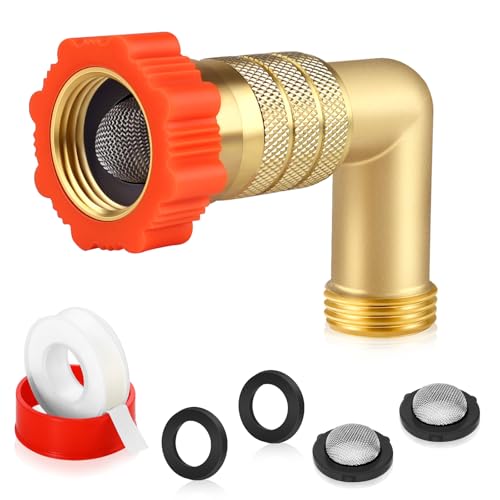
The AquaNPT builds a 90 degree elbow into the regulator body, so the hose drops straight down from the spigot instead of bending sharply at the threads. It uses lead-free brass with a preset of 50 to 55 psi and a 3/4 inch garden thread, male on one end and female on the other.

It sets the pressure and it relieves the stress that a heavy hose puts on a rigid spigot connection. The kit also includes a rubber washer and Teflon tape, so the installation parts are already in the box.

As the most expensive pick in this guide, the elbow geometry is the reason the step up makes sense.

What works

  • Elbow keeps the hose from kinking at the spigot
  • Lead-free brass body
  • Washer and Teflon tape included
  • Removable inlet screen is easy to rinse

Watch out for

  • Most expensive pick in this guide
  • Fixed preset cannot be adjusted
The catch
A removable stainless screen sits at the inlet to catch sand and rust.
02
Valterra RV Hi-Flow Water Regulator, Lead-Free Brass, 50-55 psi
  • 50-55 psi preset, brass body
  • Screened washer at the inlet
  • Lead-free potable construction
Check price on Amazon for Valterra RV Hi-Flow Water Regulator, Lead-Free Brass, 50-55 psi (opens in a new tab)
Best for: Owners who want a known RV accessory brand and a straightforward 50-55 psi preset.

Our take

It slots in as a small step up from the entry pick, and the extra goes toward a recognizable brand and a documented lead-free construction.

Why it made the shortlist

Valterra is one of the long-standing names in RV plumbing accessories, and this Hi-Flow regulator is its fixed-pressure answer to restrictive budget parts. The brass body is lead-free, the preset sits at 50 to 55 psi, and a screened washer at the inlet removes debris before it reaches the valve.

Where the cheapest picks here lean on a flow claim in the title, the Valterra pairs that claim with a plain behavior description. That is a sensible design for a regulator that sits in front of drinking water.

A familiar part makes sense for a spigot that will see use all season.

What works

  • Established RV accessory brand
  • Leaves low campground pressure alone
  • Screened washer is simple to clean
  • Lead-free brass for drinking water

Watch out for

  • Costs noticeably more than the entry picks
  • No gauge to see the actual pressure
03
Hourleey Brass RV Water Pressure Regulator, Hi-Flow With Filter Screen and Gauge
  • Brass body with pointer gauge
  • Stainless inlet filter screen
  • 3/4 inch hose thread, CSA low lead
Check price on Amazon for Hourleey Brass RV Water Pressure Regulator, Hi-Flow With Filter Screen and Gauge (opens in a new tab)
Best for: Owners who want to see the real pressure at each campsite before connecting the rig.

Our take

Its position in the lineup is mid-pack on price, a small step above the cheapest presets.

Why it made the shortlist

The Hourleey adds a pointer gauge to a brass hi-flow regulator, which turns a blind clamp into something you can read. Spin it onto the spigot and you see the pressure leaving the regulator before the hose ever reaches the RV. Brass makes up the body, and a stainless filter screen protects the valve.

That gauge is the feature that separates it from the silent presets around it. A regulator can quietly stick or wear, and a visible reading is the earliest warning that the number you expect is no longer the number you get. A CSA low lead content certification is cited as support for its lead-free claim.

The extra pays for visibility, and it fits owners who move often and meet a new spigot every few days.

What works

  • Gauge shows real pressure at the spigot
  • CSA low lead content certification
  • Stainless screen protects the valve
  • Fits all 3/4 inch hose threads

Watch out for

  • Gauge adds a point that can fail
  • Preset range is not stated in the listing
04
Wadoy High Flow RV Water Pressure Regulator, 50-55 PSI, Lead-Free Brass
  • 50-55 psi preset, lead-free brass
  • Two-layer stainless mesh screen
  • 3/4 inch GHT and NH thread
Check price on Amazon for Wadoy High Flow RV Water Pressure Regulator, 50-55 PSI, Lead-Free Brass (opens in a new tab)
Best for: Owners with two bathrooms or an outdoor shower who want the least restrictive budget preset.

Our take

Near the entry end of the shortlist on price, a little above the two cheapest picks.

Why it made the shortlist

The Wadoy is built around its flow story. The listing contrasts it with regulators that significantly restrict water flow and describes a design aimed at maximum flow to the fixtures. It holds a 50 to 55 psi preset in a lead-free brass body, and a two-layer stainless mesh screen stops sediment at the inlet.

The two-layer screen is the useful detail. It protects the valve with a finer barrier than a single washer screen, which matters when a campground line carries grit after maintenance flushing. The thread covers both U.S. 3/4 inch garden and NH formats, so it mates with nearly any spigot.

Rigs where a second faucet running often makes shower pressure the first complaint are the natural home for it.

What works

  • Flow-focused design in the listing
  • Two-layer screen catches finer grit
  • Does not cut pressure below the setpoint
  • Fits GHT and NH threads

Watch out for

  • Flow gain is a listing claim, not a chart
  • No gauge or adjustment
05
Best for: Older rigs or fragile plumbing that benefit from a lower 40-50 psi ceiling.

Our take

At the very bottom of this shortlist on price, it is essentially tied with the cheapest alternative.

Why it made the shortlist

The SheeChung presets at 40 to 50 psi, which is lower than most of the other picks in this guide. That lower ceiling is gentler on older PEX, thin-wall fittings and small appliance valves. The body is lead-free brass of the C46500 grade, and a built-in inlet screen filters debris.

It carries the high flow label while holding the tighter setpoint, so the buyer is trading a few psi of headroom for a softer load on the plumbing. Independent lead testing is noted for the brass, and installation needs no tools because it threads straight onto a standard 3/4 inch garden hose connection.

Owners whose rig has a history of leaking fittings and who value the lower setpoint over extra pressure get the best use from it.

What works

  • Lower setpoint is gentler on old plumbing
  • C46500 lead-free brass
  • Tool-free installation
  • Among the cheapest picks here

Watch out for

  • Lower psi can feel soft in a shower
  • Fixed preset only
06
CircleCord RV Hi-Flow Water Pressure Regulator 50-55 psi, Lead-Free Brass
  • 50-55 psi factory setting
  • C46500 hot-cast lead-free brass
  • Inlet screened filter, GHT and NH
Check price on Amazon for CircleCord RV Hi-Flow Water Pressure Regulator 50-55 psi, Lead-Free Brass (opens in a new tab)
Best for: First-time buyers who need a lead-free brass regulator at the lowest outlay.

Our take

Cheapest of the six, it proves that a basic regulator can already cover the essentials of lead-free brass, a 50 to 55 psi clamp and a screen.

Why it made the shortlist

The CircleCord is the cheapest way into a brass hi-flow regulator in this guide. It uses C46500 lead-free brass processed by hot casting, and the listing reports a lead content below 0.13 percent. The preset is 50 to 55 psi, with 3/4 inch garden and NH threads.

Its listing claims 15 to 20 percent more water flow at the factory setting, which positions it directly against the restrictive regulators that dominate the bottom of the market. An inlet screened filter keeps particles from blocking the valve.

Buyers who want to protect the plumbing right now and may upgrade later are its audience.

What works

  • Lowest entry cost for brass
  • Lead content reported below 0.13 percent
  • Listing claims more flow for showers
  • Screened inlet filter

Watch out for

  • Flow figure is the seller's claim
  • Basic body with no gauge

Methodology

How We Built This Shortlist

Each pick was assessed across 5 criteria weighted for real-world use.

01

Flow design first

Because the whole point of this guide is protection without starvation, we looked at how each listing describes its flow design. We compared claims such as a high flow label, the screen layout and any stated preset behavior. These are listing statements, not measurements, so we treated them as a way to rank intent rather than guarantee results.

02

Preset range

We compared the fixed setpoint of each regulator because it decides both protection and shower feel. A 40 to 50 psi preset is gentler on old plumbing, while 50 to 55 psi keeps more pressure at the fixtures. We favored regulators that state their range plainly.

03

Body material and lead claims

A regulator sits upstream of drinking water, so we looked for brass bodies and explicit lead-free statements. We compared claims such as C46500 brass and reported lead percentages. Plated or unspecified bodies would have ranked lower.

04

Screen and debris protection

We compared the inlet screens, from a screened washer to a two-layer stainless mesh. A clogged screen lowers flow just as a restrictive valve does. Removable or replaceable screens earned more credit than sealed ones.

05

Value at the entry price

We ordered the six by what each adds over the cheapest regulator. The question was whether a step up buys a gauge, an elbow, a brand or a finer screen. If a pick added nothing beyond a different label, it did not rank above the entry option.

Decision guide

Match a Budget High Flow RV Water Pressure Regulator to Your RV

By Setpoint Preference

The preset range decides how hard the regulator clamps, so match it to your plumbing and your shower tolerance.

Your situationRecommended pick
Older plumbing or thin fittingsSheeChung 40-50
Standard modern rig, 50-55 psiCircleCord Hi-Flow
Want a brand you recognizeValterra Hi-Flow
Want to read the actual pressureHourleey Gauge
Tight spigot clearanceAquaNPT Elbow

By Budget

Every pick sits in the entry band of the category, so the step up is about features rather than basic protection.

Price bandRecommended pick
Entry of this shortlistCircleCord Hi-Flow
Entry, tied with the cheapestSheeChung 40-50
Low-mid of this shortlistWadoy High-Flow
Mid-pack with a gaugeHourleey Gauge
Top of this shortlistAquaNPT Elbow

Restrictive vs Flow-Focused

That tension is the core of this category, and it decides how the shower feels.

Basic preset regulators

These clamp pressure with a standard valve and give the strongest plumbing protection for the lowest outlay. In this guide that is SheeChung 40-50 and CircleCord Hi-Flow at the entry end, with the lower setpoint of SheeChung giving the most protection.

Flow-focused designs

These widen the passage or the screen so the shower holds up better when a second tap opens. Wadoy High-Flow and Valterra Hi-Flow lean on this design, with Valterra also leaving low incoming pressure alone.

If your rig only ever runs one fixture at a time, take SheeChung 40-50; if two run together, take Wadoy High-Flow.

By Visibility and Fit

A second axis is whether you want to see the pressure or simply forget the part is installed.

NeedRecommended pick
Set and forget, no gaugeCircleCord Hi-Flow
Pointer gauge at the spigotHourleey Gauge
Spigot too close to the wall for a straight barrelAquaNPT Elbow
Finer inlet screen for gritty linesWadoy High-Flow
Installs with no tape or washers neededValterra Hi-Flow

For a Rig With Two Showers Specifically

Rigs with two bathrooms or an outdoor shower draw heavily, so flow matters more than on a small trailer.

Look for

A flow-focused body, a clean inlet screen and a preset that holds pressure at the fixtures rather than clamping hard.

In this comparison

Wadoy High-Flow is built around the flow story, while Valterra Hi-Flow passes low incoming pressure through untouched.

When to Spend More

The entry picks already deliver brass and a screen, so spending more has to buy something specific.

Spend more if

You want a gauge on Hourleey Gauge, an elbow on AquaNPT Elbow, or a recognized brand on Valterra Hi-Flow.

Save if

Your plumbing is modern and you only need a clamp, in which case CircleCord Hi-Flow or SheeChung 40-50 does the same protective job.

FAQ

Before You Bring One Home

Does a high flow regulator really cut flow less than a basic one?

The listings that use the label describe wider passages or better valve seats, but none of these parts publish a flow chart. Treat the label as design intent. If you want proof for your rig, compare shower pressure with a gauge before and after installation. One that holds the shower steady with two taps open is doing its job.

Which preset is better, 40-50 psi or 50-55 psi?

The lower range protects older plumbing and small valves more gently, which is why SheeChung 40-50 suits aging rigs. The higher range keeps more pressure at the fixtures, which feels better in the shower. Most modern RV plumbing tolerates the higher range, so choose by age and tolerance.

Will a regulator reduce pressure when the campground is already weak?

Fixed regulators only clamp pressure that exceeds its setpoint. Valterra's listing states it does not reduce pressure when the inlet is already below 50 psi. If your shower is weak at a low-pressure site, the regulator is usually not the cause, and a restriction upstream such as a clogged screen deserves a look.

How do I keep the inlet screen from clogging?

Unscrew the regulator and rinse the screen whenever flow drops or after the campground flushes lines. A removable stainless screen is simple to rinse with a brush. A two-layer mesh catches finer grit but also needs cleaning. Cleaning the screen is the first fix for a sudden pressure drop.

Is an elbow regulator worth it over a straight one?

It earns its place when the spigot sits low or close to a wall, because a straight regulator forces the hose into a hard bend that kinks and strains the threads. On an open spigot with clearance, a straight regulator does the same protective job. The elbow adds convenience, not extra protection.

Where should the regulator go in the water line?

Install it at the spigot, ahead of the hose, so the entire hose and the RV plumbing see regulated pressure. Putting it at the RV inlet leaves the hose exposed to full campground pressure. Add any filter after the regulator so the filter housing is also protected.

Bottom line

The short version

Browse more budget high flow rv water pressure regulators on Amazon →
Bowen Higgins, RV Editor at RV Gear Lab

About the author

Bowen Higgins

RV Editor at RV Gear Lab

Bowen covers RV power, water systems, towing and leveling, upkeep and interior comfort, with a focus on matching gear to the rig, the hookups and the way you actually travel.

More from Bowen →Editorial standards

Keep reading

Related guides